

In this section we cover directly extruded snack products and the final fully expanded RTE product of snack pellets.
Intermediate products are covered in the section snack pellets.
Explore 挤压型零食 产品
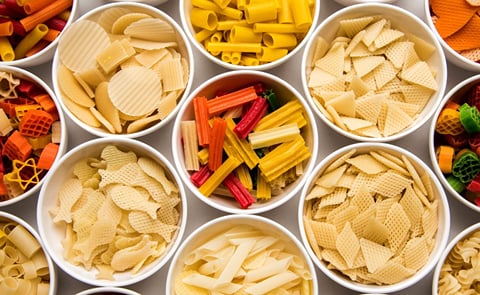
Native Potato Starch (Fryums)
Native Potato Starch is a carbohydrate, consisting of amylose and amylopectin.
Browse Companies Offering 挤压型零食
Bach Snacks Sal
Bach Snacks SAL is a renowned producer of semi-finished dry pellets, offering a wide range of high-quality products derived from potatoes, corn, and wheat.

Frequently Asked Questions
If extruded snacks are healthier than fried snacks, why are they still often perceived as “junk food”?
The perception largely stems from early generations of extruded snacks that prioritized flavor and affordability over nutrition, using refined starches, high salt and artificial flavorings. While modern extrusion allows nutrient fortification, whole grains and low-fat processing, consumer perception has not evolved at the same pace as technology. Health outcomes depend more on formulation choices than on extrusion itself.
Can extrusion technology realistically contribute to solving global malnutrition?
Yes, extrusion is uniquely suited for large-scale nutrition interventions because it enables fortification, improves digestibility, reduces anti-nutritional factors and produces shelf-stable foods. Its use in RUTF and fortified cereal-legume blends demonstrates its potential to deliver affordable, nutrient-dense foods in food-insecure regions, especially when combined with local raw materials.
Does increasing protein or fiber in extruded snacks compromise consumer acceptability?
Not inherently, but it requires precise formulation and process optimization. High protein and fiber interfere with starch expansion, which can negatively affect texture. However, blending strategies, controlled shear and optimized moisture levels can balance nutrition with sensory quality. The challenge is technological, not conceptual.
How does extrusion balance high-temperature processing with nutrient retention?
Extrusion operates on a high-temperature, short-time (HTST) principle, meaning exposure lasts seconds rather than minutes or hours. This minimizes nutrient degradation compared to prolonged baking or frying. While some heat-sensitive vitamins are lost, targeted fortification and ingredient selection compensate effectively.
Can extruded snacks be both clean-label and shelf-stable without preservatives?
Yes. Low moisture content (1–5%), reduced water activity and microbial inactivation during extrusion inherently provide shelf stability. When combined with barrier packaging and natural antioxidants, extruded snacks can achieve long shelf life without synthetic preservatives, aligning with clean-label demands.
Why are twin-screw extruders essential for future snack innovation?
Twin-screw extruders offer superior mixing, ingredient flexibility and process control, which are critical for high-protein, high-fiber, plant-based and co-extruded products. As formulations become more complex and nutrition-driven, single-screw systems often lack the adaptability required for consistent quality.
Is the glycemic index of extruded snacks inherently high?
No. While starch gelatinization can increase GI, formulation strategies such as high-amylose starches, resistant starch formation, fiber inclusion and protein blending can significantly lower GI. Extrusion can be used to design both high and low-GI products depending on nutritional objectives.
How does extrusion support sustainability beyond energy efficiency?
Extrusion supports sustainability by enabling the use of climate-resilient crops (millets, sorghum), upcycling food by-products, reducing water usage and minimizing waste. Its compatibility with circular economy principles makes it more than just an efficient process—it is a sustainability-enabling technology.
What limits extrusion from replacing frying or baking entirely?
Certain sensory attributes—such as rich mouthfeel, oil-driven flavor release and indulgent textures—are difficult to replicate fully through extrusion alone. Consumer preference, cultural eating habits and product positioning ensure that frying and baking remain relevant alongside extrusion.
How will artificial intelligence change extrusion-based snack manufacturing?
AI will enable real-time optimization of temperature, moisture, screw speed and formulation variables, reducing trial and error, energy use and waste. Predictive modeling will accelerate product development and ensure consistent quality during scale-up, making extrusion more precise and adaptive.
Can extrusion technology adapt to personalized nutrition trends?
Yes. When integrated with digital formulation systems and 3D food printing, extrusion can produce customized snacks tailored to age, health conditions or dietary needs. This positions extrusion as a cornerstone technology for personalized and functional food systems.
Are extruded snacks industrial foods or can they align with traditional diets?
They can align closely with traditional diets when formulated with regionally relevant grains, pulses and spices. In countries like India, millet-based extruded snacks bridge modern processing with traditional nutrition, demonstrating that extrusion is a tool—not a dietary ideology.
Make This Page Even Better!
This content was last updated on 五月 27, 2026
Have a helpful detail to contribute? Catch something that should be corrected?