
The Role of Harvesters in Modern Potato Farming
Mechanization in potato harvesting has revolutionized contemporary agriculture, transforming what was once a labor-intensive and time-consuming process into an efficient, high-output operation that underpins global food security. As one of the world’s leading staple crops, with annual production exceeding 376 million tons, potatoes demand timely and careful harvesting to preserve tuber quality and minimize post-harvest losses.
Traditional manual harvesting relying on tools such as forks and hoes requires immense labor input, often exposing workers to physical strain, repetitive injuries and harsh field conditions. In contrast, mechanized harvesters automate critical stages including lifting, cleaning and collection, significantly improving productivity and efficiency while safeguarding tuber integrity.
Mechanized systems reduce labor requirements by 49–80%, as a single harvester can match the output of 20–23 manual workers. Harvesting time is shortened dramatically from several days to mere hours per hectare while field capacity increases from 0.1–0.2 ha/day (manual) to 2–5 ha/day (mechanized). Moreover, tuber losses decline from 6–9% in manual methods (due to cuts, bruising, or missed tubers) to just 1.4–2.35% with machines, thanks to their precise soil separation and gentle handling mechanisms. These improvements not only raise marketable yields but also help curb global post-harvest waste, which can reach up to 20% of total production.
For small-scale farms (under 10 ha), tractor-mounted or semi-automatic harvesters offer cost-effective and versatile solutions, especially in hilly or confined fields. In contrast, large-scale commercial farms (over 50 ha) employ self-propelled multi-row harvesters, equipped with high-capacity bunkers and advanced automation for seamless transport to storage. This scalability ensures that mechanization benefits every level of production, from smallholder growers in developing regions to industrial producers across Europe and North America.
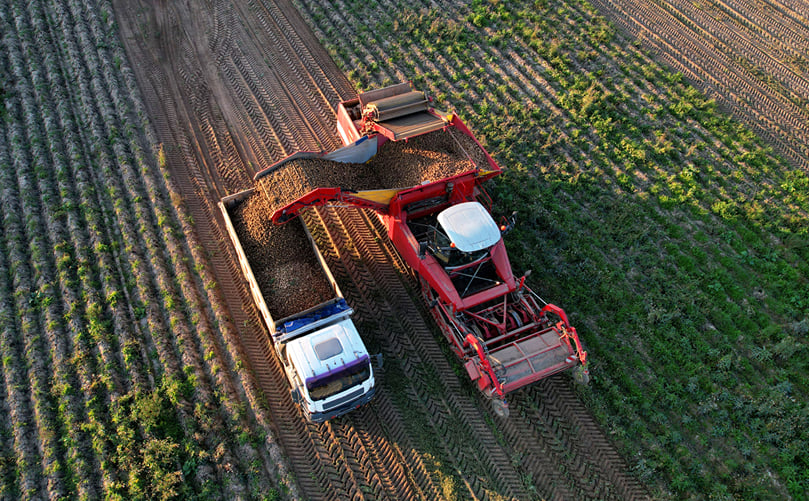
Four-Row Self-Propelled Potato Harvester in Large-Scale Field Operation
Global Market Overview and Leading Companies
The global potato harvester market is experiencing robust growth, valued at approximately USD 5.1 billion and projected to reach USD 16.4 billion by 2031, expanding at a CAGR of 13.8%. This rapid expansion is fueled by increasing global potato production exceeding 383 million metric tons annually and rising demand for processed potato products such as French fries and chips. Additionally, widespread labor shortages, coupled with government-supported mechanization programs in developing economies are accelerating adoption.
Europe remains the market leader, accounting for over 40% of the global share, driven by advanced agricultural systems in Germany, Belgium and the Netherlands. North America follows, emphasizing high-capacity, precision-engineered harvesters designed for large-scale operations. Meanwhile, the Asia-Pacific region especially China and India is witnessing a surge in adoption due to farm modernization incentives, equipment subsidies and growing export-oriented potato processing industries.
Self-propelled and multi-row harvesters dominate with over 45% of total sales, offering higher efficiency and incorporating smart technologies like AI, GPS and IoT. Sustainability is emerging as a defining trend, with manufacturers developing low-compaction frames, hybrid and electric models and AI-based sorting systems to minimize fuel use, soil degradation, and tuber bruising. Despite high upfront costs ranging from USD 50,000 for compact units to over USD 500,000 for advanced self-propelled models farmers typically achieve return on investment within 2–4 years, driven by substantial labor and time savings.
The market is moderately consolidated, with the top ten companies controlling 60–70% of global sales. Continuous R&D, mergers and regional customization are key competitive strategies shaping technological leadership and global reach.
Leading Manufacturers in the Global Market
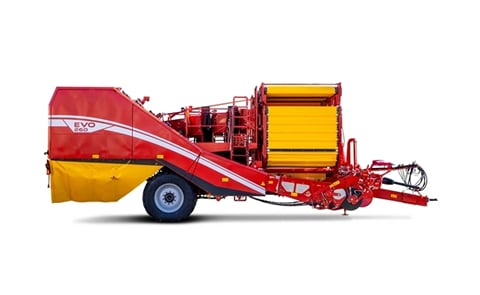
GRIMME Group (Germany): GRIMME dominates with an estimated 15–20% market share and offers a comprehensive range of machinery spanning planting to storage. Its flagship VARITRON 470 and EVO 290 multi-row self-propelled harvesters feature AI-driven sorting (98% accuracy), GPS precision steering and low-compaction tracked systems like the SPUDNIK TERRATRON (683 hp; 500 t/h capacity). The company leads Europe’s premium harvester segment through continuous innovation in automation and soil-friendly design.
AVR bvba (Belgium): Holding 10–12% of the global market, AVR is known for its tractor-mounted and self-propelled harvesters such as the Puma 4.0 and Spirit 9200i. The brand integrates IoT-based monitoring, Varioweb cleaning systems and real-time tuber sizing. With over 550 Puma units in operation worldwide, AVR’s machines are recognized for sustainability, precision and strong export performance.
Dewulf (Belgium): With 8–10% market share, Dewulf specializes in both sieving and top-lifting harvesters, including the Kwatro and Enduro models. Its patented Fill-Tastic ring elevator (200 t/h) and Soil-Saver weight distribution system (as low as 1.5 kg/cm² ground pressure) promote high throughput and minimal compaction. The company’s collaboration with CLAAS for ergonomic cab systems reinforces its position in large-scale, soil-conscious farming.
Spudnik Equipment Company LLC (USA): Spudnik controls 7–9% of the market, renowned for durable harvesters like the 6740 series. As part of the GRIMME Group, it integrates complete planting-to-harvesting systems. Its AirSep air separation technology reduces bruising by up to 50% in stony soils, while joint development with John Deere on electric harvester prototypes underscores its commitment to innovation.
Lockwood International (USA): Accounting for 6–8% market share, Lockwood specializes in gentle-handling harvesters such as the 774 and 472AH series, optimized for processing-grade potatoes. Its dual-blower vine removal system and Air Cup Planter (99% seed placement accuracy) make it a preferred choice for both fresh-market and industrial growers emphasizing tuber quality.
Oxbo International (USA): With 5–7% global share, Oxbo is recognized for versatile self-propelled windrowers and harvesters like the AR-4BX. Its Harvest Vision System enables real-time monitoring and yield mapping, while partnerships with Allan Equipment strengthen its North American network. Oxbo’s modular design approach ensures adaptability across various crop and terrain conditions.
Allan Equipment Manufacturing Ltd (Canada): Holding 4–6% market share, Allan Equipment produces robust traction and self-propelled harvesters such as the EB10 2-row and 2012 Series 6-row. The company pioneers fully electric 3–4 row models with independent section speed control and robotic precision manufacturing, excelling in cold climates and uneven terrains. Its exclusive distribution partnership with Oxbo further enhances market reach.
Working Principle of a Potato Harvester
A potato harvester functions through a coordinated sequence of mechanical and pneumatic operations designed to extract tubers from the soil efficiently while minimizing physical damage. The entire process is carried out in five key stages lifting, separating, cleaning, conveying and collecting each operating in synchronization to ensure smooth flow and tuber quality.
Lifting: Gentle Extraction of Soil and Tubers
The harvesting process begins as the machine moves forward at a controlled speed, typically between 1 and 3 km/h, powered by a tractor’s Power Take-Off (PTO) or its own engine in self-propelled models. The share blade or digging share penetrates the soil ridge at a depth of 12 to 27 cm and an angle of 10 to 24 degrees. This controlled entry gently lifts the soil–tuber mass without cutting into the tubers. Advanced models employ vibratory or oscillating shares that loosen compact soils uniformly, preventing tuber injury and ensuring an even flow of material onto the primary elevator. Some harvesters are equipped with automatic depth control systems or gauge wheels that adjust the working depth based on soil resistance and ridge height, maintaining consistent performance across varying field conditions.
Separating: Soil and Debris Removal
After lifting, the mixture of soil, tubers and plant residues is transferred onto the primary elevator or web conveyor composed of interlinked steel rods. As the conveyor oscillates and moves upward, loose soil and small clods fall through the gaps, while the heavier tubers continue to roll forward. Secondary separation follows through vibrating sieves or star rollers that break down clods and remove haulm residues. Hydraulic or mechanical vibration settings can be adjusted according to soil type more intense shaking for heavy clay soils and gentler oscillation for sandy or loamy fields ensuring efficient separation without bruising.
Cleaning: Refining Tuber Quality
In the cleaning section, the focus shifts to removing any remaining impurities such as fine soil, stones and vines. This stage uses a combination of hedgehog rollers, spiral or rubber-finger cleaners and airflow systems that gently scrub and separate the tubers from debris. Inclined spirals set at 15 to 19 degrees help crush clods, while air blasts remove lighter materials. Modern European models, such as those from Grimme and Dewulf, even integrate optical sensors and camera-based systems that identify and reject damaged or undersized tubers, ensuring a clean and uniform final output. Through these multi-stage cleaning systems, impurity removal efficiency often exceeds 95%, producing market-ready potatoes directly from the field.
Conveying: Safe and Gentle Transport
Once cleaned, the tubers move through a series of padded conveyors or swan-neck elevators that transport them toward the collection point. The belts are lined with rubber or polyurethane materials to reduce friction and impact. Drop heights between conveyors are kept below 30 cm, and transfer flaps or rollers ensure a cushioned descent, preventing mechanical injury. In self-propelled harvesters, conveyor speeds are automatically synchronized with the field speed and flow rate to maintain continuous movement and minimize pileups or overloading.
Collecting: Efficient Loading and Handling
The final stage involves collecting the harvested tubers in an onboard bunker or directly into a trailer. Onboard bunkers typically range from 8 to 20 tons in capacity, equipped with hydraulic unloading systems that gently transfer the potatoes to storage or transport vehicles at drop heights below one meter. Some self-propelled models allow for continuous bunker unloading while harvesting, maximizing field efficiency and reducing downtime. By minimizing handling and maintaining low impact, the machines ensure that less than 2% of the harvested tubers suffer bruising or surface damage.
Efficiency and Quality Management
Operational efficiency in potato harvesters is governed by careful control of machine speed, soil conditions, and tuber temperature. Harvesting is most effective when soil moisture is maintained at 60 to 70% of field capacity, which allows smooth lifting and easy soil separation. The ideal tuber pulp temperature ranges from 10 to 15°C; higher temperatures or excessive vibration can increase the risk of cracking and bruising. Over-speeding beyond 3 km/h can also lead to up to 4–6% tuber damage. With proper adjustments, modern harvesters achieve high field efficiency, low fuel consumption and consistent tuber quality, greatly reducing post-harvest losses.
The working principle of a potato harvester combines precision engineering and agronomic understanding to deliver a clean, damage-free harvest. Through a sequence of lifting, separation, cleaning and collection processes, these machines transform potato harvesting from a labor-intensive manual task into a highly efficient, quality-driven operation. By optimizing mechanical design and operational parameters, modern harvesters support both small and large-scale farmers in achieving higher productivity, reduced labor costs, and improved tuber quality for the market.
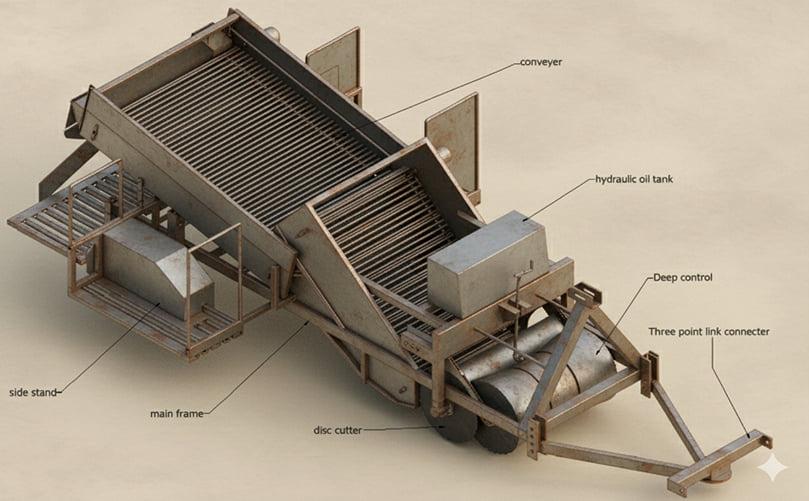
Step-by-Step Working Mechanism of a Modern Potato Harvester (Lifting to Collection)
Types of Potato Harvesters
Potato harvesters are classified based on their design, power source and operational scale, ensuring that farms of all sizes from smallholdings to large industrial operations can efficiently extract tubers while minimizing losses. Each type offers a balance between cost, capacity and terrain adaptability, allowing farmers to select machinery best suited to their field conditions and labor resources.
Tractor-Mounted Harvesters: Tractor-mounted harvesters are among the most widely used models for medium-sized farms ranging between 10 and 50 hectares. These machines attach to a tractors three-point linkage and operate through the Power Take-Off (PTO) system, drawing power for lifting and separation. Single-row models such as the MechMaxx 3-Point or 4U-1 series are designed to harvest one ridge at a time, typically achieving a field capacity of around 0.25 hectares per hour. They are compact, cost-effective and ideal for smaller fields or orchards where maneuverability and low maintenance are key advantages.
Double-row variants, including models like the AVR Puma and GRIMME KE-75, handle two ridges simultaneously, doubling operational efficiency with field capacities ranging from 0.5 to 1 hectare per day. These machines strike a balance between affordability and output, making them highly suitable for progressive farmers. However, they require tractor compatibility in the range of 50–80 horsepower to maintain steady performance and avoid strain under heavier soil conditions.
Self-Propelled Harvesters: Self-propelled potato harvesters represent the pinnacle of mechanized efficiency, designed for large-scale operations exceeding 50 hectares. These units operate independently with powerful onboard engines ranging between 100 and 200 horsepower, allowing them to harvest 2 to 4 rows in a single pass. Models such as the GRIMME VARITRON 470 or Dewulf 4-row series exemplify advanced engineering, offering field capacities of 5 to 10 hectares per day depending on soil texture and ridge structure.
Self-propelled harvesters integrate sophisticated automation features, including GPS-based auto-steering, yield monitoring and depth control systems that ensure uniform digging and minimal tuber loss. Their large onboard bunkers, often with capacities of 8 to 20 tons, enable continuous harvesting without frequent unloading stops. This not only saves time but also minimizes mechanical handling of tubers, preserving quality and reducing bruising. These machines are particularly advantageous on expansive flatlands, where uninterrupted operations and high throughput justify their higher investment costs.
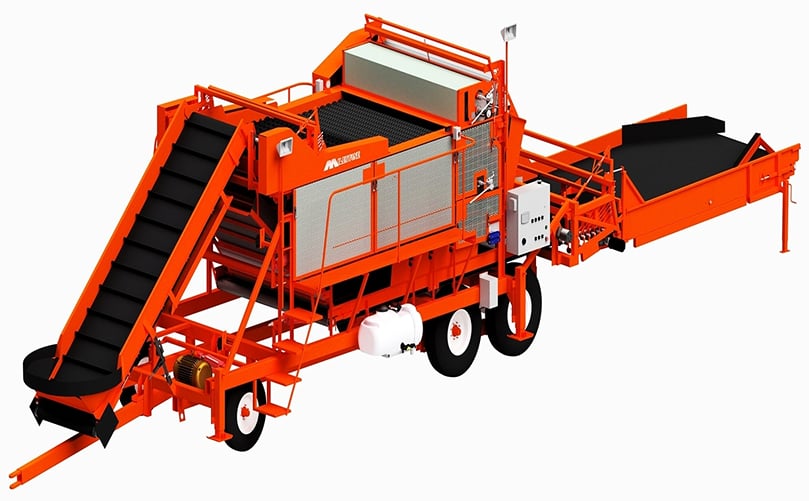
Modern Self-Propelled Potato Harvester Machine
Semi-Automatic and Manual-Assist Harvesters: In contrast, semi-automatic or manual-assist harvesters cater to smallholders and farms situated on hilly or uneven terrain, typically covering areas below 10 hectares. Machines like the KST-1.4 walk-behind digger or flick picker models use mechanical shares to lift tubers and deposit them in windrows for manual collection. While they combine mechanized digging with human sorting, their simplicity makes them suitable for regions where terrain constraints or limited mechanization budgets restrict the use of larger harvesters. These units generally achieve field capacities of 0.3 to 0.5 hectares per day, balancing efficiency and affordability.
Their lightweight construction minimizes soil compaction, and their low fuel consumption makes them eco-efficient choices for small-scale growers or organic farmers who prioritize gentle soil handling and minimal disturbance.
Efficiency, Cost and Performance Comparison: The efficiency of a potato harvester increases with the number of rows it handles single-row models operate at about 70–80% efficiency, while multi-row and self-propelled versions can achieve up to 95%. Harvesting capacity and operational speed scale accordingly, with tractor-mounted models offering moderate throughput and self-propelled harvesters leading in productivity. The cost varies widely: tractor-mounted machines range between USD 5,000 and USD 15,000, while advanced self-propelled harvesters can exceed USD 200,000. Despite the higher initial investment, most mechanized systems achieve a return on investment within 2–3 years, primarily through substantial labor savings, reduced post-harvest losses and improved marketable yields.
Key Components and Their Functions
A potato harvester is a precisely engineered system in which each component performs a synchronized role to ensure maximum efficiency, gentle handling and minimal tuber damage. The design integrates mechanical, hydraulic and control systems to work harmoniously, translating power into smooth soil lifting, cleaning and collection processes with minimal energy loss.
The lifting unit serves as the first point of contact with the soil, comprising the share blade and depth-regulating wheels. It penetrates the ridge at depths of 16–24 cm to carefully loosen the soil–tuber mass, maintaining accuracy through hydraulic or electronic depth sensors capable of detecting variations within ±2 cm. Modern lifting units often use vibratory or bionic designs, inspired by earthworm movement, to reduce soil resistance by 14–59%. This ensures gentle excavation even in compacted or moist soils while preserving tuber integrity.
Following this, the separation unit takes over, consisting of elevator chains or rod webs that vibrate continuously to exploit gravity and inertia. As the soil–tuber mixture advances along the webs, lighter particles like loose soil and fine clods fall through the gaps, while the heavier tubers and stones move onward. Spiral separators set at a 15° incline effectively manage larger clods up to 10 cm in diameter, ensuring thorough sifting and maintaining a consistent material flow without clogging.
The cleaning unit then refines the separation process, employing sieves, rollers and adjustable airflow fans to remove remaining impurities. Rubber-finger rollers or hedgehog drums dislodge attached soil and haulm residues without bruising the tubers. Multi-stage configurations, often arranged horizontally and vertically, achieve up to 95% cleaning efficiency while maintaining a smooth flow rate. The precision in agitation speed and roller material selection ensures minimal physical injury, a key factor for maintaining post-harvest quality and storability.
Next, the conveyor belt system transfers the cleaned tubers toward the rear of the harvester. Lugged or swan-neck belts equipped with rotors measuring 0.65–1 meter in diameter transport tubers at controlled speeds ranging from 0.2 to 2 meters per second. Soft rubber buffers and flexible mounts cushion the tubers during transitions, significantly reducing bruising and internal cracking that can occur with high-impact transfers.
The entire system operates under the control of a hydraulic system, which powers depth adjustments, conveyor speeds and bunker tipping operations. Advanced models integrate load sensors and feedback controllers that automatically modulate hydraulic torque according to soil resistance, ensuring steady operation across variable field conditions. This dynamic adjustment reduces fuel consumption and enhances performance efficiency, especially in soils with uneven compaction or moisture gradients.
All these subsystems are harmonized through robust gearbox assemblies that convert PTO or engine power into synchronized motion, minimizing mechanical losses and optimizing energy distribution. This integration not only ensures operational smoothness but also prevents excessive vibration and mechanical stress on the frame and components, extending machine lifespan.
Together, these key components form a cohesive mechanism that transforms the complexity of potato harvesting into a streamlined, high-throughput operation capable of maintaining tuber quality from soil to storage.
Field Conditions and Operational Settings
Field Conditions and Operational Settings for Efficient Harvesting Successful potato harvesting depends heavily on aligning machine settings with specific field and soil conditions to achieve high recovery rates, minimal losses and optimal tuber quality. Every operational parameter from soil moisture to digging depth directly influences efficiency, tuber injury levels and post-harvest storability.
Optimal soil moisture should be maintained at 60–80% of field capacity, providing the right balance between cohesion and friability. Excess moisture above 80% can cause soil clumping and blockages within the harvester’s conveyor or cleaning units, leading to downtime and reduced throughput. Conversely, overly dry soils below 60% field capacity become brittle, increasing the risk of shattering ridges and leaving unextracted tubers behind. Loamy and sandy soils offer ideal conditions for separation and lifting due to their friable texture and good drainage, while heavy clay soils often necessitate the use of vibratory mechanisms or agitators to overcome adhesion and maintain steady material flow.
Digging depth is another critical parameter and is typically controlled hydraulically to match ridge height and soil composition. In lighter, sandy soils or shallow ridges, a depth of 12–16 cm is sufficient for full tuber recovery. In contrast, heavier or clay-based soils may require a digging depth of up to 27 cm to ensure complete lifting without leaving tubers embedded in compact layers. Automated ridge-height sensors assist in maintaining precise depth control with an accuracy of ±2 cm, ensuring consistency across uneven terrain and minimizing mechanical strain on the lifting shares.
The forward operating speed of the harvester should generally range between 1.0 and 2.5 km/h, striking a balance between throughput and tuber protection. Higher speeds may increase field capacity but elevate the risk of bruising and mechanical injury, particularly when pulp temperatures are low. Tractor-mounted models typically require 50–80 horsepower for single-row operations, while larger multi-row or self-propelled units may demand 100 horsepower or more. The power take-off (PTO) operates at approximately 540 rpm, translating to conveyor chain speeds of around 150 feet per minute, adequate for smooth material flow without excessive agitation.
Timing of harvest plays an equally vital role. For best results, vine-killing or desiccation should be carried out 14–21 days prior to harvest, using approved agents such as diquat or natural senescence methods. This period allows sufficient time for skin set, during which the periderm layer lignifies, strengthening the tuber surface and enhancing bruise resistance during mechanical handling. Ideal tuber temperature at harvest ranges between 10–15°C, ensuring sufficient firmness for handling while minimizing the risk of cold-induced damage. In cooler regions, harvesting should be scheduled post-frost to avoid skin softening and to ensure tubers have matured adequately for storage.
By fine-tuning these parameters moisture balance, digging depth, speed and harvest timing farmers can optimize machine performance, reduce field losses and maintain high tuber quality from field to storage.
Advantages of Using Potato Harvesters
Mechanized potato harvesters offer multiple benefits that significantly enhance farm efficiency, profitability and product quality. Harvest duration can be reduced by up to 70%, as these machines cover five to ten times more area than manual labor, allowing timely operations that help avoid weather-related losses. Advanced lifting and conveying systems minimize tuber damage to 1.5–6%, compared to 6–9% in manual harvesting, ensuring superior quality suited for premium and processing markets.
Automation also reduces labor costs by 49–80%, effectively addressing workforce shortages and dependency on seasonal labor. Machine precision achieves up to 93.5% soil removal efficiency and 98% tuber transfer rates, resulting in uniform, marketable yields averaging 13.2 t/ha. Overall, the integration of mechanized harvesters not only boosts productivity but also enhances the sustainability and economic resilience of potato production systems.
Limitations and Challenges
Despite their substantial advantages, potato harvesters encounter several challenges that require careful management and adaptation. The high initial investment, ranging from USD 5,000 to USD 300,000, often deters small and medium-scale farmers, with returns on investment (ROI) delayed under low-yield or fragmented operations. Stony or uneven soils can cause frequent blockages, leading to 5–10% additional losses, while heavy clay soils promote compaction and clod formation that can be mistaken for tubers.
Skilled operation is critical inexperienced handling increases tuber injury and machine wear and routine maintenance of blades, hydraulics and belts adds 10–20% to operational costs. Furthermore, adoption remains limited in hilly or mountainous regions (below 5% mechanization) due to poor maneuverability and terrain restrictions, widening regional disparities in harvesting efficiency and profitability.
Modern Innovations and Smart Technologies
Advancements in digital agriculture are revolutionizing potato harvesting, pushing the machinery toward full automation and precision management. GPS-guided systems such as John Deere AutoPath or GRIMME’s SmartView enable automated row alignment, minimizing overlaps by up to 20% and significantly cutting setup time. These systems ensure uniform ridge tracking, particularly beneficial in large-scale or irregularly shaped fields.
Smart sensors: including multispectral, load and ultrasonic sensors detect tuber size, count and quality in real time with up to 98.5% accuracy, supporting on-the-go yield mapping. This data allows farmers to make informed adjustments to harvester settings, optimizing throughput and minimizing losses.
AI-powered sorting and separation systems: Using convolutional neural networks (CNNs), have transformed the cleaning process. These technologies automatically distinguish between tubers, stones and soil, achieving up to 99% separation purity while processing 12–180 tonnes per hour, depending on model capacity. Self-cleaning webs further enhance uptime by preventing soil adhesion, especially in wet or clay-heavy conditions.
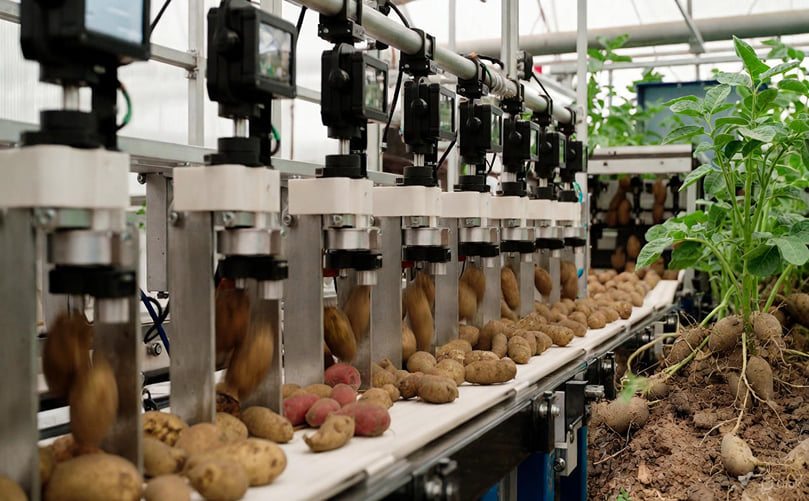
AI-Powered Optical Sorting System with Real-Time Tuber Quality Detection
Integration with IoT-based platforms such as AVR Connect or Dewulf SmartWeb allows continuous monitoring of performance parameters, hydraulic pressure and blockages. These systems transmit live data to farm management software or mobile apps, enabling predictive maintenance and data-driven decision-making.
The latest generation of machines is moving toward Level 3 autonomy, where harvesters operate semi-independently coordinating with drones and field sensors for pre-harvest scouting, soil condition assessment, and dynamic path planning. This synergy marks the transition from mechanization to intelligent, interconnected harvesting ecosystems.
Maintenance and Safety Practices
Proactive maintenance is essential for extending the operational life of potato harvesters and ensuring safe, efficient performance in field conditions. Regular inspections before and after each use help detect early signs of wear or malfunction. Blades and digging shares should be checked for dullness or deformation, belts and chains for tension and cracks and hydraulic lines for leaks or pressure drops. Post-harvest cleaning especially of soil, vines and residues prevents corrosion and clogging of moving parts. Lubricate all bearings, gears and chains according to the manufacturer’s schedule (typically every 40–50 hours of use), and store the machine in a dry, covered area to prevent rusting during off-season periods.
Safety is equally critical. All moving components must be fitted with protective guards to prevent accidental contact. Operators should never lubricate, clean or repair the machine while it is running, and should use mechanical stands or hydraulic locks when working beneath raised sections. Wearing personal protective equipment (PPE) such as gloves, steel-toe boots and safety eyewear is mandatory. Proper operator training is vital to ensure awareness of emergency shut-off systems, safe turning radii and load-handling limits. Clear hand signals and communication among crew members minimize accidents, as most field incidents stem from entanglement or poor coordination.
A well-maintained and safely operated harvester not only improves efficiency and reduces downtime but also upholds worker safety standards ensuring reliable, long-term field performance.
Economic and Environmental Impact
Mechanized potato harvesters deliver substantial economic gains while promoting environmentally responsible farming practices. Economic assessments reveal that mechanized systems reduce overall harvesting costs by up to 49% compared to semi-manual methods, with total expenses averaging USD 300–1,000 per hectare depending on scale and machine type. Labor savings and improved operational efficiency typically enable farmers to recover their investment within 2–3 years, while yield increases of 13–20% further strengthen profitability. Lower post-harvest losses (2.35% vs. 6.32% manual) ensure more marketable produce and consistent returns, particularly in regions facing chronic labor shortages.
From an environmental perspective, modern harvesters are designed with low-mass chassis and wider tire footprints to reduce soil compaction vital for maintaining soil structure in erosion-prone or light-textured soils. Fuel-efficient engines and optimized hydraulic systems reduce carbon emissions by 20–30%, while precision technologies such as auto-steering and sensor-based adjustments minimize unnecessary passes, conserving fuel and extending equipment life.
Integration of controlled-traffic farming and regenerative practices further enhances sustainability by limiting rutting, maintaining infiltration rates and conserving moisture. This results in more efficient water utilization around 500–700 mm per season and reduced degradation risks. Collectively, mechanized harvesting supports a shift toward resilient, low-impact agriculture, aligning with global sustainability goals and the principles of climate-smart farming.