

Potato Armyworm: A Rising Global Threat to Potato Production
The potato armyworm, often referring to the fall armyworm (Spodoptera frugiperda) is a highly invasive lepidopteran pest belonging to the family Noctuidae. In recent years, it has increasingly infested potato (Solanum tuberosum) crops causing significant damage through larval feeding on foliage, stems and tubers. Native to the tropical and subtropical regions of the Americas, this polyphagous pest attacks more than 350 plant species across 76 families, including major crops such as maize, rice, sorghum, sugarcane and cotton. Although it shows a higher preference for grasses, it has successfully adapted to solanaceous crops like potato.
The larvae, identifiable by their green to black bodies with white longitudinal stripes and an inverted Y-shaped mark on the head capsule, feed gregariously in “army-like” formations leading to rapid defoliation and plant destruction. In potatoes, infestation results in irregular leaf holes, skeletonization, frass accumulation and tuber tunneling, which often predispose tubers to secondary bacterial infections such as soft rot rendering them unmarketable.
First confirmed on potatoes in regions such as Pakistan (2024), its impact is intensified by the existence of two host strains (corn and rice), high fecundity (up to 2,000 eggs per female) and strong migratory ability making it a serious global threat to potato production. Yield losses in infested potato fields can reach 20–50%, especially among smallholder farmers lacking access to resistant varieties or effective integrated pest management (IPM) tools. Climate change further aggravates the situation by expanding the pest’s potential habitat and increasing the number of annual generations.
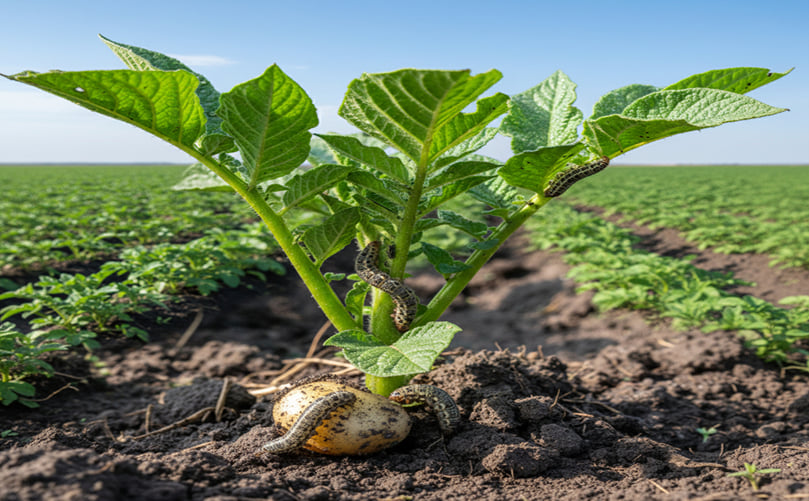
Fall Armyworm Larva Devastating Potato Foliage
Recent studies have demonstrated its ability to reproduce and develop efficiently on potato and sweet potato with reported net reproductive rates (R₀) of 47.892 and intrinsic rates of increase (rₘ) of 0.083 day⁻¹ on sweet potato, indicating a strong potential for population outbreaks and adaptation to new hosts.
Historical Spread and Evolution of Potato Armyworm (Spodoptera frugiperda)
The armyworm (Spodoptera frugiperda), also referred to as the potato armyworm in potato infested contexts has a long history as an agricultural pest. It was first described byJ.E. Smith in 1797 from Georgia, USA where it was noted for devastating maize crops though early records from the 19th century also mention occasional potato damage as potato cultivation expanded across the Americas.
In the early 20th century reports from the U.S. Department of Agriculture documented its polyphagous nature including infestations on potatoes with notable outbreaks in the southern United States where the pest overwintered and later migrated northward. Following World War II, synthetic pesticides such as DDT provided initial control but by the 1970s widespread resistance had emerged prompting research into integrated pest management (IPM) and biological control strategies.
The pest global history changed dramatically in 2016 with its invasion of Africa first detected in São Tomé and later spreading to 28 countries by 2017. Potato damage was reported by 2018 aggravating regional food security concerns. In Asia, detections began in 2018 (Bangladesh and India) with potato specific infestations reported in Pakistan by 2024 marking a new threat to this crop. Oceania followed in 2020 (Australia) where risk assessments indicated potential impacts on potatoes.
Historical management milestones include the development of Bt crops in the 1990s though resistance emerged by the 2000s. By 2023 genomic studies had revealed key adaptation mechanisms including host shifts to potatoes. In South Africa, invasions since 2017 have reshaped pest dynamics with fall armyworms replacing traditional maize pests and extending their host range to potatoes.
Across Continents: Global Distribution and Spread of the Armyworm
The armyworm (Spodoptera frugiperda), the primary potato armyworm is native to the tropical and subtropical regions of the Americas, spanning from Argentina to the southern United States. It overwinters in mild climates such as Florida and Texas and migrates northward up to Canada on wind currents traveling as far as 500 km per generation.
Its invasive spread began in Africa in 2016, first detected in Sao Tome and now present in 44 countries including many across sub-Saharan Africa, where it affects potatoes alongside maize. In Asia, invasions started in 2018 (Bangladesh and India) and have since expanded to 21 countries including China, Southeast Asia and the Middle East (with Syria reporting detections in 2020). The first potato specific damage was recorded in Pakistan in 2024.
In Oceania, detections began in 2020 (Australia and Papua New Guinea) followed by New Zealand in 2022, while Europe remains at risk for seasonal establishment.
Spread mechanisms include natural migration, international trade (such as infested produce) and unintentional human mediated transport. Climate projections under the CMIP6 model suggest further global expansion with increasing environmental suitability in South and Southeast Asia, Australia and North Africa. Potato specific distribution is now emerging in invasive regions posing new risks for major producers such as China, India and Indonesia.
Expanding Host Range of the Potato Armyworm
The armyworm (Spodoptera frugiperda) exhibits an exceptionally broad host range feeding on more than 353 plant species across 76 families. Although it shows a strong preference for members of the Poaceae (grasses), recent evidence indicates increasing adaptation to potatoes and other Solanaceae crops.
Major host plants include maize, sorghum, rice, sugarcane, cotton, beet, tomato and potato, where the pest causes considerable economic losses. Non-crop hosts such as various weeds (e.g., witch hazel) act as important reservoirs that sustain populations between cropping seasons.
On potatoes, larvae demonstrate high reproductive potential recorded as R₀ = 47.892 on sweet potato and rₘ = 0.083 day⁻¹ comparable to or exceeding performance on rice confirming potato as a viable host. Feeding occurs on both foliage and tubers leading to significant yield and quality losses.
Two primary genetic strains are recognized: the corn strain, which favors maize and sorghum and the rice strain, which prefers rice and pastures. However, both are capable of infesting potatoes with some studies even reporting superior larval growth and development on potato compared to corn.
Key host families include Poaceae (major), Asteraceae and Fabaceae. The inclusion of potato within this expanding host spectrum underscores the pest adaptability and the growing risk it poses to diverse agroecosystems. Efforts are ongoing to identify and develop potato varieties with resistance to armyworm infestation.
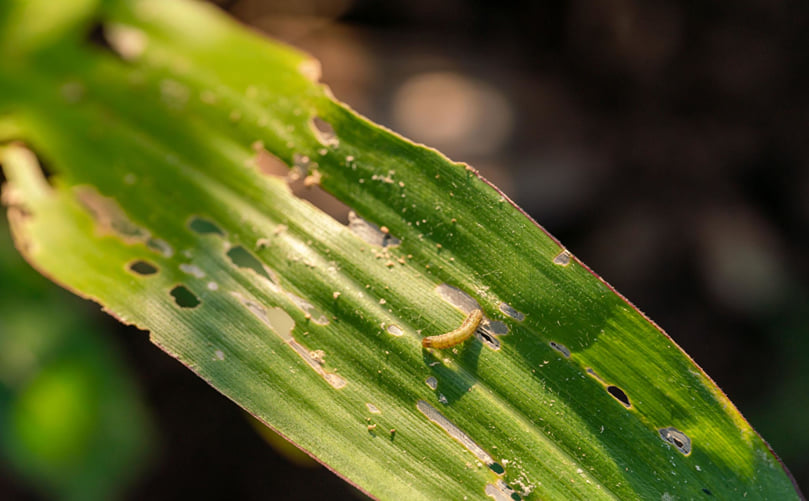
Fall Armyworm (Spodoptera frugiperda) Feeding Damage on Maize Leaves
Counting the Cost: Economic Impact and Yield Loss from the Armyworm
The economic impact of potato armyworms, primarily the armyworm (Spodoptera frugiperda) on potato cultivation is substantial, particularly in regions where potatoes are staple or cash crops. Infestations lead to direct yield reductions and increased production costs.
In Africa, invaded since 2016, annual losses from armyworms on crops including potatoes are estimated at USD 2.9–5.6 billion. Potential maize yield reductions of 8.3–20.6 million tons per year suggest similar proportional impacts on potatoes in mixed farming systems. Specific to potatoes, yield losses range from 18–75% in heavily infested fields translating to economic damages of USD 72.4–675.3 per hectare compounded by control expenses and reduced marketability due to tuber damage.
In China, impacts on rice and potato host plants are higher on reproduction than on growth indicating indirect economic ripple effects through increasing pest populations. Farmer surveys in Uganda report 25–50% yield losses in affected districts highlighting broader food security concerns in sub-Saharan Africa where potatoes support livelihoods.
Globally, armyworms economic burden across multiple crops including potatoes is projected at USD 13 billion annually in maize, rice, sorghum and sugarcane with potato-specific losses emerging in invasive ranges such as Pakistan and India. Control measures further add costs with insecticides representing 7.5–21% of production expenses. Without intervention, losses could escalate to 90–100% in severe outbreaks.
In the Pacific, impacts on minor hosts like potatoes are noted but understudied posing broader threats to food crops. Climate amplified invasions may double these figures by 2030, emphasizing the urgent need for adaptive management strategies to protect potato production and global food security.
Rapid Reproduction: Biology and Life Cycle of the Armyworm
The armyworm (Spodoptera frugiperda) is highly adapted for rapid reproduction and survival on diverse hosts such as potatoes. Its life cycle completes in about 30 days during summer (optimal 25–30°C) and extends to 80–90 days under cooler conditions. The pest has no true diapause, allowing continuous breeding in tropical regions.
Adults are nocturnal moths with a wingspan of 32–40 mm and gray-brown forewings, living 10–21 days. Mating occurs shortly after emergence and females lay egg masses of 100–200 eggs each, totaling up to 2,000 eggs per lifetime, deposited on potato leaves or soil. Eggs hatch within 2–3 days into larvae, which pass through six instars over 14–30 days.
Young larvae feed on potato leaves creating “windowpane” damage, while older larvae (up to 4 cm) bore into stems and tubers. Pupation occurs in soil cocoons for 7–37 days. Two primary genetic strains exist corn and rice with hybrids showing varied performance on potatoes. Life table studies indicate higher reproduction on potatoes than on corn, with a net reproductive rate (R₀) of 47.892 and intrinsic growth rate (rₘ) of 0.083 day⁻¹ on sweet potatoes, highlighting potatoes suitability as a host.
Cannibalism among larvae helps regulate dense populations. In mild climates, armyworms overwinter as pupae, while adults migrate seasonally in temperate regions. Temperature strongly influences development growth slows in cold conditions, but wet soils can increase activity. Laboratory studies confirm the armyworm’s viability and adaptability on potato crops.
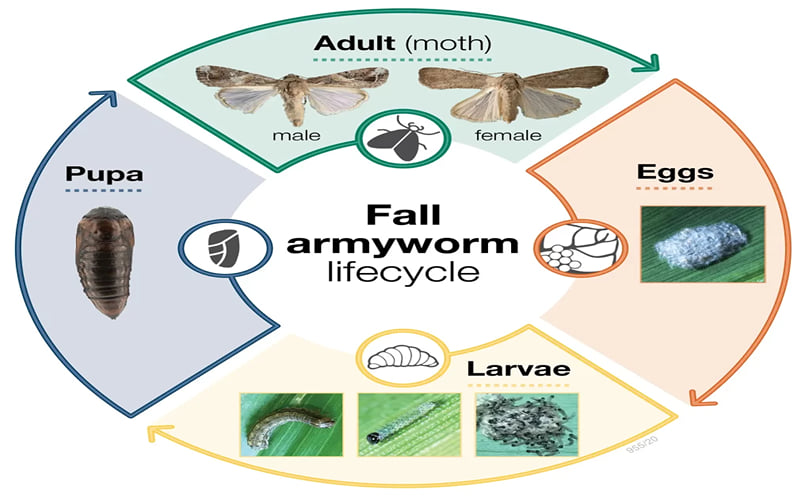
Life Cycle of Potato Armyworm in Action
Visible Threat: Symptoms and Damage Caused by the Armyworm
Symptoms of potato armyworm infestation typically begin with small, irregular holes or “windowpanes” in leaves caused by young larvae feeding on the underside. As larvae mature, damage progresses to ragged leaf edges and skeletonization. Frass moist, sawdust like excrement accumulates near feeding sites, often in the plant funnel or on upper leaves providing a clear indication of larval presence.
Older larvae bore into stems, causing wilting, lodging or complete plant collapse and tunnel into tubers, creating entry points for secondary pathogens such as Fusarium or Erwinia leading to rot and foul odors. Damage often appears in patches, particularly near field edges or weeds with severe infestations potentially stripping foliage entirely. In turf or pastures, bare patches may develop.
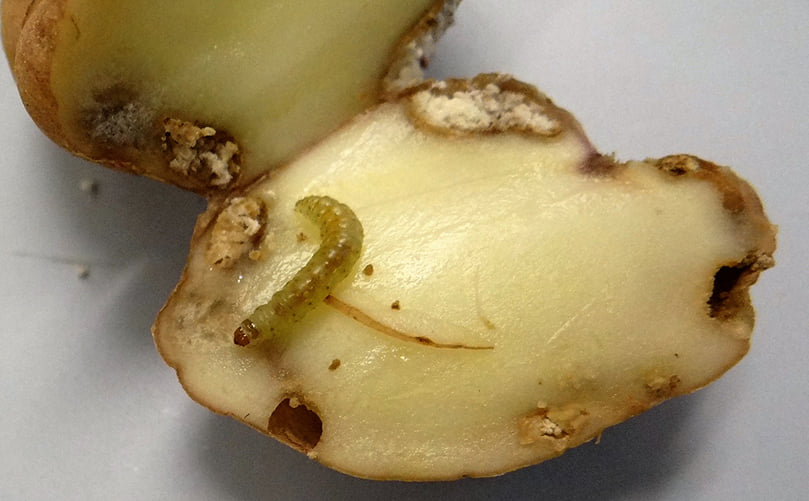
Potato Tuber Ravaged by Armyworm Larvae
Armyworms may march in groups consuming everything in their path. Early symptoms can mimic drought or nutrient deficiencies making detection challenging. In potatoes, tuber boring causes internal decay, reducing storage life and market value. Action thresholds are generally 10–20% defoliation, emphasizing the importance of early detection to prevent large scale crop losses.
Complex Battles: Management Challenges of the Armyworm
Managing potato armyworms presents multifaceted challenges due to their biology, rapid adaptation and environmental factors. Insecticide resistance is a major issue, with armyworms developing tolerance to pyrethroids, organophosphates and Bt traits, complicating chemical control in potato fields where applications must be precisely timed for young larvae.
Nocturnal feeding and soil hiding habits reduce the efficacy of foliar treatments, often necessitating multiple applications that increase both costs and environmental impact. In smallholder systems, limited access to resistant varieties, biopesticides and monitoring tools hinders adoption of integrated pest management (IPM), while labor-intensive cultural practices, such as weed control add further challenges.
Biological control agents, including Nomuraea rileyi fungus and specific viruses, perform inconsistently under wet or hot conditions typical of potato growing regions. Sporadic outbreaks and migratory behavior make predictions difficult and in some crops like alfalfa, armyworm pressure co-occurs with pests such as potato leafhoppers complicating management strategies.
Regulatory restrictions on broad spectrum pesticides further limit control options, while conservation tillage practices can inadvertently favor armyworm buildup. In regions like the Pacific Northwest, integration of management strategies must also account for interactions with other pests, such as the Colorado potato beetle adding additional layers of complexity.