

"Introducing our honored guest, Solanum tuberosum the 'humble tuber' that took root in the Andes and spread across six continents, easing hunger, driving economies and reshaping human history."
Andean Heritage: The Birthplace of the Potato
The potatoes origins trace back approximately 8,000 years to the high-altitude regions surrounding Lake Titicaca, situated at about 3,800 meters above sea level in the Andes Mountains, on the border between modern-day Bolivia and Peru. Archaeological and genetic evidence indicates that domestication occurred between 8,000 and 5,000 BC in southern Peru and northwestern Bolivia. Hunter-gatherer communities, who had migrated into South America at least 7,000 years earlier, began selecting and cultivating wild potato plants that grew abundantly in the areas diverse microclimates. This process involved careful breeding to enhance desirable traits like size, yield and resistance to environmental stresses.
Over 200 species of wild potatoes are native to the Americas, spanning from the southern United States to Chile and Argentina. However, it was in the Central Andes where early farmers achieved the first successful domestication, leading to the development of the cultivated potato (Solanum tuberosum). This represents just a small portion of the crop's immense genetic diversity, with at least four domesticated species and nearly 5,000 distinct varieties still grown in the Andes today. These varieties exhibit a remarkable range of colors, shapes and flavors, from purple-skinned tubers with yellow flesh to elongated fingerlings in shades of red and blue.
Andean farmers cultivated a variety of crops, including tomatoes, beans, quinoa and maize, but the potato was particularly well-adapted to the challenging conditions of the quechua or "valley" zone, elevationally between 3,100 and 3,500 meters along the Andean slopes. This zone was considered the cradle of Andean civilization due to its fertile soils and moderate climate. Additionally, farmers developed frost-resistant varieties that could thrive in the harsher puna zone, up to 4,300 meters, where freezing nights and intense sunlight posed significant challenges. These adaptations were crucial for food security in the rugged terrain, allowing communities to store surplus and trade with lower-altitude regions. The potato's ability to grow in poor soils with minimal water made it a cornerstone of Andean diets, providing essential calories, vitamins and minerals.
Myths of Origin
In Incan mythology, the creator god Viracocha emerged from Lake Titicaca, bringing forth the sun, moon and stars to illuminate the world. He is depicted as a supreme deity who shaped the earth, humans and animals, often associated with water, fertility and creation. To introduce agriculture, Viracocha sent his two sons to the human realm with the mission to study, classify and teach the cultivation and use of plants, ensuring perpetual food abundance. This myth underscores the divine origins of farming in Andean culture, where agriculture was seen as a sacred gift.
The potato holds a special place in these narratives, intertwined with deities like Axomamma, the Incan goddess of potatoes and daughter of Pachamama (Mother Earth). Villages often worshiped uniquely shaped potatoes as symbols of prosperity, and the crop's diversity thousands of varieties in various shapes and colors reflected the Incas' reverence for agricultural variety. These myths not only explained the natural world but also reinforced social practices, such as communal labor in fields and rituals to honor the earth for bountiful harvests.
The Dawn of Agriculture
The transition to agriculture in the Andes marked a pivotal shift from nomadic hunter-gatherer lifestyles to settled communities around 8,000 years ago. Early Andean peoples developed sophisticated techniques, including terracing steep slopes to prevent erosion and create microclimates for diverse crops. Irrigation systems, such as canals and aqueducts, harnessed mountain streams to water fields in arid valleys. These innovations supported the growth of potatoes alongside maize, quinoa and beans, forming a balanced diet that sustained growing populations.
Mythologically, this dawn is tied to Viracocha's teachings, but archaeologically, it involved gradual experimentation with wild plants. By the time of the Incas, agriculture was highly organized, with state-managed fields and crop rotation to maintain soil fertility. The potatoes role was central, as its tubers could be stored for years, providing resilience against droughts and frosts.
From Papa to Potato
The term "papa" originates from Quechua, the language of the Incas, and remains the common name for potatoes in much of Latin America. When Spanish conquistadors encountered the crop in the 16th century, they confused it with the sweet potato, known as "batata" in the Taíno language of the Caribbean. This led to the Spanish adopting "patata," blending the two. In English, the word evolved to "potato" by the late 16th century.
In 1597, English herbalist John Gerard distinguished the sweet potato as "common potatoes," while Solanum tuberosum was initially called the "Virginia potato" (due to mistaken origins) or "Irish potato." By the 18th century, it simplified to "potato." This linguistic confusion reflects the crop's transatlantic journey and cultural adaptations.
Civilizations Built on Potatoes and Maize
The synergy of potatoes and maize, bolstered by advanced irrigation and terracing, propelled the rise of sophisticated Andean civilizations. Around 500 AD, the Huari (Wari) civilization emerged in the highland Ayacucho basin, expanding through a network of roads and administrative centers. They shifted agriculture toward maize and tubers, using terraces to maximize arable land in mountainous terrain.
Simultaneously, the Tiahuanaco (Tiwanaku) culture near Lake Titicaca innovated with "raised field" systems elevated beds surrounded by water canals that trapped heat and prevented frost, yielding up to 10 tonnes of potatoes per hectare. This supported a population exceeding 500,000 by 800 AD. Llamas provided meat and transport, while quinoa and beans complemented the diet. These advancements fostered urban centers, trade, and cultural exchange across the Andes.
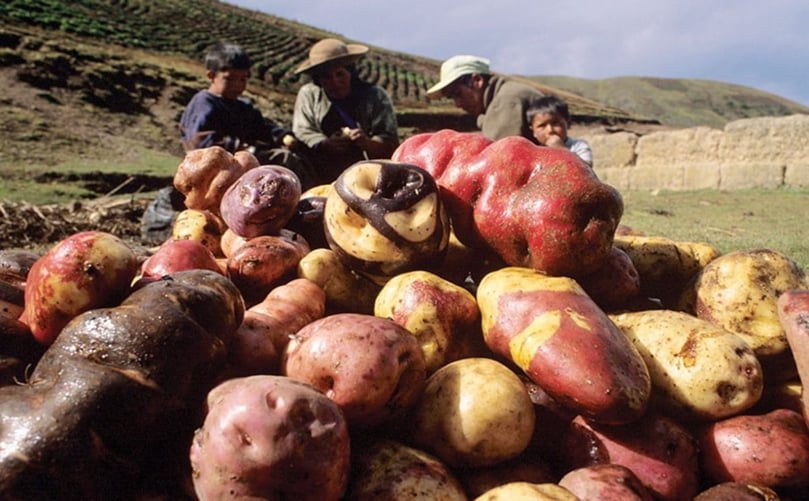
Peruvian family farmers harvesting native potatoes.
Meteoric Rise of the Incas
The collapse of Huari and Tiahuanacu between 1000 and 1200 ushered in a period of turmoil that ended with the meteoric rise of the Incas in the Cusco Valley around 1400. In less than a century, they forged the largest state in Pre Columbian America, stretching from present day Argentina to Colombia.
The Incas built upon and refined the agricultural advances of earlier highland cultures, giving particular importance to maize. Yet the potato remained fundamental to the empire’s food security. Within their vast network of state storehouses, potatoes especially chuno, a freeze dried potato product were staples used to feed officials, soldiers and corvee laborers, while also serving as a vital reserve during times of crop failure.
The Peoples Food of the Andes
The Spanish conquest in 1532 dismantled the Inca Empire, but potato cultivation endured as a cultural cornerstone. Known as "the people's food," it symbolizes identity and resilience. Time was once gauged by potato cooking duration, and land measured in "topo" the plot needed for a family's annual supply. Near Lake Titicaca, planting remains a key ritual, with the potato revered as Mama Jatha, "mother of growth."
Today, Andean farmers classify potatoes by ecological niches, often growing multiple species on small plots to preserve biodiversity. This practice maintains genetic resources vital for global agriculture, amid challenges like climate change.
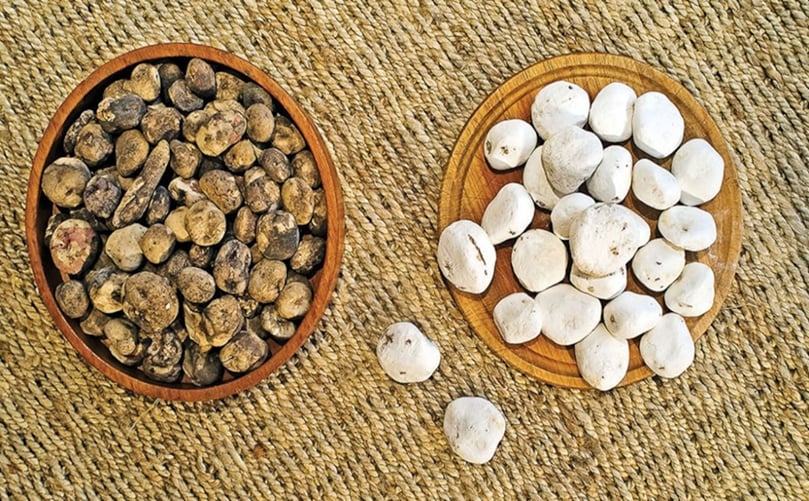
Black and white chuno, an ancient Andean technique, transforms potatoes into a long-lasting freeze dried food
Planting tubers remains the most important activity of the agricultural calendar near Lake Titicaca, where the potato is revered as Mama Jatha or “mother of growth.” To this day the potato endures as the seed of Andean society.
Diffusion and Global Spread of the Potato
From the Andes to Europe: The First Journey of the Potato
The story of potato diffusion began with the Spanish conquest of Peru between 1532 and 1572, which destroyed the Inca civilization and claimed countless lives. While the conquistadores came in search of gold, the true treasure they carried back to Europe was Solanum tuberosum.
The first evidence of potato cultivation outside South America appeared in Spain’s Canary Islands in 1565 and soon after on the Spanish mainland by 1573. From there, potatoes spread across Europe as exotic gifts, passing from the Spanish court to the Pope in Rome, then to Vienna, London in 1597, and eventually to France and the Netherlands.
Global Expansion: Acceptance and Adaptation
Although potatoes gained entry into botanical gardens and herbals, European society initially showed little interest beyond admiring their flowers. The tubers were considered food for the poor and even feared as poisonous. Yet, during the Age of Discovery, sailors recognized their value as nourishment on long voyages, enabling the spread of potatoes to India, China and Japan in the early 17th century.
The crop found especially favorable conditions in Ireland, where it thrived in the cool, moist climate, and by the early 1700s Irish immigrants had introduced the “Irish potato” to North America.
Potato Adoption in Europe: From Hesitation to Staple Crop
Adapting to Long Summer Days
The widespread adoption of the potato in the northern hemisphere was delayed not only by entrenched eating habits, but also by the difficulty of adapting a crop that had been grown for millennia in the Andes to temperate climates. Only a small fraction of the rich potato gene pool left South America and it took more than 150 years before varieties suited to long summer days were developed.
These new varieties arrived at a crucial time. In the 1770s, much of continental Europe was devastated by famine and the potatos value as a food security crop was suddenly recognized. Frederick the Great of Prussia ordered his subjects to cultivate potatoes as insurance against cereal crop failures, while in France, the scientist Antoine Augustin Parmentier succeeded in having the potato officially declared “edible.” Around the same time, across the Atlantic, U.S. President Thomas Jefferson famously served French fries to his White House guests.
After initial hesitation, European farmers – even in Russia, where the potato was nicknamed the “devil’s apple” – began growing it on a large scale. The potato soon became Europe’s food reserve during the Napoleonic wars, and by 1815 it had established itself as a staple crop across northern Europe.
Meanwhile, the Industrial Revolution was transforming agrarian society in the United Kingdom, forcing millions from rural areas into crowded cities. In this new urban environment, the potato became the first modern “convenience food” energy rich, nutritious, cheap, easy to grow on small plots and requiring little processing before cooking.
Increased potato consumption during the 19th century is credited with reducing diseases such as scurvy and measles, while also contributing to higher birth rates and the population explosion in Europe, the United States, and the British Empire.
The Potato Famine
The potatos success turned into vulnerability as Europe and North America relied on a few genetically similar varieties. In 1845, late blight devastated crops across Europe, hitting Ireland hardest where the potato supplied most of the diet. Three consecutive crop failures led to famine, killing about a million people.
This crisis pushed breeders to develop more productive, disease resistant varieties using new germplasm from Chile, laying the foundation for modern potato cultivation. Mean while colonial expansion and migration spread the potato worldwide from Asia to Africa, Australia and South America. By the 20th century it had become a global staple and even a popular snack food, with innovations like potato crisps and frozen French fries driving its cultural impact.