
Introduction: From Humble Roots to Snack Icon
Potato sticks, also known as shoestring potatoes, potato straws or potato matchsticks are ultra-thin, elongated crisps made from finely julienned potatoes that are deep-fried to deliver an unmatched addictive crunch, distinguishing them from thicker potato chips. Typically cut to about 1.5-2 mm thickness, their origins link to mid-19th century innovations at Moon's Lake House in Saratoga Springs, New York, where thin-sliced fried potatoes known as Saratoga chips first gained fame as a side dish. Historical records credit African American cook Kate Wicks with experimenting and originating the paper-thin frying technique in the early 1850s, predating the popularized myth involving chef George Crum (born George Speck, of Native American and African American descent).
While Crum, who joined as head chef in 1853, helped popularize the dish possibly in response to a demanding patron like Cornelius Vanderbilt the story of his defiant creation is largely apocryphal, with similar recipes appearing in earlier cookbooks like William Kitchiner's 1817 The Cook's Oracle. Potato sticks as a packaged product emerged commercially in the early 20th century, boosted by packaging advances like Laura Scudder's wax paper bags in the 1920s.
A landmark was French Potato Sticks, launched in 1935 by the R.T. French Company (now under McCormick & Company), America's first mass-marketed potato stick snack made from 100% real potatoes fried in vegetable oil. Marketed for their stackable shape and preservative-free freshness in tins, they boomed post-World War II as portable rations and party snacks. In Brazil, batata palha evolved from Portuguese influences in the early 1900s, becoming a feijoada topping with scaled production in the 1950s; brands like Elma Chips lead today. Globally, potato sticks reflect processing innovations like continuous fryers from the 1920s, with their shoestring cut enabling 20-30% greater crunch via rapid moisture evaporation, as per food science research.
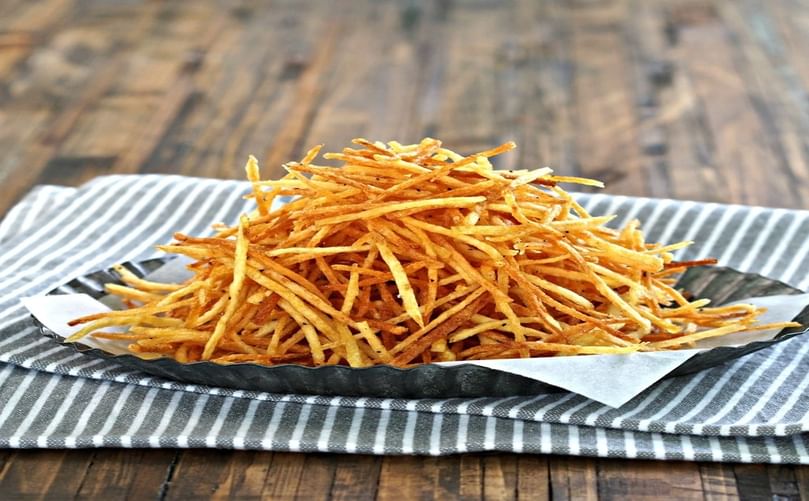
Crispy Crunchy Potato sticks (Source: Simply Sated)
The Processing Behind the Crunch: From Farm to Fry
Production begins with high-starch potato varieties such as Russet Burbank, Innovator or Lady Rosetta. Tubers are washed to remove soil and debris, then peeled using steam or abrasion methods to minimize waste (in some products, peels are retained for extra fiber). Potatoes are then cut into thin sticks (1.5–2 mm) using hydrocutters or mechanical slicers, ensuring uniformity and reducing irregularities that can promote acrylamide formation.
Next, the sticks are blanched in hot water (80–95 °C for 2–5 min) to remove excess sugars and starch, which reduces oil uptake by up to 15%, improves texture and prevents premature browning. After blanching, dewatering through air knives or centrifuges removes surface moisture before frying.
Frying occurs in continuous or batch systems at 170–180 °C for 1–3 minutes, typically using refined oils like sunflower, canola or palm olein. This step creates a crispy outer layer and a light golden color. The fries are then cooled on vibratory conveyors, allowing structure to set and excess oil to drain. Seasoning is applied in tumbling drums, where the high surface to volume ratio (about 40% greater than chips) enhances flavor coating and retention by up to 25%.
Finally, fries are nitrogen-flushed and packaged to ensure long term freshness and prevent oxidation. For extruded potato sticks (e.g., India’s aloo bhujia or spiced snack variants), the process differs potato flakes or flour are mixed into a dough, extruded into thin pellets, dried, and quick-fried for expansion. Modern production lines integrate Pulsed Electric Field (PEF) technology, which reduces cutting force, energy use by approximately 30% and oil absorption while enhancing texture consistency.
Potato Sticks vs. Potato Chips: Crunch, Calories and More
Potato sticks and potato chips, both crafted from Solanum tuberosum, share a common origin yet diverge in structure, crunch and nutrition. Potato sticks are julienned into ultra-thin strands (1.5–2 mm thick) and fried to achieve a sharp, multi-layered crunch. Their high surface to volume ratio about 40% greater than chips accelerates moisture loss, producing 20–30% higher acoustic crispness peaks in sensory studies. This structure enhances flavor adhesion, allowing seasonings to coat evenly for a bold, intense taste ideal for spicy or herbed varieties.
Potato chips, sliced into broader, round pieces (1–2 mm thick), deliver a gentler but satisfying snap, often with less uniform seasoning due to flatter geometry. Nutritionally, both are calorie-dense fried snacks, yet sticks tend to absorb up to 15% less oil owing to a blanching step that removes surface starch. Per 100 g, Food Struct data report potato sticks at 522 kcal, 34.4 g fat, 53.3 g carbohydrates (3.4 g fiber), and 6.7 g protein, with notable potassium (1,270 mg, 27% DV) and around 20% of daily vitamin C retained post-frying. Chips show similar calorie and fat levels but slightly lower antioxidant retention.
Both snacks rank high on the glycemic index (70–80), causing rapid glucose spikes, though sticks’ marginally higher fiber offers better satiety. A trade-off is acrylamide: sticks average 750–1,000 µg/kg, versus 500 µg/kg in chips, due to faster browning from their thin cut. Even so, inherent antioxidants help mitigate oxidative stress by up to 20%. Compared with French fries (274 kcal/100 g, lower fat but higher carbs), potato sticks offer the crunch and portability of chips with a uniquely explosive texture.
Sustainability: Rooted in Efficiency and Innovation
Potato production for snacks like sticks ranks among the world’s most resource efficient cropping systems. Compared to cereals, potatoes produce roughly 150% more edible output per hectare while requiring less land, water, and energy. Life cycle assessments estimate their carbon footprint at just 0.4 kg CO₂ eq/kg, versus 2.9 kg CO₂ eq/kg for rice and a water footprint of approximately 100 L/kg, about 30% lower than wheat.
Regenerative practices such as cover cropping, no-till and crop rotation are now used across over 50% of McCain Foods’ global acreage, enhancing soil biodiversity and sequestering 2–5 t CO₂ per hectare annually, while reducing pesticide runoff by nearly 50% in alignment with EU “Farm to Fork” objectives.
Despite these gains, processing remains energy-intensive. Frying emits around 7 t CO₂ eq per hectare of processed potatoes and generates waste oil (approximately 0.1 L/kg), though 70% of this oil is recycled within the EU. Packaging plastics also contribute to microplastic pollution concerns. By-products such as potato peels (20–30% of total yield) pose disposal challenges but offer circular solutions via biogas, composting or animal feed, cutting landfill impact by up to 40%.
Emerging technologies like pulsed electric field (PEF) systems cut frying energy by 30% and preserve more nutrients, while organic sourcing models like those adopted by Earth’s Best reduce eutrophication risk. Overall, potatoes have the lowest greenhouse gas footprint among major staple crops, positioning them as a sustainable foundation for future food systems. Achieving net-zero snack production by 2050 will depend on advances in clean frying energy, biodegradable packaging and carbon-smart farming.
Varieties of Potato Sticks: Global Crunch with Local Flavor
Potato sticks showcase remarkable diversity across the globe from classic salted russet-based originals to creative, culturally inspired innovations. Traditional russet varieties, prized for their high starch content, deliver up to 20% higher fry yield and a light, shattering crunch. Emerging purple potato variants, rich in anthocyanins and vitamin C (around 50% DV per 100 g), bring natural color and antioxidant power to premium snack lines.
Flavors reflect global palates: in the U.S., brands like Utz and Pik-Nik dominate with Original, Cheddar and BBQ profiles that account for roughly 35% of market share, while spicy and cheesy variants cater to adventurous consumers. In India, Haldiram’s Aloo Bhujia reimagines the stick with potato, besan (chickpea flour), and masala spices—boasting 20+ regional variants and a USD 1 billion market value. Japan Calbee Jaga Pokkuru pairs potato with umami-rich seaweed or butter-soy flavors, Brazil’s batata palha adds crunch to stroganoff dishes and Indonesia’s keripik kentang blends with sambal for a fiery edge, supporting USD 50 million in annual exports.
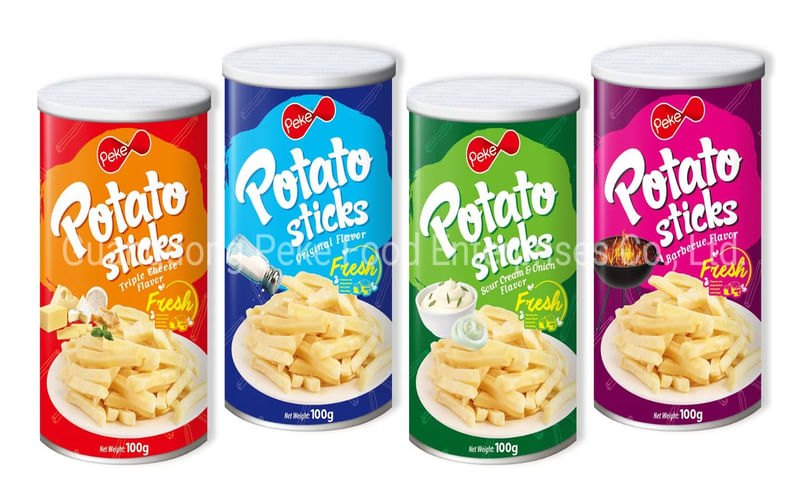
Potato sticks in diverse taste profiles
Health-conscious innovations are reshaping the category: baked or air-fried sticks contain up to 70% less acrylamide, while gluten-free and vegan options now represent over 80% of new U.S. launches. Fortified lines infused with pea protein, fiber, or probiotics cater to functional snack trends. Meanwhile, gourmet twists such as truffle (Europe), peri-peri (Africa), and sea salt–lime (Asia-Pacific) highlight the global fusion wave, with Indian spiced exports growing 15% annually to Middle Eastern markets.
Why Potato Sticks Are Booming Worldwide
The global potato snacks industry, with potato sticks representing around 10–15% of the total market, continues to surge thanks to urbanization, convenience-driven lifestyles and diverse flavor innovation. The broader potato chips segment is valued at USD 39.6 billion in 2024, projected to reach USD 59.7 billion by 2034 at a CAGR of 4.2% (Future Market Insights, 2024). Meanwhile, the potato processing industry overall is expected to expand from USD 33.6 billion in 2024 to USD 52 billion by 2034, growing at 4.5% CAGR, fueled by Asia-Pacific’s 40% market share driven by products like India’s aloo bhujia and other spiced snacks and North America’s USD 10–15 billion segment led by brands such as Frito-Lay and Utz.
Market trends include a 20% annual rise in e-commerce snack sales and the rise of premium and gourmet flavors, projected to boost total category growth to 5.5% CAGR by 2029 (Mintel, 2024). Potato sticks portability, crisp texture, and stackable packaging cater to modern on the go consumers. Global potato snack consumption surpassed 19 million tons in 2024, valued at approximately USD 78 billion, underscoring their expanding role in both traditional and health oriented snack markets.
Leading Companies in Potato Sticks and Snacks
Global and regional players dominate the potato sticks and snack market through innovation, branding, and processing expertise:
PepsiCo (Lay’s) holds around 25% of the global potato snacks market, leveraging extensive R&D and a wide distribution network.
Utz Brands generates approximately USD 1.4 billion in revenue and reaches 20% U.S. household penetration, specializing in gluten-free potato sticks and premium snack lines.
McCain Foods and Lamb Weston lead the processing segment, supplying over 60% of industrial potato fries and sticks, supporting both retail and foodservice markets
Regional innovators also shape local markets:Calbee (Japan) sells roughly 10 million packs annually, offering flavors like seaweed, butter-soy, and tempura-inspired sticks; Haldiram’s (India) dominates with USD 1.5 billion in snack sales, including spiced aloo bhujia and other stick-based products.
Processing, Trends and Market Relevance Globally
Processing: Potato sticks start with high-starch Russet potatoes, which are washed and peeled (steam or abrasion). The tubers are julienned using hydrocutters for uniformity, then blanched at 80–95°C to remove surface starch and reduce oil uptake by up to 15%. Sticks are fried at 170–180°C for 1–3 minutes, cooled on conveyors, seasoned and packed in nitrogen-flushed packaging to extend shelf life and maintain crispness.
Trends: The market increasingly favors clean-label snacks with no preservatives, functional enhancements such as probiotics or fiber and sustainably sourced ingredients. Premium flavors, baked/air-fried options and gluten-free variants are driving growth in health conscious segments.
Market Relevance: Potato sticks cater to the global snacking boom, especially in emerging economies. For example, Kenya’s Deepa Industries reports a 15% increase in African exports, highlighting the products role in regional economic growth and international trade.
Challenges in Production and Potential Downsides
Pest and Yield Losses: Potato stick production faces 20–30% losses due to pests like weevils and nematodes, which can be reduced by integrated pest management (IPM) and careful chemical use, cutting losses by up to 50%.
Acrylamide Formation: Thin fried sticks can accumulate up to 1,000 µg/kg acrylamide, a compound linked to cancer and neurotoxicity, particularly affecting reproductive health. The EU limit of 750 µg/kg encourages practices like blanching, which can reduce acrylamide levels by approximately 40%.
Nutritional Concerns: Potato sticks are high in fat (around 34 g/100 g), and frequent consumption can increase cholesterol and obesity risk by approximately 10% per 50 g daily intake. Overconsumption also contributes to elevated diabetes risk (approximately 20%).
Sustainability Challenges: Frying generates waste oil and consumes significant water, though drip irrigation and oil recycling can reduce environmental impact by approximately 20%.
Home Consumption Risks: Frying at home poses burn hazards; the FDA recommends limiting intake to 1–2 servings per week to balance taste, nutrition and safety.
Future Trends in Potato Sticks
By 2034, the potato sticks segment is projected to grow strongly, driven by consumer demand for portable, convenient and functional snacks. Innovations and market shifts include:
Functional Fortification: Protein-enriched, fiber-boosted or probiotic-infused sticks are expected to capture approximately 7% of segment growth, appealing to health conscious consumers.
Healthier Processing: Baked or hybrid sticks with lower glycemic index (approximately 50) reduce calorie impact while retaining crispness.
Sustainable Packaging: Leading brands aim for 100% recyclable or compostable packs by 2025, minimizing environmental footprint.
Regenerative Farming: Potatoes grown using cover crops, no-till, and crop rotation sequester CO₂ and reduce chemical inputs.
Biotech & Smart Production: CRISPR-engineered low-asparagine potatoes can reduce acrylamide in sticks by up to 70%, while IoT-enabled fry lines cut energy use by approximately 30%.
Global Flavor Expansion: Nostalgic and fusion flavors (e.g., kimchi, truffle, peri-peri) drive approximately 10% higher premium sales, appealing to adventurous eaters worldwide.
"Potato sticks: A timeless crunch that turns everyday potatoes into pure joy one salty strand at a time."