

Introduction
Potatoes represent a cornerstone crop in global agriculture, demanding a precise balance of major nutrients to achieve robust growth, substantial yields and high-quality tubers suitable for both fresh market and processing. Nitrogen, phosphorus, and potassium collectively known as NPK play integral roles in various physiological processes, from energy production and root development to stress resistance and starch accumulation. Their management is critical, as potatoes have shallow root systems that limit natural uptake, making them susceptible to deficiencies in sandy or low-fertility soils. Effective strategies involve soil testing, split applications, and integration with organic amendments to optimize nutrient availability, minimize environmental impacts like leaching, and enhance overall sustainability. NPK interactions influence not only yield but also tuber attributes such as size, specific gravity, and nutritional content, underscoring the need for tailored approaches based on variety soil type, and climatic conditions.
Role of Nitrogen in Potato Cultivation
Nitrogen is fundamental to potato (Solanum tuberosum) cultivation, serving as a primary component in the synthesis of proteins, nucleic acids and chlorophyll key molecules that drive vigorous vegetative growth and efficient photosynthesis. This nutrient promotes the development of a robust canopy early in the growing season, enhancing light interception and energy capture, which directly support tuber initiation and bulking.
Beyond its structural roles, nitrogen stimulates enzyme activities associated with carbohydrate metabolism, ensuring efficient translocation of sugars to developing tubers for optimal starch accumulation and quality. However, excessive nitrogen application can extend the vegetative phase, delay maturity and increase susceptibility to foliar diseases such as late blight due to excessive foliage growth.
In humid subtropical regions, adequate nitrogen supply enhances both root and shoot vigor, improving the plant’s tolerance to environmental stresses. Moreover, its interaction with irrigation management enhances overall water and nutrient use efficiency. Nitrogen also modulates hormonal signaling, particularly cytokinins, which influence tuber set, plant architecture and harvest uniformity.
Recent studies further highlight nitrogen’s role in shaping rhizosphere microbial communities, fostering beneficial bacteria that promote nutrient cycling and disease suppression, thereby contributing to a more resilient and productive potato crop.
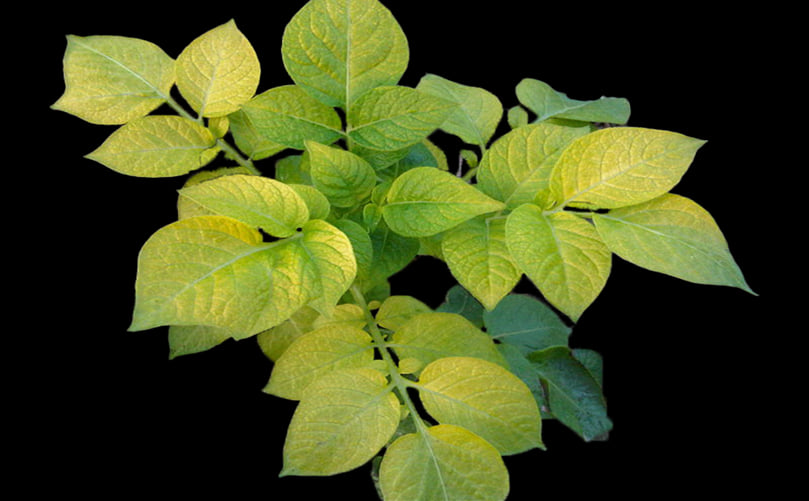
Illustration depicting the role of nitrogen in potato plant growth and development
Nitrogen Requirements and Uptake in Potato
Potatoes (Solanum tuberosum) have high nitrogen (N) requirements due to their rapid growth and high biomass production, typically ranging from 120 to 150 kg N/ha to achieve a 30 t/ha yield. Nitrogen uptake averages 4–5 kg N per tonne of tubers produced and follows an S-shaped pattern slow during sprouting, increasing rapidly through vegetative growth and tuber bulking, when 70–80% of total nitrogen absorption occurs between 40 and 90 days after emergence.
Approximately 40–50% of absorbed nitrogen is utilized by the vines, with about half of this recycled back into the soil through senescence, while the remaining nitrogen is allocated to tubers for export. Peak nitrogen demand reaches 2–4 lb per acre per day (≈2.2–4.5 kg/ha/day) during the bulking phase. Requirements vary with environmental and genetic factors irrigated crops may require up to 20% more nitrogen, whereas early-maturing cultivars often need 10% less.
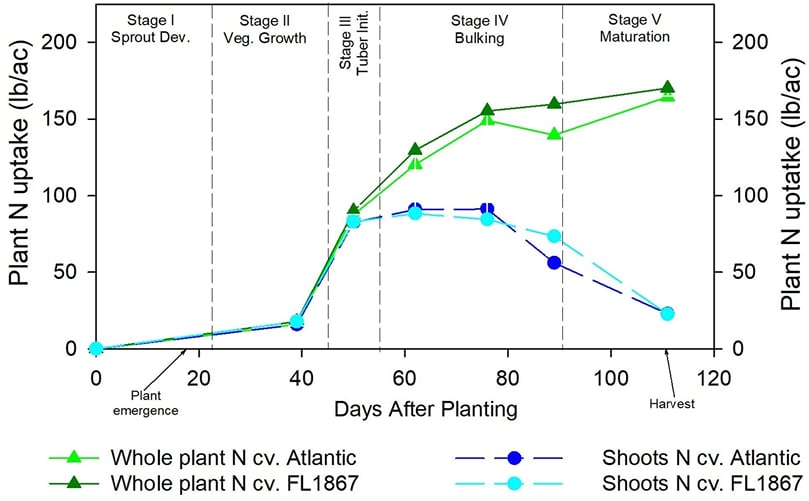
Graph showing nitrogen uptake patterns in potato plants over the growing season
Nitrogen use efficiency (NUE) typically ranges from 40–60% of applied nitrogen. On sandy soils, 20–30% of nitrogen losses can occur via leaching, which can be mitigated by deep placement (15–25 cm). Nitrate-N is preferred before tuber initiation due to its rapid availability, while ammonium-N is favored post-tuber formation to match plant uptake dynamics. Genotypic variation also influences uptake, with some fresh-market red varieties absorbing up to 353 lb N/acre (≈395 kg/ha). Tools such as the Nitrogen Nutrition Index (NNI) are increasingly used for precision nitrogen management and improved fertilizer efficiency.
Nitrogen Deficiency Symptoms in Potato
Nitrogen deficiency in potato (Solanum tuberosum) develops gradually, first appearing as a uniform pale green to yellow chlorosis on older leaves. This occurs because nitrogen is a mobile nutrient, readily translocated from mature to younger tissues when supply is limited. Affected plants exhibit stunted growth, reduced vine length and smaller leaves, resulting in a sparse canopy that diminishes light interception and photosynthetic efficiency.
Deficient plants produce smaller tubers of lower quality, often characterized by reduced starch content, specific gravity and overall yield losses of up to 30%. In more advanced stages, leaves may curl, develop necrotic spots and drop prematurely symptoms that can resemble sulfur deficiency or viral infections but are distinguished by the uniform yellowing across the foliage.
Nitrogen deficiency also delays maturity and weakens root development, increasing vulnerability to drought stress, especially in sandy or leached soils. Field symptoms may appear patchy or uniform, depending on soil nitrogen variability. Rapid correction is often possible within days through sidedress nitrogen applications. Diagnostic confirmation typically shows petiole nitrate-N levels below 800 ppm, emphasizing the need for early monitoring and timely intervention to prevent irreversible effects on tuber bulking and quality.
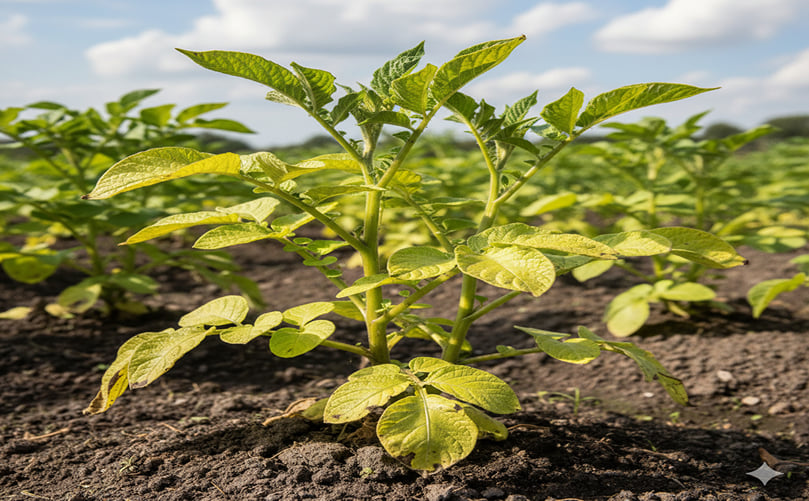
Visual symptoms of nitrogen deficiency in potato leaves, showing yellowing and stunting
Nitrogen Management Recommendations for Potato
Effective nitrogen (N) management in potato (Solanum tuberosum) cultivation requires split applications to synchronize nutrient availability with crop demand. The total nitrogen input typically ranges from 120 to 200 kg N/ha, applied as follows: 40–50% as basal, 25% at emergence and the remainder during tuber bulking, preferably through fertigation. This approach can reduce leaching losses by 20–30% and enhance overall nitrogen use efficiency.
Application rates should be guided by soil testing, yield targets and varietal response. On acidic sandy soils, ammonium sulfate is recommended to help maintain pH balance. Weekly petiole nitrate monitoring is advised, maintaining levels of 1200–1600 ppm during early growth and 400–700 ppm during late bulking to fine-tune fertilizer adjustments and avoid excessive vine growth that compromises tuber quality.
Incorporating biological nitrogen sources such as Azotobacter can fix 20–30 kg N/ha, potentially reducing chemical fertilizer needs by up to 25% while improving soil health and nutrient efficiency. Under deficit irrigation, lower rates of 60–120 kg N/ha can sustain yields, as supported by field trials under stress-prone conditions.
To prevent environmental risks such as nitrate leaching and groundwater contamination, nitrogen applications should not exceed 200 kg/ha and deep band placement (15–25 cm) is recommended in dryland systems. Optimal nutrient balance with phosphorus and potassium in a 1:0.6:1 ratio enhances nutrient synergy, while the use of nitrate forms before tuber initiation and ammonium forms afterward aligns with crop uptake patterns for maximum productivity and tuber quality.
Role of Phosphorus in Potato
Phosphorus (P) is indispensable for potato(Solanum tuberosum) cultivation, serving as a key driver of energy transfer through the ATP and ADP cycles that fuel vital cellular processes. It plays a crucial role in root elongation and early establishment, supporting vigorous growth in the crop’s naturally shallow root system. Phosphorus activates enzymes involved in nutrient acquisition and translocation, thereby enhancing the uptake efficiency of other essential ions, especially under phosphorus limited conditions.
At the physiological level, phosphorus supports DNA and RNA synthesis, promoting active cell division and canopy expansion, which are critical for timely tuber initiation. It also contributes to starch metabolism, influencing tuber specific gravity, dry matter accumulation and processing quality. Beyond growth, phosphorus enhances stress resilience, improving drought tolerance by strengthening root structure and maintaining metabolic stability under environmental stress.
Synergistic interactions between phosphorus and nitrogen promote balanced vegetative and reproductive growth, while deficiency can restrict micronutrients such as zinc (Zn), intensifying nutrient imbalance. Banded phosphorus applications at planting stimulate seed vigor and rapid emergence, often advancing maturity by 10–15 days, underscoring its vital role in achieving high yields and superior tuber quality in intensive production systems.
Phosphorus Requirements and Uptake in Potato
Phosphorus (P) requirements in potato(Solanum tuberosum) are moderate but critical for achieving optimal yield and tuber quality. On average, the crop requires 21–24 kg P₂O₅/ha to produce a 30 t/ha yield, equivalent to 0.7–0.8 kg P₂O₅ per tonne of tubers. In acidic or phosphorus-fixing soils, demand can increase by 20–30% due to reduced nutrient availability.
Phosphorus uptake occurs steadily throughout the growing season, with 30–40% absorbed before tuber initiation. Uptake rates typically peak at around 0.3 kg/ha/day during the bulking phase. Despite its importance, phosphorus use efficiency remains low (5–25%), largely due to the potato’s shallow root system and strong soil phosphorus fixation. Approximately 60–70% of absorbed phosphorus is allocated to the tubers, reflecting their high energy and starch metabolism requirements.
Varietal differences are evident processing cultivars generally require about 10% more phosphorus to support higher starch synthesis. Soil testing remains the foundation of fertilizer management, with measurable responses sometimes observed even at soil test levels above 40 ppm, particularly in sandy soils with limited retention. Irrigation can enhance phosphorus uptake by up to 15%, while deficit irrigation strategies combined with phosphate-solubilizing microorganisms (PSMs) improve efficiency in low-phosphorus environments.
Because significant amounts of phosphorus are exported through harvested tubers, annual replenishment is essential. Predictive tools such as the QUEFTS (Quantitative Evaluation of the Fertility of Tropical Soils) model help estimate phosphorus requirements based on yield targets. Under deficiency conditions, potato roots adapt by increasing root length and branching, improving their capacity for phosphorus foraging and sustaining growth under limited availability.
Phosphorus Deficiency Symptoms in Potato
Phosphorus (P) deficiency in potato (Solanum tuberosum) develops gradually and is often subtle in the early stages. Affected plants exhibit thin, dark green leaves that tend to cup upward, accompanied by general stunting, reduced vigor and delayed maturity. As deficiency intensifies, leaf margins and undersides develop a purplish-red coloration, progressing to interveinal necrosis on older foliage, which may lead to leaf deformation or elongation.
Stems often take on a reddish hue and root growth is restricted, resulting in poor tuber set and yield reductions of 15–20%. Although the canopy may appear darker green than normal, plants remain noticeably smaller. Symptoms are more pronounced under cold, wet, or alkaline soil conditions, where phosphorus availability is reduced by fixation.
In advanced stages, plants become dwarfed, with gradual progression toward necrosis a condition that can resemble other stress factors but is distinguished by the purplish pigmentation and absence of uniform yellowing typical of nitrogen deficiency. Soil phosphorus levels below 20 ppm or low tissue phosphorus concentrations confirm the diagnosis. Because early symptoms can be easily mistaken for nitrogen-related issues, timely monitoring and corrective action are essential to prevent lasting effects on tuber initiation and bulking.
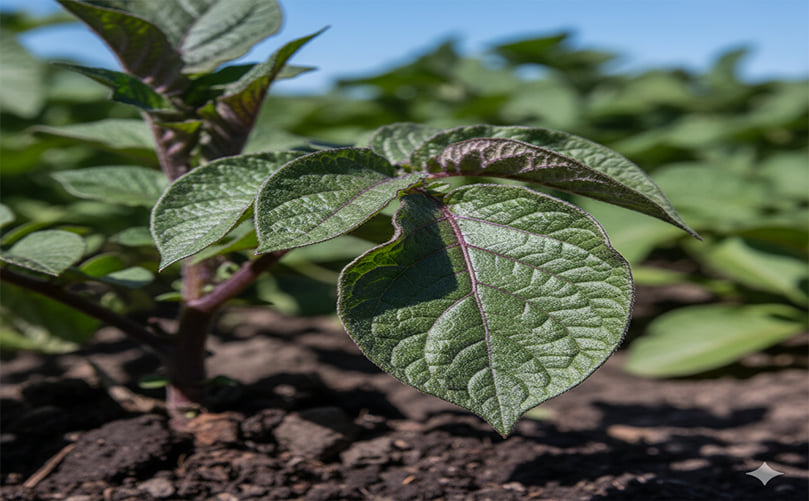
Symptoms of phosphorus deficiency in potato plants, including purplish leaves and stunting
Phosphorus Management Recommendations for Potato
Effective phosphorus (P) management in potato (Solanum tuberosum) cultivation emphasizes strategic placement and precise timing to address the crop’s inherently low phosphorus use efficiency. Recommended application rates range from 60 to 100 kg P₂O₅/ha, preferably banded 5–8 cm (2–3 inches) below the seed at planting, which offers a 20% efficiency advantage over surface broadcasting.
Soil testing remains the foundation for determining application needs phosphorus may be omitted when soil P levels exceed 65 ppm, although yield responses can still occur in potatoes even at higher concentrations due to their shallow root system. Starter fertilizers such as di-ammonium phosphate (DAP) or mono-ammonium phosphate (MAP) promote vigorous early root growth and faster crop establishment. Incorporating phosphate solubilizing bacteria (PSB) can enhance phosphorus uptake by 10–15% in deficient soils, improving nutrient accessibility.
To mitigate environmental risks, phosphorus applications should not exceed 120 lb/acre (≈135 kg/ha) in runoff-prone regions. In alkaline soils, combining phosphorus with sulfur improves solubility and plant availability. Foliar phosphorus sprays are useful for correcting early-season deficiencies, ensuring continuous root and shoot development. Maintaining a balanced nutrient ratio with nitrogen and potassium (1:0.6:1) enhances physiological efficiency and overall crop performance.
Under deficit irrigation, adequate phosphorus supply supports sustained yields by improving root foraging and stress tolerance. Economic optimization using yield-goal-based models helps determine site-specific rates, ensuring profitability and environmental stewardship without excessive application.
Role of Potassium in Potato
Potassium (K) plays a central role in the growth and productivity of potato (Solanum tuberosum), functioning as a key regulator of osmotic balance and turgor pressure that facilitates efficient water uptake and enhances drought tolerance a crucial factor for this shallow-rooted crop. It activates numerous enzymes involved in photosynthesis, carbohydrate translocation and starch synthesis, ensuring optimal energy utilization and tuber quality.
Potassium strengthens disease resistance and overall plant health, reducing physiological disorders such as blackspot bruising and improving post-harvest storability through enhanced metabolic stability. It promotes root growth and nutrient mobility, aiding the uptake and assimilation of nitrogen and phosphorus, thereby supporting balanced plant nutrition.
Functionally, potassium directly influences tuber size, specific gravity and fry color by optimizing metabolic pathways related to starch deposition and sugar regulation. It also helps modulate the rhizosphere microbiome, promoting beneficial microbial populations that improve stress resilience. In high-yielding or processing cultivars, potassium is critical for ATP generation and protein metabolism, underpinning the superior quality and consistency required for industrial potato production.
Potassium Requirements and Uptake in Potato
Potassium (K) is required in the largest quantities among all essential nutrients for potato (Solanum tuberosum), reflecting its central role in tuber growth and quality. To achieve a 30 t/ha yield, potatoes typically require 150–180 kg K₂O/ha, equivalent to 5–6 kg K₂O per tonne of tubers, with processing varieties especially those high in starch demanding up to 15% more.
Potassium uptake is continuous throughout the growing season, peaking early at 30–40 days after emergence, then gradually tapering off toward maturity. During the bulking phase, uptake rates can reach 6 kg K₂O/ha/day, with tubers absorbing 60–70% of the total accumulated potassium. Optimal potassium levels in soil and plant tissue are typically established using regression analyses across developmental stages.
Sulfate-based potassium fertilizers (e.g., K₂SO₄) are preferred over chloride forms to enhance tuber quality and processing characteristics, as potatoes generally absorb more potassium than nitrogen. However, sandy soils are prone to 20–30% potassium losses through leaching, necessitating split applications for improved retention and use efficiency.
Stage-specific potassium demand is high during sprouting and vegetative growth to support root establishment and continues through the bulking stage to promote tuber enlargement. Potassium also interacts antagonistically with magnesium (Mg), requiring careful nutrient balance to prevent Mg deficiencies.
Maintaining approximately 1.8% potassium concentration in tubers correlates with an uptake of 0.22 kg K₂O per acre per unit yield, underscoring the crop’s high export rate and the need for annual replenishment to sustain productivity and quality.
Potassium Deficiency Symptoms in Potato
Potassium (K) deficiency in potato (Solanum tuberosum) develops first on older leaves, where yellowing and necrosis appear along the margins and tips, gradually spreading interveinally to create a scorched or burnt appearance on mature foliage. Leaves often develop a dark green, glossy texture with deepened veins and marginal scorching, eventually becoming curled or crinkled as the deficiency progresses.
Affected plants wilt easily under water or heat stress, showing necrotic spotting between veins and weakened stems, which reduce overall vigor and canopy development. Tubers from deficient plants are typically smaller, lower in starch and more prone to cracking or deformation, leading to yield losses of 20–30% and poor processing quality.
In young plants, early symptoms may include a bluish-green tint that advances to brown spotting and premature leaf drop. While these symptoms can resemble magnesium (Mg) deficiency, potassium deficiency is distinguished by the characteristic leaf-edge scorching pattern. The crop often appears stunted, with closely spaced, cup-shaped leaves that reflect restricted cell expansion.
Diagnostic confirmation is achieved through petiole analysis, where potassium levels below 3–5% of dry matter indicate deficiency. Early detection and correction are critical to restore plant vigor and prevent irreversible effects on tuber bulking and quality.
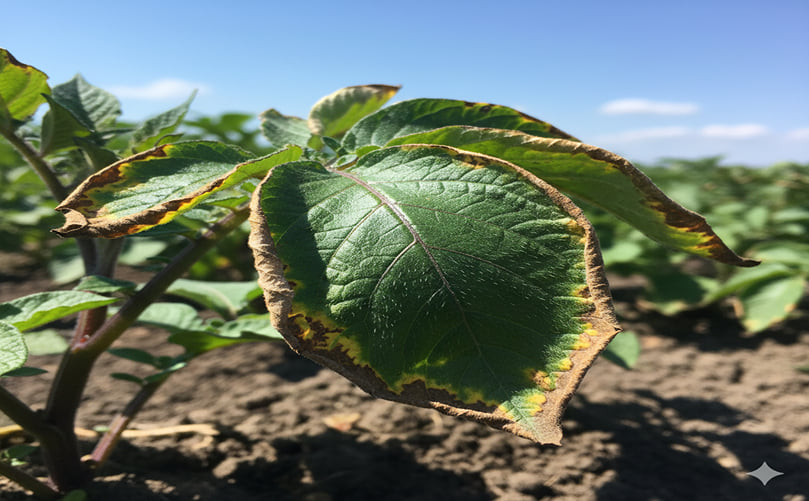
Symptoms of potassium deficiency in potato foliage, including scorching
Management Recommendations
Effective potassium management in potato cultivation involves a balanced, stage-specific approach to sustain yield and tuber quality. A pre-plant application of 100–200 kg/ha K₂O is recommended, preferably using sulfate-based sources (e.g., potassium sulfate) to avoid chloride-induced reductions in specific gravity and processing quality. Supplemental side-dressing during the bulking stage helps meet the crop’s peak potassium demand.
Soil and plant testing should guide nutrient programs, targeting petiole potassium levels of 3–5% and maintaining approximately 1.8% K in tuber dry matter. Incorporating organic amendments such as compost or manure enhances slow-release availability and improves fertilizer recovery efficiency.
Nutrient application should be split according to growth stages higher rates during early growth to support root establishment and sustained feeding via fertigation during tuber bulking, which can increase uptake efficiency by 10–20%. To optimize quality, avoid excessive chloride and use nitrate-based potassium formulations to improve absorption and crop vigor.
In potassium-deficient conditions, adequate supply mitigates stress severity and maintains metabolic balance. Emerging tools like vegetation indices (e.g., NDVI) enable mid-season monitoring for timely adjustments. Combining potassium with zinc enhances both economic return and nutrient synergy, while excessive levels may antagonize magnesium uptake.
Finally, potassium management not only improves yield and quality but also influences the rhizosphere microbiome, promoting potassium-solubilizing microorganisms that enhance drought tolerance and nutrient-use efficiency, especially under challenging soil environments.
NPK Uptake Patterns and Interactions
Nutrient uptake in potatoes follows a well-defined pattern,with nitrogen (N) exhibiting an S-shaped accumulation curve, characterized by rapid uptake during the vegetative and bulking phases. Nitrogen interacts synergistically with phosphorus (P) by upregulating membrane transporters that enhance ion balance and energy transfer efficiency.
Phosphorus uptake remains relatively steady, with 30–40% absorbed during early growth, supporting robust root development and promoting efficient nitrogen utilization. In contrast, potassium (K) uptake is more uniform but reaches its peak during the tuber bulking stage, where it drives carbohydrate translocation and starch synthesis.
Recommended nutrient ratios for optimal balance are 1:0.2:0.9 (N:P:K) for whole plants and 1:0.2:0.8 for tubers. According to QUEFTS (Quantitative Evaluation of the Fertility of Tropical Soils) models, approximately 4 kg N, 0.7 kg P and 3.5 kg K are required per megagram (Mg) of tuber yield, adjusted for climatic variations.
Nutrient interactions strongly influence crop performance: adequate potassium supports canopy longevity under high nitrogen conditions, extending the bulking period, while excess potassium can antagonize phosphorus and magnesium uptake, lowering starch accumulation. Genotype × environment interactions further modify nutrient responsiveness, requiring site-specific calibration of NPK inputs.
Irrigation enhances nutrient uptake efficiency by 15–20%, while omission studies identify nitrogen as the most limiting nutrient, followed by potassium. Although higher NPK applications can raise uptake levels, over-supply often decreases specific gravity and processing quality, underscoring the importance of balanced nutrient management for optimal yield and tuber attributes.
Key Research Insights
Studies consistently indicate that balanced NPK management significantly enhances potato yield and soil fertility. Field trials in regions such as Nepal report that applying 150:150:90 kg/ha (N:P₂O₅:K₂O) maximizes productivity and sustains long-term soil nutrient status. Similarly, research summaries from Florida identify 200:120:140 pounds per acre as optimal, with split applications improving nutrient-use efficiency and minimizing leaching losses.
While increasing soil NPK levels elevates tuber nutrient concentrations, excessive fertilization reduces specific gravity and provides no additional yield advantage beyond optimal rates. Removal studies reveal that potatoes extract approximately 4.85 kg N, 1.26 kg P₂O₅, and 6.98 kg K₂O per tonne of tubers, emphasizing the high nutrient export and the need for replenishment.
The Nutrient Expert decision-support tool has been shown to reduce fertilizer surpluses by 20–30%, aligning yield targets with sustainability. In arid regions like Xinjiang, specialized NPK formulations have increased yields by up to 15% through improved nutrient uptake efficiency. Additionally, integrating zinc with high NPK regimes enhances tuber quality parameters, such as dry matter and starch content.
Precision nutrient management approaches, including those developed by the University of Minnesota, demonstrate that yield optimization and environmental protection can coexist when fertilizers are applied based on site-specific needs, ensuring both profitability and sustainability in potato cultivation.