

Understanding Potato Tuber Moth: A Major Pest Threat in Potato Production and Storage
Potato Tuber Moth (Phthorimaea operculella) is one of the most destructive insect pests affecting potatoes worldwide causing severe damage under both field and storage conditions. The pest damages potato tubers through larval tunneling, resulting in significant yield losses, reduced seed quality, post-harvest deterioration, market rejection and increased vulnerability to secondary fungal and bacterial infections.
Common names for the pest include potato tuber moth (PTM), potato tuber worm and tobacco split worm. Scientifically, it is classified as Phthorimaea operculella (Zeller), belonging to the family Gelechiidae under the order Lepidoptera.
Why Potato Tuber Moth Is Economically Important: Potato tuber moth is considered economically important due to the severe damage caused by its larvae, which tunnel into potato tubers and make them unsuitable for commercial sale. Damaged tubers become highly susceptible to rotting and secondary infections, reducing both marketability and storage life. Even low levels of infestation can escalate rapidly in storage environments, where pest populations multiply quickly and may result in near total crop losses if left unmanaged.
In the field, infestations reduce both tuber yield and quality, while infected seed potatoes can negatively affect crop establishment and productivity in subsequent planting cycles. The pest poses a serious challenge across the potato value chain, impacting table potatoes, seed potatoes and processing potatoes used for products such as chips and French fries. In many cases infestations may also lead to quarantine concerns and export restrictions in international potato trade.
Most Affected Regions: Potato tuber moth is believed to have originated in the tropical mountainous regions of the Andes in South America and has since become a globally distributed pest. Today, it is reported in more than 90 countries and thrives particularly well in tropical, subtropical and warm Mediterranean climates.
Major potato producing regions significantly affected by potato tuber moth include India, China, Peru, Pakistan, Egypt, Kenya, several regions across Africa, Latin America, Australia and parts of the Mediterranean basin. Although the pest is generally less problematic in colder temperate climates, it can survive in storage facilities and persist in areas with relatively mild temperatures.
Why Growers and Storage Operators Should Care: For potato growers and storage operators, potato tuber moth represents a major economic threat. If infestations are not effectively managed, the pest can cause field yield losses ranging from 30% to 70%, while storage losses may reach up to 100% under favorable conditions. The moth spreads easily through infested seed tubers, harvested potatoes and storage facilities, increasing the risk of recurring infestations and economic losses, particularly in regions with limited access to cold storage infrastructure.
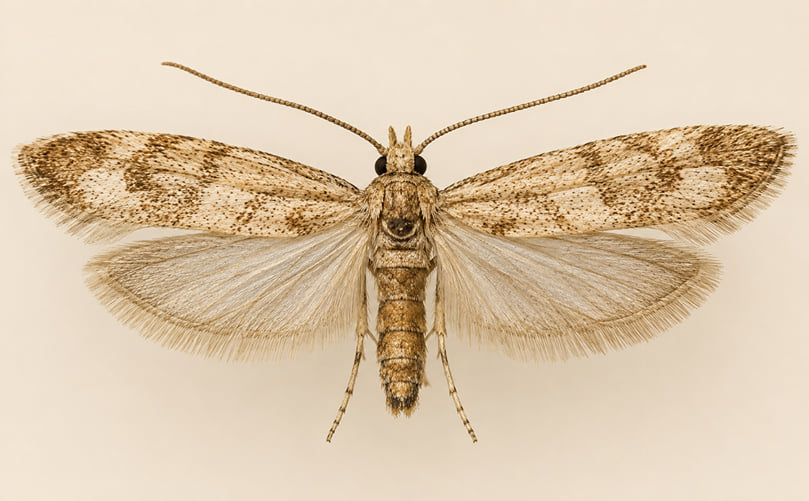
Potato Tuber Moth: A Major Pest in Potato Production
Geographic Distribution and Global Spread of Potato Tuber Moth
Potato Tuber Moth originated in the tropical mountainous regions of South America, particularly in the Andes of Peru and Bolivia, which are also considered the center of potato domestication. From this origin, the pest has expanded globally and is now classified as a cosmopolitan species, reported in more than 90 countries across tropical, subtropical and warm Mediterranean climatic zones.
Today, potato tuber moth is especially severe in potato production systems across developing regions where storage infrastructure and integrated pest management practices may be limited. In Africa, it is widely reported in countries such as Egypt, Kenya, Ethiopia, South Africa and several other sub-Saharan regions. In Asia, it is a major concern in countries including India, China (particularly southern and central provinces such as Karnataka and Sichuan), Pakistan, Iran and Syria. In Latin America, it remains a persistent pest across Peru, Bolivia, Colombia, Ecuador and much of Central and South America. It is also present in Oceania including Australia and parts of New Zealand.
In the United States, potato tuber moth has been recorded in multiple states across the country with greater economic impact in warmer regions. In southern Europe, it is considered an important pest in subtropical potato-growing areas such as Spain, Italy and Portugal. In colder temperate regions, outdoor populations are often limited by harsh winters; however, the pest can still persist and cause significant damage in stored potatoes or protected environments such as warehouses and storage facilities.
Climate change is increasingly influencing the distribution and intensity of potato tuber moth infestations. Predictive modeling approaches including phenology-based tools such as ILCYM and GIS-based simulations, indicate a potential expansion in both geographic range and population abundance by mid-century. Areas experiencing more than four generations per year thresholds associated with significant economic damage are projected to increase from approximately 30% to over 42% of global potato production zones.
Model projections also suggest a northward shift in pest distribution across the Northern Hemisphere, including parts of Asia, North America and Europe along with increased risk in tropical highland regions where potatoes are widely cultivated. While extremely high temperatures may reduce suitability in certain localized areas, overall pest pressure is expected to intensify in most current potato growing regions due to faster generational turnover and higher population growth rates. This highlights the growing need for adaptive and region-specific management strategies, particularly in vulnerable production systems across Asia, Africa and parts of Europe.
Scientific Classification and Pest Biology of Potato Tuber Moth
Potato Tuber Moth (Phthorimaea operculella ) belongs to the family Gelechiidae under the order Lepidoptera. It is considered one of the most economically damaging insect pests of potatoes due to its ability to infest crops both in the field and during storage.
Potato (Solanum tuberosum) is the primary economic host of potato tuber moth. However, the insect also attacks several other crops within the Solanaceae family, including tomato, tobacco, eggplant, pepper and wild host plants such as black nightshade. More than 60 host species have been reported though potato remains the most severely affected crop from a commercial perspective.
The pest undergoes complete metamorphosis through four developmental stages: egg, larva, pupa and adult. Potato tuber moth populations can increase rapidly because multiple overlapping generations occur throughout the year. In temperate climates, the insect generally completes two to eight generations annually, whereas tropical and subtropical regions may experience six to thirteen or more generations.
Potato tuber moth thrives under warm, dry conditions and is particularly problematic in areas with exposed tubers, cracked soils, delayed harvesting and poor sanitation in storage facilities. Environmental conditions strongly influence pest pressure with warm temperatures favoring faster population growth and wider spread.
Life Cycle of Potato Tuber Moth (Phthorimaea operculella)
The development of potato tuber moth varies according to environmental conditions, particularly temperature. Under warm conditions, a complete life cycle may be completed in approximately four to five weeks, while cooler temperatures can significantly delay development.
Egg Stage: Female moths lay small, oval, translucent to yellowish white eggs either singly or in small groups. Eggs are commonly deposited on the undersides of leaves, stems, exposed tubers, soil near plants or around potato eyes in storage. A single female may lay between 100 and 300 eggs during her lifespan. Depending on temperature, eggs generally hatch within 2 to 6 days.
Larval Stage (Most Damaging Stage): The larval stage is responsible for the greatest economic damage. Newly emerged larvae initially mine leaves or migrate through cracks in the soil to reach exposed potato tubers. Feeding larvae create tunnels and galleries inside tubers, leaving frass and increasing susceptibility to secondary infections.
Larvae pass through four developmental instars and grow to approximately 9–13 mm in length before pupation. Depending on environmental conditions and host availability, larval development generally lasts between 13 and 33 days. Pupal Stage: After completing larval feeding, mature larvae form silken cocoons and pupate in soil, crop debris, storage structures or on infested tubers. The pupae are brownish in color and approximately 7–8 mm long. This stage generally lasts 6–9 days although lower temperatures may prolong development.
Adult Moth Stage: Adult potato tuber moths are small, grayish brown insects with a body length of approximately 5.5–9 mm and a wingspan of 12–16 mm. Their forewings contain dark markings and fringed edges, which aid identification. Adults are nocturnal and relatively weak fliers with mating occurring shortly after emergence. Adult moths generally survive for one to two weeks.
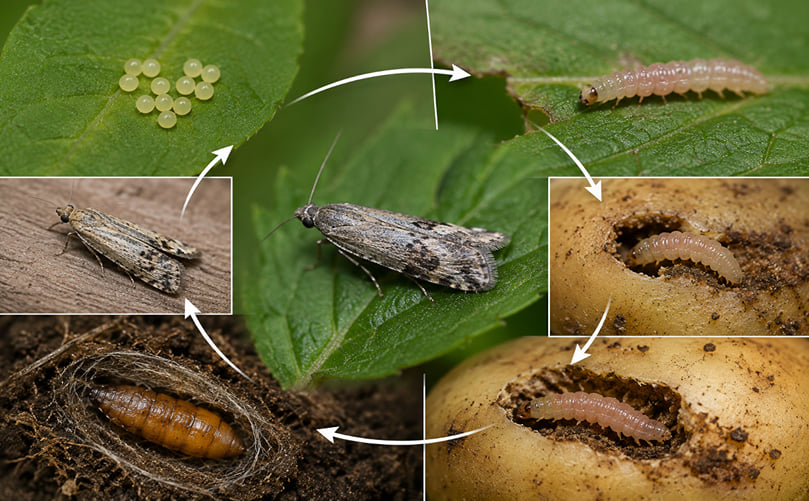
Life Cycle of Potato Tuber Moth (Phthorimaea operculella): Egg, Larval, Pupal and Adult Stages in Field and Storage Conditions
Potato Tuber Moth Identification and Damage Symptoms in Potatoes
Accurate identification of Potato Tuber Moth infestation is essential for timely management, as symptoms often begin subtly before progressing to severe field and storage damage. The pest can attack leaves, stems and tubers, with larval feeding responsible for the most economically significant losses.
Field Symptoms: In the field, potato tuber moth larvae initially feed on foliage by creating characteristic leaf mines. These often appear as “window-like” or blotch mines, formed when larvae consume the mesophyll tissue while leaving the upper and lower leaf epidermis intact, resulting in a translucent appearance. As infestations intensify, leaves may become heavily mined, curl, dry out or eventually undergo defoliation.
Larvae may also tunnel into stems, petioles and growing points, weakening plant structure and sometimes causing wilting of terminal shoots or stem breakage. In late season crops, especially under dry conditions, larvae frequently migrate from senescing foliage through soil cracks to reach developing tubers, increasing the risk of underground infestation.
Tuber Symptoms: Tuber damage caused by potato tuber moth is often difficult to detect during the early stages of infestation. Newly hatched larvae create extremely small entry holes, commonly near the potato eyes or through cracks in the soil making visual diagnosis challenging.
As larval feeding progresses, the pest produces narrow, dirty looking tunnels beneath the tuber skin or deeper irregular galleries within the potato flesh. These feeding channels are often lined with silk and filled with frass (insect excreta). Dark frass may accumulate near entrance holes or be expelled outside the tuber serving as an important diagnostic sign.
Infested tubers become increasingly vulnerable to secondary fungal and bacterial infections, often resulting in foul odors, tissue decay, shriveling and reduced storage quality. Under severe infestations, multiple larvae may attack a single tuber, destroying internal pulp and damaging eye buds, ultimately rendering potatoes unmarketable for fresh consumption, seed use or processing.
Adult Moth Identification: Adult potato tuber moths are small, slender, nocturnal insects and relatively weak fliers. During resting, adults typically hold their wings in a roof like position over the body giving them a narrow appearance.
The forewings are generally yellowish gray to brownish gray, featuring fringed margins. Males commonly possess two to three dark longitudinal spots, while females often exhibit a more noticeable “X”-shaped marking on the wings. Hindwings are lighter gray in color and also fringed along the edges. Adult moths generally measure 8–10 mm in body length with a wingspan of approximately 12–16 mm.
Larval Identification: Potato tuber moth larvae pass through four developmental instars before reaching maturity. Newly hatched larvae are extremely small, measuring approximately 1–1.5 mm and are usually grayish-white or pale yellow with a distinct dark brown head capsule and prothoracic shield.
As larvae mature, they grow to approximately 9–13 mm in length and may appear pinkish, greenish, grayish or pale brown depending on feeding conditions and age. Mature larvae often display small dark spots and fine bristles across body segments. They are highly mobile and frequently produce silk while feeding or moving through tunnels.
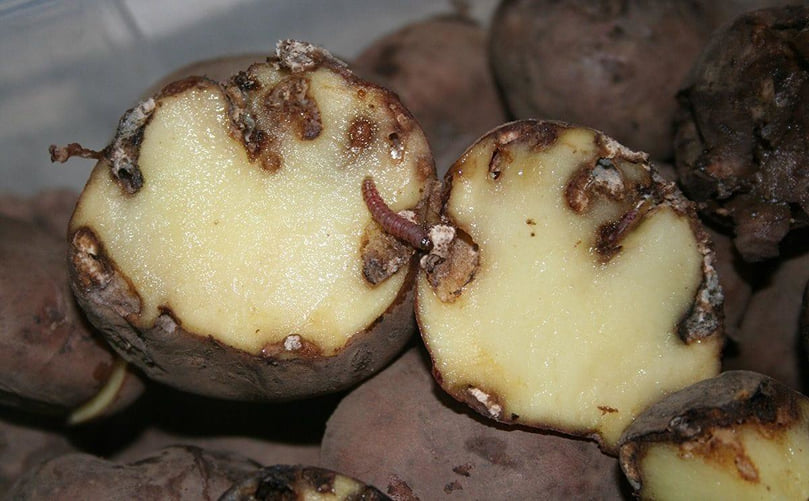
Potato Tuber Showing Larval Damage of Potato Tuber Moth
Economic and Quality Losses Caused by Potato Tuber Moth
Potato Tuber Moth causes both direct yield losses and severe quality degradation across all stages of potato production including field, storage, seed systems and processing industries. Under heavy infestation, field yield losses can range from 30–70%, depending on crop stage, environmental conditions and management practices.
Beyond yield reduction one of the most serious impacts is tuber quality deterioration. Larval tunneling creates internal galleries that serve as entry points for secondary pathogens such as bacteria and fungi accelerating tuber rot. Infested tubers often develop off-flavors, bitterness and foul odors making them unsuitable for both fresh consumption and industrial processing.
In seed potato systems, even low levels of infestation can have long-term consequences. Damaged seed tubers exhibit reduced sprouting vigor, weak plant establishment and poor field performance. Additionally, infested seed material acts as a primary pathway for spreading the pest into new production areas, increasing regional infestation pressure.
In processing potatoes used for chips and French fries, larval feeding causes serious quality defects such as internal browning, increased oil absorption and uneven frying characteristics. These defects lead to rejection during grading, sorting and processing quality control, reducing industrial efficiency and profitability.
In storage conditions potato tuber moth populations can multiply rapidly converting minor field infestations into severe post-harvest losses. Under warm and poorly managed storage environments, losses may approach complete crop destruction (up to 100%) within a few months due to continuous larval development and reinfestation cycles.
The pest also has significant implications for domestic and international trade. Even hidden infestations including early larval stages can trigger quarantine restrictions, phytosanitary rejections and export barriers, affecting market access and trade value.
Overall, potato tuber moth represents a major threat to food security and profitability by causing compounded losses across table potato markets, seed systems and processing industries, particularly in regions with limited storage infrastructure and weak pest management systems.
Field vs Storage Infestation of Potato Tuber Moth: Key Differences and Impact
Potato Tuber Moth causes damage in both field and storage systems, but the nature, intensity and economic impact of infestation differ significantly between these two environments. Understanding this distinction is critical for effective integrated pest management.
Field Infestation: In field conditions, infestation often begins on the upper canopy, where larvae initially mine leaf tissue in a protected environment. As the population develops, larvae gradually move downward within the plant and eventually reach the tubers. A strong relationship exists between foliar infestation levels and subsequent tuber damage as high early season populations create a reservoir for later tuber attack.
Late season infestation is particularly severe when soil conditions are dry and cracked or when tubers are exposed due to inadequate earthing-up. These conditions facilitate larval movement from foliage to tubers. Delayed harvesting further increases risk as senescing plants and exposed tubers become more attractive for egg-laying. In some cases, infested foliage near harvest can attract adult females, leading to additional egg deposition and increased carryover infestation into harvested produce.
Storage Infestation: Storage environments present conditions that favor continuous and overlapping generations of potato tuber moth. Unlike field conditions, all life stages eggs, larvae, pupae and adults can coexist simultaneously in storage systems, enabling rapid population buildup from even a small number of infested tubers.
In poorly managed or traditional storage structures, warm temperatures, limited sanitation and residual infested material allow the pest population to expand quickly. Larvae can migrate between tubers, while adults disperse within storage units, increasing the spread of infestation across stored batches. Pupation may occur not only on tubers but also on walls, sacks, crates and debris, making eradication difficult without thorough sanitation.
Latent infestations are a major challenge in storage systems. Early-stage larvae inside tubers often remain undetected during sorting and only become visible later when frass accumulation, tunneling or rot develops. In the absence of temperature control and hygiene practices, storage losses can escalate rapidly, often exceeding field level damage and making storage the most economically vulnerable stage in the potato value chain.
Conditions Favoring Potato Tuber Moth Infestation in Field and Storage
Potato Tuber Moth infestations are strongly influenced by environmental, agronomic and storage conditions that support faster pest development and increased exposure of potato tubers. Understanding these risk factors is essential for predicting outbreaks and implementing effective management strategies.
Prolonged dry and warm weather conditions, particularly within the optimal range of 20–30°C, significantly favor pest development. Such conditions accelerate the life cycle of the insect while also causing soil moisture loss and cracking, which exposes developing tubers and facilitates larval entry. At the same time, plant stress under drought conditions further increases susceptibility to infestation.
In field situations, agronomic practices play a major role in infestation risk. Shallow planting depth, inadequate or irregular earthing-up (hilling) and uneven irrigation practices can leave tubers partially exposed making them more accessible to larvae. The presence of volunteer potato plants and nearby solanaceous weeds also serve as a continuous reservoir for pest survival and reproduction, enabling carryover between cropping cycles.
In storage systems, infestation is intensified by poor post-harvest management practices. High storage temperatures, inadequate ventilation and high humidity conditions create an ideal environment for rapid pest multiplication. The presence of infested crop debris, unclean storage facilities and mixing of newly harvested potatoes with older infected lots further accelerates population buildup and spread.
Additionally, proximity to previously infested fields, dumping sites or unmanaged waste heaps increases the likelihood of reinfestation. Climate variability including extended drought periods and milder winters is also contributing to longer pest activity periods and an expansion of the geographical range of infestation making management increasingly challenging across potato growing regions.
Diagnosis of Potato Tuber Moth in Field and Storage Conditions
Potato Tuber Moth diagnosis requires careful field and storage inspection as early infestations often remain hidden inside leaves or tubers. Accurate identification is essential to avoid confusion with other pests, diseases or physiological disorders that can show similar symptoms.
Visual Diagnosis in Field and Storage: In field conditions, early infestation is typically recognized by serpentine or blotch type leaf mines, where larvae consume internal mesophyll tissue while leaving the upper and lower epidermis intact. These mines appear as translucent “window-like” patches on leaves. Additional indicators include frass deposits near mines or stem entry points, wilting of terminal shoots and stem breakage caused by internal tunneling.
In tubers, diagnosis is confirmed by cutting open suspected samples. Infested tubers show narrow feeding tunnels, silk-lined galleries and accumulations of frass, often accompanied by live larvae or pupae. In storage conditions, common symptoms include small entry holes (frequently near eyes), frass mounds, webbing, shriveling of tubers and secondary rotting accompanied by foul odors. Because early-stage infestations may show minimal external signs, random sampling and systematic tuber dissection are necessary for accurate detection.
Laboratory Confirmation: In cases where visual diagnosis is uncertain or where quarantine regulations apply, laboratory confirmation is recommended. This may involve rearing larvae to adult stages for morphological identification, using pheromone traps for adult capture and monitoring or applying molecular diagnostic tools such as DNA barcoding. In newly affected or low-prevalence regions, confirmation by diagnostic laboratories or extension specialists is important for accurate pest identification.
Differentiation from Similar Pests and Diseases
Potato tuber moth damage can be confused with several other pests and disorders. Wireworm damage typically produces clean, uniform tunnels without frass or silk and does not affect foliage. Cutworms cause external feeding damage at the soil line rather than internal tunneling.
Other tuber borers, such as the Andean potato tuber moth (Symmetrischema tangolias) and the Guatemalan potato tuber moth (Tecia solanivora), may produce similar symptoms but can be differentiated through larval morphology, adult wing patterns and regional occurrence.
Fungal and bacterial diseases such as soft rot or Fusarium dry rot lack insect indicators such as larvae, frass, silk or distinct entry holes and instead cause mushy or dry tissue decay. Physiological disorders like hollow heart or frost damage also differ as they do not involve feeding structures or progressive tunneling.
Common Misidentifications: A common diagnostic error is attributing tuber damage solely to secondary rots while overlooking the underlying insect activity that initiated infection. Similarly, early leaf mines may be mistaken for leaf minor fly damage or nutrient related stress symptoms. In storage systems, tuber entry holes may also be confused with mechanical injury or vertebrate pest damage.
In mixed infestation scenarios, potato tuber moth often acts as the primary pest, facilitating secondary fungal or bacterial infections that amplify overall losses. Accurate diagnosis therefore requires distinguishing primary insect damage from secondary decay processes.
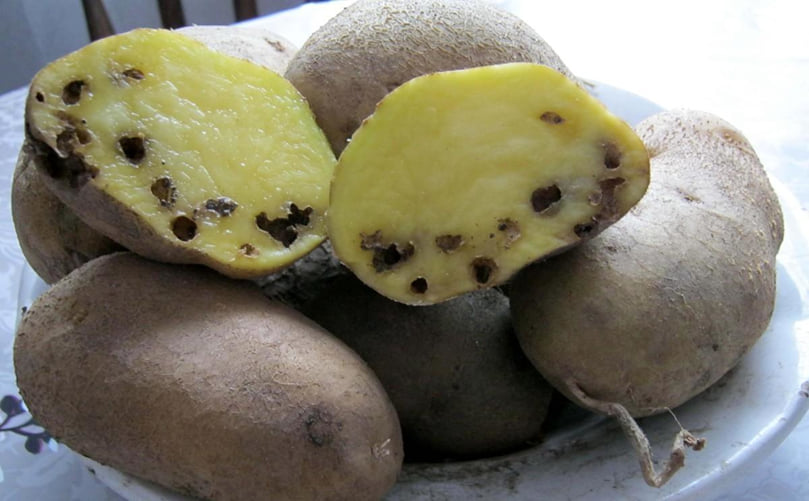
Diagnosis of Potato Tuber Moth (Phthorimaea operculella) in Field and Storage Conditions: Symptoms, Detection and Identification of Infestation in Tubers
Monitoring and Early Detection of Potato Tuber Moth
Potato Tuber Moth monitoring and early detection are critical components of integrated pest management as timely intervention can prevent rapid population buildup in both field and storage systems. Because the pest can complete multiple overlapping generations and remain hidden inside plant tissue or tubers, continuous monitoring is essential for effective control.
Pheromone Traps for Monitoring: Pheromone traps are the most widely used tool for detecting and monitoring adult male moth activity. These traps typically use water pan or delta type sticky trap systems baited with a synthetic sex pheromone that attracts males.
In field conditions, traps are generally placed at a density of 1–4 traps per hectare or per field zone, positioned approximately 15 meters inside field edges and maintained at canopy height. Traps should be inspected at least twice per week to track population trends.
Trap catch data is used to detect the onset of moth activity, monitor population fluctuations and guide the timing of control measures. While action thresholds vary by region, some guidelines suggest intervention when trap catches reach approximately 15–20 moths per trap per night with lower thresholds recommended for seed potato crops due to stricter quality requirements. Pheromone traps are also effective in storage environments for detecting hidden infestations.
Field Scouting and Surveillance: Field scouting involves systematic inspection of potato crops to detect early signs of infestation. This includes examining lower leaves for leaf mines, checking stems for tunneling and frass and observing soil cracks where larvae may move toward tubers. Sampling of exposed or late season tubers is also important for early detection of underground infestation.
Greater attention should be given to field margins, volunteer potato plants and nearby solanaceous weeds, as these often serve as pest reservoirs. Scouting frequency should increase from mid-season onwards, especially as the crop approaches maturity. In some cases, nighttime scouting can help detect adult moth activity more effectively.
Storage Monitoring and Inspection: In storage systems, regular inspection of incoming and stored potato lots is essential. Monitoring includes random tuber sampling, visual checks for frass, webbing, entry holes and signs of emerging adults. Pheromone traps placed inside storage facilities can help detect adult populations and assess infestation levels.
Inspections should be conducted weekly or more frequently in warm storage conditions, where pest development is faster and population growth is more rapid.
Thresholds and Timing of Action: Unlike many agricultural pests, potato tuber moth does not have a universally accepted economic threshold due to its high destructive potential. In seed and processing potatoes, even very low infestation levels can cause significant economic losses making tolerance thresholds extremely low.
Management decisions are often based on a combination of pheromone trap catches, field symptom observations and crop stage. In advanced management systems, degree day models can also be used to predict pest development and optimize intervention timing.
Early detection is critical because populations can increase rapidly under favorable conditions, particularly in warm and dry environments. Timely monitoring and response significantly reduce the risk of severe field damage and post-harvest losses.
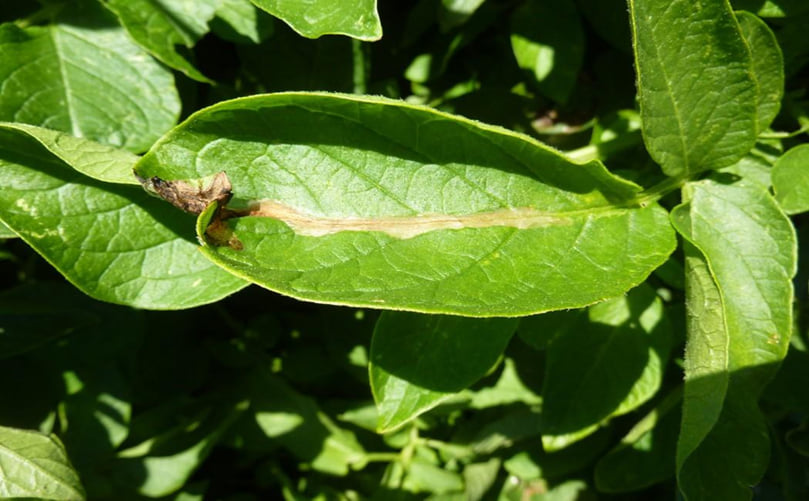
Diagnosis of Potato Tuber Moth (Phthorimaea operculella) in Leaves: Identification of Leaf Mines, Larval Feeding Damage and Early Field Symptoms
Integrated Pest Management (IPM) for Potato Tuber Moth
Potato Tuber Moth management requires an Integrated Pest Management (IPM) approach that combines multiple tactics to reduce pest populations below economic levels while minimizing reliance on synthetic insecticides and reducing environmental impact.
Cultural Control: Cultural practices form the foundation of effective IPM. Removal of volunteer potatoes and solanaceous weeds such as black nightshade helps eliminate alternative hosts that support pest survival between cropping cycles. The use of certified, pest-free seed tubers and avoiding planting near previously infested fields reduces initial infestation pressure.
Irrigation management also plays an important role. Overhead sprinkler irrigation helps maintain soil structure and reduces cracking, limiting larval access to tubers compared to dry furrow systems. In storage systems, rapid post-harvest handling and maintaining cool, low humidity conditions help slow pest development. Infested cull piles should be destroyed and waste heaps must be properly covered with soil to prevent adult emergence. Intercropping with non-host crops such as onion, pepper or peas can also help disrupt pest development.
Biological Control: Biological control relies on conserving and enhancing natural enemies of potato tuber moth. Important predators include lacewing larvae, big-eyed bugs, ground beetles, earwigs and rove beetles. Key parasitoids include Copidosoma koehleri and species of Apanteles.
Entomopathogenic organisms also play an important role. Formulations of Bacillus thuringiensis (Bt), particularly dust or spray applications are effective when applied early in infestation. The granulosis virus is another important biocontrol agent, especially in storage conditions with low initial infestation. Entomopathogenic nematodes and fungi have also shown potential in both field and post-harvest environments. In some highland potato systems, Bt-based treatments have significantly reduced tuber damage levels.
Pheromone-Based Management: Pheromone-based strategies are used not only for monitoring but also for direct control. Mating disruption and mass trapping systems using synthetic sex pheromones can reduce reproduction and oviposition. Common pheromone compounds include blends such as E, Z-4,7,10-tridecatrienyl acetate.
Microencapsulated pheromone formulations or dispenser systems can reduce adult mating success in both field and storage environments. Attract-and kill systems combine pheromones with insecticides to improve targeted control efficiency.
Chemical Control: Chemical control should be used selectively and based on monitoring data. Effective insecticides include chlorantraniliprole, indoxacarb, spinosad and certain neonicotinoids and pyrethroids. However, rotation of different modes of action is essential to manage resistance development.
Foliar insecticide applications are most effective before tuber bulking as larvae inside tubers are largely protected from chemical exposure. Botanical insecticides such as neem-based products may also be used as lower risk alternatives within an IPM framework.
Storage Management: Storage hygiene is critical for preventing population buildup. Facilities should be thoroughly cleaned between season and infested tubers must be removed and destroyed immediately. Application of Bt dust formulations, mineral oils and certain plant-based products can provide protection in storage environments.
Mixing of new and old potato lots should be avoided to prevent infestation spread. In traditional or rustic storage systems, which are common in many developing regions, these integrated practices are especially important to prevent continuous pest multiplication and severe post-harvest losses.
Potato Tuber Moth Prevention: Practical Checklist for Field, Harvest and Storage
Potato Tuber Moth prevention requires an integrated, stage wise approach covering planting, crop growth, harvest and storage to minimize infestation risk and reduce post-harvest losses.
Before Planting: Use only certified, pest free seed tubers and avoid planting any material showing signs of damage or infestation. Where possible, select varieties with deeper tuber placement to reduce exposure to larvae. Field preparation should include deep tillage and proper planning for effective earthing-up operations during crop growth.
Crop rotation with non-solanaceous crops helps break the pest life cycle, while removal of nearby solanaceous weeds and volunteer potato plants reduces alternate host availability. New fields should ideally be located away from previously infested areas or sites where cull piles have been stored.
During Crop Growth: Planting should be done at sufficient depth (approximately 10–15 cm or more) to reduce tuber exposure. Multiple hilling operations (2–3 times during the season) are important to ensure tubers remain well covered with soil.
Consistent irrigation practices help prevent soil cracking, which reduces larval entry points. Overhead irrigation systems are often preferred where feasible due to better soil coverage. Regular field scouting using pheromone traps and visual inspection should be conducted along with removal of volunteer plants and weeds that may act as pest reservoirs.
Early application of cultural or biological control measures is recommended when monitoring indicates increasing pest activity. In some systems, the use of mulch or botanical deterrents such as neem-based products may provide additional protection.
At Harvest: Timely harvesting at physiological maturity helps reduce exposure to late-season infestation. Tubers should not be left exposed in the field for extended periods. Care should be taken to minimize mechanical damage during harvesting operations.
Infested or damaged tubers should be sorted and removed directly in the field whenever possible to prevent spread. Rapid post-harvest handling is essential to limit the movement of eggs or larvae into storage systems.
In Storage: Storage facilities must be thoroughly cleaned and sanitized before use, with all plant debris and residues removed. Tubers should be stored in cool, well-ventilated and low humidity conditions whenever possible to slow pest development.
Incoming lots should be carefully inspected and suspect batches should be isolated immediately. Protective treatments such as Bacillus thuringiensis (Bt)-based dusts or approved botanical products may be applied at the beginning of storage.
Regular monitoring using pheromone traps and weekly inspections is essential with prompt removal of infested tubers to prevent population buildup. Storage structures should be designed or managed to prevent access to pests through poor covers or contaminated materials such as wilted vines.
Economic Impact and Industry Importance of Potato Tuber Moth
Potato Tuber Moth causes severe economic losses across the potato value chain, affecting field production, storage systems, seed quality, processing industries and international trade. Under high pest pressure, field yield losses typically range from 30–70%, while storage losses can reach 50–100% in poorly managed or warm storage conditions.
In extreme cases, reported losses include up to 86% in parts of North Africa around 90% in Kenya and near total losses in countries such as India and the Philippines, particularly where storage infrastructure is limited and infestations remain unmanaged. In storage environments, even low initial infestations can escalate rapidly with the potential to destroy entire potato batches within 2–3 months under favorable conditions.
Beyond direct yield losses, the economic impact extends to multiple segments of the potato industry. In table potato markets, tuber tunneling, frass contamination, internal rot and off flavors significantly reduce marketability and farm gate prices. In seed potato systems, infestation leads to poor sprouting, reduced germination and the spread of pests to new production areas, increasing long-term production risk.
In processing potatoes used for chips and French fries, quality degradation is a major concern. Larval damage results in internal defects, higher oil absorption during frying and increased rejection rates during processing and grading. These quality issues directly affect industrial efficiency and profitability.
International trade is also impacted as many export markets enforce strict phytosanitary regulations. Even minor or latent infestations can lead to shipment rejection or trade restrictions creating additional economic barriers for producers and exporters.
In major potato producing countries such as China and India, the combined impact of field and storage losses poses a significant threat to food security, farmer income and supply chain stability. Additional economic burdens include increased pest management costs, loss of seed value and post-harvest handling expenses. Overall, potato tuber moth remains a major constraint to profitable and sustainable potato production, particularly in tropical and subtropical regions reliant on traditional storage systems.
Latest Research and Innovations in Potato Tuber Moth Management
Potato Tuber Moth management research is increasingly focused on sustainable, reduced chemical and precision-based solutions that improve control efficiency across field and storage systems.
Recent advances in biological control include improved formulations of Bacillus thuringiensis (Bt), particularly Bt-talc powders and granulosis virus applications, which have demonstrated strong effectiveness in post-harvest conditions, especially in Andean region trials. Ongoing research continues to enhance the use of parasitoids and entomopathogenic organisms for more stable field and storage level control.
Pheromone-based technologies have also advanced with improved systems for mating disruption, mass trapping and attract and kill strategies. These approaches reduce mating success and oviposition pressure contributing to lower population buildup in both field and storage environments.
Host plant resistance research has identified potato cultivars with reduced susceptibility to tuber moth damage. Certain breeding lines, including Chinese selections such as Jing1 and G22, have shown lower larval density and reduced tuber damage due to morphological and semio-chemical traits. In addition, genetically modified Bt-potatoes, such as SpuntaG2 expressing Cry proteins have demonstrated strong resistance under field conditions and extended storage protection in controlled studies.
Digital agriculture and precision pest management tools are also emerging as important innovations. Phenology models such as ILCYM, GIS-based risk mapping and climate projection tools are being used to predict outbreak risk and guide timely interventions. Artificial intelligence and machine learning approaches are increasingly being explored for early detection of pest symptoms and damage identification in potato crops.
Research into insect behavior and chemical ecology including odorant receptors and plant volatile compounds is contributing to improved breeding strategies and semio-chemical-based control methods. At the same time, climate change modeling indicates potential shifts in geographic distribution and increased generation cycles driving the need for adaptive management strategies in expanding risk zones.
Botanical insecticides such as neem, rosemary and Ricinus extracts along with biorational products like spinosad and mineral oils are being evaluated and validated as eco-friendly components of integrated pest management systems.
Overall, these innovations support the development of more precise, sustainable and region-specific strategies for managing potato tuber moth across diverse global production systems.