

Introduction: The Hidden Menace Beneath the Soil
Common scab is one of the most persistent and economically significant soil-borne diseases of potato (Solanum tuberosum), caused mainly by actinobacteria in the genus Streptomyces notably S. scabies, along with S. acidiscabies, S. turgidiscabies and related species. The disease manifests as rough, raised or pitted corky lesions on tuber surfaces, severely downgrading their market value and visual appeal, even though internal tissues and plant vigor remain largely unaffected.
At the heart of the disease process is the production of thaxtomin phytotoxins, which disrupt plant cell wall formation, triggering localized cell death and lesion development. These pathogens thrive in neutral to alkaline soils (pH 5.2–8.0) under dry and warm conditions, making them especially troublesome in sandy or poorly irrigated fields.
First documented by Thaxter in 1890, common scab now occurs worldwide, affecting up to 75–100% of potato growing areas in some regions. Economic losses are substantial estimated between USD 100 and 500 per hectare due to tuber downgrading and reduced consumer acceptance.
Recent research highlights the vital role of geocaulo sphere microbiome dynamics in regulating disease severity and introduces biostimulant-based management (e.g., Ginkgo biloba litter) as a promising, eco-friendly suppression strategy. However, with climate change increasing soil dryness and alkalinity, disease incidence is expected to rise, underscoring the urgency of developing QTL-based resistant varieties and microbiomenenhancing soil interventions for sustainable potato production.
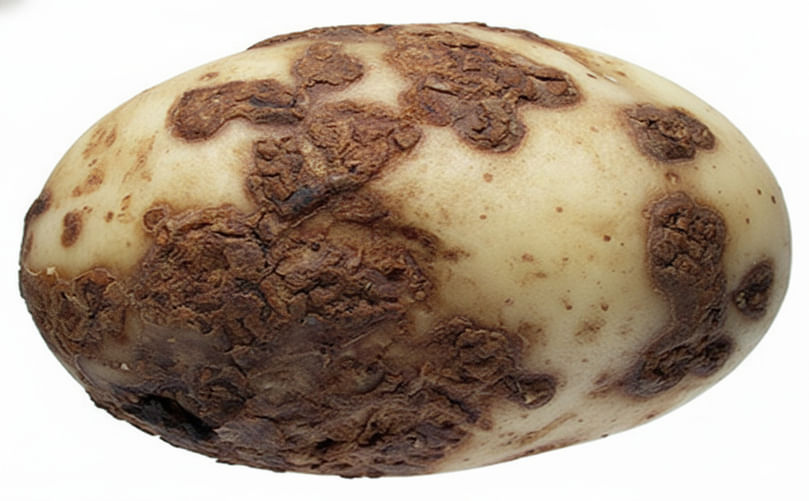
Potato tuber exhibiting typical corky lesions from common scab infection
History: Tracing the Roots of Common Scab
The history of common scab dates back to 1890, when Roland Thaxter in the United States first described the disease and successfully isolated Streptomyces scabies from infected potato tubers. This marked a landmark discovery one of the earliest documented cases of a plant disease caused by actinobacteria rather than fungi or bacteria of other genera.
Through the early 20th century, severe outbreaks across Europe and North America prompted extensive investigation into environmental drivers. Researchers, notably Millard (1923), established the pivotal roles of soil pH and moisture in disease development and formally classified S. scabies, setting the foundation for modern pathogen taxonomy.
In subsequent decades, scientific advances expanded the known diversity of the scab causing complex. The 1980s brought the identification of S. acidiscabies and S. turgidiscabies in Japan and the U.S., revealing that multiple Streptomyces species could independently cause similar symptoms under varying soil conditions. A major breakthrough came in 1989 with the discovery of thaxtomin phytotoxins, uncovering the molecular mechanism responsible for lesion formation and cementing the role of toxin mediated pathogenicity in common scab biology.
Global Distribution and Spread of Common Scab
Common scab, caused by Streptomyces species such as S. scabies, S. acidiscabies and S. turgidiscabies, is a cosmopolitan disease affecting all major potato growing regions worldwide. It is most prevalent in neutral to alkaline soils (pH 5.2–8.0), which favor infection during tuber development. The pathogen occurs across North America, Europe, Asia, Africa and Australia, affecting 75–100% of potato fields in certain regions, including Canada and the U.S. Midwest.
S. scabies predominates in temperate zones such as the U.S. and Europe, whereas S. acidiscabies dominates in acidic soils (pH <5.2), e.g., in parts of eastern U.S. and Japan. Spread occurs via multiple pathways: contaminated seed tubers, soil adhering to machinery, windblown dust, manure from animals fed infected potatoes and irrigation water. Streptomyces spores are highly resilient, surviving in soil for 10–20 years. Global trade in seed potatoes has facilitated transboundary movement, exemplified by the introduction of S. turgidiscabies to Scandinavia and Japan in the 1980s.
Surveys in Germany (2007–2010) identified S. scabiei, S. europaeiscabiei and S. stelliscabiei as prevalent species, with distribution influenced by soil pH and moisture. Climate change is expected to modify pathogen distribution, as drier and warmer soils favor spore survival and infection in emerging potato-growing regions such as sub-Saharan Africa and South Asia. Recent isolations in China and Pakistan (2022) highlight these new hotspots.
Disease severity is higher in sandy soils with low organic matter, and mechanical harvesting can amplify spread by dispersing infested soil. Although quarantine measures are limited due to the soil-borne nature of the pathogen the use of contaminated seed tubers remains a primary route for introducing common scab to previously uninfested fields.
Host Range and Cross Infection Dynamics of Common Scab Pathogens
Common scab pathogens, particularly Streptomyces scabies, possess a broad host range, infecting more than 20 crop species beyond potatoes. These include root vegetables such as carrots (Daucus carota), beets (Beta vulgaris), radishes (Raphanus sativus), parsnips (Pastinaca sativa) and turnips (Brassica rapa), as well as taproot crops like sweet potatoes (Ipomoea batatas) and peanuts (Arachis hypogaea). S. scabies is the most widespread species, pathogenic on potato, carrot, radish and beet, while S. acidiscabies infects similar hosts under acidic soil conditions.
Interestingly, some non-pathogenic Streptomyces strains isolated from potato lesions can suppress disease development, indicating complex host–pathogen interactions. The pathogens virulence is primarily associated with thaxtomin toxins, which inhibit cellulose synthesis in dicot hosts. Consequently, monocots such as cereals remain non-hosts, making them suitable options for crop rotation to reduce disease pressure.
Weeds like nightshade (Solanum spp.) and volunteer potatoes act as important reservoirs, enabling the pathogen persistence and spread to cultivated hosts. Cross-pathogenicity studies show that S. scabies isolates from carrot can infect potato and radish, although virulence may vary, leading to either superficial or pitted scab symptoms. In Germany, S. scabiei and S. stelliscabiei primarily affect potatoes, whereas S. europaeiscabiei has a broader host range that includes beets. Emerging species such as S. rhizophilus, recently reported in China (2022), have further expanded the pathogen’s ecological and climatic range to include potatoes grown under diverse conditions.
Overall, members of the genus Streptomyces infect crops belonging mainly to the families Solanaceae, Apiaceae, Brassicaceae and Chenopodiaceae, with potato remaining the most economically significant and severely affected host.
Global Economic Burden and Quality Losses Due to Common Scab
Common scab causes considerable economic losses in potato production, primarily through reduced tuber marketability rather than direct yield reduction. The disease is largely cosmetic and does not affect plant vigor or total yield, but it significantly decreases the commercial value of potatoes due to downgrading or rejection of infected produce.
In Canada, annual losses are estimated at CAND 15.3–17.3 million from rejected or downgraded tubers, with mean losses of approximately USD 7,500–8,500 per grower (2002 surveys). The highest economic impact occurs in Prince Edward Island, reflecting the large number of potato growers in the region. Similar trends are observed in the United States, where common scab results in a value reduction of USD 100–500 per hectare for fresh market and processing potatoes, primarily due to a 5–10% increase in peeling waste caused by lesions.
Globally, the disease affects 75–100% of potato fields in some regions, leading to billions of dollars in losses from unmarketable produce. In Newfoundland, Canada, scabbed potatoes remain safe for consumption but lose significant market value, and entire crops can be rejected when lesion severity exceeds thresholds (typically >5% surface coverage). On average, yield quality losses range from 10–30%, while severe infections can cause up to 50% rejection in export markets such as Australia.
Management practices, including soil amendments and the use of resistant varieties, add an additional 5–10% to overall production costs. In China, 2024 studies reported that reduced tuber quality has adversely affected export value. Economic thresholds vary across regions, but when more than 10% of tubers are affected, fresh market potatoes are typically deemed unmarketable. Innovations such as microbiome-based suppression strategies could potentially mitigate 20–30% of future losses. Furthermore, climate change especially in drier, scab-prone regions—is projected to increase management costs by 15–20% in the coming decades.
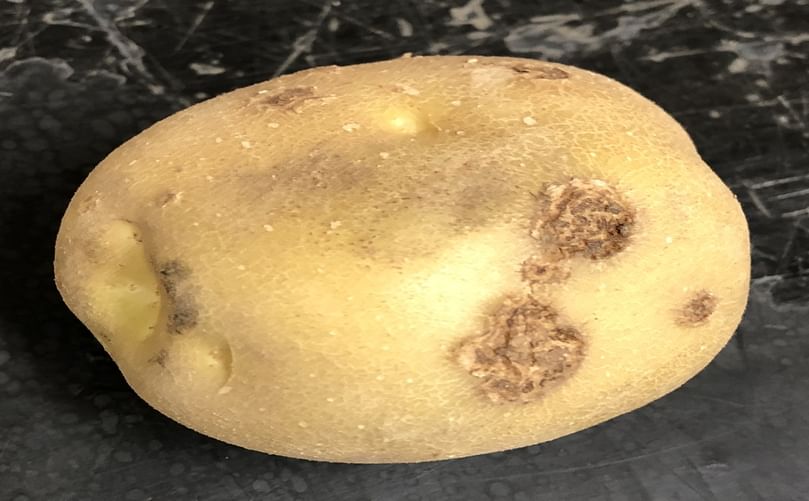
Potato tubers with common scab lesions, illustrating economic impact on marketability.
Biology, Life Cycle and Pathogenicity of Streptomyces scabies
Streptomyces scabies, the principal causal agent of common scab, is a Gram-positive, filamentous actinobacterium characterized by a complex life cycle encompassing vegetative growth, sporulation and toxin production. The cycle begins when spores in the soil germinate near developing potato tubers, typically during the tuber initiation stage (4–6 weeks after planting). The emerging hyphae penetrate lenticels or wounds on young tubers, establishing infection sites.
Once established, the hyphae produce thaxtomin A, a phytotoxin that inhibits cellulose synthesis in host tissues, leading to cell hypertrophy and the formation of characteristic scab lesions. Under dry, neutral to alkaline soil conditions (pH 6–8), the pathogen forms aerial mycelia that differentiate into chains of spores, enabling long-term survival and dispersal. These spores can persist in soil for 10–20 years, ensuring the pathogens longevity and re-emergence across growing seasons.
The pathogen is not seed transmitted but spreads through contaminated soil, irrigation water, dust, manure or agricultural machinery. Quorum sensing mechanisms regulate thaxtomin biosynthesis and other virulence-associated genes, coordinating pathogenic activity in response to population density. Recent studies indicate that *S. rhizophilus*, a related species identified in Asia, follows a similar life cycle but exhibits higher virulence and broader environmental adaptation.
The complete life cycle from spore germination to sporulation typically occurs over 2–4 weeks, influenced by soil temperature, moisture and microbiome composition. Acid-tolerant species such as *S. acidiscabies* can complete their cycle under lower pH conditions (4.0–5.2), extending the ecological range of common scab pathogens.
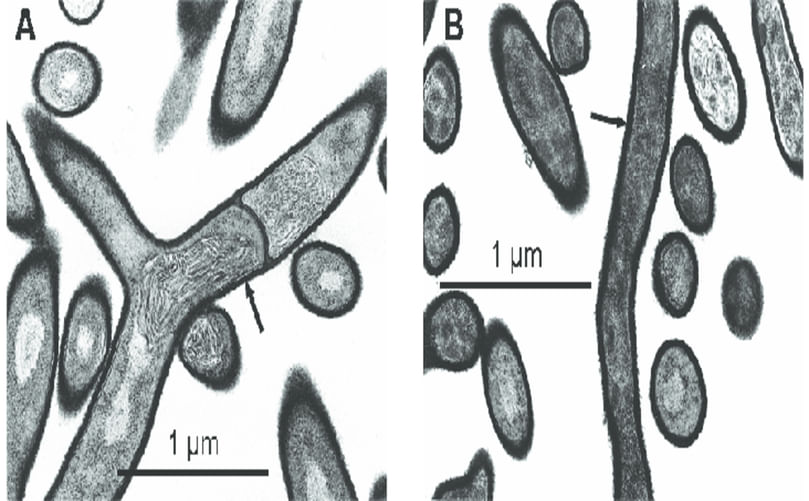
Microscopic image of *Streptomyces scabies* hyphae and spores.
Factors Influencing Disease Severity in Common Scab
Varietal Resistance: Although the mechanisms of resistance to common scab are not fully understood, potato varieties with varying levels of resistance have been identified through field screening programs. Using resistant varieties is an effective management strategy, although they are not immune; high inoculum levels and favorable environmental conditions can still lead to infection. Resistance to common scab generally correlates with resistance to acid scab. The variety 'Superior' is the standard for resistance in the Northeast, while other resistant varieties include Keuka Gold, Lehigh, Pike and Marcy. Moderately resistant varieties include Chieftain, Eva, Reba, Andover and Russet Burbank.
Soil Acidity: Soil pH significantly affects scab severity. Soils with pH 5.2 or lower markedly reduce disease, whereas small increases above 5.2 can rapidly increase losses. Maintaining soils near pH 5.0–5.2 is common practice for scab control. S. acidiscabies (“acid scab”) can infect low-pH soils but is less competitive with other soil microbes and can often be managed through seed treatments and crop rotation. However, acid soils can limit crop rotation options and reduce nutrient availability, as most plant nutrients are most available near pH 6.5. Maintaining pH near 5.0 may also reduce fertilizer efficiency and cause phytotoxicity of minor elements.
Soil Moisture: Soil moisture during tuberization greatly influences infection. Maintaining moisture levels above -0.4 bars (near field capacity) during 2–6 weeks post-tuber initiation inhibits S. scabies infection, as bacteria thriving in moist soils can outcompete the pathogen. Excessive irrigation, however, may be difficult in some soils and could promote other diseases.
Soil Type and Amendments: Light-textured soils and soils with high organic matter content favor scab infection. Streptomyces species, being decomposers are stimulated by organic matter. The application of manure can increase disease incidence. Coarse-textured soils, which dry quickly, are particularly prone to heavy scab infection, especially in gravelly or eroded field areas.
Crop Rotation: Crop rotation reduces inoculum levels in potato fields, though S. scabies can survive for many years due to saprophytic activity or infection of alternate hosts. Infection of seedlings and roots of crops such as beet, cabbage, carrot, radish, spinach, and turnips has been reported. Rotating with non-host crops like small grains, corn or alfalfa effectively reduces disease pressure. Red clover, however, can exacerbate scab problems and should be avoided in infested fields. S. acidiscabies has a host range similar to S. scabies but survives poorly in the presence of non-host crops.
Symptoms and Damage of Common Scab
Common scab symptoms on potato tubers range from superficial russeting tan, rough patches to raised corky lesions or deep pits measuring 1–10 mm in diameter. Lesions are brown to black, often circular or irregular, and can cover 5–80% of the tuber surface in severe infections. Lesion formation occurs during tuber expansion, typically 4–6 weeks post-planting, with pitted scab more prevalent under dry soil conditions and russet scab favored by cooler climates.
Although foliage remains largely symptomless, stems and stolons may occasionally show shallow lesions. The damage is primarily cosmetic, reducing peel efficiency by 5–10% and decreasing market value. Similar scab symptoms can occur on radish and carrot roots, while secondary infections are rare but may lead to rot if the tissue is wounded.
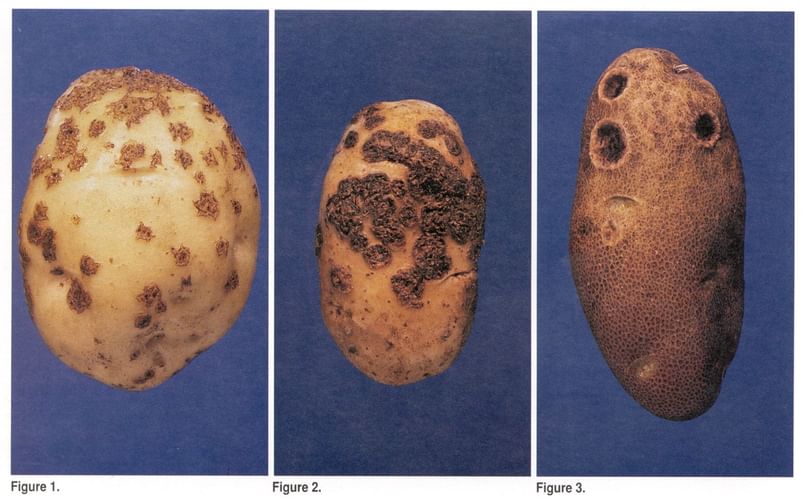
Symptom and Sign of Scab
Management Strategies for Common Scab
Integrated Pest Management (IPM) is the most effective approach for controlling common scab, combining cultural, chemical, biological and host resistance strategies. Key components include:
Soil pH Management: Acidifying soils to pH 5.0–5.2 using elemental sulfur reduces the incidence of scab, as Streptomyces species favor neutral to alkaline conditions. Maintaining slightly acidic soils during tuber development limits pathogen activity.
Irrigation Control: Adequate soil moisture during tuber initiation and expansion reduces lesion formation. High soil moisture at this stage can lower scab incidence by 30–50%, as overly dry soils favor sporulation and infection.
Biostimulants and Organic Amendments: Organic matter such as Ginkgo biloba litter and other plant-based amendments can suppress Streptomyces populations by 40–60% through enhancement of beneficial soil microbes and antagonistic activity.
Chemical Treatments: Sulfur amendments (1–2 t/ha) lower soil pH, reducing scab by 50–70% in neutral soils but are less effective in alkaline conditions. Copper and zinc sulfates reduce lesion severity by 20–40%, while fluazinam achieves 30–50% control but faces emerging resistance. Organic acids, such as lactic acid, provide 25–35% suppression in trials. Regulatory restrictions in regions such as the EU encourage the adoption of biocontrol alternatives.
Host Resistance: Cultivars with genetic resistance, such as ‘Russet Burbank,’ identified via QTL mapping, demonstrate 30–50% lower scab severity compared to susceptible varieties. Using resistant varieties in rotation with susceptible crops can reduce overall disease pressure.
Microbiome Manipulation: Enhancing beneficial soil microbes, such as specific Streptomyces antagonists or other bacteria, can suppress pathogenic populations. Practices like compost amendments, crop rotation with non-hosts and inoculation with beneficial strains have shown promise in reducing disease incidence.
Crop Rotation and Cultural Practices: Rotating with non-host crops, such as cereals and avoiding reuse of infested soil for seed tubers can prevent pathogen buildup. Mechanical disturbance of soil should be minimized to reduce spore dispersal.
By combining these strategies in an integrated approach, growers can significantly reduce common scab incidence, maintain tuber quality and improve marketability without relying solely on chemical treatments.
Prevention and Good Practices for Common Scab
Preventing common scab requires proactive, integrated strategies to minimize Streptomyces infection risks. Key practices include:
Certified Disease-Free Seed: Using certified seed tubers significantly reduces scab incidence (60–80%), as they are tested for Streptomyces, typically detecting <10³ CFU/g via qPCR. In regions like Africa, low adoption rates (10–20%) increase disease risk by 30–40%. Advanced biosensors targeting thaxtomin genes can improve seed screening accuracy by 20–30%, though high costs (USD 40–80 per sample) limit widespread use.
Soil pH and Moisture Management: Maintaining soil pH below 5.2 through sulfur amendments (1–2 t/ha) suppresses S. scabies activity by 50–70%. Adequate soil moisture (80–90% field capacity) during tuber initiation (2–4 weeks post-planting) reduces thaxtomin production by 30–50%. Soil solarization in warm climates, such as Australia, can decrease Streptomyces populations by 40–50%. Drip irrigation further enhances moisture management efficacy by 15–20% compared to sprinkler systems.
Crop Rotation and Green Manures: Rotating potatoes with non-host crops (e.g., wheat, maize) for 3–4 years reduces soil Streptomyces populations by 50–70%. Green manures such as mustard or rye release glucosinolates that suppress S. scabies by 20–40%. Cover crops like Brassica juncea have been shown to lower scab incidence by 25–35% in field trials. Rotation effectiveness may decline in alkaline soils, highlighting the need for integrated approaches.
Sanitation and Weed Control: Sanitizing machinery and equipment with quaternary ammonium compounds prevents the spread of Streptomyces via soil residues, reducing risk by 30–40%. Removing weed hosts, such as nightshade, reduces pathogen reservoirs by 15–25%. Avoiding the use of manure from animals fed infected tubers is critical, as spores can survive digestion. Integrated weed management strategies are essential to minimize the presence of alternative hosts.
Monitoring and Early Detection: Pre-planting soil testing using qPCR allows detection of Streptomyces at 10³ CFU/g, enabling informed decisions that can reduce scab incidence by 40–50%. Rapid biosensors targeting thaxtomin genes provide results within 6–8 hours, though adoption remains low (10–15%) due to cost and training requirements. Farmer training for visual lesion identification is critical, particularly in high-prevalence regions such as Pakistan. Emerging technologies, including drone-based soil mapping, offer enhanced large-scale monitoring capabilities.
Future Threats to Potato Production from Common Scab
The future of common scab is increasingly concerning due to climate change, pathogen evolution and global trade dynamics, posing significant risks to potato production worldwide. Key threats include:
Climate-Driven Disease Expansion: Rising temperatures and drier soils (<20% moisture) are expected to increase common scab incidence by 15–25% in temperate regions such as the U.S. and Europe. Acid-tolerant S. acidiscabies thrives in warmer soils (25–35°C), potentially increasing scab prevalence by 10–20% in acidic soil regions like the northeastern U.S. and Japan. High-altitude potato zones, including the Andes and Himalayas, face a 10–15% higher risk, potentially affecting 30–40% more acreage. Elevated CO₂ levels may enhance Streptomyces toxin production by 10–15%, worsening lesion severity.
Emerging Pathogen Strains: New Streptomyces variants, such as S. turgidiscabies in Scandinavia, exhibit higher virulence (5–10%) and produce 15–20% more thaxtomin A in trials. Genomic analyses reveal enhanced txtAB genes, leading to 10–15% greater tuber damage. Horizontal gene transfer with soil bacteria could generate hybrid strains, increasing infection risks by 10–20%. In Pakistan, S. scabies isolates with novel toxin profiles have emerged, complicating management strategies.
Global Trade and Pathogen Spread: Contaminated seed tubers and soil on equipment facilitate Streptomyces dispersal, with an estimated 20–30% of global seed lots carrying spores. Recent invasions, such as S. acidiscabies in Australia, underscore trade risks, with a 10–15% likelihood of new introductions in Europe and Oceania. Irrigation water and manure from infected fields amplify spread in Asia, increasing incidence by 15–25%. Inconsistent quarantine protocols in developing countries exacerbate pathogen movement.
Increasing Resistance to Controls: Resistance to sulfur and copper-based treatments is rising, with 15–20% of S. acidiscabies isolates in North America unaffected by standard doses. Biological controls such as Bacillus subtilis lose 20–30% efficacy in soils exceeding 30°C. Ginkgo biloba-based biostimulants remain effective (40–60% suppression) but are not scalable due to high costs (USD 50–80/ha). Climate-induced shifts in soil microbiomes may favor Streptomyces over beneficial microbes, reducing control efficacy by 10–15%.
Synergistic Effects with Other Stressors: Environmental stresses such as drought and nutrient deficiencies weaken tuber defenses, increasing scab severity by 15–25%. Co-infections with pathogens like Rhizoctonia solani or pests such as wireworms exacerbate lesions by 20–30% through wound entry points. Microbiome imbalances, for example reduced Pseudomonas populations, can further increase scab severity by 15–20%.
Socioeconomic Vulnerabilities: Smallholder farmers are particularly at risk, experiencing 25–40% higher scab losses due to limited access to resistant varieties, soil testing, and biostimulants. In Pakistan, only 10–15% of farmers use certified seed, and less than 20% adopt soil pH management due to high costs (USD 50–100/ha). Extension services reach only 15–20% of farmers in developing regions, restricting the adoption of advanced control strategies.
Management Challenges in Controlling Common Scab
Managing common scab in potato crops, caused by Streptomyces species (S. scabies, S. acidiscabies, S. turgidiscabies), is highly challenging due to the pathogens persistence in soil, environmental adaptability and limited control options. Key challenges include:
Soil Persistence and Detection Difficulties: Streptomyces species produce resilient spores that can survive in soil for 10–15 years, even in the absence of host crops, making eradication nearly impossible. Detection is challenging because populations as low as 10³ CFU/g soil can initiate infection, yet standard soil assays detect only 10–20% of latent populations. Advanced qPCR methods improve sensitivity to 90% but remain costly, limiting their adoption in developing regions where smallholders dominate potato production. Complex soil microbiomes, including competing Bacillus species, further mask pathogen detection, complicating pre-planting assessments.
Limited Chemical Control Options: No fully effective chemical treatments exist for common scab. Sulfur-based soil amendments reduce soil pH to suppress S. scabies, but efficacy declines in alkaline soils (pH 7–8), which are common in many potato growing regions. Copper and zinc sulfates reduce lesion severity by 20–40%, but overuse can harm soil microbial diversity. Fungicides such as fluazinam show moderate control (30–50%), but resistance is increasing, particularly in S. acidiscabies strains. Regulatory restrictions in regions like the EU further limit chemical use, increasing reliance on costly biostimulants.
Variable Efficacy of Cultural Practices: Soil acidification and irrigation during tuber initiation can reduce scab incidence by 30–50% but performance is inconsistent across soil types and climates. For example, sandy loam soils may retain sulfur poorly, requiring multiple applications at increased cost. Crop rotation with non-host crops such as wheat or maize reduces Streptomyces populations by 50–70%, but long rotations (3–4 years) are often impractical for smallholders due to limited land. Some green manure rotations (e.g., mustard) can suppress S. scabies by 20–40%, but adoption remains low due to cost and knowledge gaps.
Partial Resistance in Varieties: No potato cultivars are fully resistant to common scab. Varieties like Russet Burbank and Yukon Gold show modest reductions in lesion severity (20–30%). Breeding for resistance is slow; identified QTLs linked to tolerance require years for introgression into commercial varieties. Gene-editing approaches, such as CRISPR, can enhance tolerance by 15–20% in trials but regulatory hurdles and seed costs limit widespread adoption. Smallholders relying on susceptible local varieties experience higher losses.
Socioeconomic and Knowledge Barriers: Smallholder farmers often lack access to soil testing, resistant varieties and biostimulants, increasing disease incidence by 30–40%. The cost of pH adjustment is prohibitive for many and extension services frequently reach only a fraction of growers. Limited infrastructure for certified seed distribution exacerbates reliance on contaminated seed.
Climate Variability Impacting Control: Warmer, drier soils favor S. scabies and S. acidiscabies, expanding scab-prone areas. Erratic rainfall can disrupt irrigation timing, reducing the effectiveness of moisture based controls by 20–30%. Prolonged dry periods can increase thaxtomin production and high temperatures reduce the efficacy of biological controls such as Bacillus subtilis by 25–35%, complicating integrated disease management.
“The battle beneath the soil determines the value above it managing invisible foes like Streptomyces is key to healthy, marketable potatoes.”