CAPTION


CAPTION
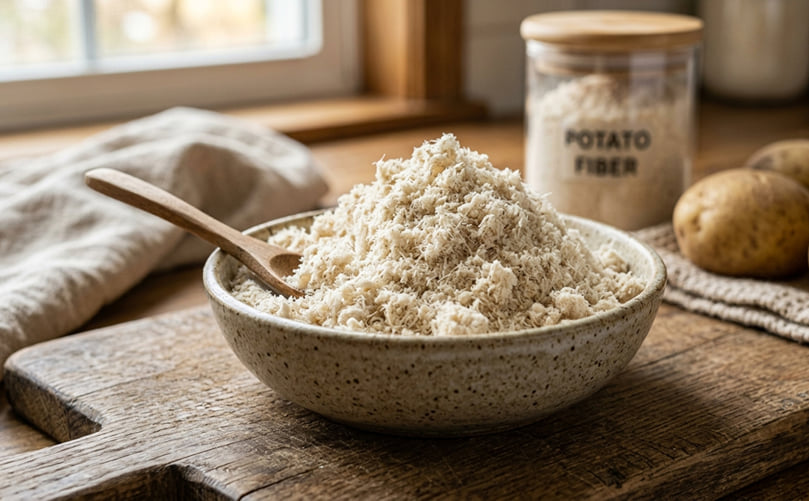
Potato fiber is a plant-based dietary fiber ingredient made mainly from the cell-wall material of potatoes. It contains non-digestible components such as cellulose, hemicellulose and pectin and is used in foods for fiber enrichment, water retention, texture and moisture management.
Potato fiber is mainly produced from the fiber-rich pulp left after starch and soluble components are separated from potatoes during starch processing. The pulp is washed, pressed, dried and milled to produce a fiber-rich powder.
Potato fiber is generally made by washing and rasping potatoes, separating starch and potato juice, recovering the remaining fiber-rich pulp, washing and pressing the pulp, and then drying and milling it into a powder. The exact process varies by manufacturer and grade.
Potato fiber provides both nutritional and functional benefits. It increases dietary fiber content and can bind water and oil, helping improve moisture retention, texture, structure and yield in formulated foods.
Potato fiber can contribute to dietary fiber intake and may support normal digestive function and satiety. However, evidence for specific health effects depends on the type and composition of the fiber and potato-fiber-specific human research remains limited.
Some potato-fiber components can be fermented by gut microorganisms, producing short-chain fatty acids. Research has also reported effects on gut bacteria and fermentation, but more human research is needed before making broad gut-health claims for all potato-fiber products,
Potato fiber has a high water-holding capacity, but the exact value depends on the fiber grade, particle size and testing method. Commercial and technical sources report values in the range of several times the fiber's own weight, with some applications using fibers with WHC above 8 g or mL per gram.
Potato fiber is used in bread, keto and low-carbohydrate baking, gluten-free products and other baked foods to absorb water, improve moisture retention and add dietary fiber. Because it absorbs substantial amounts of liquid, recipes often require adjustment of the water level.
Potato fiber is mainly composed of non-digestible cell-wall components such as cellulose and hemicellulose, whereas potato starch consists primarily of amylose and amylopectin. Fiber is mainly used for water binding, bulking, texture and fiber enrichment, while starch is mainly used for thickening, gelatinization and gelling.
No. Potato fiber and resistant starch are different materials. Potato fiber is mainly made from non-starch cell-wall polysaccharides, while resistant starch is starch that resists digestion in the small intestine. Potato-fiber products can contain some residual or resistant starch, but the two ingredients are not interchangeable.
Potato fiber itself is naturally gluten-free because it comes from potatoes. However, manufacturers should verify the specification and processing environment when making a gluten-free claim because regulatory requirements and contamination limits apply to the finished ingredient or food.
Potato fiber can contain both soluble and insoluble dietary fiber. Its insoluble fraction is largely associated with cellulose and other structural cell-wall components, while soluble functionality is mainly associated with pectic substances. The ratio varies between products and processing methods.
Potato fiber is used in bakery products, meat products, plant-based foods, snacks, cereals, pasta, sauces, fillings and other formulated foods. It is primarily added for dietary-fiber enrichment, water binding, moisture retention, texture and processing functionality.
Potato fiber and psyllium can both absorb water, but they do not behave identically. Psyllium generally produces stronger viscosity and gel formation, while potato fiber is commonly used for water binding, moisture retention, bulking and texture. A direct one-to-one substitution may therefore require reformulation. User discussions also specifically mention potato fiber as a gluten-free baking ingredient used as an alternative to psyllium in some applications.
There is no single standard dosage for potato fiber. The appropriate level depends on the product, fiber grade, particle size, water-holding capacity and desired texture. Formulators normally begin with a low inclusion level and adjust water, processing conditions and texture based on product trials and the supplier's specification. Studies in meat products, for example, have evaluated potato fiber at levels from about 0.5% to 1.5%.
This content was last updated on augustus 17, 2026
Have a helpful detail to contribute? Catch something that should be corrected?