

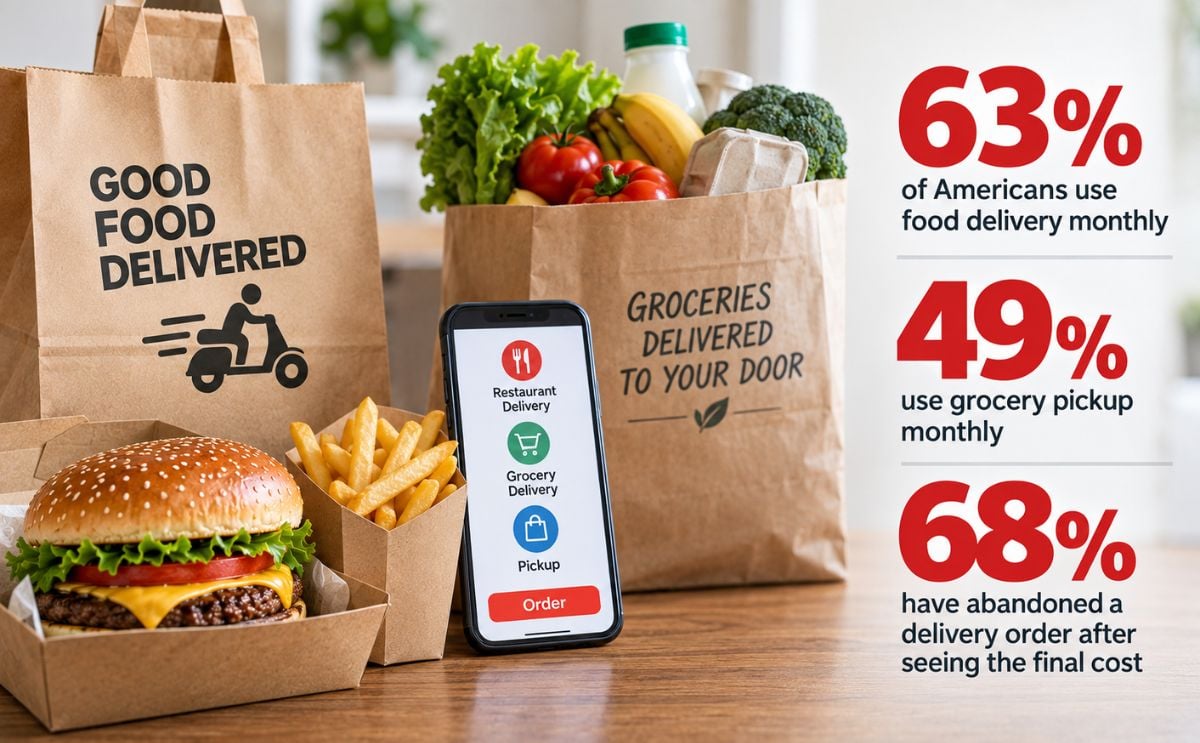
A survey of 2,000 United States adults conducted by FinanceBuzz in partnership with Bank of America found that convenience services have become a regular part of consumer spending, particularly across restaurant takeout, food delivery and grocery shopping.
Overall, 97 percent of respondents used at least one convenience service during the previous month, while 52 percent said their spending on convenience had increased compared with five years ago. The survey found that 85 percent purchased takeout meals, 63 percent used food delivery, 49 percent ordered groceries for pickup and 50 percent had groceries delivered during the month.
Takeout and Food Delivery Remain Widely Used
The survey found that 57 percent of Americans get takeout or delivery at least once a week. Takeout was used weekly by 49 percent of respondents, while 30 percent ordered food for delivery at least weekly. Usage was particularly high among Gen Z, with 72 percent ordering food for delivery monthly, compared with 47 percent of Baby Boomers.
Gen Z respondents reported an average of 5.1 takeout meals per month, more than double the 2.5 reported by Baby Boomers. The most common reason for ordering takeout or delivery was not wanting to cook, cited by 63 percent, followed by treating themselves or their family at 58 percent. Lack of time and not wanting to go out were each cited by 38 percent, while 35 percent said they lacked the energy to cook after work.
Grocery Pickup and Delivery Gain Ground
Convenience spending also extends to grocery shopping, with more than one in three Americans ordering groceries for pickup or delivery at least weekly. Among consumers using these services, home cooking remains significant, accounting for 68 percent of their meals.
Consumers were relatively evenly divided between using online grocery services for full grocery shops and smaller top-up orders. Cost perceptions were also mixed: 43 percent of grocery delivery and pickup users said the services cost them more overall, while 34 percent believed they saved money.
Avoiding the effort associated with visiting a supermarket was one of the main motivations. Some 56 percent said they used grocery pickup or delivery because they did not want to deal with crowds, queues or parking, while 55 percent cited lack of time. Another 31 percent said they lacked the energy to shop after work, and 24 percent said shopping digitally helped them avoid impulse purchases.
Despite the growth of these services, 77 percent of respondents said they still preferred doing their own grocery shopping, while 23 percent preferred having someone else shop for them.
Consumers Put a Price on Convenience
The survey also examined how consumers value the time saved through convenience services. After excluding outlier responses, Americans valued an hour of their free time at an average of USD 87, while the median response was USD 40.
When deciding between food delivery and collecting an order themselves, respondents were willing to pay an average of USD 9.49 in delivery fees before choosing pickup instead. The median threshold was USD 7, while USD 5 was the most common response.
For a typical USD 100 grocery basket, respondents said they would accept an average additional cost of 11.4 percent for someone else to shop for the order if they collected it themselves. That tolerance increased to 15.9 percent when the groceries were delivered.
High Fees Lead Consumers to Abandon Orders
Despite widespread use of convenience services, additional costs remain an important consideration. Some 68 percent of respondents said they had abandoned a delivery order after seeing the final price including fees. The figure increased to 78 percent among Gen Z and 73 percent among Millennials, compared with 41 percent of Baby Boomers.
Distance was not always a deterrent to ordering delivery. Some 57 percent of respondents said they had ordered food from a restaurant located within one mile of their home, rising to 62 percent among Gen Z.
Delivery Costs Also Influence Tipping
Americans reported tipping an average of USD 8.26 on food delivery orders and USD 11.17 on grocery deliveries. Most consumers adjusted their tips according to the size of the order, with 84 percent saying their tip changed either significantly or slightly between larger and smaller orders.
However, 22 percent said they had left no tip because the meal was already expensive or the associated fees were high. In contrast, 76 percent said they had tipped more when a delivery was more difficult for the driver, including during bad weather, over longer distances or when stairs were involved.
Convenience Memberships Become Part of Consumer Spending
Convenience subscriptions have also become widespread. The survey found that 85 percent of respondents paid for at least one convenience membership, spending an average of USD 22 per month, equivalent to USD 264 annually.
One in three respondents had a delivery-specific subscription such as DashPass, Uber One, Instacart+ or Grubhub+. Amazon Prime was the most widely held convenience membership at 74 percent, followed by Walmart+ at 31 percent and DoorDash DashPass at 21 percent.
The findings show that consumers increasingly use convenience services across restaurant meals and grocery shopping, while balancing the time saved against delivery fees, service charges and other additional costs.