
Introduction
Potato starch, extracted from the tubers of Solanum tuberosum is a renewable, biodegradable biopolymer prized for its versatility in food, pharmaceutical and industrial applications. Its unique physicochemical properties, driven by a high amylopectin content and large granule size, make it a preferred choice over cereal starches like corn or wheat.
With global production exceeding millions of tons annually, potato starch serves as a thickener, stabilizer, excipient and sustainable material. Modifications chemical, physical and enzymatic enhance its functionality, addressing limitations such as retrogradation and thermal sensitivity, thus expanding its applications from glossy food pastes to targeted drug delivery systems and eco friendly bioplastics.
Starch Composition
Potato starch is primarily composed of two polysaccharides: amylose (20-30%) and amylopectin (70-80%). Amylose, a linear polymer of glucose units linked by α-1,4 glycosidic bonds, contributes to gelation and film-forming properties. Amylopectin with its branched structure via α-1,6 linkages, enhances swelling and viscosity. The granules, ranging from 10-100 micrometers are oval to spherical with a B-type crystalline structure (20-40% crystallinity), among the largest of plant starches.
Naturally occurring phosphate monoester groups (59-90 mg/100g dry matter) bound to amylopectin distinguish potato starch, boosting hydration and paste clarity. Minor components include lipids (0.1-0.3%), proteins (0.06-0.1%) and ash (0.1-0.4%), varying by cultivar and environment. The amylose-to-amylopectin ratio influences digestibility, with higher amylose linked to slower digestion and increased resistant starch, ideal for low-glycemic-index products.
Production and Extraction
Process Overview
Potato starch extraction begins with harvesting mature tubers followed by washing to remove soil and debris. The tubers are peeled and rasped into a pulp, creating a starch rich slurry. Mechanical separation via screening, centrifugation or hydrocyclones isolates starch granules from fibers, proteins and soluble impurities.
Wet milling, the dominant industrial method, yields high purity starch (up to 99%) through multiple washing and dewatering stages, followed by low-temperature drying (40-50°C) to preserve granule integrity. The process consumes significant water (10-15 m³/ton of starch), prompting research into water-efficient methods.
Advanced Extraction Techniques
Enzymatic Extraction: Cellulases and pectinases break down cell walls, increasing starch yield by 10-12% while reducing impurities (e.g., ash content to <0.1%). This method enhances whiteness and purity for food-grade applications.
Ultrasound-Assisted Extraction: High-frequency ultrasound (20-40 kHz) disrupts potato cell matrices, recovering starch from peel waste with yields up to 45%. This supports circular bio economies by valorizing byproducts.
Alkali-Assisted Methods: Sodium hydroxide treatments (0.1-0.5%) combined with ultrasonication improve starch nanoparticle recovery from peels, achieving 50% yield with enhanced dispersibility for pharmaceutical uses.
Supercritical CO₂ Extraction: An emerging green technology, it minimizes water use and chemical residues, though scalability remains a challenge.
Sustainability Considerations
Modern extraction focuses on reducing environmental impact. Recycling process water and using peel derived starch for bioplastics or nanoparticles lowers waste. Enzymatic methods reduce energy consumption by 15-20% compared to traditional wet milling, aligning with sustainable production goals.
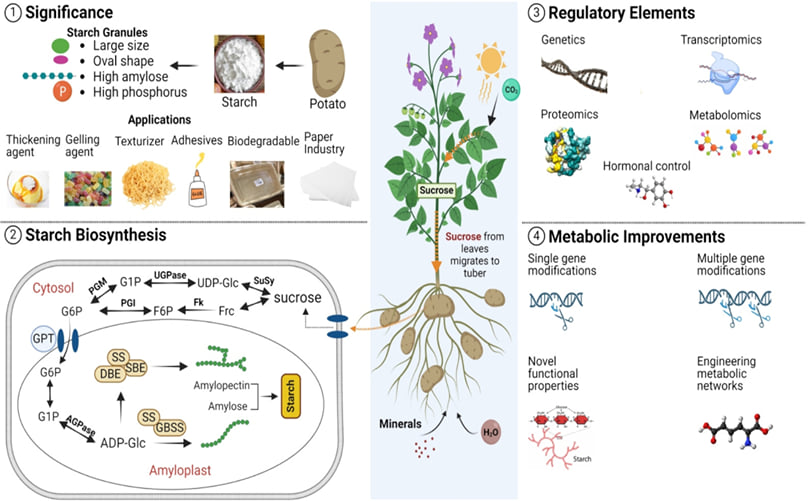
Understanding Potato Starch Pathways and Industrial Significance( Source: Science Direct)
Physicochemical Properties
Potato starch granules exhibit a B-type crystalline structure with 20-40% crystallinity, contributing to high swelling capacity (30-40 g/g at 75°C) and paste clarity. Gelatinization occurs over a narrow temperature range (onset 58-65°C, peak 62-70°C, conclusion 73-80°C) with an enthalpy of 10-15 J/g, reflecting energy needed to disrupt crystalline regions.
The high phosphorus content (59-90 mg/100g) enhances viscosity and stability, distinguishing it from cereal starches. Granule size (10-100 µm) and amylose content (2-30% by cultivar) influence digestibility and gel strength. Acid hydrolysis or prolonged heating can reduce crystallinity, creating fissures and amorphous regions, altering functionality for specific applications.
Functional Properties
Potato starch’s functional properties stem from its hydration, rheological and thermal behaviors:
Swelling Power and Solubility: Absorbs 30-40 g/g water at 75°C, with solubility increasing from 1-5% at 25°C to 15-20% at 75°C, driven by phosphate groups repelling water molecules. This makes it an excellent thickener for soups and sauces.
Pasting and Viscosity: Rapid Visco Analyzer profiles show peak viscosities of 2000-4500 mPas, with shear-thinning behavior forming smooth, glossy pastes. Weak, thixotropic gels form upon cooling, ideal for custards and puddings.
Retrogradation: Slow recrystallization (amylose and amylopectin realignment) occurs during storage but cooling cycles (e.g., 4°C for 24 hours) increase resistant starch (20-30%), enhancing prebiotic properties.
Water-Binding Capacity: Up to 150-200%, supporting moisture retention in baked goods and frozen products. Native starch has moderate freeze-thaw stability (2-3 cycles before syneresis), improved by modification.
Oil Absorption: Moderate at 0.5-0.7 g/g, suitable for fat replacement in low-calorie foods.
Thermal Stability: Native starch degrades above 250°C, but modifications like cross-linking extend stability to 280-300°C for industrial uses.
Film-Forming Ability: Amylose rich starch forms flexible, transparent films for edible coatings, extending shelf life in fruits by 10-15 days.
These properties make potato starch a natural choice for applications requiring smooth textures, high clarity and stability under varying conditions.
Derivatives and Modifications
Modifications tailor potato starch for specific applications by altering its molecular structure. They are grouped into chemical, physical and enzymatic categories, often combined for synergistic effects.
Chemical Modifications
Acetylation: Adds acetyl groups (0.5-2.5% substitution) using acetic anhydride, increasing hydrophobicity and fat absorption (up to 2.6 g/g). Acetylated starch forms clear, stable pastes for glossy food coatings and cosmetic creams.
Oxidation: Sodium hypochlorite introduces carboxyl groups (0.2-2.5%), reducing viscosity for pumpable fluids in paper coatings. Oxidized starch exhibits shear thickening flow, ideal for industrial adhesives.
Cross-linking: Sodium trimeta-phosphate creates covalent bonds, yielding resistant starch (36-66% indigestible) for low-calorie foods and prebiotics. Cross linked starch resists high shear and temperatures (up to 120°C).
Hydroxypropylation: Adds hydroxypropyl groups, reducing retrogradation and improving freeze-thaw stability (5-7 cycles without syneresis) for frozen desserts and sauces.
Cationization: Quaternary ammonium groups enhance emulsification and adhesion, used in textiles and paper sizing, with 10-15% improved ink retention.
Phosphorylation: Increases phosphate content, boosting viscosity (up to 5000 mPa·s) and water-binding (206%) for thickened food systems.
Physical Modifications
Heat-Moisture Treatment (HMT): At 100-120°C and 20-30% moisture, HMT shifts crystallinity to C-type, increasing peak viscosity (2000 cP) and reducing retrogradation for stable gels in canned foods.
Microwave Irradiation: Short bursts (3-5 minutes at 800 W) create indented granules, enhancing water absorption (1.2 g/g) and lowering pasting temperatures (by 5-10°C) for faster hydration.
Ultrasonication: High-frequency waves (20-40 kHz) disrupt granule surfaces, increasing amylose leaching and solubility (20-25%) for smoother textures in sauces and gravies.
Annealing: Soaking at 40-50°C enhances crystalline perfection, improving thermal stability (up to 90°C) for high temperature processing in extruded snacks.
High-Pressure Processing: Pressures of 400-600 MPa reduce swelling and increase gel firmness, suitable for firm jellies.
Enzymatic Modifications
Debranching: Pullulanase or isoamylase cleaves α-1,6 bonds, producing linear chains for firm gels (stable in inversion tests) used in confectionery and jellies.
Cyclodextrin Production: Cyclodextrin glycosyltransferase forms cyclic oligosaccharides, used as encapsulants for drug and flavor delivery, with 80-90% encapsulation efficiency.
Transglycosylation: 4-alpha-glucanotransferases reduce amylose content, creating softer, elastic gels for gummy candies.
Amylomaltase: Restructures amylopectin to increase resistant starch (up to 40%), supporting gut health and low-GI foods.
α-Amylase Treatment: Partially hydrolyzes starch to lower viscosity (500-1000 mPa·s), ideal for liquid nutritional supplements.
Dual Modifications
Combining methods, such as acetylation with HMT or ultrasonication with cross linking, enhances properties like water-binding (up to 206%), thermal stability (degradation onset at 280-300°C) and resistant starch content (50-60%). These are tailored for advanced applications like 3D food printing and controlled-release pharmaceuticals.
Pharmaceutical Applications
Potato starch and its derivatives are critical in pharmaceuticals due to their biocompatibility and tunable properties:
Excipients and Binders: Native starch acts as a filler and binder in tablets, promoting rapid disintegration (5-10 minutes) due to high swelling capacity. Cross linked derivatives control drug release in sustained-release tablets, extending release up to 12 hours.
Encapsulation: Cyclodextrins encapsulate hydrophobic drugs (e.g., ibuprofen), improving solubility (10-20% increase) and protecting actives from degradation (90% stability after 6 months).
Disintegrants: Carboxymethyl starch, a super-disintegrant, ensures tablet breakdown in 2-5 minutes, ideal for fast-acting medications like analgesics.
Drug Delivery Systems: Starch nanoparticles (50-200 nm) target drugs to specific sites, such as colon specific delivery for inflammatory bowel disease, leveraging resistant starch’s fermentation by gut microbiota (90% drug release in colon).
Mucoadhesive Formulations: Cationic starches adhere to mucosal surfaces, prolonging drug residence (2-4 hours) in nasal or oral applications, enhancing bioavailability.
Topical Gels and Creams: Acetylated starch forms smooth, non-greasy gels with high water retention (80-90%), used in wound healing creams and cosmetic lotions.
Wound Dressings: Cross linked starch hydrogels, often loaded with silver nanoparticles, provide moisture and antimicrobial properties (90% bacterial reduction), accelerating chronic wound healing.
Vaccine Stabilization: Starch based matrices stabilize vaccines at ambient temperatures, maintaining 85-90% potency after 3 months, critical for distribution in resource-limited settings.
Additional Applications
Food Industry: Native starch thickens gravies and soups with clear, glossy pastes, while hydroxypropylated derivatives stabilize yogurts (0.75-1% addition) against syneresis. Resistant starch (3-5 g/day) acts as a prebiotic, increasing Bifidobacterium and short chain fatty acid production for gut health.
Industrial Uses: Acetylated starches enhance adhesion in paper coatings (15% improved strength) and textiles, while oxidized derivatives improve ink retention (10-15%). Starch nanoparticles from peels create eco-friendly composites for furniture and automotive parts (tensile strength 15-20 MPa).
Sustainable Packaging: Cross-linked starch bioplastics offer tensile strength (10-20 MPa) and full biodegradability within 90 days, reducing plastic pollution in food packaging.
Cosmetics: Derivatives provide oil absorption in powders (1-1.5 g/g) and stabilize emulsions in lotions, aligning with clean label trends.
Challenges and Future Directions
Challenges include high production costs (water and energy-intensive processes) and competition from cheaper cereal starches. Native starch’s sensitivity to heat and shear limits some applications, necessitating costly modifications. Future directions include
- Optimizing enzymatic extraction for 95% efficiency and reduced water use.
- Developing natural cross-linkers (e.g., citric acid) for eco-friendly modifications.
- Scaling up starch nanoparticles for clinical drug delivery, improving stability under physiological conditions.
- Integrating peel-derived starch into circular bioeconomies to lower costs and waste.
"From humble tubers to high-tech solutions, potato starch transforms industries with its versatility and sustainability."