

Introduction
Potato protein, derived from the humble potato (Solanum tuberosum L.), is emerging as a high quality, plant based protein source with significant potential in food, pharmaceutical and technical applications. While potatoes are primarily known for their starch content, they contain a small but valuable protein fraction, typically 1-2% of their fresh weight, with potato fruit juice (PFJ) a byproduct of starch production containing about 1.5% protein.
Advances in extraction techniques and growing interest in sustainable, allergen free protein sources have positioned potato protein as a promising alternative to animal based and other plant based proteins. The global market for potato protein was valued at around USD 208.85 million in 2024 and is projected to reach approximately USD 350.71 million by 2034, growing at a CAGR of 5.32%, driven by the rising vegan population, awareness of plant-based diets and biotechnological innovations in extraction.
This growth is further fueled by the organic segment, growing at a 10.37% CAGR due to clean label demand, with isolates (≥90% protein) leading at an 8.71% CAGR. This overview explores its nutritional profile, functional properties, extraction methods, applications, market trends and challenges, providing a detailed look at its role in modern food systems.
Nutritional Value
Potato protein is recognized for its high nutritional quality, comparable to animal proteins like egg or milk. It contains a well-balanced amino acid profile, rich in essential amino acids such as lysine, threonine and leucine including high levels of branched chain amino acids. Lysine, in particular is present in higher concentrations than in many other plant based proteins, such as cereals, with content ranging from 2.99 to 7.77 mg/g across accessions, while aspartic acid and glutamic acid average 19-26 mg/g.
Cysteine and methionine are the least abundant (around 0.7 mg/g) and total non-essential amino acids often exceed essential ones, with environmental factors accounting for over 40% of variance. This low protein content, however, contrasts with legumes (over 20%), posing scalability challenges.
The biological value is high, with an amino acid score (AAS) of approximately 65% and a Protein Digestibility Corrected Amino Acid Score (PDCAAS) of 0.93, indicating effective human nutrition, though it lags behind whey or soy in some essential amino acids. Protein quality is influenced by nitrogen fertilizer use higher applications increase overall nitrogen but lower essential amino acid concentrations, reducing quality.
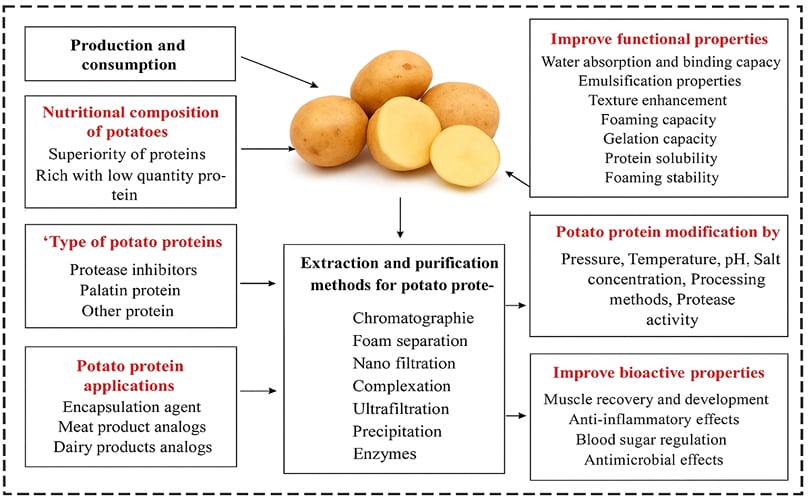
Potato Protein: Composition, Extraction and Functional Properties
Minnesota’s 2016 potato yield of 400 cwt/acre and USD 152 million in sales at USD 9.05/cwt (above the national USD 8.90/cwt) suggest regional potential, with variety as the main determinant, showing content from 5.5% to 17.8% across accessions. Genome-wide studies have identified 78 loci on chromosomes 5, 6, 9 and 11 linked to protein and amino acid content, aiding molecular breeding, with trials showing up to 60% protein increases in transgenic varieties.
Its low allergenicity suits allergen-free products like infant formulas, and concentrates exhibit antioxidant and cytotoxic properties against cancer cells, supporting benefits like improved digestive health and regulated blood sugar levels.
Functional Properties
Potato protein exhibits excellent functional properties, including emulsibility, foamability and gelation, stemming from fractions like patatin (30-40%), protease inhibitors (40-50%) and other proteins (10-15%). Patatin, soluble at pH 4.8–5.2, supports emulsifying and foaming in beverages, dairy alternatives and gluten free baked goods, with solubility enhancing use in acidic environments like fruit juices.
Proper fractionation yields high solubility, good foam overrun and firmness equal to or better than egg albumin, though its globular structure limits functionality compared to animal proteins. Enzymatic hydrolysis with papain or bromelain improves solubility and emulsibility by unfolding the protein structure.
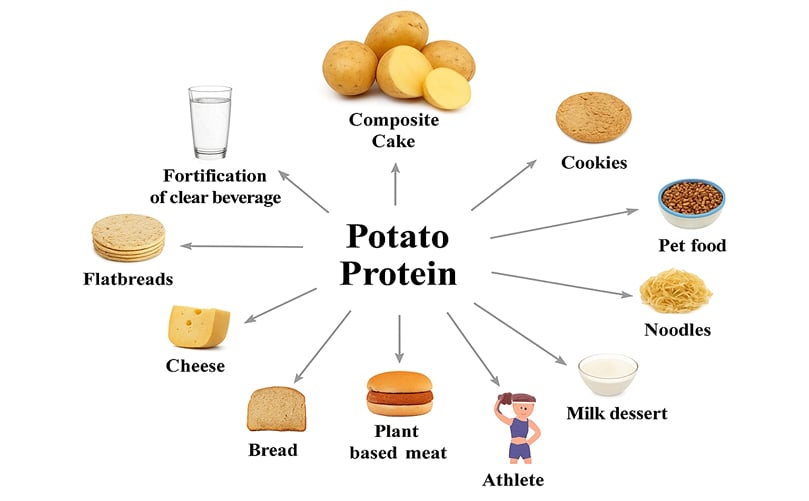
Applications of Potato Protein in Food and Industry
Recent studies explore combining it with cellulose microfibrils for double network gels, where thermal denaturation boosts storage modulus, reducing the protein needed for gelation benefiting plant based yogurts and meat analogs. Extrusion technology and moisture optimization are being researched to enhance physicochemical properties, though pH changes can impair functionality.
Extraction and Processing
Extracting potato protein is challenging due to its low 1.5% concentration in potato fruit juice (PFJ), a dilute byproduct of starch production and its susceptibility to denaturation during processing, which can impair functionality and solubility. The voluminous nature of PFJ, with high organic matter and complex composition including phenolics and total glycoalkaloids (TGA), poses additional demands on effluent treatment and requires efficient methods to avoid economic and environmental issues. Common extraction methods include:
Thermal/Acidic Precipitation: The current industrial standard, often combined with heat coagulation, achieves high recoveries but denatures proteins, reducing solubility and limiting food grade applications, while also potentially destroying protein structure and wasting energy.
Membrane Separation: Techniques like ultrafiltration and reverse osmosis allow for the recovery of native proteins with better functional properties, though challenges like membrane fouling by pectin fibers require preprocessing steps, such as flocculation with calcium ions reverse osmosis is more effective for concentration but ultrafiltration struggles with fouling, making it less economical.
Ion Exchange (IEX) and Expanded Bed Adsorption (EBA): These chromatographic methods concentrate proteins effectively while preserving functionality for food-grade uses, with EBA providing gentle separation of major protein groups like patatin (40-42 kDa) and protease inhibitors (7-21 kDa) from phenolics and TGA, resulting in highly functional preparations.
Enzymatic Hydrolysis: Used to modify protein structure, enhancing solubility, bioactivity and functional properties like emulsifying and foaming by breaking down the highly folded structure targeted hydrolysis can produce hydrolysates with improved properties for specific applications.
Alternative Precipitation: Methods using ammonium sulfate, ferric chloride or ethanol yield higher purity and reduce sensitivity to pH and temperature changes compared to acid and thermal treatments, leveraging regional potentials like Minnesota’s 400 cwt/acre yield as noted by AURI.
Isoelectric Precipitation: Adjusts pH to the protein's isoelectric point for separation, influenced by factors like pH, protein-to-polymer ratio, solvent, enzymes and concentration, affecting yield and purity.
Novel Techniques: For solid by-products like peels, enzyme-assisted, ultrasound-assisted and pulsed electric field extractions improve yield, sustainability and reduce waste by combining with biomass extraction these methods offer advantages over conventional acid-base extraction with heat, which involves solvent use and energy waste.
Innovations like high-pressure homogenization and anion exchange resins (removing 72% phenolics) enhance efficiency and sensory quality, with reusable resins supporting sustainability. Potato peels offer additional protein and new UK facilities began production in 2024. The low content necessitates large juice volumes, but AURI notes only a Dutch company (e.g., Solanic products) currently scales this commercially
Applications
Potato protein’s versatility spans: Food Industry: Ideal for dairy alternatives, meat analogs, beverages, and allergen-free products like infant formulas and pasta, with blending improving nutritional value in burgers. It supports functional foods, sports nutrition, and dietary supplements, leveraging its high digestibility and complete amino acid profile, with demand growing in Asia Pacific due to raw material abundance.
Pharmaceuticals: Hydrolysates show antioxidant and cytotoxic potential for nutraceuticals, targeting oxidative stress and cancer cells.
Technical Applications: Used in bioplastics and adhesives due to gelation properties.
Animal Feed: Thermally coagulated protein serves pigs and calves cost-effectively.
Genetic modifications, like amaranth gene insertion, boost protein content by 60%, supporting confectionery and personal care innovations. Its non-allergenic nature makes it suitable for replacing soy or whey, with Europe holding a 45% market share.
Market Trends
The market segments by type (isolates dominate with ≥90% protein, growing at 8.71% CAGR; concentrates grow steadily) and application (food & beverages at 54%, feed expanding). Asia Pacific leads with raw material abundance and vegan trends, while Europe grows with major producers. Growth at 5-7% CAGR is projected, reaching USD 350-510 million by 2030-2034, fueled by sustainability and health awareness, with the organic segment at 10.37% CAGR
Did You Know?
- The 1.5% protein content in potato fruit juice is much lower than legumes (over 20%), requiring large volumes for commercial use, as noted by AURI.
- High nitrogen fertilizer boosts protein quantity but reduces essential amino acid quality, impacting nutritional value.
Challenges and Future Directions
The low 1.5% protein concentration in PFJ requires vast potato volumes and denaturation from thermal/acidic methods limits high value uses. Glycoalkaloids and phenolics affect taste, needing resin processing, which trades off yield. Scalability lags with commercial production mostly in Europe and genetic modification faces regulatory hurdles.
Despite advances, the low content prohibits popularity compared to legumes (over 20%). Future research targets extraction efficiency, novel applications like metal chelating hydrolysates and genetic breeding to enhance profiles, with sweet potato variants emerging for added vitamins
"Potato protein is an added value ingredient produced from a byproduct of starch production. It has superior nutritional quality and functionality compared to other plant protein sources."