

Verkennen Industriële lijn voor de productie van popcorn Producten
Frequently Asked Questions
The cost of a popcorn production line depends on production capacity, automation level, popping technology, seasoning or coating equipment, packaging configuration and factory requirements. Small commercial systems may cost tens of thousands of US dollars, while fully automated industrial lines can reach several hundred thousand dollars. Installation, utilities, shipping, commissioning and factory preparation may be additional costs.
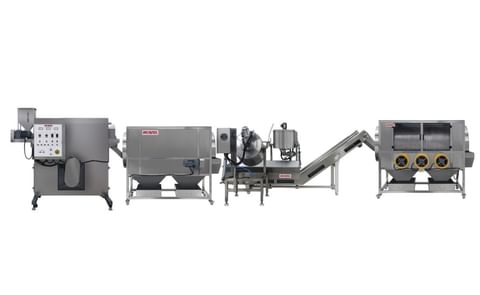
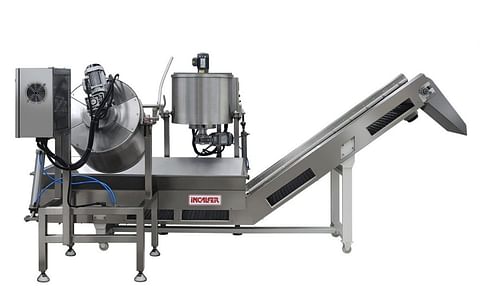
A commercial popcorn manufacturing line generally includes a popcorn popping system, product conveying equipment, cooling system, sifter or screening system, seasoning or coating equipment, storage or buffer hoppers, weighing equipment and packaging machinery. Caramel or other coated popcorn may require additional melting, dosing and coating systems. The equipment configuration depends on the product range and required production capacity.
A commercial popcorn production line normally starts with feeding and preparing popcorn kernels, followed by popping, conveying, cooling, screening and seasoning or coating. The finished popcorn is then weighed, packaged and prepared for storage or distribution. In an automated line, these stages are connected through conveyors, hoppers and centralized controls to maintain continuous product flow.
Popcorn production lines are available in different capacities, from small commercial systems to industrial continuous lines producing hundreds of kilograms per hour. Current equipment configurations commonly range from around 100 kg/h to 300 kg/h or more, with customized systems available for higher requirements. The appropriate capacity depends on expected sales volume, operating hours, product mix and future expansion plans.
Starting a popcorn manufacturing business involves defining the target market and product range, estimating production demand, selecting the appropriate processing and packaging equipment, preparing the factory, arranging utilities, meeting food safety requirements and establishing distribution and sales channels. For larger operations, a turnkey supplier can assist with plant design, equipment selection, installation, commissioning and operator training.
Yes. Depending on its configuration, a popcorn production line can produce multiple flavours such as salted, butter, cheese, caramel, chocolate, spicy and other sweet or savoury varieties. Dry seasoning systems can apply powdered ingredients, while liquid dosing and coating systems can be used for products such as caramel and chocolate popcorn. Recipe controls and suitable cleaning procedures can also support product changeovers.
A commercial popcorn machine is generally designed for smaller-scale production, food-service operations or retail applications, while an industrial popcorn production line is designed for continuous, higher-volume manufacturing. Industrial systems can integrate popping, conveying, cooling, screening, seasoning and packaging, allowing manufacturers to produce packaged popcorn at substantially higher volumes.
The required factory space depends on production capacity, equipment configuration, packaging format and the level of automation. The facility must accommodate the production line as well as raw material storage, packaging materials, finished products, operator movement, cleaning areas and maintenance access. A turnkey supplier can develop the equipment layout according to the available floor space and planned production capacity.
A popcorn production line may require electricity, a heating source such as gas or electric heating, compressed air, ventilation and, depending on the facility, water and drainage for cleaning. Utility requirements vary according to production capacity, popping technology and automation level. These requirements should be established during the engineering and plant-design stage to ensure the factory is ready before installation.
Popcorn manufacturing can be profitable when production capacity, product pricing, raw material costs, packaging, labour, energy, distribution and equipment utilization are properly managed. Profitability varies considerably by market and product type, so manufacturers should calculate expected production volume, selling price and total operating costs before investing in equipment. A higher-capacity automated line does not automatically mean higher profitability if the available market cannot support the output.
Make This Page Even Better!
This content was last updated on mei 27, 2026
Have a helpful detail to contribute? Catch something that should be corrected?