

Explore 薯片连续生产线 产品

Browse Companies Offering 薯片连续生产线

Foodera Technologies



Frequently Asked Questions
The main difference is how the product moves through the production system. In continuous processing, potatoes and potato slices move continuously through interconnected equipment, allowing high production rates and automated process control. In batch processing, a defined quantity of product is processed at a time. Continuous systems are generally better suited to high-volume manufacturing, while batch systems can be more suitable for smaller-scale production and specialty products requiring greater flexibility.
The right potato chips production line should be selected based on finished-product capacity, raw potato availability, potato variety, product specifications, factory space, automation requirements, packaging format and available utilities. Buyers should also evaluate fryer capacity, oil filtration, energy consumption, water requirements, sanitation, maintenance support and future expansion possibilities. Before purchasing equipment, it is important to define whether the required capacity refers to raw potato input or finished chip output and to obtain a complete equipment and utility specification from the supplier.
Potato slices are washed before frying mainly to remove excess surface starch released during slicing. Removing this starch helps reduce slices sticking together, improves frying uniformity and can reduce the amount of starch and fines entering the frying oil. The washing conditions depend on the potato variety, slice thickness and desired product characteristics. Some industrial plants also recover and filter process water to reduce freshwater consumption.
Potatoes used for industrial chip production generally require high dry matter, low reducing sugar content, suitable specific gravity, good frying colour and good processing quality. Chipping cultivars such as Atlantic, Lady Rosetta, Snowden and other locally adapted processing varieties are used in different regions. However, variety alone does not determine suitability; storage temperature, physiological age, dry matter and reducing sugar levels can significantly affect final chip quality.
Potato chips are commonly fried at approximately 155–185 °C, although the optimum temperature depends on slice thickness, potato variety, fryer design, residence time and desired final moisture and colour. Continuous fryers may use different temperature zones to control moisture removal and colour development. Frying conditions must be carefully controlled because excessive temperature can cause excessive browning, while insufficient frying can leave high moisture and reduce crispness.
Potato chips are commonly fried at approximately 155–185 °C, although the optimum temperature depends on slice thickness, potato variety, fryer design, residence time and desired final moisture and colour. Continuous fryers may use different temperature zones to control moisture removal and colour development. Frying conditions must be carefully controlled because excessive temperature can cause excessive browning, while insufficient frying can leave high moisture and reduce crispness.
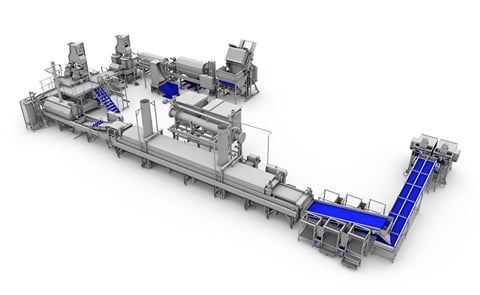
A commercial potato chips production line typically requires potato receiving and feeding equipment, washers, peelers, inspection or sorting equipment, potato slicers, slice washers, dewatering equipment, a continuous fryer, oil filtration and de-oiling systems, seasoning equipment, cooling conveyors and packaging machines. Industrial plants may also include metal detectors, check weighers, nitrogen flushing systems and PLC or SCADA automation.
Potato chips production lines are available in different capacities, from small commercial systems to large industrial plants producing hundreds or thousands of kilograms of finished chips per hour. Capacity should always be specified clearly because manufacturers may quote raw potato input capacity or finished chip output. The actual output depends on potato dry matter, peeling and trimming losses, slice thickness, frying conditions, product specifications and overall process yield.
The amount of raw potato required to produce 1 kg of finished chips depends on potato dry matter, peeling losses, processing losses and final chip moisture and oil content. As a general industrial planning estimate, approximately 3.5–4 kg of raw potatoes may be required to produce 1 kg of finished potato chips, although actual yield can vary. Higher-dry-matter potatoes generally provide better processing yield than potatoes with high moisture content.
A potato chips production line is a series of interconnected machines that converts fresh potatoes into finished potato chips through a continuous manufacturing process. The potatoes are typically washed, peeled, inspected, sliced, rinsed, optionally blanched, dewatered, fried, de-oiled, seasoned, cooled and packaged. In a continuous line, these operations are synchronized so that potatoes and potato slices move continuously from one stage to the next. The exact configuration depends on production capacity, chip specification and the required level of automation.
The cost of a potato chips production line depends on its production capacity, automation level, equipment configuration, fryer design, heating system, packaging equipment and installation requirements. Small and semi-automatic systems generally cost much less than fully automatic industrial lines. A complete project may also require factory construction, utilities, water treatment, wastewater treatment, installation, commissioning and spare parts, so the machinery price alone does not represent the total investment.
The price depends on how much can be made, how automated it is, the type of machines used and how big the whole project is. Currently, industry pages focus on the price of potato chip production lines as a key concern for buyers. However, a proper quotation depends on the required production capacity and product specifications, not just a single general price.
Both lines use some of the same equipment, like washing, peeling and packaging, but the way they process the items is different. French fries are made by first cutting potatoes into strips, then blanching them, partially frying them and finally freezing them in individual portions.Chips, on the other hand, are made by slicing potatoes very thinly, frying them, removing excess oil and then adding seasoning.
Make This Page Even Better!
This content was last updated on 五月 27, 2026
Have a helpful detail to contribute? Catch something that should be corrected?