The modified starch market is expanding as manufacturers focus on clean-label ingredients that enhance stability, texture and processing performance.
Global modified starch market forecast to reach USD 17.30 billion by 2030
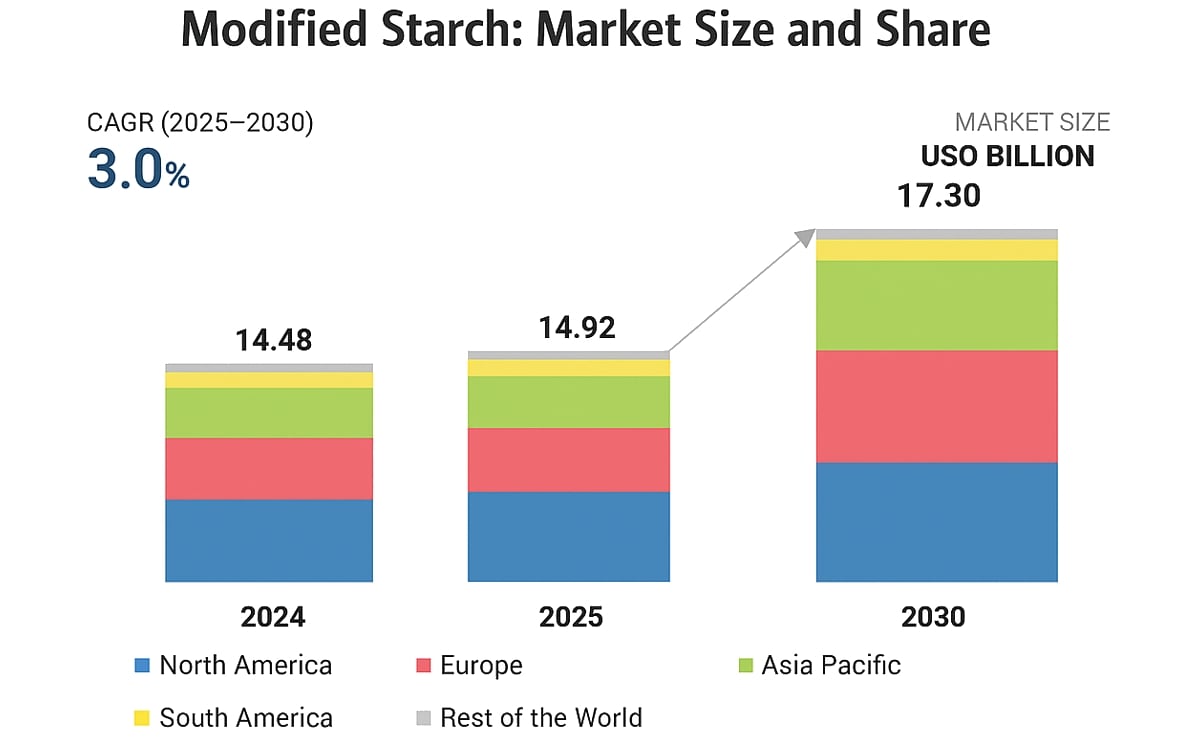
According to MarketsandMarkets™, the modified starch market is estimated at USD 14.92 billion in 2025 and is projected to reach USD 17.30 billion by 2030, at a CAGR of 3.0 percent. Browse 250 market data Tables and 55 Figures spread through 280 Pages and in-depth TOC on "Modified Starch Market - Global Forecast to 2030".
Modified Starch Market Size & Forecast
- Market Size Available for Years: 2020–2030
- 2025 Market Size: USD 14.92 billion
- 2030 Projected Market Size: USD 17.30 billion
- CAGR (2025–2030): 3.0 percent
Modified Starch Market Trends & Insights
- Growth due to the increasing awareness about the natural ingredients and cost-effectiveness offered by them, along with the enhanced functionalities they provide in comparison to native starch.
- The physically modified starch type segment is estimated to account for the highest market share during the forecast period.
- The dry form segment is estimated to represent a significant market share in the modified starch market during the forecast period.
- The enzymatically modified starch segment is set to register a higher CAGR of 6.8 percent.
- The Asia Pacific region is estimated to be the fastest-growing region in the modified starch market.
The global modified starch market is expanding rapidly as food manufacturers increasingly prioritize product stability, texture enhancement, and clean-label functionality across processed and convenience foods. Growing consumer demand for healthier, high-quality, and easy-to-use food products, as well as rising awareness of ingredient transparency, is driving strong adoption of modified starches in a wide range of applications. The shift toward functional, science-backed ingredients that improve viscosity, binding, freeze–thaw stability, and overall product performance is a significant factor accelerating market growth.
Physically Modified Starch Segment
The physically modified starch type segment is estimated to account for the highest market share during the forecast period.
Physically modified starch has emerged as the dominant segment within the modified starch market primarily because it aligns with the global shift toward clean-label, natural, and minimally processed ingredients while still delivering strong functional performance. Unlike chemically modified starches, physically modified variants are produced through non-chemical processes such as:
- heat–moisture treatment
- pregelatinization
- annealing
- spray-drying
- extrusion
These methods enhance key properties, such as:
- viscosity
- solubility
- water absorption
- freeze–thaw stability
This clean-label advantage is especially significant in regions with strict food regulations, such as Europe and parts of Asia, where chemically modified additives face tighter scrutiny. In addition, physically modified starches offer cost-efficient production, easier scale-up, and broad formulation flexibility across bakery, dairy, snacks, instant foods, gluten-free products, pharmaceuticals, and industrial applications.
Their ability to withstand diverse processing conditions, deliver consistent performance, and remain compliant with evolving regulatory requirements has made them the preferred choice for both food and non-food sectors. As demand grows for natural, functional ingredients that enhance texture and stability without compromising safety or label transparency, physically modified starch continues to outpace other starch categories in adoption and market share.
Dry Form Segment
The dry form segment is estimated to represent a significant market share in the modified starch market during the forecast period.
The dry form is set to account for the largest share of the modified starch market because it offers superior stability, longer shelf life, and easier storage and transportation compared to liquid forms. Its powdered nature allows for precise dosing, simple handling, and efficient blending in both food and industrial applications. Dry modified starch is widely used in:
- bakery mixes
- snacks
- instant foods
- paper
- adhesives
- pharmaceuticals
Lower logistics costs, reduced risk of spoilage, and broad functional applications make the dry form the most preferred and widely adopted format in the market.
Asia Pacific Region
The Asia Pacific region is estimated to be the fastest-growing region in the modified starch market.
Asia Pacific is the fastest-growing region in the modified starch market due to its strong agricultural base, rapid industrialization, and expanding food processing sector. Countries like China, India, Thailand, Indonesia, and Vietnam provide abundant raw materials such as:
- cassava
- corn
- potatoes
Rising urbanization, busy lifestyles, and higher consumption of processed and convenience foods are driving demand for modified starch in:
- bakery
- snacks
- dairy
- ready-to-eat products
Growth is further supported by increasing use of starch in pharmaceuticals, paper, textiles, and adhesives, along with government initiatives promoting agri-processing and bio-based industries. Local and global manufacturers are investing in new facilities, R&D, and partnerships to meet the region's growing need for functional and clean-label starch solutions. Together, these factors position Asia Pacific as the fastest-growing market for modified starch globally.
Top Companies
The report profiles key players such as:
- ADM (US)
- Cargill (US)
- Ingredion (US)
- Tate & Lyle (UK)
- Roquette Frères (France)
- Avebe U.A. (Netherlands)
- Grain Processing Corporation (US)
- Emsland (Germany)
- AGRANA (Austria)
- SMS Corporation (Thailand)
- Global Bio-Chem Technology Group (Hong Kong)
- SPAC Starch (India)
- Qingdao CBH Company (China)
- Tereos (France)
- KMC (Denmark)
KRONEN GmbH
Like to receive news like this by email? Join and Subscribe!
Get the latest potato industry news straight to your WhatsApp. Join the PotatoPro WhatsApp Community!
精选企业







相关新闻

四月 19, 2026
Starch producer Royal Avebe completes 2025 potato campaign and enters inter-campaign period
Royal Avebe has completed the potato campaign for the 2025 growing year. The potato starch factories in the Netherlands and Germany operated well and steadily during the campaign.

一月 18, 2026
Emsland Group Launches Emjel® LC 15, Redefining Vegan and Vegetarian Jellies with Gelatin-Like Performance
Emsland Group unveils Emjel® LC 15, a plant-based starch enabling gelatin-like jellies and gums under atmospheric cooking, offering smooth texture, clear appearance, improved heat stability, lower energy use, and access to vegan markets.

十一月 26, 2025
Potato Starch Market Set to Surpass USD 6 Billion by 2032
The global potato starch market is experiencing steady growth, driven by increasing demand across various industries, including food processing, pharmaceuticals, textiles, paper manufacturing, and adhesives.