


January 13, 2018
When pests graze certain potatoes, yields double
When some Colombian potato varieties are lightly grazed by a pest, the plants respond by growing larger tubers, at times doubling their yields. Researchers see an opportunity and want to know more...From the archive


September 03, 2017
Cornell University to receive 400k for update of nematode research facilities
In a visit to the Nematode Quarantine laboratory at Cornell University last Friday, US Senate Minority Leader Chuck Schumer, announced a commitment of $400,000 from the USDA for the upgrades to the facilities and equipment.From the archive

August 25, 2017
National Potato Council awards scholarship to Adrienne Gorny for nematode research
Adrienne Gorny, a fourth-year doctoral student in Plant Pathology and Plant-Microbe Biology at Cornell University, is the recipient of the 2017-2018 NPC Academic Scholarship.From the archive

November 10, 2016
Method developed to predict root mass of willow shrubs may be helpful for potato crop as well
Scientists at Cornell University have developed an electric capacitance measurement that is able to predict the root mass of shrubs and trees. What's more, they hint it may helpful for tubers and root crops as wellFrom the archive

October 20, 2016
Cornell University receives state grant to upgrade Golden Nematode Lab
Cornell University receives $1.2 million of new state funding to upgrade the Federal Golden Nematode LabFrom the archive

July 17, 2016
Dickeya Blackleg: New Potato Disease Causing Major Impact
Dickeya blackleg, often just called Dickeya, is a new disease in the United States. It was severe in 2015 at least partly reflecting hotter weather than previous 2 years when the pathogen likely was present and is developing again in 2016.From the archive
Sponsored Content
Sponsored Content
Sponsored Content

May 05, 2016
Potato plants trigger aboveground defenses in response to tuber attacks
Potato plants boost the chemical defenses in their leaves when Guatemalan tuber moth larvae feed on their tubers, report researchers at the Boyce Thompson Institute (BTI).From the archive
May 02, 2016
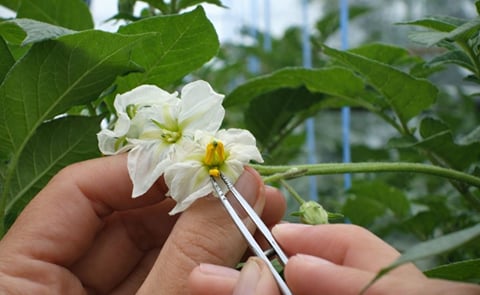
Potato Breeding at Cornell University: an update
Potatoes have been bred at Cornell for at least 50 years and 70% of the university’s breeding efforts are focused on developing new chip varieties. Walter De Jong reports.From the archive

May 10, 2015
New York Senator launches push to replace Cornell University's outdated nematode lab
U.S. Senator Charles E. Schumer has urged the U.S. Department of Agriculture (USDA) to prioritize the replacement and modernization of the Federal Nematode Quarantine Facility at Cornell University in the Agricultural Research Service’s (ARS) Capitol Investment Strategy for Fiscal Year 2016.From the archive