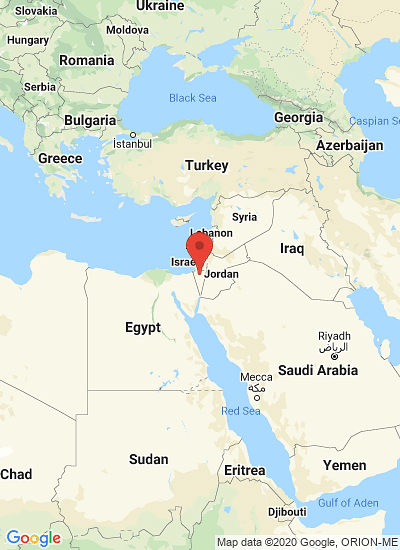

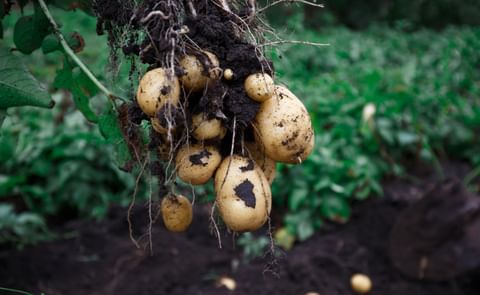
After nearly 30 years of research, Professor David Levy has developed a strain of potato that can be grown in hot, dry climates, and irrigated by saline water sources.
Professor David Levy's windowsill is lined with potatoes of numerous shapes and sizes. It's an appropriate decoration for a man who has spent his lifetime breeding the staple food.
Now Levy, an Israeli scientist from the Hebrew University Institute for Plant Sciences, at the Faculty of Agriculture, Food and the Environment, has developed not only a new strain of potatoes suitable for growth in hot, dry climates, but also new strains that can be grown using irrigation from saline water sources.
His development will have a huge impact on potato production in hot, desert regions like the Middle East, where temperatures are scorching, and water resources scarce.
Levy believes that farmers in these desert regions will now be able to grow their own potatoes, and market them to Europe and the US, helping their economies thrive.
Levy also hopes that his research will "enhance understanding and maybe even peace"between Israel and its neighbors, as scientists and officials from Jordan, Egypt, Lebanon and Morocco meet with Israeli scientists at USAID-sponsored regional meetings held in Morocco, Israel, Egypt and Cyprus to share knowledge and build bridges of information and technology.
Heat and saline resistant potato varieties reach commercial stage
¿Te gustaría recibir noticias como esta por correo electrónico? ¡Únete y suscríbete!
Get the latest potato industry news straight to your WhatsApp. Join the PotatoPro WhatsApp Community!
Noticias relacionadas
Septiembre 28, 2026
México: menor oferta de papa podría impulsar los precios durante el invierno
En México, el cierre de cosechas, los menores rendimientos y la reducción de la superficie sembrada podrían restringir la oferta de papa y generar presión al alza sobre los precios entre diciembre de 2026 y febrero de 2027.

Septiembre 28, 2026
España: la sequía reduce la cosecha de patatas en 2026
La producción española de patata caerá entre un 8% y un 10% en 2026, hasta unos 1,8 millones de toneladas, con descensos de hasta 35% en Andalucía debido principalmente a la sequía y los menores rendimientos.

Septiembre 23, 2026
Chile: buscan mejorar el diagnóstico molecular de la sarna polvorienta y la sarna común en papa
En Chile, el proyecto SCAB-ID 2.0 busca validar un sistema de qPCR multiplex capaz de detectar y diferenciar simultáneamente la sarna polvorienta y la sarna común de la papa, con miras a transferirlo a laboratorios de diagnóstico agrícola.