
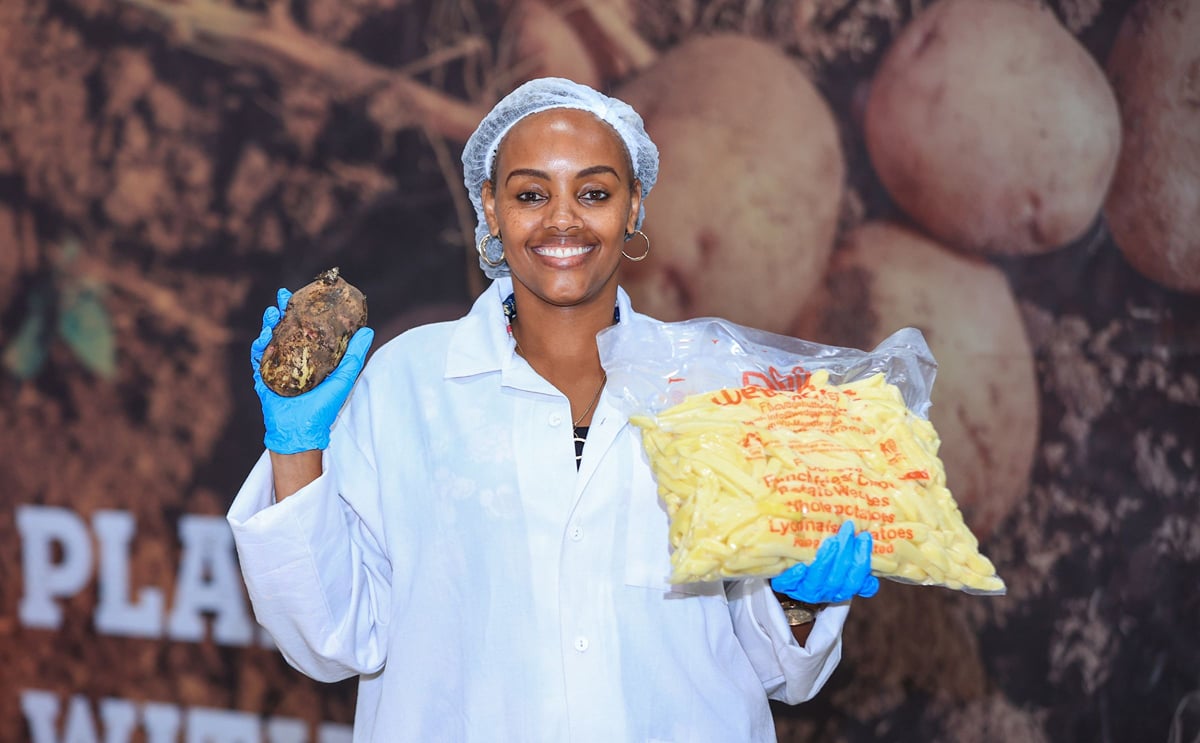
From freshly harvested potatoes to ready-to-cook fries, Wanjiru Mambo demonstrates how Wedgehut Foods adds value to Kenyan potatoes and creates new market opportunities for local growers.
From Farm to Fries: The Fry Industry in Kenya Prepares to Welcome the World
With the World Potato Congress (WPC) 2026 coming to Kenya, the global potato industry is turning its attention to the country’s evolving potato market. Beyond production, a quieter shift is under way on the processing side, as more Kenyan potatoes are peeled, cut and supplied as fries to hotels, restaurants and institutions.
To understand that shift from the ground, PotatoPro spoke with Wanjiru Mambo, Founder and CEO of Wedgehut Foods Limited, a Nairobi-based processor that sources potatoes directly from smallholder farmers and supplies them uncooked, peeled and cut to food-service customers. She shared her view of how Kenya’s fry industry has developed, where it still needs to grow, and what the Congress could mean for it.
Meet Wanjiru Mambo and Wedgehut Foods
Wedgehut was born during the Covid-19 pandemic, after Mambo’s restaurant closed and she began selling four bags of potatoes from the back of her truck. Seeing how perishable the crop was, and how hard it was for farmers to find reliable markets, she founded Wedgehut Foods in 2021.
The company now peels, cuts and supplies smallholder-grown potatoes to hotels, schools, restaurants and hospitals.
Wanjiru Mambo, Founder and CEO of Wedgehut Foods Limited:
"We started off processing 300 kilos a day. Now we are processing more than four tons in a day,"
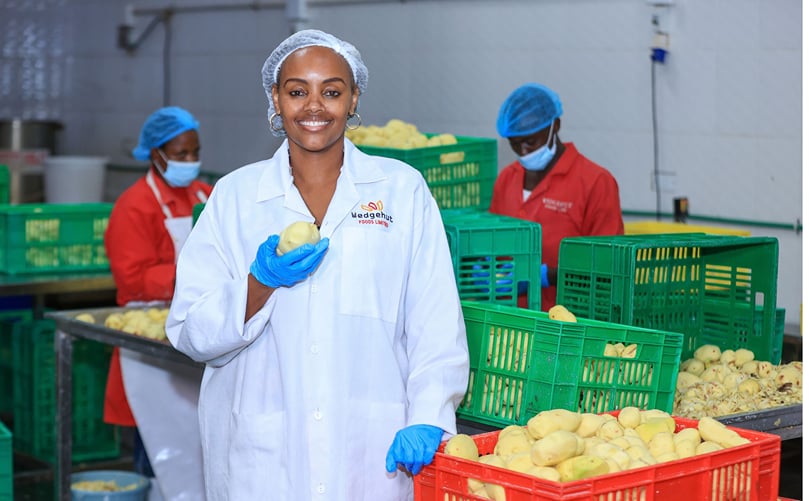
Wedgehut Foods founder Wanjiru Mambo at the company processing facility in Nairobi, where potatoes sourced from Kenyan farmers are peeled and prepared for the fresh-cut fries market
How has Kenya’s fry-processing sector changed?
According to Mambo, demand for potatoes and fries in Kenya has grown quickly.
Wanjiru Mambo:
"Currently, we are told that potato is becoming the second staple food after maize in Kenya,"
She attributes this growth to three main drivers: the expansion of the hospitality sector, including the arrival of multinational hotels and restaurants; rapid urbanisation; and commercial kitchens that are short on space and increasingly prefer ready-to-cook products to peeling potatoes themselves.
The industry is also maturing. There is a better understanding that "a potato is not just a potato" and that different varieties suit different uses, and policies are being introduced to formalise a market long dominated by brokers and middlemen.
Even so, only a small share of Kenya’s potatoes is processed today, which Mambo sees as the sector’s biggest opportunity:
Wanjiru Mambo:
"It’s a 400 million dollar economy of potatoes produced, yet only 6 to 8% goes into value addition. We are still experiencing 40% post-harvest losses of all the potatoes produced."
Is domestic supply meeting processors’ needs?
Not fully yet, but the gap is narrowing. Kenya has historically relied on imported frozen fries, but tighter import restrictions and a major potato shortage around 2023 pushed the industry towards local sourcing. Two Kenyan companies have since set up frozen-fry production and now serve some multinational customers, a development Mambo calls "very encouraging."
The remaining gap is about quality and consistency rather than volume.
Wanjiru Mambo:
"There’s still a gap of the right potato for processing,"
Processors need the right varieties and sizes, fully mature potatoes and good crop management, starting with soil health.
They also need supply every day of the year.
Wanjiru Mambo:
"Whether at the farm level you have potatoes or not, my clients expect me to supply the potatoes for their kitchens,"
This is why she sees irrigation as key: it allows farmers to keep supplying when rain-fed production falls, often at better prices.
Which processing varieties are gaining ground?
Shangi is still Kenya’s most common variety, but farmers are now trying varieties suited to processing, such as Challenger, Markies and Unica. Malaika and Glen, launched last year, have also performed well.
Wanjiru Mambo:
"In terms of variety, I would say we are doing very well in the country,"
The main hurdle is the supply of seed potatoes.
Wanjiru Mambo:
"When we go as processors and tell farmers, ‘I want you to plant for me this variety,’ the first question they always ask is: where are the seeds?"
Seed potatoes often have to be booked about six months ahead, so farmers, seed suppliers and processors need to plan together.
Seed potato companies such as FreshCrop, Kisima Farm, Kevian Kenya and Agrico, with support from the Ministry of Agriculture, are working to increase supply, and cooperatives are being encouraged to multiply seed for their members.
What is changing at farm level?
Wedgehut took part in a baseline study with the World Resources Institute (WRI) and Jomo Kenyatta University of Agriculture and Technology (JKUAT) that tracked potato losses from farm to fork. Some of those losses show up at the factory.
Wanjiru Mambo:
"Personally, as a processor, you also lose so much. At least 15% is not converted to the end product,"
She traces much of this back to the farm and advocates smart farming: the right varieties, better soil health, and more mechanisation, which smallholders can share through cooperatives.
Packaging is improving too. The National Potato Council of Kenya has introduced standard 50 kg bags in place of overfilled sacks, and selling by weight gives farmers "better returns," she says.
How developed are storage and cold-chain systems?
Several cold-storage facilities have been established with support from development partners and the government, but Mambo says "much of it is not in use." The problem, she argues, is that cold storage cannot function as an isolated investment.
Wanjiru Mambo:
"If I store potatoes at the farm level in a cold room, I need to transport them with a cold truck, store them at a cold storage at the processing facility, and retain the same temperature levels,"
High electricity costs make this difficult, while technical knowledge around potato storage is also important because temperature changes can affect sugar levels and, ultimately, frying performance.
Kenya, however, has one advantage.
Wanjiru Mambo:
"We can grow potato three times a year,"
Unlike countries dependent on one major harvest, Kenya can produce potatoes at different points during the year. For Mambo, this makes investment in value-added products particularly interesting: rather than focusing only on storing raw potatoes for longer periods, surplus potatoes could be converted into products that can be stored and marketed over time.
What is bringing farmers and processors together?
According to Mambo, the answer is information and partnerships. Farmers need to know what processors require, from variety and tuber size to maturity and delivery timing, so they can plan production around demand.
No processor can provide all of that alone, so a support ecosystem is forming around the crop.
Wanjiru Mambo:
"There’s quite a lot happening,"
Development partners run farmer programmes, which Wedgehut has benefited from, while different organisations cover soil health, seed, crop protection, irrigation and finance. Processors complete the chain as buyers.
Universities are part of it too. JKUAT, supported by the Japan International Cooperation Agency (JICA), is working with Wedgehut and other partners on everything from farm mechanisation to new products such as potato starch and flour, and whether processing waste could become animal feed for farmers.
How are hotels and restaurants responding to local fries?
Buyers fall into two groups. Multinational hotels, often led by international chefs used to frozen fries, mostly stick with frozen products because they are pre-cooked and quick to prepare. Kenyan hotels, restaurants, caterers and schools prefer local varieties, and many now buy fresh-cut fries.
Two forces are pushing more buyers towards local supply: the higher cost of imported products, and a "buy local, build local" mindset.
Wanjiru Mambo:
"You find even the multinational brands are now considering local,"

Wedgehut Foods offers fresh-cut, ready-to-cook fries to meet growing demand from hotels, restaurants and institutional kitchens in Kenya, a market where local potato processing continues to expand
For fresh-cut processors, the biggest competitor is often the traditional market, where kitchens buy raw potatoes and peel them in-house. Demand itself, she says, is not the problem:
Wanjiru Mambo:
"There’s a huge demand, and we can’t really satisfy it. I always say the market is not a problem. The problem is the supply chain."
How is the fry market currently split?
Based on what she sees in the food-service market, Mambo estimates that fries made in-house from potatoes purchased through the traditional market account for at least 40%.
Wanjiru Mambo:
"I will say 30% still is going to frozen,"
She adds, noting that cost can limit how much frozen product some kitchens use for high-volume requirements. Chilled and fresh-cut processed potatoes account for the balance.
These are Mambo’s market estimates rather than official industry statistics, but they point to two potential avenues for local processors: replacing part of the frozen-fries segment and converting kitchens that continue to peel and cut potatoes in-house.
Inclusive business models: what can the industry learn from Wedgehut?
Inclusion of women, youth and smaller enterprises is a key theme of WPC 2026, and Wedgehut’s model offers three lessons for the wider industry. Smallholders can grow with the right market. Mambo measures Wedgehut’s success by how its farmers grow.
Wanjiru Mambo:
"My success with my farmers is when I start with a farmer, they were growing, let’s say, two acres. Now they’re doing five acres. They go to 10 acres, 15 acres, and you’ll find they keep introducing other people around them,"
Small changes can bring women in. Women do much of the farm work in Kenya, but when Wedgehut held farmer trainings in the morning two years ago, most attendees were men, as women were busy with household duties at that time. Moving sessions to the afternoon and closer to farming communities changed that.
Wanjiru Mambo:
"We had maybe 20% that is female, but now it has increased to around 35%, and we hope we can get it to 40%."
The sector needs younger farmers.
Wanjiru Mambo:
"The average age of a farmer is 65 years, but the highest consumers of potato are below 35,"
She calls on young Kenyans to return to farming, where their greater exposure to knowledge could help raise yields.
WPC 2026: where can international partners make a difference?
As the global potato industry gathers in Kenya, Mambo sees several areas where international collaboration could support the next stage of growth.
Research and development is one of them. When processors select only larger potatoes, farmers can be left with smaller tubers of lower value. Developing products capable of using different potato sizes could improve overall returns.
Soil health is another priority.
Wanjiru Mambo:
"I believe that’s the beginning or the genesis of everything that we grow,"
Then there is seed potato availability.
Wanjiru Mambo:
"There is a huge gap of seed,"
Finally, she sees an opportunity to strengthen cooperative models. Cooperatives have played an important role in Kenya’s coffee, tea and dairy sectors, and more recently in avocado. A similar approach in potatoes could help organise growers, coordinate production and give processors greater confidence in consistent supply.
Looking five years ahead
For Mambo, Kenya’s domestic market remains the immediate opportunity.
Wanjiru Mambo:
"I believe the local market is still huge,"
But she also sees potential in the UAE market, where domestic potato production is limited.
Within East Africa, countries such as Tanzania and Uganda also produce potatoes, so she sees regional trade partly as a mechanism for balancing shortages and surpluses. Kenya already sources potatoes from Tanzania during periods of scarcity, while surplus production could move in the opposite direction.
Value-added products could expand the opportunity much further.
Wanjiru Mambo:
"If we can do more potato products like the flours, the starches, then it opens up a huge market for export for all of us,"
Like to receive news like this by email? Join and Subscribe!
Get the latest potato industry news straight to your WhatsApp. Join the PotatoPro WhatsApp Community!
Highlighted Company




Related News

October 12, 2026
Iscon Balaji Foods Showcases Hungritos CrispX Fries and Wins Saudifood Excellence Award 2026
Iscon Balaji Foods won the Saudifood Excellence Award 2026 and unveiled its Everlasting CrispX fries at The Saudi Food Show in Jeddah, showcasing high-holding performance and its Hungritos frozen potato portfolio.

October 12, 2026
IFCG to Showcase Frozen Sweet Potato Fries at SIAL Paris 2026
International Food & Consumable Goods – Egypt (IFCG) will present its frozen sweet potato fries and private label solutions at SIAL Paris 2026, taking place October 17–21 in France.

October 12, 2026
McCain Foods to Acquire Falcon Agrifriz Frozen Potato Processing Business in India
McCain Foods has announced plans to acquire Falcon Agrifriz Foods' frozen potato processing business in Gujarat, India. The acquisition will expand its manufacturing capacity and its presence in India, and support local farmers and supply chains.