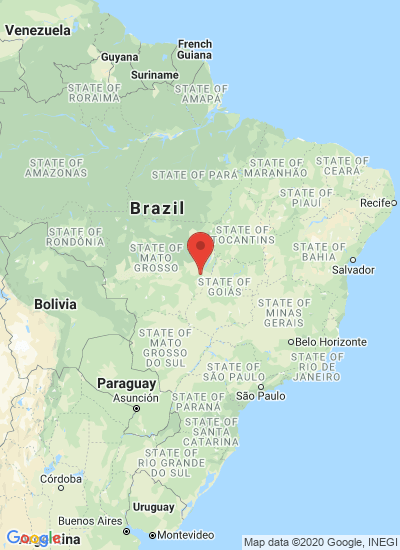
Fresh tubers of Embrapa’s BRS F21 potato cultivar, developed for high yield and industrial processing.
Embrapa launches BRS F21 potato variety for industrial frying in Brazil

Embrapa has introduced a new potato cultivar, BRS F21, developed to meet the demands of both the production chain and the processing industry. The cultivar combines high yield potential, disease resistance and strong performance in frying applications, particularly for potato chips and shoestring potatoes.
Developed over more than ten years by the Potato Breeding Program, BRS F21 earned the nickname "Braschips" due to its high industrial yield and the superior quality of the fried products it produces.
Quality traits for industrial frying
Giovani Olegário, Researcher at Embrapa Vegetables:
"The cultivar is apt for industrial processing because it features two factors that offer excellent quality for frying when they are combined. The first one is its high dry-matter content, which means the tubers contain less water, resulting in chips that are drier and crispier."
"Secondly, the low sugar content stops the potato from caramelizing and ensures the product will have a lighter, more uniform color, which consumers prefer."
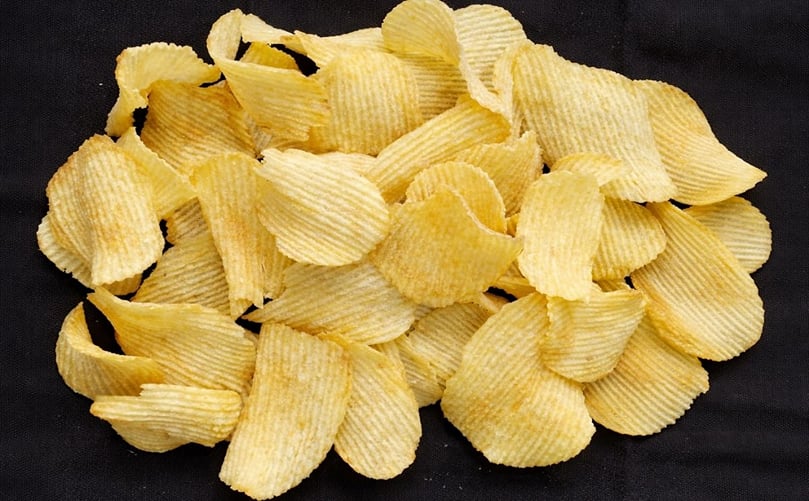
Potato chips produced from the BRS F21 cultivar, showing light color and uniform frying quality.
Olegário also highlighted the cultivar’s firm texture, characteristic flavor, light-yellow flesh and oval tuber shape as favorable attributes for high-quality frying. In addition, BRS F21 has shown a low incidence of physiological disorders such as internal spots and cracking, reducing processing losses and increasing industrial yield.
Preliminary industrial trials demonstrated strong performance for both potato chips and shoestring potatoes. The cultivar is currently undergoing larger-scale evaluations to confirm acceptance among growers supplying raw material for processing.
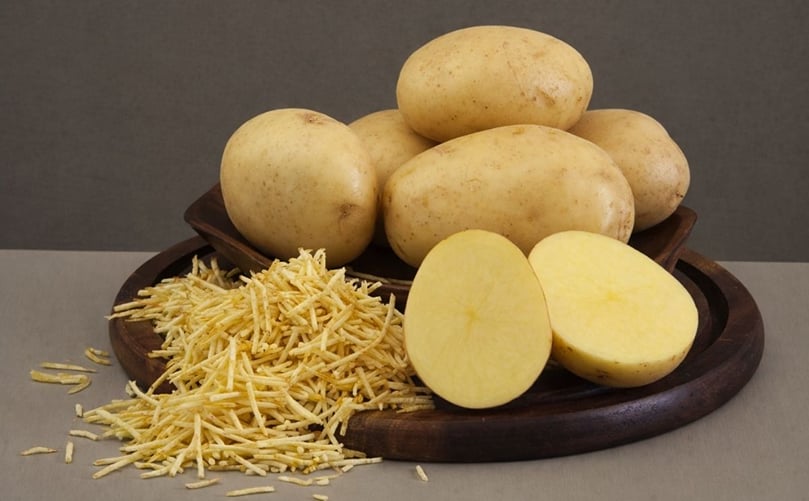
BRS F21 potatoes shown with shoestring-style potato products, highlighting suitability for frying.
High yield, stability and adaptability
BRS F21 reaches the market with the potential to outperform leading competitors in yield, adaptability and performance stability across Brazil’s main potato-growing regions. These include the Triângulo Mineiro, one of the country’s most important potato supply areas for agro-industries in terms of volume.
The cultivar’s plant vigor and higher yield potential help reduce raw material costs for industrial processing. Its slightly longer production cycle allows for increased starch accumulation in the tubers, meeting industry requirements for frying quality.
At harvest, desiccation followed by an interval of around ten days is recommended to allow sugars to convert into starch, contributing to lighter-colored chips. Regular field monitoring toward the end of the crop cycle helps determine the optimal harvest point based on dry matter and frying quality.
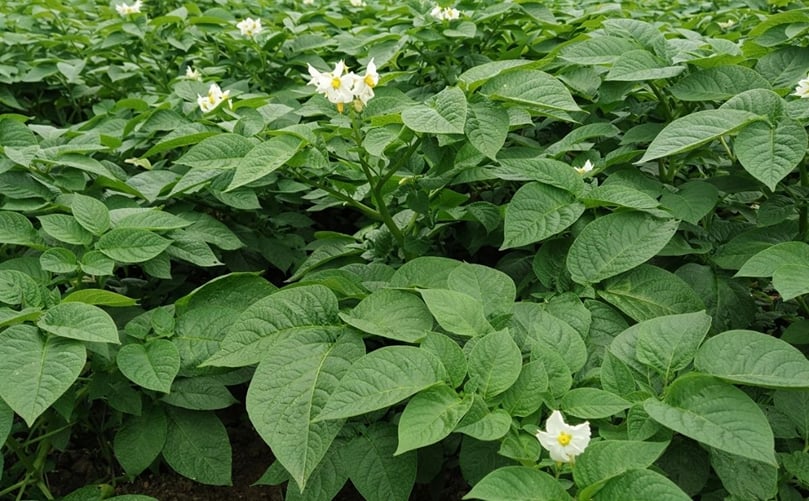
BRS F21 potato plants in the field as part of Embrapa’s processing-oriented breeding program.
Resistance to Potato Virus Y
A key competitive advantage of BRS F21 is its resistance to Potato Virus Y (PVY), one of the most significant phytosanitary challenges in Brazilian potato production. The virus, commonly known as mosaic, weakens plants and can significantly reduce yields, while also compromising seed quality due to vegetative propagation.
Low susceptibility to PVY helps maintain plant vigor across successive production cycles, representing an important advance for both seed and commercial potato producers. The cultivar also demonstrated good resistance to late blight and black spot, two major foliar diseases in southern Brazil’s potato-growing regions.
Diversification of Embrapa potato cultivars
Caroline Castro, Researcher and Head of the Potato Breeding Program at Embrapa:
"When we generate cultivars, we consider not only customer satisfaction, but also approval in the fields and in the industry, in order to obtain quality products that meet different demands."
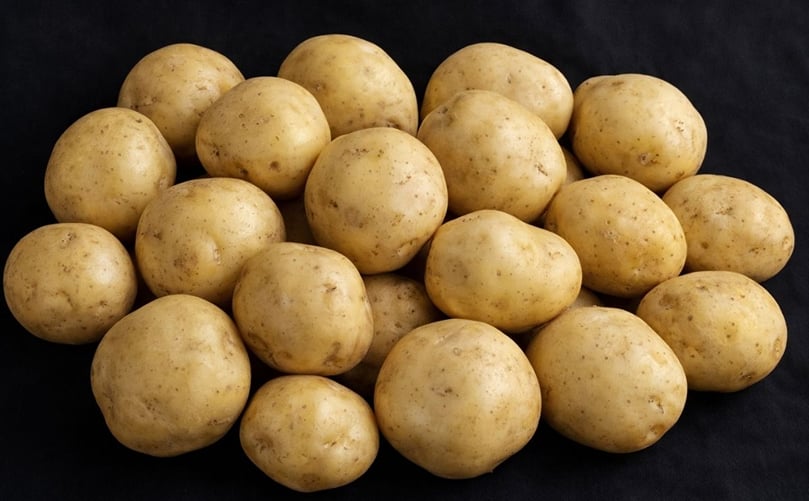
Harvested BRS F21 potato tubers bred for productivity, processing quality, and disease resistance.
Embrapa’s breeding strategy targets different market segments, covering fresh consumption and industrial processing, while also addressing adaptation to tropical and subtropical growing conditions. Cultivars are released with clear recommendations for their most suitable uses, such as frying, baking or salads, and for specific production systems, including organic farming.
Over the past decade, Embrapa has released several other potato cultivars alongside BRS F21, including BRS F63 Camila, BRS F183 Potira, BRS F50 Cecília and BRS Gaia. According to Castro, limited availability of cultivars adapted to Brazil’s climate, particularly heat tolerance, can restrict planting windows and processing supply, reinforcing the importance of continued breeding and genetic improvement.
The breeding and evaluation work behind BRS F21 was carried out through a partnership between Embrapa Temperate Agriculture and Embrapa Vegetables, with trials conducted at experimental stations in Santa Catarina and Rio Grande do Sul, alongside evaluations by partner growers and processing industries across Brazil.
Like to receive news like this by email? Join and Subscribe!
Get the latest potato industry news straight to your WhatsApp. Join the PotatoPro WhatsApp Community!
Uitgelichte Bedrijven

Potato varieties mentioned


Gerelateerd nieuws
september 07, 2026
Calbee Potato Harvest Ceremony 2026 Highlights Stronger Hokkaido Potato Quality and Yield
Calbee Potato expects Hokkaido’s 2026 processing potato crop to reach 240,000–250,000 tons, with better quality and yields than 2025. Favorable temperatures and rainfall have boosted growth, although heavy rain remains a major harvest risk now.

september 07, 2026
Aardappeldemodag 2026 Draws Over 4,500 Visitors as Dutch Potato Sector Faces Year of Extremes
Aardappeldemodag 2026 brought over 4,500 visitors to Westmaas amid a challenging year for the Dutch potato sector. The event focused on market pressures, extreme growing conditions, knowledge sharing, machinery and innovation.

september 07, 2026
EUROPLANT en Finpom onderstrepen het voordeel van Finse pootaardappelteelt bij toenemende viruisdruk in Europa
Finpom wijst op de voordelen van Noord-Finland voor de productie van hoogwaardige pootaardappelen terwijl klimaatverandering de virusrisico's in Europa doet toenemen, en breidt zijn EUROPLANT-assortiment verder uit met LARISSA, JUVENTA, Filipa, FAVOLA en INA.