
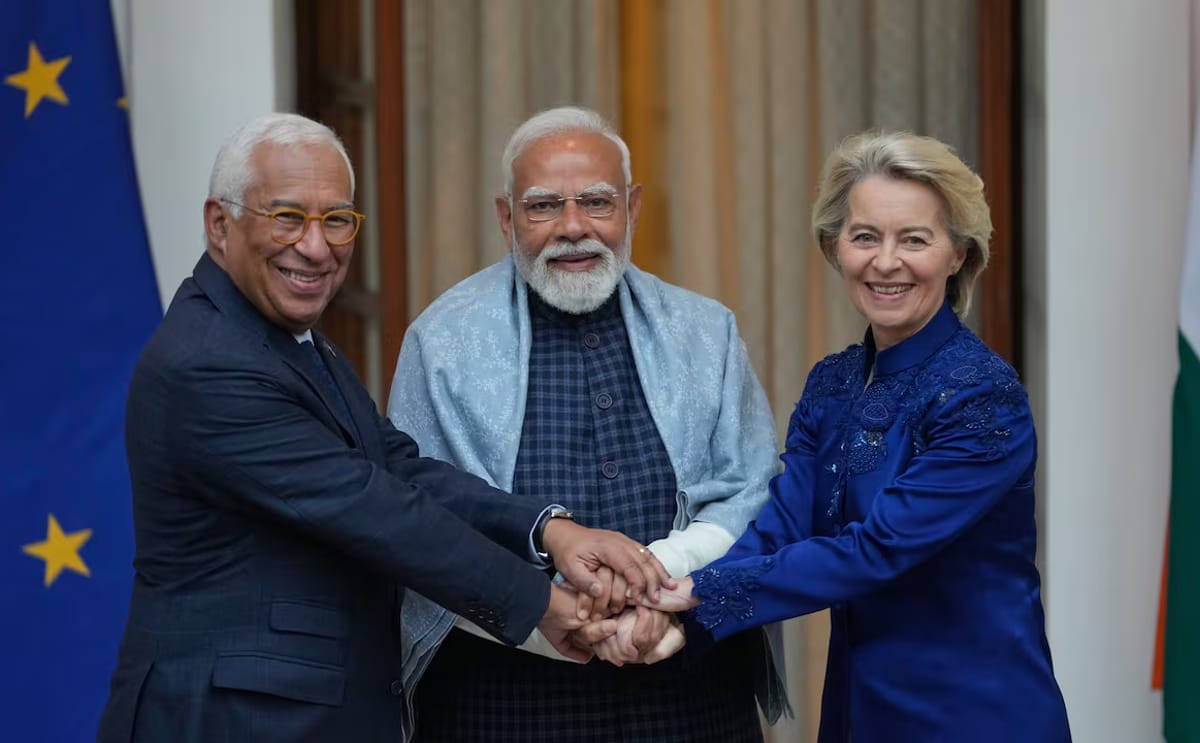
From left, European Council President Antonio Costa, Indian Prime Minister Narendra Modi and European Commission President Ursula von der Leyen meet in New Delhi on Tuesday. India and the EU announced a wide-ranging trade deal Tuesday. (Courtesy: Manish Swarup/The Associated Press)
EU-India trade agreement set to ease market access for European food processing equipment suppliers
The European Union and India have largely reached agreement on a long-awaited bilateral trade deal, following nearly twenty years of negotiations. The agreement is expected to remove around 90% of existing import duties and trade barriers, creating significantly improved market access for exporters on both sides.
According to the European Commission, the deal could lead to a doubling of EU exports to India over time, supported by simplified customs procedures, reduced tariffs and stronger intellectual property protection. Once fully implemented, 99.5% of bilateral trade will benefit from some form of tariff concession.
Marcel van Huissteden, Director at Kiremko:
"I am very pleased with it. I am very proud of it."
India is a key growth market for potato processing, driven by rising consumption of processed potato products and increasing demand for capacity, efficiency and sustainable production solutions. The trade agreement is expected to lower barriers for European processing equipment suppliers, making it easier and more cost-effective to serve Indian processors and expand long-term partnerships in the region.
Key trade provisions affecting EU–India trade
Under the EU–India trade agreement, both sides will benefit from wide-ranging tariff reductions:
- For EU exporters, Indian tariffs on 30% of goods imported from the EU will fall to zero immediately, while tariffs will be eliminated or reduced on 96.6% of EU exports overall, generating annual savings of up to EUR 4 billion (USD 4.7 billion).
- For Indian exporters, the EU will scrap tariffs on 90% of Indian goods, rising to 93% within seven years. Partial tariff cuts and quotas will apply to around 6% of goods, reducing the EU’s average tariff rate from 3.8% to 0.1%.
(Click to enlarge)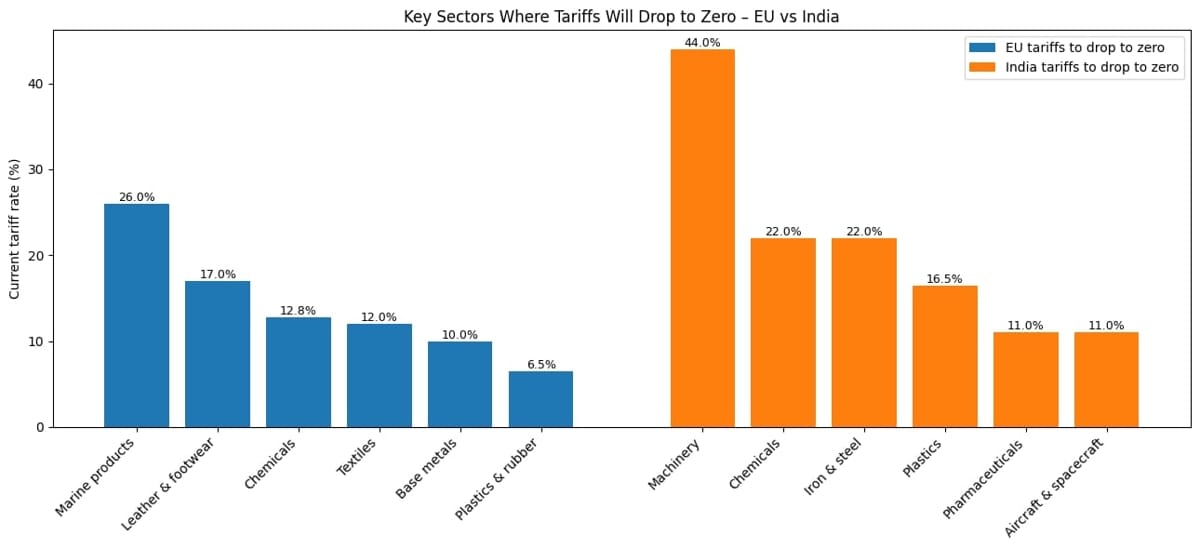
Current tariff rates in key sectors set to fall to zero under the EU–India trade agreement, highlighting areas of market opening on both sides.
Both Indian Prime Minister Narendra Modi and Ursula von der Leyen, president of the European Commission, called it "the mother of all deals." Modi also emphasized the trade agreement is the largest and most comprehensive that India has ever signed, representing a third of all global trade.
Ursula von der Leyen:
"We are creating a market of two billion people. This is the tale of two giants, the world's second and fourth largest economies. Two giants who choose partnership in a true win-win fashion."
(Click picture to watch video)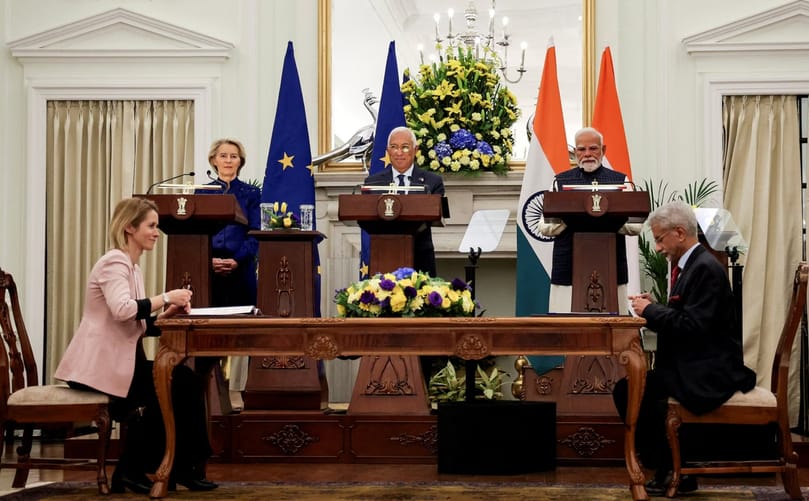
India and EU announce landmark trade deal | BBC News
Like to receive news like this by email? Join and Subscribe!
Get the latest potato industry news straight to your WhatsApp. Join the PotatoPro WhatsApp Community!
Uitgelichte Bedrijven
Related News

augustus 01, 2026
Elea Technology appoints Vassilis Smoilis as Strategic Business Advisor
Elea Technology has appointed Vassilis Smoilis as Strategic Business Advisor to support the adoption of Pulsed Electric Field (PEF) technology and expand customer engagement across the food processing industry.

juli 30, 2026
Elea Showcases Smart PEF Solutions with PiCon Tools at PEF Advantage Day 2026
Elea will host PEF Advantage Day 2026 on September 9 in Quakenbrück, Germany, featuring AI-powered PiCon Tools for smarter PEF processing. The free event includes live demos, expert talks, networking, and product testing opportunities.
juli 30, 2026
Natural Storage Solutions signs Memorandum of Understanding with Ghana on post-harvest infrastructure
Natural Storage Solutions Pvt. Ltd. has signed an MoU with the Republic of Ghana to support agricultural development through food processing technologies and post-harvest infrastructure, with the aim of reducing losses and improving food security.