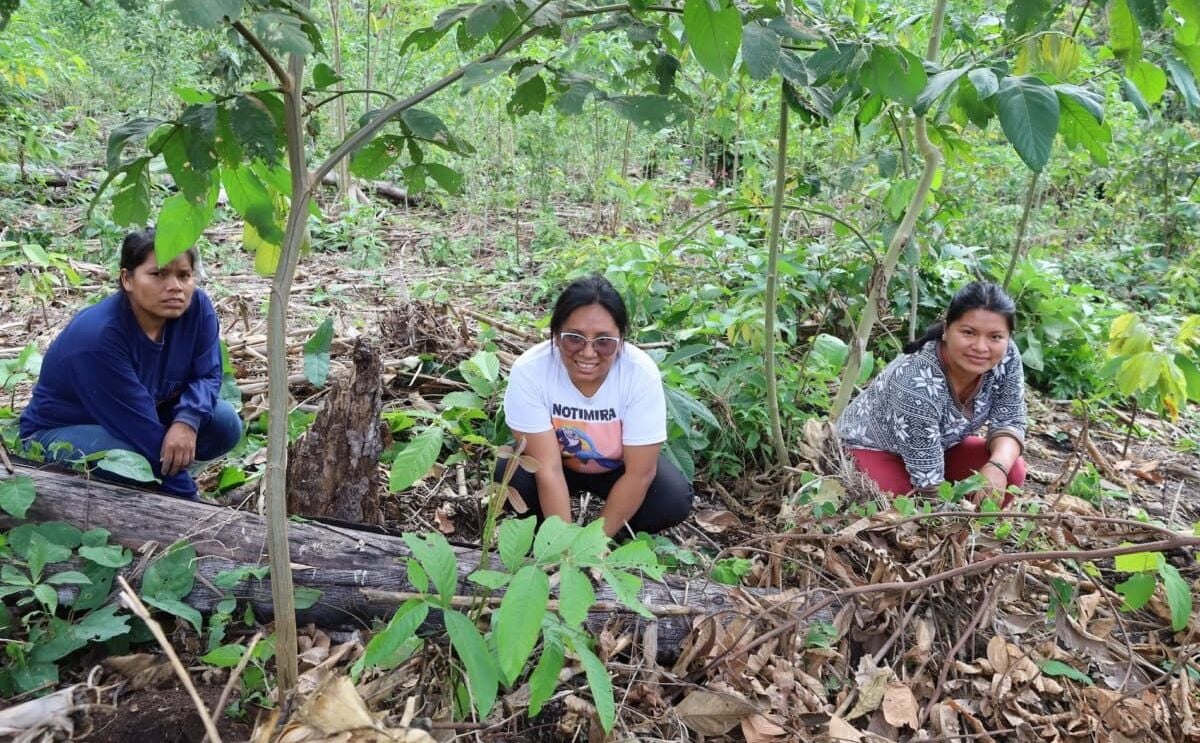
Loaiza Seri (at the center) and members of her nature-caring association. (Courtesy: Conservation International Peru)
Indigenous Women in Peru Revive Ancestral Tubers and Build Sustainable Food Future
Kashiri, the Moon, saw the young woman through a window. The celestial body descended from the sky and found her eating soil molded into the shape of a tubercle. "What you are eating is mud, not yuca," the root of the cassava plant. "I will let you taste the true yuca," it said. In love with her, Kashiri handed a sacred seed and taught her how to plant it. This is the story that has survived through the tales of grandmothers and grandfathers of the Machiguenga people.
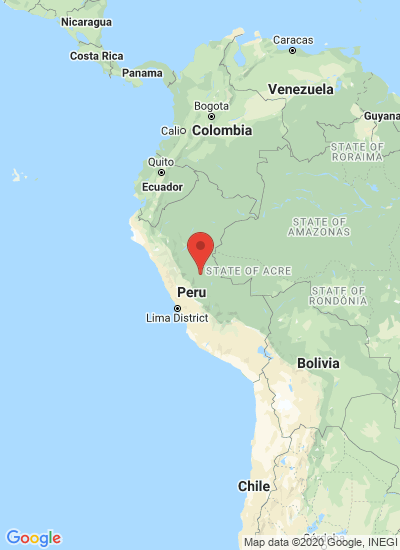
Gabriela Loaiza Seri recalls the ancestral anecdote. The account speaks about the origin of crops in her village of San José de Koribeni, in Cusco, in southeastern Peru - the largest Indigenous Machiguenga community in the South American country.
Gabriela Loaiza Seri, Agronomy Engineer and Community Leader:
"The young woman learned how to plant yuca, magona potatoes, shonaki [an Indigenous name for a type of sweet corn root] and all the tubers we have always consumed."
Since then, women have been responsible for these crops. This time-honored knowledge, however, is now facing increasing threats. The expansion of monocultures and intensive agriculture in Peru has put many of these native species at risk of disappearing, according to Loaiza Seri. To make matters worse, the introduction of new varieties and foreign crops has reduced the diversity of yucas that once secured food to Indigenous communities year-round. The arrival of external projects has also distanced the community from their chacras ( small, traditional farming plots).
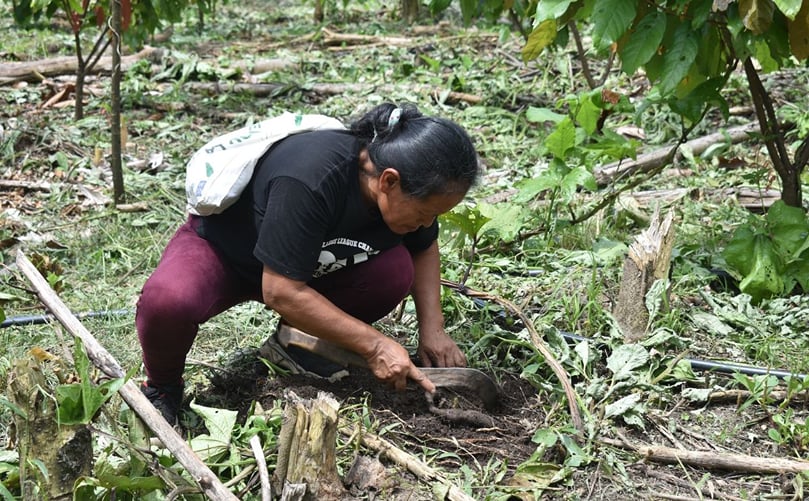
A member of the association Mujeres Emprendedoras de Raíz Amazónica (Entrepreneurial Women of Amazonian Roots) harvesting the magona potato. (Courtesy: Conservation International Peru)
Gabriela Loaiza Seri:
"The young prefer to migrate to the city to work as they no longer see the chacras as a sustainable option; mostly, those who stay are the older ones."
Due to this scenario, since 2023, Loaiza Seri and a team of 14 women have been working to rescue 17 traditional varieties of yuca and 11 varieties of magona potato (Dioscorea spp.). Also popularly known as sachapapa, the magona tuber is at risk of extinction. Together, the crew has consolidated their association, named Mujeres Emprendedoras de Raíz Amazónica (Spanish for Entrepreneurial Women of Amazonian Roots), seeking to strengthen their income while ensuring food security for the community.
Recovering the magona potato and traditional yuca varieties for the Machiguenga is not their only mission. The group also produces snacks and flours for both local consumption and external sale. The collective effort, in the end, has already reached a milestone: the Indigenous women now have their own small processing plant.
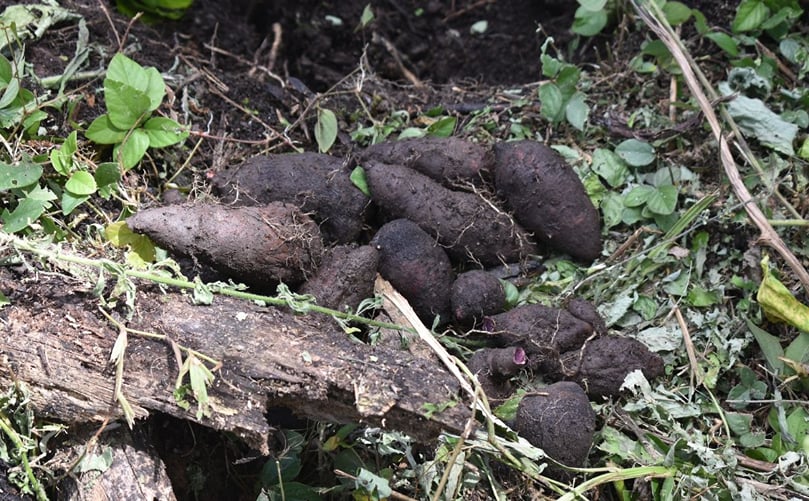
The purple-colored magona potato. According to Machiguenga tradition, babies should not eat purple magona potatoes, as their culture believes the tuber could give infants speech problems. (Courtesy: Conservation International Peru)
It all started with eight women and a semillera (a small seed plot). It was where they treated the land following local inherited practices.
Gabriela Loaiza Seri:
"Although yuca is planted by both men and women, when it comes to magona potato, only women do the planting. This is how they told us: In the times of Pairani — which means ‘before,’ or ‘in ancient times’ — the sun shone only until 10 in the morning. That is when women have to plant it. If it is done later, or in any other way, the product is ruined."
Loaiza Seri’s sense of respect for this technique is also based on personal experience: What she and her colleagues have done, strictly following their grandmothers’ procedures, has worked.
Gabriela Loaiza Seri:
"I studied agronomy and have university knowledge. But I highly esteem the ancestral techniques we have from our people’s traditions. To me, it relates to the respect we have for our own origins: We believe what they tell us — because Indigenous peoples do not lie."
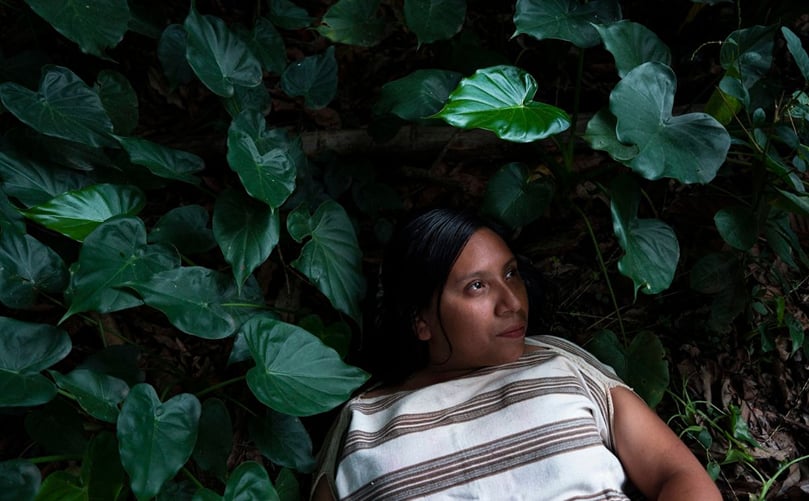
Gabriela Loaiza Seri, a young Machiguenga agronomist. (Courtesy: Conservation International Peru)
A diverse tubercle with unique flavors
The magona potato is a diverse and singular tuber: Even from a single plant, it can vary in size and shape without a specified pattern; it has a slightly wrinkled surface and is sometimes covered in small rootlets. Its solid pulp varies in color — being white, cream, yellow or purple — and, when cooked, each type reveals a particular flavor. The white one, for instance, narrowly resembles the Andean potato; however, from Loaiza Seri’s perspective, the purple magona potato is incomparable. Each tuber weighs 100-400 grams (0.2-0.9 pounds).
Although the plant germinates from the second week, growing quickly subsequently, it does not bloom until the sixth month. When the leaves and stems turn yellow and become dry, there is a signal: It is time to harvest. The entire cycle is completed in a period of 8-10 months.
Gabriela Loaiza Seri:
"Our chacras are made of black soil, with a very, very pleasant smell. The magona potato grows like a vine and grabs onto everything it finds: papaya, cacao, corn, banana, yuca. It is a highly diverse chacra, and there is the magona potato, tangling itself with its large leaves, forming a shape like a hand."
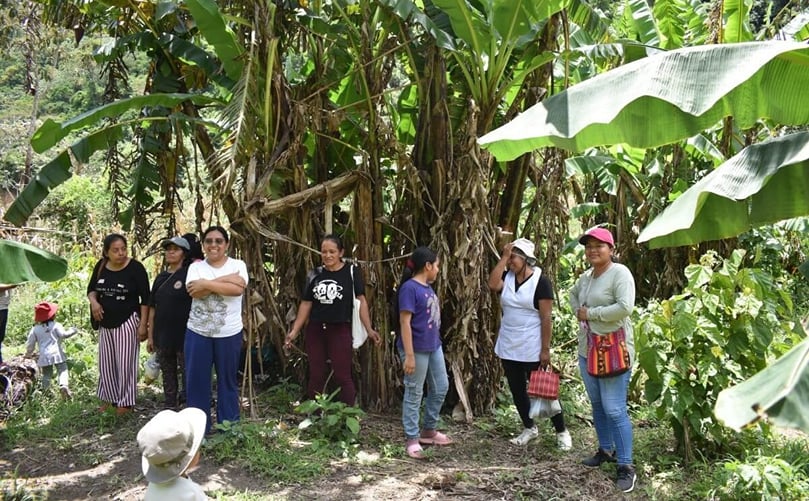
Loaiza Seri and the 14-woman team who work to rescue traditional varieties of cassava and magona potato. (Courtesy: Conservation International Peru)
Loaiza Seri has documented the entire process — from the phase of agricultural research to the rescue of ancestral knowledge, methods of use and nutritional value — and has compiled it into an educational booklet, now available to her community.
In her records, she explains that planting begins with careful land preparation: First, one burns the tobacco to repel evil spirits and ask protectors for permission; then, the earth is excavated to about 30 centimeters (12 inches) deep, with spaced holes opened, filled mostly with fertilizer to form small mounds. One or two tuber seeds are placed there, covered with soil and mulch to protect moisture and stimulate sprouting.
Weeks later, it is time for surface weeding, without damaging the roots. And as the plant grows, stakes are placed to ensure its proper exposure to light.
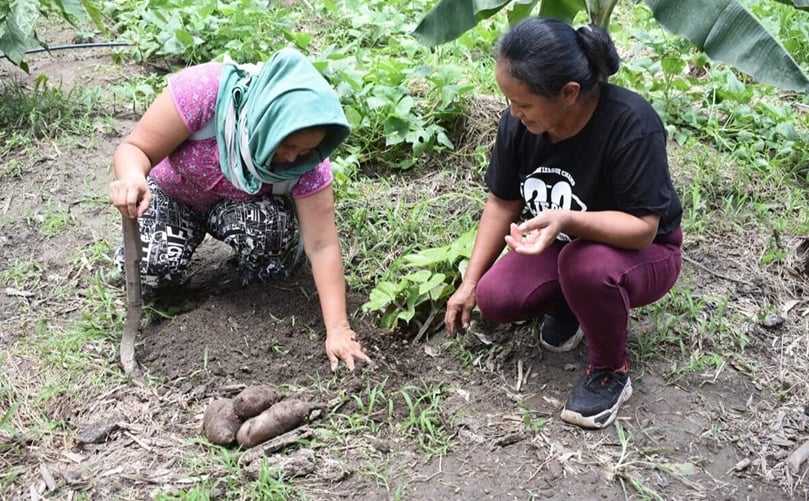
Machiguenga women follow harvesting practices inherited from their grandparents. (Courtesy: Conservation International Peru)
Gabriela Loaiza Seri:
"It is an ecological and sustainable process because we do not use agrochemicals or machines in the chacra. Projects have arrived everywhere, but without cultural pertinence. There is also loss of biodiversity: They [projects] arrived with CCN-51 cacao [a high-yield hybrid] and … everything began to be seen as commerce. People stopped planting the magona potato and other Amazonian tubers that were once there. Now, we find very little of it in some remote chacras."
"We have to realize what we are consuming via monocultures. Why should we buy a potato at the store if we can have it naturally in our chacras? We have plenty of land … but the impacts have been great."
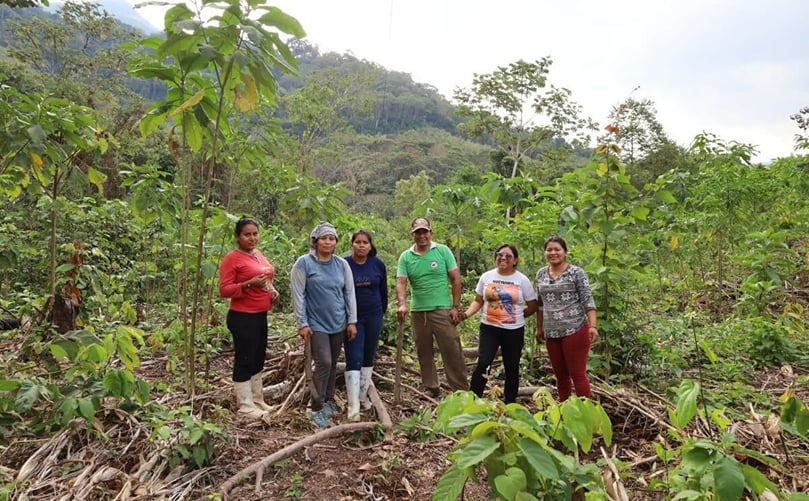
Planting the magona potato is an ecological and sustainable process: It uses neither agrochemicals nor machinery. (Courtesy: Conservation International Peru)
A processing plant to consolidate the brand
Loaiza Seri has received two grants from Conservation International Peru — in 2021 for the rescue of Machiguenga knowledge and in 2023 for the rescue of traditional tubers — that have allowed her to access financing, mentorship, a support network and additional funds to strengthen her women-led initiative.
Daniela Amico, Communications Director at Conservation International Peru:
"She is now working on consolidating a brand for these snacks and flours, which are made with native potatoes to generate income, add value and rescue biodiversity. Gabriela is very inspiring: I think the connection she has with her territory and her identity is very genuine."
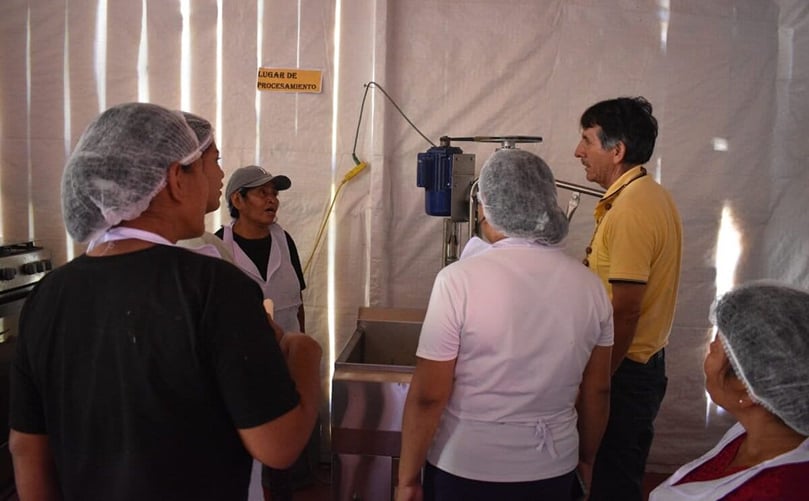
Women have been learning to use equipment to fry and dehydrate food products. (Courtesy: Conservation International Peru)
In the small processing plant that the Entrepreneurial Women of Amazonian Roots have managed to implement - for now, in Loaiza Seri’s home -they have equipment to wash, peel, coat and fry the vegetable-made snacks. To make flour, they use a solar dehydrator in which tubers stay for four days before being ground and packed under their own brand: Kipatsi, which means “earth” in the Matsigenka language.
Gabriela Loaiza Seri:
"We took part in different fairs to show how this product can be used. And we also held a ‘typical dish competition,’ where participants showed the gastronomic diversity of the magona potato."
Tubers are traditionally known for their high energy content. Today, the native food is prepared in ways very similar to the common potato: boiled, mashed, used in soups, porridges, roasted or even in stews. When the element is fried, it is turned into crunchy chips with an intense flavor. Derived products — such as flours, cakes, ice cream, slices or potato chips — are also made from it, which expands its uses and reaffirms its culinary versatility.
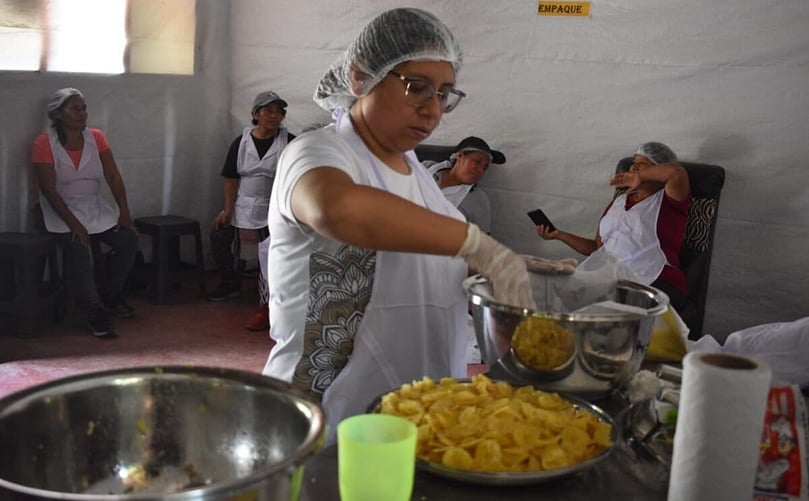
Loaiza Seri during the processing of magona potato snacks. (Courtesy: Conservation International Peru)
Gabriela Loaiza Seri:
"We have plenty of production: 1 hectare [2.5 acres] of magona potato gives us up to 5,000 kilograms [ 11,000 lbs]. Therefore, to make it sustainable, we set aside part of our production for family consumption and another part to be sold."
Women have the great daily responsibility of caring for the family, Loaiza Seri recalls, saying she is convinced that change starts at home. When a woman drives a project or adopts a conservation vision, that conviction is passed on to the children, the partner and, little by little, to her surroundings.
Gabriela Loaiza Seri:
"That is how a family’s worldview changes, something that spreads to another and another, until we grow and reach the whole community. That’s the reason why we, women, are important: because of the love we have for the land. Going further, we seek to position ourselves not only as a women-led entrepreneurship rescuing or conserving these potatoes, but also to strengthen the Indigenous economy to avoid economic violence."
The Indigenous engineer says hope is sustained by the work that survives between generations. Her initiative brings together women, youth and children, while recognizing and centering the knowledge of grandfathers and grandmothers, which, she says, guides every step of the process.
Gabriela Loaiza Seri:
"We, women, have always been in a process of conservation: We are the ones who walk, here and there, carrying our seeds, either asking each other for them or taking them from our gardens to share."
Like to receive news like this by email? Join and Subscribe!
Get the latest potato industry news straight to your WhatsApp. Join the PotatoPro WhatsApp Community!
Gerelateerd nieuws
september 07, 2026
Calbee Potato Harvest Ceremony 2026 Highlights Stronger Hokkaido Potato Quality and Yield
Calbee Potato expects Hokkaido’s 2026 processing potato crop to reach 240,000–250,000 tons, with better quality and yields than 2025. Favorable temperatures and rainfall have boosted growth, although heavy rain remains a major harvest risk now.

september 07, 2026
Aardappeldemodag 2026 Draws Over 4,500 Visitors as Dutch Potato Sector Faces Year of Extremes
Aardappeldemodag 2026 brought over 4,500 visitors to Westmaas amid a challenging year for the Dutch potato sector. The event focused on market pressures, extreme growing conditions, knowledge sharing, machinery and innovation.

september 07, 2026
EUROPLANT en Finpom onderstrepen het voordeel van Finse pootaardappelteelt bij toenemende viruisdruk in Europa
Finpom wijst op de voordelen van Noord-Finland voor de productie van hoogwaardige pootaardappelen terwijl klimaatverandering de virusrisico's in Europa doet toenemen, en breidt zijn EUROPLANT-assortiment verder uit met LARISSA, JUVENTA, Filipa, FAVOLA en INA.