News on Dickeya / Blackleg

Sponsor of the month (Learn more)
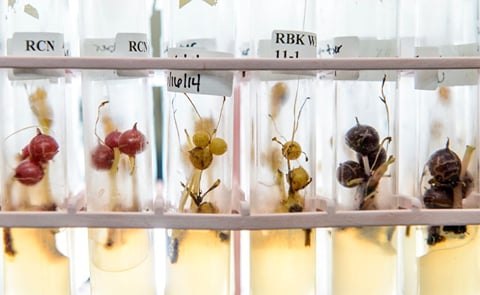
Researchers are developing bacteriocin-based treatments to help protect potato crops from blackleg and soft rot.
August 30, 2026
Scottish Researchers Develop New Bacteriocin-Based Approach to Protect Potato Crops
Scottish researchers led by the University of Glasgow have developed a bacteriocin-based treatment to suppress potato blackleg and soft rot. Supported by IBioIC the research has led to spin-out Casdu Crop Solutions.
Fresh Potatoes
January 25, 2024
New potato-threatening pathogens reported for first time in Pennsylvania, United States
Researchers of the Pennsylvania State University identified potential threats to the local potato crop by collecting potato stems or tubers that exhibited symptoms of black leg or soft rot from 26 potato fields. They were able to isolate, culture and identify 456 samples of bacteria infecting potatoes.
New Antibiotic Comes From a Pathogenic Bacterium in Potatoes
October 24, 2022
New Antibiotic Solanimycin discovered in a Pathogenic Bacterium in Potatoes (Dickeya solani)
The growing threat of antimicrobial resistance has led researchers to search for new compounds everywhere. This week in mBio, a multinational team of researchers in Europe report the discovery of a new antifungal antibiotic named solanimycin.
World Potato Congress Inc. Webinar: 'Above and Below Ground: Diseases threatening sustainable potato production'
October 21, 2020
World Potato Congress Inc. Webinar: 'Above and Below Ground: Diseases threatening sustainable potato production'
The World Potato Congress is pleased to be beginning its Fall webinar series on November 12, 2020, with Professor Jacquie van der Waals from the University of Pretoria, South Africa.
Important Potato Diseases and Tips to Manage them in Storage
September 18, 2020
Potato Diseases and Tips to Manage them in Storage
A key requirement for a longtime potato storage is that the storage conditions match the needs and end use of the crop. These requirements of can be assessed before harvest by doing several test digs which allow to determine the distribution and level of tuber infection.
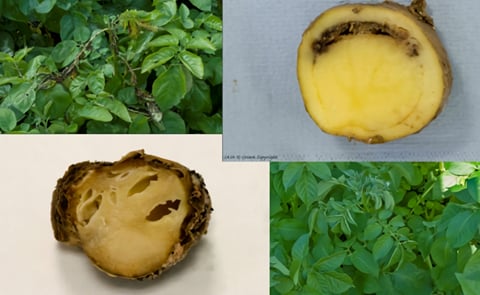
Dickeya dianthicola is a serious bacterium that can cause tuber soft rot and blackleg (shown) in potatoes
(Courtesy: Government of Western Australia)
December 05, 2019
Online tool to detect blackleg disease in potato using DNA testing has widespread application
Scientists have developed a user-friendly online tool called Uniqprimer, which quickly and automatically designs species-specific DNA tags (also known as primers) for detecting pathogens such as Dickeya dianthicola using DNA testing.
Sponsored Content
Sponsored Content
Sponsored Content
Lakesh Sharma, assistant professor with the University of Maine Cooperative Extension and University of Maine Presque Isle, talks about trials using beneficial mycorrhizae fungi in potatoes at the Aroostook Research Farm in Presque Isle on August 8.(Cou
August 12, 2018
Range of potato experiments underway at Maine Research Farm (Aroostook)
Farmers, researchers and members of the public gathered at the University of Maine’s Aroostook Research Farm in Presque Isle last Wednesday to learn about the latest in potato research.
From the archive
Researchers from all over the world were in Bangor for the '2017 Dickeya and Pectobacterium Summit', organized by the University of Maine Extension.
November 17, 2017
Potato researchers gather in Maine to find solutions for the Blackleg disease
Researchers from all over the world were in Bangor for the '2017 Dickeya and Pectobacterium Summit', organized by the University of Maine Extension.
From the archive
Wilting of a potato plant caused by blackleg
August 12, 2017
Scottish Potato Industry unites to fund major Blackleg Research project
In Scotland, a group of major potato businesses and public sector organisations have sponsored a £242,000 (USD 313,000) research project aimed at reducing the impact of potato disease blackleg on the Scottish seed potato industry.
From the archive
The bacterial pathogen Dickeya dianthicola causes a disease called blackleg where potato stems decay. The disease can kill growing plants within a few days.
June 12, 2017
Colorado State University to study the spread of pathogens in US potato crops
Colorado U.S. Senators Michael Bennet and Cory Gardner this week announced that Colorado State University will receive $264,600 in funding from the U.S. Department of Agriculture (USDA) to study the spread of pathogens in U.S potato crops.
From the archive
Potato tuber infected with Dickeya dianthicola, a bacteria that causes the rotting disease blackleg (Courtesy: Steve Johnson)
May 11, 2017
Should Seed Potato Growers start testing for Dickeya?
The potato disease Dickeya can be detected by laboratory testing — but is there enough of it present to justify the higher costs? That is the question facing Canadian Seed Potato Growers exporting to the United States who are increasingly asked for the test.
From the archive
Microtuber potato cultivars used in research by the Wisconsin Seed Potato Certification Program inside an environmentally-controlled growth room at the Biotron Laboratory at UW–Madison. (Courtesy: Bryce Richter)
May 09, 2017
From test tube to plate, UW–Madison program keeps potatoes clean
Years before that french fry landed on your plate, the plant that would eventually give rise to the spud your fry was cut from was sealed away deep in a secure-access building, growing slowly in a test tube inside a locked growth chamber.
From the archive
Sponsored Content

Current Selection 30 items. Refine:

You May Also Like

In potato plants with milder symptoms of Dickeya, leaves are curled. (Courtesy: Amy O. Charkowski)
April 11, 2017
Guarding against Dickeya: testing your seed potatoes
With clean seed potatoes recognized as the best defense against this new blackleg-causing pathogen, the demand for Dickeya testing is growing fast.
From the archive
Three of the AHDB speakers at the Seed Industry Event held in ST. Andrews, Scotland (from left to right): Peter Hardwick, AHDB’s Head of Exports; Rob Burns,Head of Crop Exports Trade Development; Rob Clayton, AHDB Potatoes Strategy Director
November 10, 2016
AHDB committed to keep the UK Seed Potato Industry healthy
AHDB Potatoes has pledged to work closely with the seed potato sector and Scottish Government to ensure that the industry maintains a low level of the bacterial disease blackleg.
From the archive
Potato Plant wilting due to Dickeya (Courtesy: Cornell University)
July 17, 2016
Dickeya Blackleg: New Potato Disease Causing Major Impact
Dickeya blackleg, often just called Dickeya, is a new disease in the United States. It was severe in 2015 at least partly reflecting hotter weather than previous 2 years when the pathogen likely was present and is developing again in 2016.
From the archive
Potato and oat fields can be seen on the last day of planting on June 18 at Hemphill Farms in Presque Isle. The farm rotates fields between oats and potatoes. (Courtesy: Hemphill Farms / Bangor Daily News)
June 27, 2016
Potato planting in Maine complete after winter dealing with Dickeya
Maine potato farmers have wrapped up planting and are hoping for a good year.
From the archive
Blackleg symptoms in the potato plant and tuber.
May 26, 2016
New ‘Focus on Potato’ Webcast Helps Potato Growers Minimize the Spread of Blackleg
Blackleg, caused by strains of soft rot bacteria known as Dickyea, has traditionally had little impact on North American potato production, but it now appears to be on the move throughout Europe and could increasingly threaten growers in the Eastern United States.
From the archive
In this "Focus on Potato" presentation on potato blemishes, Jacquie van der Waals (Professor, Department of Plant Science, University of Pretoria, South Africa) focuses on known biotic causes.
March 23, 2016
Blemishes of Table Potatoes: Common Biotic Causes
Potato tubers are affected by a number of blemishes, which can cause severe economic losses. This 'Focus on Potato' presentation by Jacquie van der Waals, Professor at the University of Pretoria in South Africa can serve as a guide for growers and others in the potato industry to help with identification of these blemishes.
From the archive

Frequently Asked Questions

Will PotatoPro edit my article?

Yes. We edit almost all submitted articles for style and layout. If you notice a change you are not happy with, contact us and we will find a solution. If you submit news before its official publication date, you can review the item privately before it goes live.

How can I get more visibility for my company’s news?

Besides free news publishing, companies can list in the PotatoPro directories, become PotatoPro sponsors, or use targeted email blasts, the Event Promotion Package and social media exposure with analytics. Find out why companies advertise on PotatoPro.

Does PotatoPro delete old news? Can I add older news?

No, we do not delete old news. News on PotatoPro goes back to 2006, and we consider it a valuable historical record of developments in the industry. If we missed a key development in the history of your company, we can still add it.

What can I do after my news is published?

Share the article with your colleagues and on the social media channels where you are active, and add it to the “Company in the news” section of your website if you have one. You are also welcome to point other media to the PotatoPro article, as long as they include a clickable link to the item on PotatoPro.

I have created an account, but I am not receiving the newsletters. What should I do?

Log in to your profile and check that you have opted in to the newsletters you would like to receive. Also check your spam or promotions folder and make sure you registered with the right email address. If you still do not receive them, contact us at info@potatopro.com. For sign-in or password issues, see the PotatoPro Login & Account FAQs.

Is reading news on PotatoPro free?

Yes. All news articles on the PotatoPro website are free to read. The PotatoPro app is also free but requires a free PotatoPro account, which also works on PotatoPro AI.

Where is PotatoPro news published and how can I follow it?

News appears on the PotatoPro News page and in the PotatoPro weekly newsletter, which you can receive by creating a free PotatoPro account. It is also available in the PotatoPro app for iPhone and iPad and Android, and shared on LinkedIn, Facebook, Instagram, X, YouTube, Telegram and Bluesky.

My company is not in the PotatoPro directory. Can I still submit news?

Yes. Companies that are not yet listed can still submit news, and they are also welcome to contact PotatoPro to be added to the Company Directory.

In what languages can I submit news?

You can submit news in any language. PotatoPro publishes in English, Spanish, Dutch and Simplified Chinese, and plans to add German, French, Arabic, Hindi and Portuguese in 2027.

How long does it take for news to be published?

It depends on the timing of the news, the editorial workload and how much editing the article needs. News from PotatoPro sponsors may be given priority.

When should I submit my news?

As soon as possible, and ideally on the day the news becomes public, even if it is only a link to material published elsewhere. Extra material such as videos or illustrations can be added later. You can also send news before it is public, as long as you clearly state the embargo date and time, including the time zone.

Can I include links in my news article?

You can include one dofollow link to an external source in the body of the text. Links to your brands, your company profile, previous news and other content about your company on PotatoPro are mostly added automatically.

Can I include a video in my news article?

Yes. We can embed videos hosted on YouTube or Vimeo. For best results, use HD quality or better, include sound, and keep the video professionally edited, ideally 1.5 to 3 minutes long.

What images should I send with my news?

Every news item on PotatoPro must have an illustration at the top, which is also used in article summaries and social media posts. The best top images are closely related to the story, eye-catching and colorful, in landscape format and at least 1,200 pixels wide. Avoid logos, pictures with a prominent logo and images with a lot of text, because Google and Facebook may not display them. Send high-resolution JPG or PNG files that you own or have permission to use, each with a caption and photo credit, and mention if an image was made using AI. Extra images for the body of the article are welcome.

What are the guidelines for writing a news article?

There is no maximum length, but we recommend more than 300 words, and we do not accept articles of fewer than 200 words. An article cannot consist only of a list; it needs paragraphs of text. Provide factual, useful information, keep sentences short, and write in the third person or include quotes attributed to a named person. Self-praise full of superlatives is unlikely to be published without heavy editing. Keep abbreviations to a minimum, and if English is not your first language, we recommend having your text reviewed by a native English speaker.

What type of news does PotatoPro accept?

PotatoPro accepts industry and company news, product launches, new facilities, appointments, technology and research updates, and other developments in the potato and savory snack industries. Submissions should give industry professionals useful information rather than being purely promotional.

How can I submit news to PotatoPro?

Email your article, press release or company announcement to news@potatopro.com. Send the text in a Word or Google document, or in the body of the email, and attach images separately. We may also pick up stories shared on X that tag @PotatoPro.

Is it free to publish news on PotatoPro?

Yes. News about the potato and snack industries is published free of charge if we consider it relevant. All submissions are subject to editorial review and will be edited for style and layout.

Filters

Refine By Topics
Refine By Regions
Refine By Year
Language preferences