El Niño’s growing impact: extreme heat and flooding threaten global potato harvests, disrupting supply, quality, and food markets worldwide.
El Niño 2026 Impact on Agriculture: How Climate Shifts Threaten Global Potato Supply and Food Security
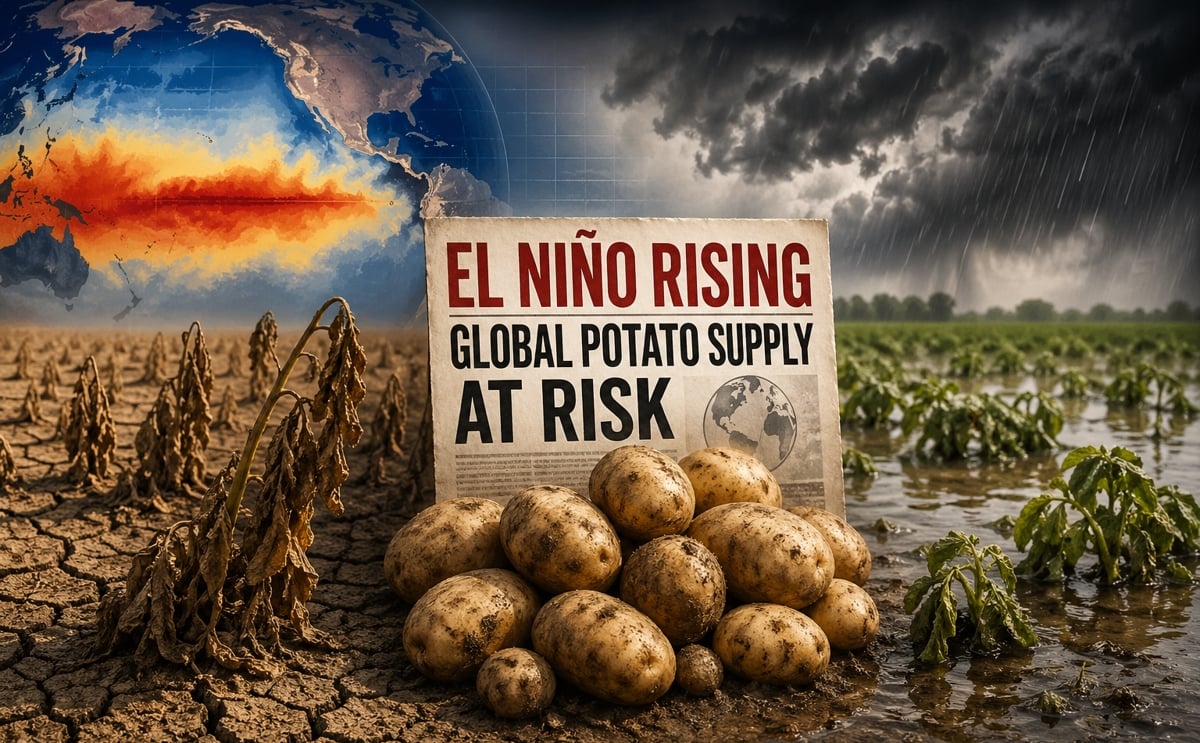
The recurring El Niño climate phenomenon, part of the broader El Niño–Southern Oscillation (ENSO) system, remains a major driver of global climate variability and agricultural risk. As of late April 2026, ENSO-neutral conditions prevail following the recent La Niña, with forecasts indicating a likely transition to El Niño conditions emerging between May and July 2026 (around 60–70% probability) and persisting through at least the end of 2026.
El Niño is best understood not as an isolated event but as part of natural climate variability that can interact with longer-term warming trends to heighten extremes in temperature and precipitation. This variability poses particular challenges for climate-sensitive crops such as potatoes, which require relatively stable temperature and soil moisture conditions for optimal tuber development.
Why Potatoes Are Climate-Sensitive Crops
Potatoes are physiologically sensitive to heat and water stress. Optimal tuber initiation and bulking typically occur under cool conditions, with mean daily temperatures in the range of 15–20°C. Night temperatures above 18–20°C and sustained daytime temperatures above 22–25°C often shift plant resources toward vegetative (leaf and stem) growth at the expense of tuber formation. This results in lower yields, smaller or irregularly shaped tubers, reduced dry matter (starch) content, and elevated reducing sugar levels, which impair processing quality.
Under El Niño conditions, these stresses can intensify. Parts of South and Southeast Asia, including India, often experience delayed or weaker monsoon rainfall and higher temperatures, increasing drought risk. In contrast, certain regions in South America may see above-average precipitation, raising the likelihood of waterlogging or flooding. Both drought and excess moisture disrupt root function and tuber bulking.
Climate Extremes and Regional Production Imbalance
ENSO-driven variability can lead to desynchronized impacts across major potato-producing regions in Asia, Europe, and the Americas. While not every El Niño event affects all zones equally, strong events increase the chance that multiple key production areas experience stress simultaneously—through drought/heat in some and excess rainfall in others.
In water-stressed areas, irrigation demand surges, sometimes exceeding infrastructure capacity. In high-rainfall zones, prolonged soil wetness promotes fungal diseases, notably late blight (Phytophthora infestans), which thrives in cool, moist conditions and can rapidly destroy foliage and reduce marketable yield.
This uneven pattern creates global supply imbalances. Because potatoes are bulky and perishable, surpluses in one region rarely fully offset shortages elsewhere due to high transport costs, storage limitations, and timing mismatches.
Supply Chain Disruptions Beyond the Field
The effects extend through the entire supply chain. Potato quality for industrial processing depends heavily on consistent dry matter, starch content and low reducing sugars. Heat and water stress during growth can lower specific gravity and increase sugar levels, leading to higher oil absorption, darker color, and poorer texture in products like frozen fries, chips and flakes.
Inconsistent harvest volumes also strain contract farming arrangements. Processors facing shortfalls must source from distant or lower-quality suppliers at higher cost. Warmer conditions further raise energy expenses for cold storage and increase post-harvest losses.
Price Volatility and Market Sensitivity
Climate-related production shocks frequently drive price volatility in both fresh and processed potato markets. In countries where potatoes are a dietary staple, tighter supply can contribute to food inflation. Trade adjustments occur, but the crop’s perishability and bulk limit rapid global redistribution compared to grains. Export-oriented regions may gain from higher prices, while import-dependent areas face greater pressure.
Processing Industry Under Quality Pressure
Industrial processors require uniform raw material. Even modest deviations in tuber composition raise rejection rates, reduce extraction efficiency and increase sorting and production costs. This squeezes margins, particularly in competitive export markets with strict quality standards.
Contract farming systems, designed to stabilize supply, become more vulnerable under climate stress, often leading to renegotiations or shortfalls between growers and buyers.
Uneven Global Impact and Trade Shifts
Impacts vary significantly by region. Areas with advanced irrigation, resilient varieties and strong infrastructure tend to fare better, while rainfed systems face higher exposure. Temperate zones may occasionally benefit from milder conditions, whereas tropical and subtropical regions typically experience greater variability. Structural constraints in storage and logistics limit the ability of global markets to fully compensate for regional deficits.
Long-Term Outlook: Climate Variability as a Structural Risk
Scientific evidence indicates that ENSO variability will continue to interact with anthropogenic climate change, potentially amplifying the frequency and intensity of extreme weather events in many regions. This elevates climate risk from a purely cyclical issue to a more persistent structural challenge for potato production.
In response, the sector is advancing adaptation measures, including the development and adoption of heat- and drought-tolerant varieties, improved irrigation efficiency, precision agriculture techniques, enhanced disease management and expanded cold-chain infrastructure. Climate-informed forecasting tools are also gaining importance for planting and procurement decisions.
Conclusion: A Stress Test for Global Potato Systems
The El Niño cycle underscores a core vulnerability in the global potato system: its dependence on stable temperatures and water availability during critical growth stages. While potatoes rank among the world’s most productive and nutritious crops, their sensitivity to climate extremes makes them an important indicator of broader agricultural risk.
As climate variability increases, the key challenge shifts from simply boosting production to building system-wide resilience — across farms, processing, storage, and trade. The coming years will test whether the potato sector can move from reacting to shocks toward proactive, climate-resilient strategies.
Like to receive news like this by email? Join and Subscribe!
Get the latest potato industry news straight to your WhatsApp. Join the PotatoPro WhatsApp Community!
相关新闻
九月 07, 2026
Calbee Potato Harvest Ceremony 2026 Highlights Stronger Hokkaido Potato Quality and Yield
Calbee Potato expects Hokkaido’s 2026 processing potato crop to reach 240,000–250,000 tons, with better quality and yields than 2025. Favorable temperatures and rainfall have boosted growth, although heavy rain remains a major harvest risk now.

九月 07, 2026
Aardappeldemodag 2026 Draws Over 4,500 Visitors as Dutch Potato Sector Faces Year of Extremes
Aardappeldemodag 2026 brought over 4,500 visitors to Westmaas amid a challenging year for the Dutch potato sector. The event focused on market pressures, extreme growing conditions, knowledge sharing, machinery and innovation.

九月 07, 2026
EUROPLANT与Finpom强调芬兰种薯优势,应对欧洲日益加剧的病毒压力
Finpom强调芬兰北部在高等级种薯生产方面的优势,因为气候变化提高了欧洲的病毒风险,同时通过LARISSA、JUVENTA、Filipa、FAVOLA和INA扩展了其EUROPLANT产品组合。