

Corn Masa: From Traditional Nixtamalization to Global Food Industry
Corn masa is a traditional alkaline-processed maize dough used to make tortillas, tortilla chips, taco shells and tamales. Originating in Mesoamerica thousands of years ago, this food-processing tradition relies on nixtamalization, a technique in which dried maize kernels are cooked and steeped in an alkaline solution, usually food-grade calcium hydroxide (lime). The process changes the kernels' texture, flavour, nutritional composition and functional properties, making the maize suitable for a wide range of food applications.
Today, nixtamalization connects traditional food preparation with modern food manufacturing. Fresh masa and masa harina are used by tortilla producers, snack manufacturers, foodservice operators and retail brands across international markets. While fresh masa is a moist dough ready for further processing, masa harina is a dried flour that can be rehydrated to produce dough. Both are important ingredients in the production of traditional maize-based foods and commercially manufactured snacks.
The nutritional benefits of nixtamalization include increased calcium content and improved niacin bioavailability, although the final nutritional value depends on the processing method and overall diet. At industrial scale, manufacturers must also manage raw material quality, cooking conditions, moisture, texture, consistency and wastewater generation. These factors influence product performance, manufacturing efficiency and environmental impact.
The global corn masa industry is evolving alongside international demand for tortillas, tortilla chips and other maize-based products. GRUMA, the Mexican multinational behind the Maseca and Mission brands, is one of the world's leading producers of corn flour and tortillas. Market research published by Fortune Business Insights estimated the global nixtamalized corn flour market at USD 3.67 billion in 2025 and forecast it to reach USD 6.27 billion by 2034. These figures represent third-party market estimates, while the wider industry also includes fresh masa, finished tortillas, snacks and other related products.
Understanding corn masa therefore requires examining more than its traditional origins. Its production technology, nutritional characteristics, industrial applications, leading manufacturers, market opportunities and sustainability challenges all contribute to its growing importance in the global food industry.
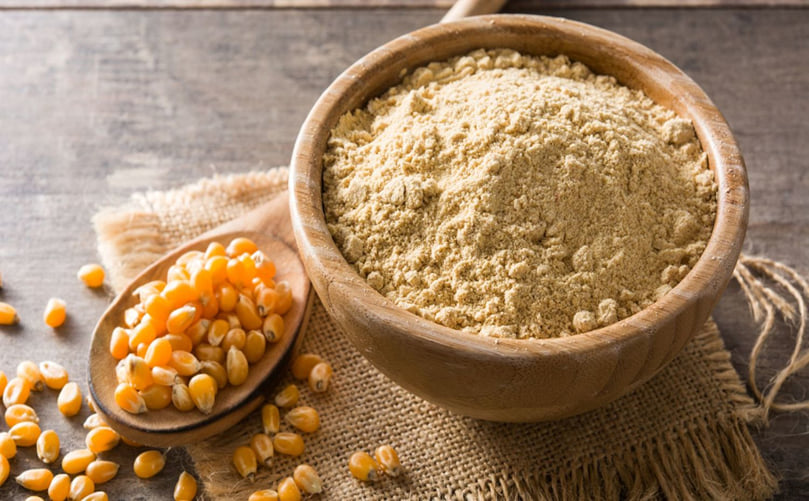
Corn Masa: The Foundation of Tortillas and Corn Chips
What Is Corn Masa?
Corn masa is a soft, pliable dough made by grinding maize kernels that have been cooked and steeped in an alkaline solution, usually containing food-grade calcium hydroxide (slaked lime). This process, known as nixtamalization, changes the maize's texture, flavour, nutritional properties and processing characteristics. The treated kernels are called *nixtamal*, while the ground dough is known as *masa*. The word *masa* comes from Spanish, while *nixtamal* derives from the Nahuatl language of Mesoamerica.
Corn masa is widely used to manufacture tortillas, tortilla chips, taco shells, tamales and other maize-based foods. In commercial production, its moisture content, texture and dough-handling properties influence manufacturing efficiency and final product quality.
Main Ingredients and Raw Materials
Traditional corn masa requires three primary ingredients: dried, mature maize kernels, food-grade calcium hydroxide and water. Dent maize and other suitable field-maize types are commonly used, depending on the intended product and processing method. Calcium hydroxide, also known as slaked lime, creates the alkaline conditions required for nixtamalization, while water is used for cooking, steeping, washing and adjusting the dough's moisture content.
Industrial masa formulations may also include preservatives to extend shelf life, hydrocolloids such as guar gum or carboxymethyl cellulose (CMC) to improve dough handling and moisture retention, enzymes to modify functional properties, or acidulants to adjust acidity. The use of these ingredients depends on the formulation, manufacturing requirements and applicable food regulations. They are not essential components of traditional corn masa.
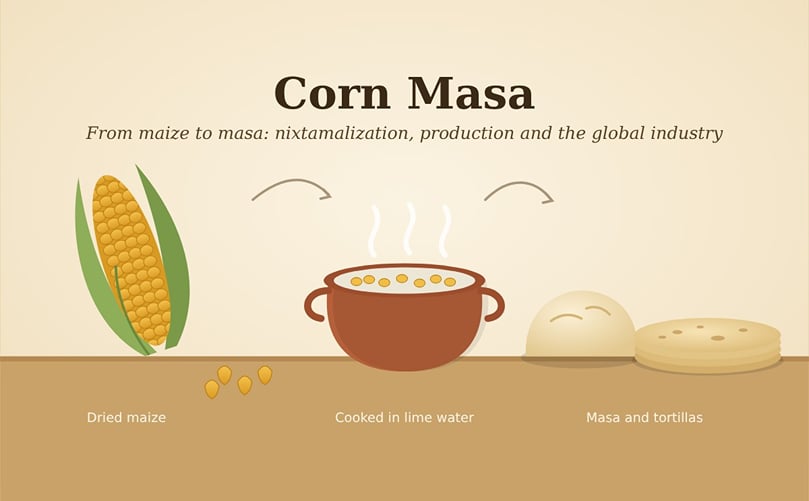
Corn Masa Production: From Nixtamalization to Tortillas and Corn Chips
Corn masa vs. masa harina vs. cornmeal vs. corn flour
These four terms are often confused, especially outside the Americas:
- Fresh corn masa is wet dough (roughly 50–58% moisture) made from freshly ground nixtamal. It is perishable: it is used the same day at room temperature, or within a few days if chilled.
- Masa harina (nixtamalized corn flour, sometimes called instant masa flour) is fresh masa that has been dehydrated and milled into a shelf-stable powder. Adding water turns it back into dough.
- Cornmeal is dry-milled maize that has not been nixtamalized. It is gritty, does not form a cohesive dough, and is used for cornbread, polenta and coatings.
- Corn flour usually means finely ground, untreated maize. In British English "cornflour" means pure corn starch, which adds further confusion for global readers.
The key difference is nixtamalization: only masa and masa harina have been alkaline-cooked, which is why only they can be pressed into a tortilla that holds together.
Corn masa vs. arepa flour (masarepa)
Global readers often meet a fifth product on the same supermarket shelf: arepa flour, also called masarepa, sold under brands such as Harina P.A.N. It is made from maize that has been precooked but not nixtamalized, so it has no lime flavour and gives a different dough. Arepa flour is right for Venezuelan and Colombian arepas; masa harina is right for tortillas, tamales and pupusas. They are not interchangeable (America's Test Kitchen).
Traditional and industrial uses: In Mexican and Central American households and small molinos (mills), fresh masa is still ground daily for tortillas, tamales, sopes, gorditas, pupusas and atole drinks. At industrial scale, masa and masa harina are the base for packaged tortillas, tortilla chips, taco shells, tostadas, frozen tamales and food-service ingredients sold across North America, Europe, the Middle East and Asia.
What Is Nixtamalization?
Nixtamalization is the process of cooking and steeping dried maize in an alkaline solution, then washing and grinding it. It is what turns ordinary grain into masa, and it changes the kernel's structure, chemistry, flavour and nutrition all at once.
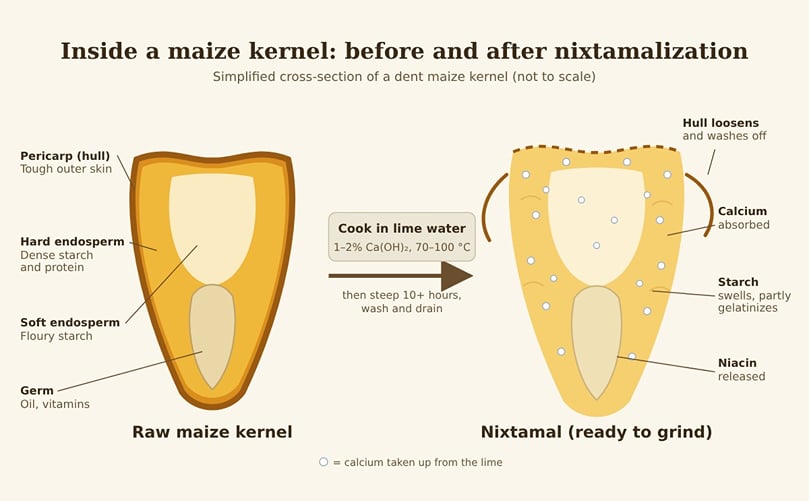
Inside a maize kernel before and after nixtamalization. Illustration created for this article.
Definition and history
The technique was developed in Mesoamerica — present-day Mexico and Central America. The earliest evidence, from Guatemala's southern Pacific coast, dates to roughly 1500–1200 BCE, some 3,200–3,500 years ago. Aztec and Maya cooks used slaked lime, wood ash or crushed shells to make alkaline cooking water. When maize spread to Europe, Africa and Asia after 1492, the grain travelled but the process did not. Populations that relied on untreated maize — in 18th- and 19th-century Spain and northern Italy, the early-20th-century US South, and later parts of Africa and Asia — suffered outbreaks of pellagra, a niacin-deficiency disease that was rare in Mesoamerica itself.
How pellagra proved the value of lime cooking
The pellagra story is the clearest proof of what nixtamalization does. The Spanish physician Gaspar Casal first described the disease among maize-eating peasants in 1735. By 1912, South Carolina alone reported about 30,000 cases, with a fatality rate of around 40%. From 1914, the US Public Health Service doctor Joseph Goldberger showed through diet experiments that pellagra was caused by poor diet, not infection. In 1937, Conrad Elvehjem identified the missing nutrient as niacin (US National Library of Medicine, Texas Medical Center Library). Mesoamerican cooks had been releasing that niacin with lime for some 3,000 years.
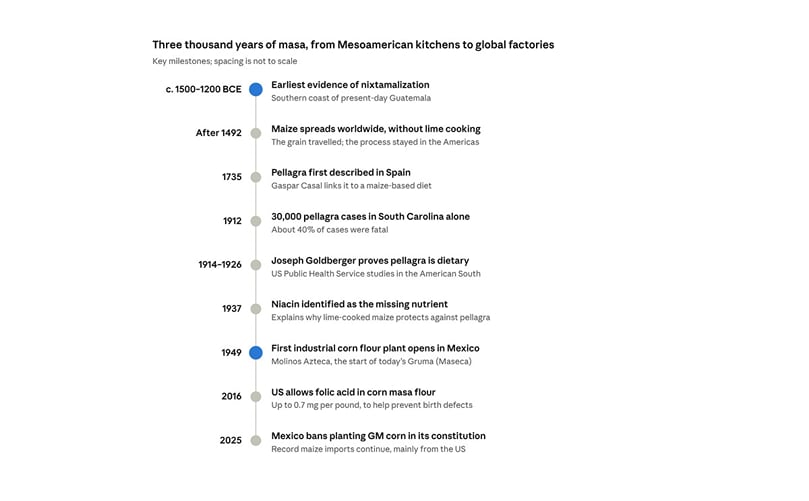
Key milestones in the history of masa and pellagra.
The industrial era of masa began only in 1949, when the first industrial corn flour plant opened in Mexico.
The role of calcium hydroxide (lime)
Food-grade calcium hydroxide, Ca(OH)₂, is the standard alkali. Concentrations of roughly 0.5–2% of corn weight are common, with about 1–2% typical in industrial practice. The lime does several jobs at once: it loosens the hull, swells and partly gelatinizes the starch, adds calcium, releases niacin and creates the typical tortilla flavour (see Figure 5).
- Cooking. In the traditional method, one part maize is cooked in about two parts lime water near boiling, typically for 5–45 minutes depending on kernel hardness.
- Steeping. The maize rests in the warm cooking liquor as it cools, traditionally for 12–18 hours. Calcium keeps diffusing into the kernel throughout.
- Draining and washing. The cooking liquor, called nejayote, is drained off. It is highly alkaline (pH 11–12) and carries dissolved hull, germ and starch. The nixtamal is then washed to remove excess lime and loose pericarp.
- Grinding. The washed nixtamal is stone-ground with a little water into fresh masa.
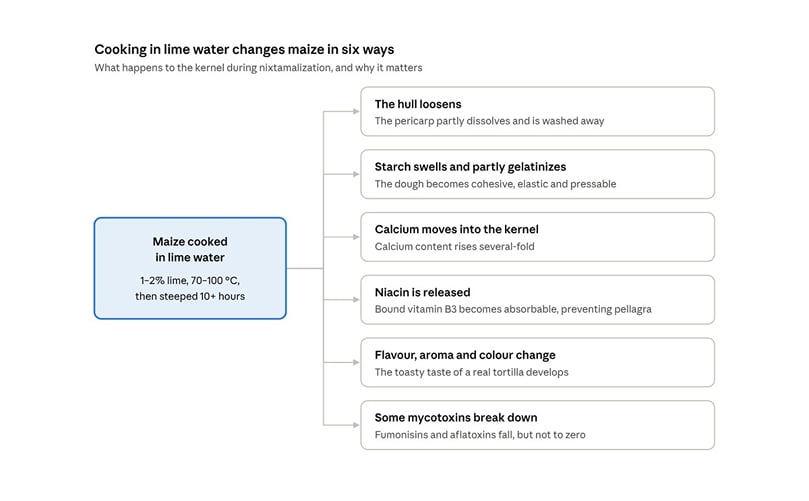
Six effects of nixtamalization on a maize kernel.
One step, six changes: the same lime cook that makes masa pressable also makes it more nutritious and safer.
Modern variants include short-time industrial cooking, extrusion nixtamalization, ohmic heating, enzymatic nixtamalization (protease enzymes at about 50–60 °C, with the whole process taking around four hours), and "ecological" nixtamalization, which replaces most or all of the lime with calcium salts such as calcium carbonate or calcium chloride to produce far less alkaline wastewater.
How Is Corn Masa Produced?
Industrial masa production follows the same logic as the village mill — clean, cook in lime, steep, wash, grind — but at tonnes per hour, with tight control of time, temperature, lime dosage and particle size. Plants then either send fresh masa straight to tortilla and chip lines, or dry and mill it into masa harina.
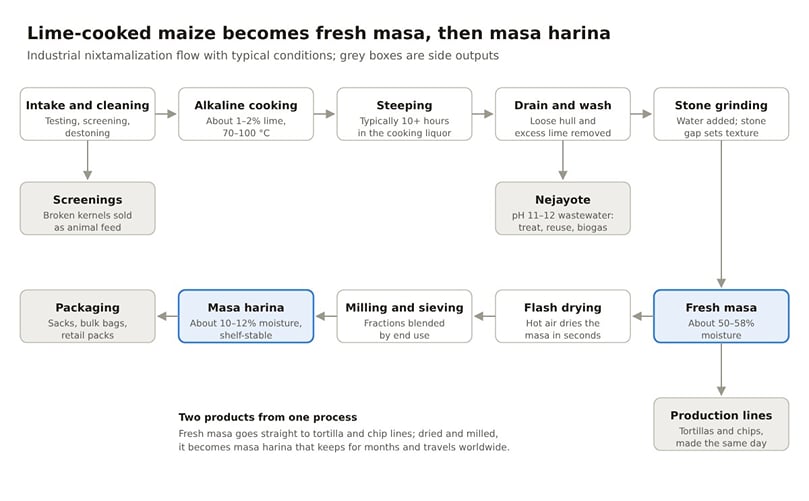
Corn masa and masa harina production process.
Fresh masa is the halfway point: it either goes straight to tortilla and chip lines, or continues through flash drying and milling to become shelf-stable masa harina.
Corn selection and cleaning: Mills buy food-grade dent maize to a specification for moisture, kernel hardness, broken kernels, foreign material and mycotoxins. On arrival, grain is sampled and tested (often with rapid aflatoxin and fumonisin strip tests), then cleaned through scalpers, aspirators, destoners and magnets. Removing broken and mouldy kernels at this stage is one of the most effective mycotoxin controls in the whole chain.
Alkaline cooking and steeping: Maize, water and lime are loaded into steam-jacketed kettles or continuous cookers. Conventional industrial practice uses about 1–2% lime on corn weight and cooks at roughly 70–100 °C for about 20–100 minutes, depending on kernel hardness and the target product. The batch then steeps in soak tanks, typically for more than 10 hours. Accelerated steam-cooking systems use about 0.3–1.5% lime and cut steeping to around an hour, and many plants quench the corn with cold water to stop cooking precisely.
Cook and steep conditions are tuned by product: tortilla masa needs more gelatinization and calcium for softness and rollability; chip masa is usually cooked less for a coarser, crisper texture with lower oil pick-up.
Washing and draining: The nejayote is drained, and the nixtamal is washed in drums or screw washers to strip loose pericarp and excess lime. Washing intensity is a trade-off: more washing gives a lighter colour and lower pH, but removes more solids and uses more water.
Grinding and dough preparation: Washed nixtamal is ground between grooved volcanic-stone or synthetic stone mills, with water added to control dough moisture. The gap between the stones sets the particle size — finer for soft table tortillas, coarser for chips. Fresh masa leaves the mill at roughly 50–58% moisture and goes directly to sheeters and cutters.
Drying and milling for masa harina: To make masa harina, the freshly ground masa is fed into a flash dryer, where hot air dries it in seconds while a hammer mill breaks it apart. The flour is then cooled, sieved and re-milled until it meets a target particle-size distribution. Many plants blend different fractions to create flours for specific uses — tortillas, chips, tamales or snacks. Commercial masa harina is typically dried to around 10–12% moisture.
Packaging and storage: Masa harina is packed in multi-wall paper sacks (often 20–25 kg) for industry, bulk bags or silos for large tortilla plants, and 1–2 kg retail packs. Fresh masa is moved in food-grade tubs or bags and kept chilled. Shelf life and storage conditions are covered in section 10.
Inside a real plant: Published plant data show what these steps look like in practice. In one Mexican nixtamalization plant studied in the Revista Mexicana de Ingeniería Química, each 700 kg batch of maize was cooked in 850–900 litres of water at about 87 °C with 8.3 kg of lime (about 1.2% of the corn weight). Cooking took 38–45 minutes, steeping 9–21 hours, and the resulting masa held 52.9–55.3% moisture (Revista Mexicana de Ingeniería Química).
Yields depend on how much solid matter escapes into the cooking and wash water. Patent literature puts dry-matter losses at about 7–9% in modern continuous plants and 11–13% in small-scale cooking. Traditional lime cooking turns each kilogram of maize into about 0.87–0.89 kg of masa harina, and newer pressure-cooking processes reach 0.90–0.92 kg (Canadian Patent 2426759).
Corn Masa Types and Their Applications in the Food Industry
Masa is sold in two physical forms fresh dough and dry flour and in several colours and formulations, each suited to different products and markets.
Fresh corn masa: Fresh masa is ground nixtamal, still moist and ready to shape. It gives the most aromatic, tender tortillas and is preferred by traditional tortillerías and premium taco restaurants. Its weakness is shelf life: at room temperature it starts to sour quickly, so tortillerías grind it fresh every day. Fresh masa still dominates in Mexico's neighbourhood tortilla shops and is the norm on most industrial chip lines, where masa is milled minutes before sheeting.
Dried masa and masa harina: Masa harina (nixtamalized corn flour) is dried and milled fresh masa. Adding warm water turns it back into dough in minutes . It travels well, stores for months and removes the need for cooking equipment and wastewater treatment at the customer's site. That convenience is why masa harina is the main way masa reaches tortilla makers in Europe, the Middle East, Asia, Africa and Oceania.
Yellow corn masa: Made from yellow dent maize, yellow masa has a golden colour from carotenoids (lutein and zeaxanthin) and a slightly sweeter, richer flavour. It is common in US tortilla chips and taco shells, and in many export markets where yellow maize is the cheaper, more available grain.
White corn masa: White masa is the standard for table tortillas in Mexico and Central America and for many restaurant-style chips. It gives a clean, neutral flavour and a bright appearance. Food-grade white maize usually commands a premium over yellow feed corn.
Blue corn masa: Blue and purple masa comes from native pigmented maize rich in anthocyanins. Alkaline cooking shifts these pigments toward grey-green or blue-grey and destroys part of them, so processors often use lower lime levels or acid adjustments to protect the colour. Blue masa is used for specialty tortillas, chips and tlacoyos, and is marketed for its antioxidant content and artisanal appeal.
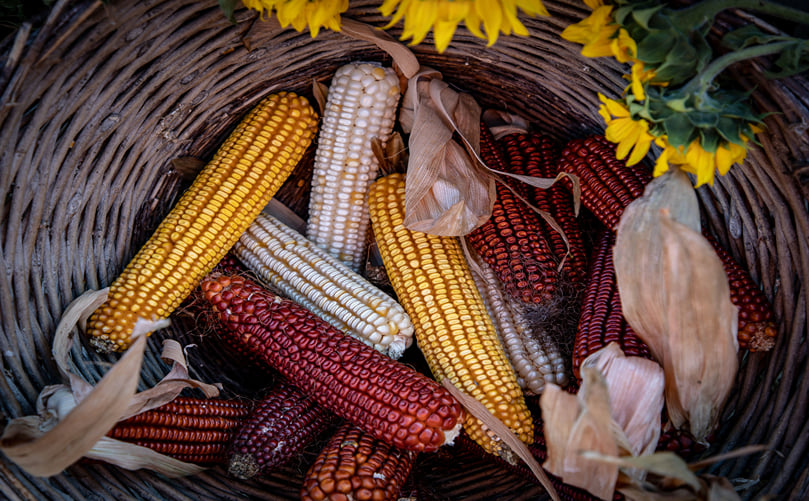
White, yellow, blue and red maize used for corn masa.
Industrial Masa Flour Formulations for Different Food Applications
Mills design formulations for specific end uses:
- Tortilla flours with finer particles, higher water absorption and added gums (around 0.5%) to keep tortillas soft and rollable
- Chip and snack flours with coarser particles for crunch and controlled oil absorption
- Tamale flours with a coarser grind for fluffy, spoonable dough
- Fortified flours with added iron, zinc, folic acid and B vitamins, mandatory or voluntary depending on the country
- Preserved masa with acidulants or antimicrobials such as fumaric acid, propionates or sorbates for longer fresh shelf life
- Organic, non-GMO, whole-grain or heirloom lines for premium and clean-label customers
Corn Varieties and Raw Material Selection
Good masa starts with the right maize. Variety, kernel hardness, moisture and contamination largely decide cooking time, yield, dough quality and food safety before the corn ever reaches the kettle.
Yellow, white and specialty-colour maize
- White dent maize is the preferred tortilla grain in Mexico, Central America and southern Africa. The US, Mexico and South Africa are major growers of food-grade white corn.
- Yellow dent maize is the world's dominant traded grain and is widely used for chips, shells and masa harina outside Mexico.
- Blue, purple, red and other native landraces are grown in smaller volumes, mostly in Mexico and the US Southwest, for specialty and premium products.
Kernel hardness and composition
Kernel hardness (the ratio of hard, vitreous endosperm to soft, floury endosperm) strongly affects processing. Harder kernels need longer cooking and absorb water more slowly, but give higher masa yield and less loss to nejayote. Softer, floury kernels cook fast but can become overcooked and sticky. Mills check hardness with tests such as floaters (the share of kernels that float in a sodium nitrate solution), test weight and 100-kernel weight.
A typical dent kernel is about 70–75% starch, 8–11% protein, 4–5% oil and 7–9% fibre on a dry basis. Pericarp thickness also matters: a thick hull needs more lime or longer cooking to remove.
Moisture content and storage conditions
Maize for masa is generally bought at or below about 14–15% moisture. Wetter grain risks mould growth and mycotoxin formation in silos. Good storage practice means drying promptly after harvest, aerating silos to keep grain cool, controlling insects, and turning stock over on a first-in, first-out basis.
Raw material quality and processing suitability
Typical mill specifications cover:
- Moisture, test weight and kernel size
- Broken kernels and foreign material
- Stress cracks (which raise cooking losses)
- Hardness and pericarp removal behaviour
- Colour, odour and insect damage
- Pesticide residues and GMO or non-GMO status where required
Many mills pre-test each new lot in a pilot cook to set lime dose and cook time before full production.
Food safety and mycotoxin management
Maize is prone to aflatoxins (from Aspergillus moulds, favoured by heat and drought) and fumonisins (from Fusarium). Both are regulated; section 10 sets out the US and EU limits and the controls mills use.
Nixtamalization itself helps. Studies summarized by the University of Nebraska–Lincoln report fumonisin B1 reductions of roughly 80–100% under some alkaline boiling conditions and total aflatoxin reductions of about 52–85% in traditional processing. But some aflatoxin can re-form when masa is acidified, so alkaline cooking is a safety net, not a substitute for clean grain.
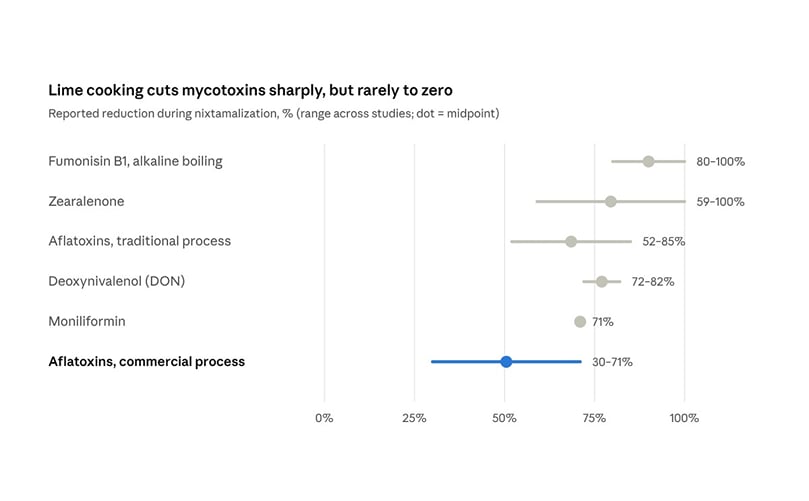
Mycotoxin reduction during nixtamalization.
The commercial process, highlighted, shows the widest gap: industrial cooks are shorter, so some aflatoxin can survive. Clean, tested grain remains the first line of defence.
Applications of Corn Masa in the Food Industry
Tortillas and tortilla chips account for the bulk of global masa demand, but the same dough feeds a wide family of traditional foods, restaurant menus and industrial ingredients.
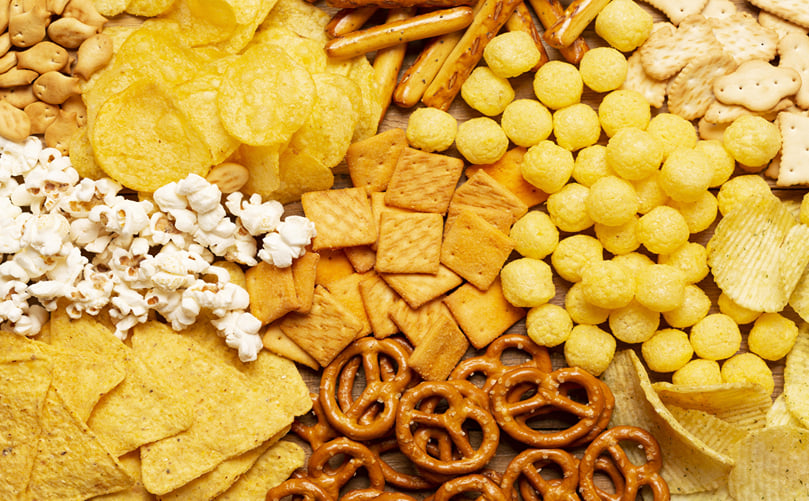
One dough, many foods: the corn masa product family
Tortilla production: Industrial corn tortilla lines take fresh masa or rehydrated masa harina through a sheeter with engraved rollers or a hydraulic press, cut discs, and bake them in a three-tier gas oven at about 280–300 °C for 20–45 seconds. Tortillas then cool on multi-tier conveyors, are counted, stacked and packed. Equipment makers such as Lawrence Equipment and Casa Herrera build lines ranging from compact units for single restaurants to continuous high-speed lines for large plants. A good corn tortilla "puffs" in the oven, stays soft for days, and rolls without cracking.
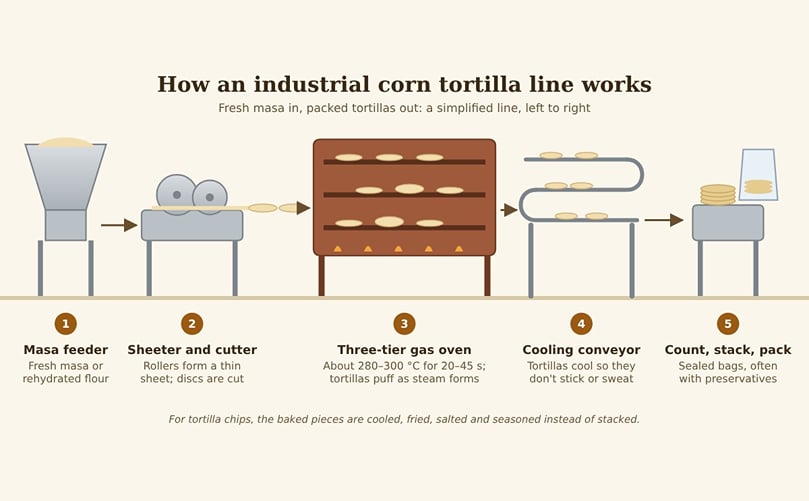
How an industrial corn tortilla production line works
Tortilla chips and corn chips: The two snacks are often confused
- Tortilla chips are cut from sheeted masa, usually toasted or baked first, then fried. Pre-baking lowers moisture and reduces oil uptake. Restaurant-style, triangle, round and "scoop" chips are all tortilla chips.
- Corn chips are made from a coarser masa extruded straight into hot oil without baking, which gives a thicker, crunchier, oilier chip.
Chip masa is typically cooked less and ground coarser than tortilla masa to deliver crunch and control oil absorption.
Tacos, tostadas and other tortilla-based products: Masa is pressed into taco shells (fried in U-shaped moulds), flat tostadas (baked or fried until crisp), and thicker products such as sopes, gorditas, huaraches, tlacoyos and Salvadoran pupusas. Frozen and chilled versions of these items are sold to food service and to supermarkets outside Mexico.
Tamales and traditional foods: Tamale masa is mixed with fat, broth and baking powder, spread on corn husks or banana leaves, filled and steamed. Masa is also thinned into hot drinks such as atole and champurrado, and used to thicken soups and stews like pozole and chili.
Selected extruded snacks and specialty corn products: Masa harina and nixtamalized grits are used in some extruded puffs, crackers, crispbreads, gluten-free baking mixes, breadings and coatings. Snack makers value masa flour for its authentic tortilla flavour, which plain corn grits cannot deliver.
Food-service and industrial ingredient applications: Quick-service and fast-casual restaurant chains buy fresh masa, par-baked tortillas or masa harina to make tacos, nachos and bowls on site. Food manufacturers use masa flour in ready meals, frozen burritos and enchiladas, meal kits, snack seasonings and pet food. In Europe, the Middle East and Asia, imported masa harina allows local tortilla and chip production without nixtamalization plants.
Quality Parameters in Corn Masa Production
Masa quality is judged by how it behaves on the line and how the finished tortilla or chip looks, tastes and keeps. The parameters below are the ones mills and snack makers track most closely.
Moisture content: Fresh table-tortilla masa is commonly ground to about 55–58% moisture, while chip dough is usually sheeted at around 45–55%. Finished tortilla chips leave the fryer at only about 1–2.5% moisture. Masa harina is dried to about 10–12%. Too wet, and masa sticks to rollers; too dry, and tortillas crack and chips become hard. Moisture is checked by oven or infrared moisture analysers at the mill and at the sheeter.
Particle-size distribution: Particle size controls water absorption, texture and oil pick-up. Fine flour hydrates quickly and gives soft, smooth tortillas; coarse flour gives crunchy chips and fluffy tamales. Mills measure distribution with stacked sieves (for example US 20, 40, 60 and 100 mesh) and blend fractions to hit each customer's target curve.
Dough consistency and machinability: Good masa is cohesive, not sticky, and releases cleanly from rollers and cutters. Mills assess it with water absorption index, texture analysers and viscosity tests such as the Rapid Visco Analyser (RVA), which show how starch swells and gelatinizes. Line operators still rely on feel: a well-adjusted masa sheets evenly with no tearing.
pH and residual alkalinity: In a 2023 study of Mexican maize, masa made from fresh nixtamal measured about pH 7.5–8.7, while samples made from commercial dry masa flours measured about pH 5.7–6.8, reflecting the acidulants many flours contain. Higher pH gives stronger corn flavour, a more yellow colour and a firmer, more resistant tortilla; too high gives bitterness and off-colours. Some products, such as high-pH "taquería-style" flours, intentionally push alkalinity for flavour. Calcium content is often tested alongside pH.
Colour, flavour and texture: Colour is measured with colorimeters (L*, a*, b* values) against customer standards. Sensory panels check aroma, sourness, bitterness and "limey" notes. Finished tortillas are tested for rollability, puffing, tear strength and staling; chips for crunch, blistering, oil content and breakage.
Microbiological quality: Fresh masa is a moist, near-neutral, starch-rich food that supports fast microbial growth. Mills monitor total plate count, yeasts and moulds, coliforms and, where relevant, Bacillus cereus, Salmonella and Staphylococcus aureus. Masa harina has low water activity and is far more stable, but still needs monitoring.
Quality assurance and process control: Modern plants combine HACCP-based food-safety plans with GFSI-recognized certification (such as BRCGS, SQF or FSSC 22000), incoming-grain testing, inline moisture and temperature sensors, and statistical process control on cook time, lime dose, steeping time and stone gap. Consistency is the main goal: a snack maker wants the same masa every hour, every day, from every lot of corn.
Nutritional Value of Corn Masa
Masa is a whole-grain-based, naturally gluten-free carbohydrate food, and nixtamalization makes it more nutritious than plain cornmeal in two important ways: more available niacin and much more calcium.
Carbohydrates, protein and dietary fibre: According to USDA FoodData Central, 100 g of dry, unenriched masa harina provides approximately 370 kcal of energy, 77 g of carbohydrates, 8 g of protein, 4.5 g of fat and 7 g of dietary fibre.
Cooking and cooling masa products can increase resistant starch formation, depending on processing and storage conditions. Maize protein is relatively low in lysine and tryptophan, while combining tortillas with beans improves the overall amino acid balance of the meal.
Calcium and other minerals: The same USDA record lists about 110 mg calcium, 93 mg magnesium, 241 mg phosphorus, 280 mg potassium, 1.7 mg iron and 1.6 mg zinc per 100 g. The calcium is the striking figure: raw yellow maize contains only about 7 mg per 100 g, according to the same USDA database. On these USDA figures, masa harina carries about 16 times the calcium of raw maize, and in Mexico tortillas are a major dietary calcium source.
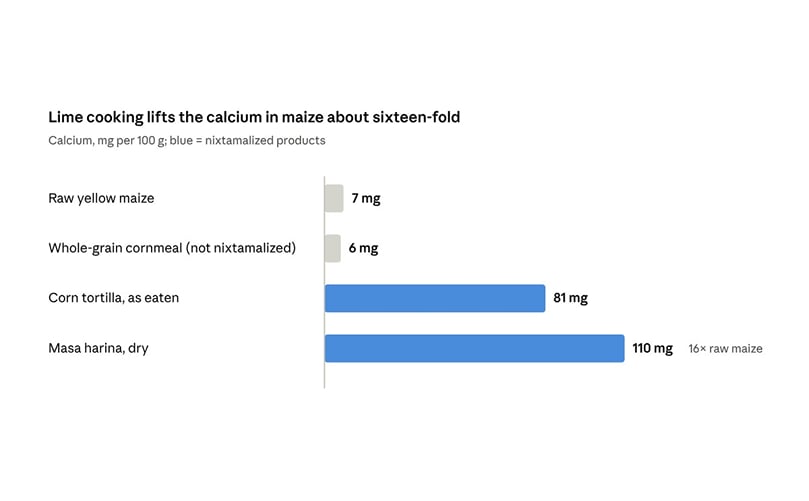
Calcium in raw maize, cornmeal, corn tortillas and masa harina.
The tortilla figure is lower than the flour's mainly because a ready-to-eat tortilla is roughly half water.
Nixtamalization and niacin bioavailability: Most of the niacin (vitamin B3) in mature maize is chemically bound and cannot be absorbed. Alkaline cooking releases it. Nixtamalization also improves the ratio of leucine to isoleucine, which lowers the body's niacin requirement. This is why lime-cooked maize protects against pellagra.
Nutrient changes during processing: Not every change is positive. Some thiamin (B1), riboflavin (B2), fat and insoluble fibre are lost with the pericarp and nejayote. Phytic acid is partly reduced, which may improve mineral absorption. Blue corn loses part of its anthocyanins at high pH. To offset losses, many countries fortify masa flour — Mexico's standard NOM-247 requires nixtamalized corn flour to carry iron, zinc, folic acid and vitamins B1, B2 and B3 (though independent tests in 2018 found no corn flour sample adequately fortified), and since April 2016 the United States has allowed voluntary folic acid fortification of corn masa flour at up to 0.7 mg per pound, to help prevent neural tube defects in babies (Nutrition Insight).
Differences between masa and finished snack products: A plain corn tortilla is a relatively lean food: masa, water and sometimes a little salt. Tortilla chips and corn chips are different products nutritionally because frying adds fat, salt and seasonings. USDA data list about 472 kcal and 21 g of fat per 100 g of plain salted white-corn tortilla chips, against about 4.5 g of fat in the same weight of masa harina. Baked chips, air-popped masa snacks, and tortillas made with whole-grain or heirloom maize are the healthier options in the category.
Corn Masa vs. Cornmeal vs. Masa Harina
Section 1 defines the three products. This section compares how they behave in practice, which matters for recipe developers, buyers and importers.
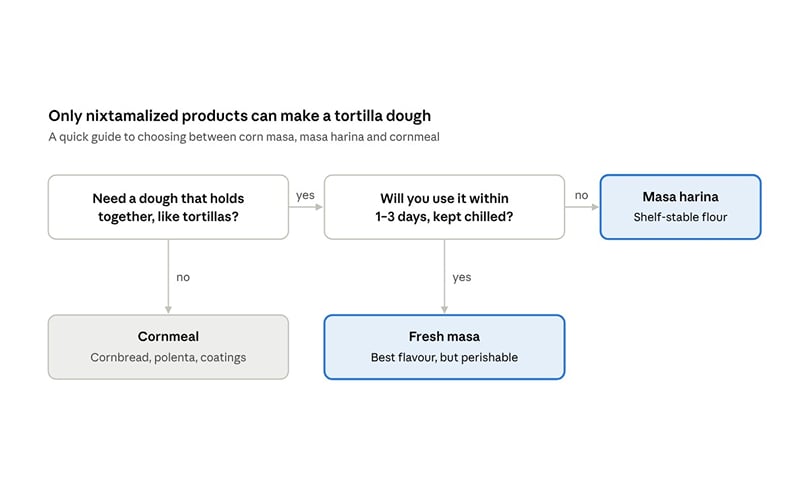
How to choose between corn masa, masa harina and cornmeal.
Nutritional and functional differences
- Niacin and calcium: masa and masa harina have available niacin and far more calcium; cornmeal does not, unless enriched.
- Dough-forming ability: gelatinized starch and calcium let masa and masa harina form a cohesive, pressable dough with only water. Cornmeal makes a crumbly mixture that needs wheat flour, eggs or binders to hold together.
- Flavour: masa has the distinctive nixtamal aroma; cornmeal tastes of plain toasted corn.
- Texture: cornmeal is gritty and suits cornbread, polenta, grits, muffins and coatings.
How to make tortillas from masa harina
For home cooks, restaurants and test kitchens outside the Americas, masa harina is the easiest way to make real corn tortillas:
- Mix masa harina with warm water, about 1 to 1.3 parts water to 1 part flour by weight, and knead until the dough is soft and smooth.
- Rest and roll. Cover the dough and let it rest so the flour can fully absorb the water, then roll it into balls. In one tortilla study, 30 g balls pressed to about 12.5 cm across and 1 mm thick (Revista Mexicana de Ingeniería Química).
- Press each ball in a tortilla press between two sheets of plastic.
- Cook on a hot, dry griddle (comal), turning until both sides have brown spots. A well-made tortilla often puffs as steam forms inside.
If the edges crack when pressed, the dough is too dry: add a little more water.
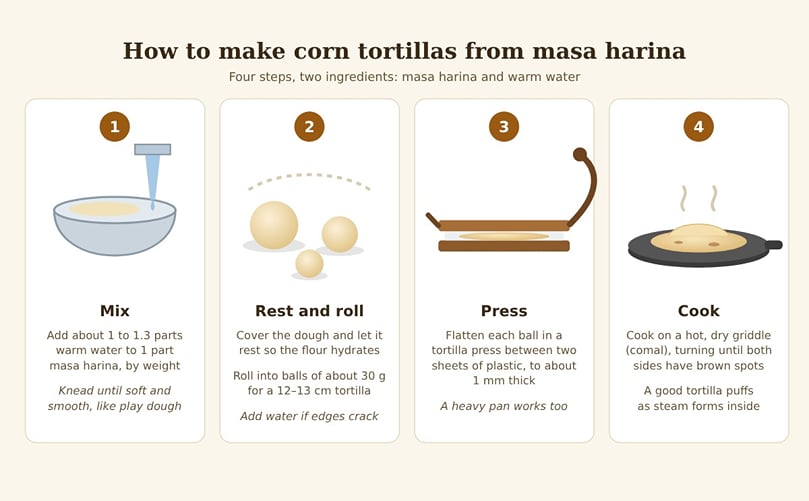
How to make corn tortillas from masa harina in four steps.
Applications in commercial food production
- Fresh masa: tortillerías, chip plants with on-site nixtamalization, premium restaurants
- Masa harina: tortilla plants without cooking lines, export markets, food service, retail home baking, tamales and snack blends
- Cornmeal: cornbread mixes, polenta, breakfast cereals, extruded puffed snacks such as cheese puffs, batters and breadings, and brewing adjuncts
Food Safety, Storage and Shelf-Life Management in the Masa Industry
Fresh masa is one of the most perishable products in the grain industry, while masa harina is one of the most stable. Managing both safely depends on cold-chain control, low moisture, clean raw maize and validated shelf-life claims.
Clean grain is the foundation: testing and sorting at mill intake prevent far more risk than cooking can remove later.
Fresh masa handling and refrigeration: Fresh masa has high moisture, near-neutral pH and plenty of starch, so lactic acid bacteria, yeasts and moulds grow quickly. At room temperature it starts to sour within hours, not days. Good practice is to:
- Cool masa quickly after grinding and keep it at or below about 4 °C
- Use refrigerated masa within roughly 1–3 days, or freeze it for longer storage
- Clean mills, hoppers and conveyors frequently, since masa residues are a major contamination source
- Use approved preservatives or acidulants where regulations allow, if longer distribution is needed
Storage of dried masa harina: Masa harina's low moisture (about 10–12%) and low water activity keep microbes in check. The main risks are rancidity of germ oil, moisture pick-up and insects. Store sacks off the floor in a cool, dry, ventilated warehouse, rotate stock first-in first-out, and keep humidity low. One industry reference estimates a shelf life of about 23 weeks at 25 °C, falling to roughly 9 weeks at 45 °C, because the fat in the germ slowly oxidizes, so hot, humid warehouses shorten it sharply.
Microbiological risks: The main concerns are spoilage organisms in fresh masa, spore-formers such as Bacillus cereus surviving cooking, and post-process contamination of tortillas during cooling and packing, where mould growth is the most common cause of complaints. Fresh tortillas are often treated with preservatives such as propionates, sorbates or fumaric acid to delay mould.
Mycotoxins and raw maize safety: Aflatoxins and fumonisins are the critical chemical hazards. The controls run from field to mill, as Figure 15 shows. Because nixtamalization reduces but does not eliminate these toxins (Figure 9), regulators set limits for raw maize as well as for finished foods:
- United States (FDA): an action level of 20 µg/kg (ppb) total aflatoxins in human food, and a recommended maximum of 4 mg/kg (ppm) total fumonisins in cleaned corn intended for masa production (FDA)
- European Union (Regulation 2023/915): 2 µg/kg aflatoxin B1 and 4 µg/kg total aflatoxins in cereal products for consumers; 5 and 10 µg/kg for maize that will be sorted before use; fumonisins capped at 4,000 µg/kg in unprocessed maize, 1,000 µg/kg in maize foods for consumers and 800 µg/kg in maize-based snacks (Food Safety Magazine)
- Exporters should check the importing country's limits too, as the Gulf states, Asia and Latin America set their own.
Packaging requirements and shelf-life validation
- Masa harina: multi-wall paper sacks with moisture barriers, or bulk bags and silo delivery; retail packs in coated paper or plastic
- Fresh masa: sealed food-grade bags or tubs, refrigerated transport
- Tortillas: sealed plastic bags, sometimes modified-atmosphere packaging for export
- Chips: metallized film, often nitrogen-flushed, to slow fat oxidation
Shelf-life claims should be validated with real-time and accelerated storage studies that track moisture, rancidity (peroxide value and sensory), microbial counts and product performance on the customer's line.
Corn Masa Market and Industry Overview
The nixtamalized corn flour market alone was worth about USD 3.67 billion in 2025 and is forecast to reach USD 6.27 billion by 2034, a 6.2% annual growth rate, according to Fortune Business Insights. The much larger downstream markets it feeds — tortillas and tortilla chips — are each measured in tens of billions of dollars.
Global demand for masa-based products
- Tortillas (corn and wheat combined): about USD 51 billion in 2025, projected to exceed USD 72 billion by 2030 at roughly 7.4% a year (Research and Markets)
- Tortilla chips: about USD 39 billion in 2025, forecast at USD 56.3 billion by 2034, around 4% a year (IMARC Group)
- Masa flour: growing at about 6% a year, faster than tortilla chips but slightly slower than the overall tortilla market
Market-research estimates vary between firms and include different product scopes, so they are best read as directional rather than exact. All point the same way: steady growth driven by the global spread of Mexican and Tex-Mex food, snacking, gluten-free demand and convenience meals.
Key producing and consuming markets
- Mexico is the heart of the industry. It accounts for close to 58% of the nixtamalized flour market by value (see the detailed figures below).
- United States is the second pillar, with large tortilla, chip and taco-shell industries and a growing Hispanic population.
- Central America (Guatemala, El Salvador, Honduras and neighbours) has deep tortilla and pupusa traditions and rising masa-flour demand.
- Europe is the largest market outside the Americas. Gruma alone runs tortilla and corn milling plants in the UK, Spain, Italy and other European countries.
- Asia-Pacific, the Middle East and Africa are emerging markets, led by Australia, Malaysia, China, the Gulf states and South Africa. Even India has seen locally produced masa harina launched.
Mexico and the US still dominate volume, but Europe and Asia-Oceania are where demand is growing fastest.
Mexico: the world's largest masa market in numbers
Mexico is where masa is eaten every day, so its numbers set the tone for the whole industry.
- Tortilla makers: Mexico had 103,716 businesses making corn tortillas or nixtamal in 2023, most of them small neighbourhood tortillerías and molinos (Statista, from INEGI data).
- Consumption: Mexicans eat about 65.8 kg of corn tortillas per person each year, according to consumer agency Profeco (El Siglo de Torreón).
- Price: a kilo of tortillas cost an average of 24.2 pesos in tortillerías in April 2026, against about 14 pesos in supermarkets. The national average has risen about 72.5% since 2018, from 14.01 to 24.17 pesos, according to government market data (SNIIM) reported by UnoTV; producers blame gas, electricity, wages and transport costs. The government has pushed to keep the price from rising further (El Imparcial).
- Imports: Mexico imported a record 24.6 million tonnes of maize in 2025, mainly yellow corn from the United States for animal feed and industry. Imports of white corn, the type used for tortillas, more than quadrupled to about 0.9 million tonnes (Mexico Solidarity Media, citing GCMA).
- GM corn rules: in March 2025, Mexico wrote a ban on planting genetically modified corn into its constitution, while imports continue after a 2024 trade-panel ruling under the USMCA agreement (Seed World).

Mexico's tortilla market by masa source.
Industrial masa flour is growing, but Mexico's neighbourhood mills still supply most of the country's tortillas (Excélsior).
Industrial demand from tortilla and snack manufacturers: Large chip makers often cook and grind their own corn on site, while most mid-size tortilla makers and nearly all producers outside the Americas buy masa harina. Food-service chains, taco-kit brands and private-label retailers are major indirect buyers.
Raw maize prices and production costs: Maize is the largest single cost in masa, followed by energy (for cooking and especially drying), water and wastewater treatment, labour and packaging. In its October 2026 report, the USDA forecast the 2026/27 US season-average corn price at USD 4.70 per bushel, up from an estimated USD 4.15 in 2025/26, on a crop of about 16 billion bushels (High Plains Journal on the October WASDE). Food-grade white maize usually trades at a premium to yellow. Gas prices, freight and the Mexican peso–US dollar exchange rate also move margins.
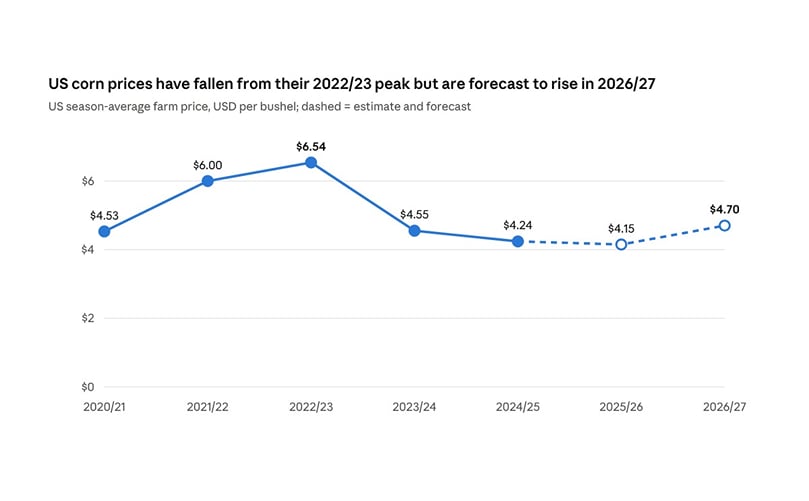
US corn season-average farm price, 2020/21 to 2026/27.
The 2022/23 spike shows how quickly the industry's main cost can move: the US corn price rose more than 40% in two seasons, then fell back by about a third (USDA Farm Service Agency).
Where the world's maize comes from: The world harvested roughly 1.3 billion tonnes of maize in 2025/26, about 5% more than the year before, led by the United States and China (Pig333, citing USDA). Most of it feeds animals or becomes starch, sweeteners and ethanol; only a small share becomes masa.
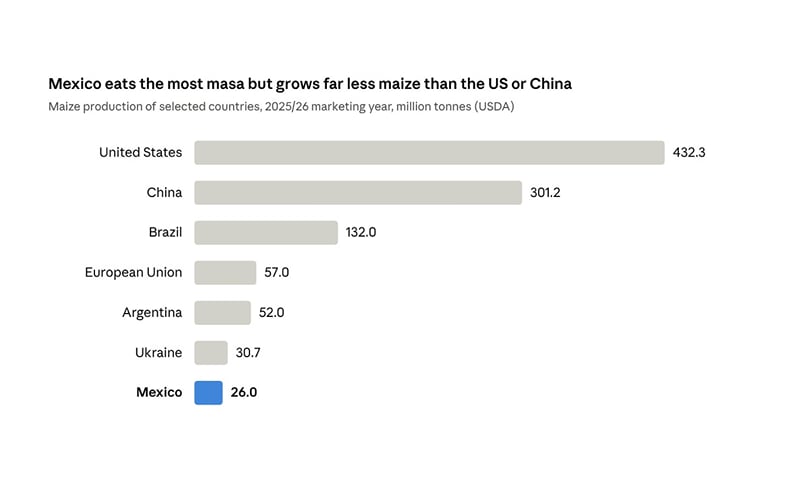
Maize production by country, 2025/26.
Mexico grew about 26 million tonnes in 2025/26, recovering from two years of drought (USDA FAS), yet it still imports roughly as much again, which is why US prices and trade policy matter so much to the masa industry.
Market developments, investments and product launches
- 2024: Gruma announced about MXN 2.3 billion (roughly USD 134 million) for a new plant in Yucatán with 56,000 tonnes a year of capacity and an expanded snack and tortilla complex in Puebla (Bloomberg Línea).
- July 2025: Bunge sold its North American dry corn and corn masa milling business to US miller Grain Craft. The deal closed on 1 July 2025 (Bunge).
- Q4 2025: Gruma reported net sales of about USD 1.59 billion for the quarter (regional growth is shown in Figure 22) and invested about USD 225 million during the year (Canal 26/EFE).
- 2026: GoodMills Innovation launched masa flours for food-service chip, taco-shell and snack makers, and Masienda introduced a high-pH flour for taquería-style tortillas (Fortune Business Insights).
- Full-year 2025: Gruma reported net sales of about USD 6.38 billion (down 1.7%), EBITDA of USD 1.14 billion and net income of USD 519 million (Ve por Más analysis of Gruma's results).
Manufacturing Challenges and Opportunities
Masa makers face five recurring pressures volatile maize prices, heavy water and energy use, wastewater, inconsistency and labour and each one is also where the best investment opportunities lie.
Raw material availability and price volatility: Maize prices swing with weather, El Niño and La Niña cycles, biofuel demand, trade policy and currency moves. Mexico imports large volumes of US yellow maize, and policy debates over genetically modified corn have added uncertainty for food-grade supply. Food-grade white and non-GMO maize are thinner markets with sharper price spikes. Mills manage this with forward contracts, identity-preserved grower programmes, diversified origins and hedging.
Water and energy consumption: Traditional nixtamalization uses roughly 1.5 litres or more of water per kilogram of maize just for cooking, before washing. Energy goes into heating kettles and, above all, flash-drying masa harina from about 50% to about 11% moisture. Heat recovery from dryer exhaust, efficient burners, and shorter cooks all cut costs.
Process efficiency and production consistency: Commercial nixtamalization loses roughly 5–14% of the maize solids to nejayote and wash water, according to industry patent literature. Every percentage point recovered is direct yield. Batch-to-batch variation in maize hardness and moisture makes it hard to deliver identical masa every day, which is why leading mills run pilot cooks, blend grain lots and adjust lime dose by lot.
Wastewater management: Nejayote is the industry's biggest environmental problem: it is highly alkaline (pH 11–12), and research cited by IntechOpen reports chemical oxygen demand (COD) of roughly 10,000–28,000 mg per litre, with high phosphorus and suspended solids. Discharged untreated, it damages sewers, rivers and soils. Treatment adds cost, but regulations increasingly require it.
Automation and quality monitoring: Inline near-infrared (NIR) moisture sensors, automated lime dosing, temperature-controlled cookers, vision systems on tortilla lines, and data dashboards that link raw-maize quality to masa performance are spreading from the largest plants to mid-size mills. They reduce waste, labour dependence and customer complaints.
Sustainability in Corn Masa Production
The biggest sustainability gains in masa come from treating nejayote as a resource rather than waste, cutting dryer energy, and sourcing maize responsibly.
Water use and wastewater treatment: Plants reduce water use by recycling part of the cooking liquor into the next batch (which also cuts lime use), using counter-current washing, and switching to low-water processes such as extrusion or "ecological" nixtamalization with calcium carbonate or calcium salts. Wastewater treatment options include neutralization, coagulation-flocculation (for example with chitosan, which in one study removed up to about 80% of suspended solids), membrane filtration, and anaerobic digestion to produce biogas.
Energy efficiency in cooking, drying and milling: Flash drying is the most energy-hungry step in masa harina. Key measures are heat recovery from dryer exhaust, high-efficiency gas burners, variable-speed drives on mills and fans, and cogeneration where biogas is available. Some patented processes reuse dryer exhaust heat to pre-heat incoming masa. Fresh-masa production avoids drying entirely, which is one reason local production is attractive where volumes allow.
By-product utilisation: Nejayote and its solids contain valuable compounds. Researchers and some producers recover:
- Ferulic acid, an antioxidant used in cosmetics and food
- Arabinoxylans and gums with food and pharmaceutical uses
- Dietary fibre and protein for animal feed
- Calcium-rich solids for soil amendment where permitted
- Biogas from anaerobic digestion
Corn cleanings and broken kernels also go to animal feed.
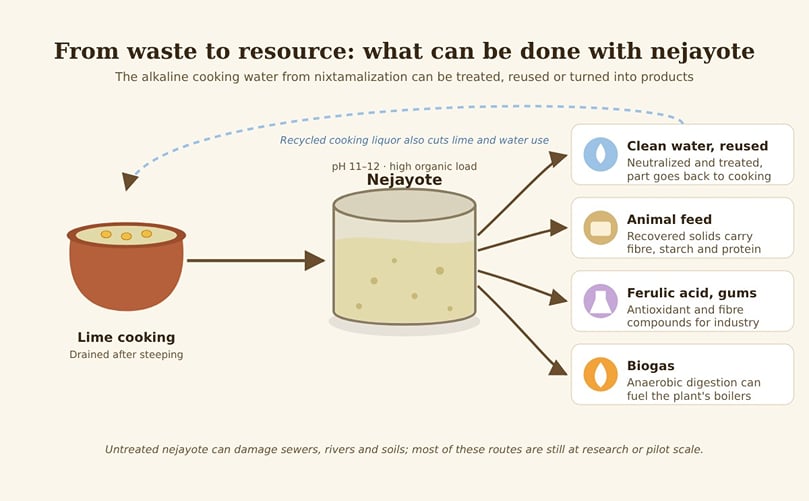
Ways to treat and reuse nejayote.
Sustainable maize sourcing: Buyers increasingly want traceable maize grown with lower fertilizer and water inputs, conservation tillage, and support for smallholders. In Mexico, programmes linking native-maize farmers to premium buyers help conserve genetic diversity while giving growers better prices. Large buyers are also starting to measure Scope 3 emissions from maize, which makes farm-level data more valuable.
Waste reduction and process optimisation: Tighter control of cook time, lime dose and stone gap reduces dry-matter loss. Returning trimmings and off-spec tortillas into masa (where safe and allowed), using demand forecasting to avoid unsold fresh tortillas, and right-sizing packaging all cut waste. Each kilogram of maize kept in the product lowers both cost and environmental load.
Major Corn Masa Manufacturers and Industry Participants
The masa value chain runs from maize growers and grain traders, through masa-flour millers and equipment makers, to tortilla, chip and food-service brands. A handful of Mexican and US companies dominate milling, while the downstream snack market is led by global food groups.
Milling is the concentrated middle of the chain: a few Mexican and US millers supply masa to thousands of tortilla makers and snack brands.
Corn masa and masa harina producers
- Gruma (Mexico) — the world's largest corn flour and tortilla producer, founded in 1949 by Roberto González Barrera as Molinos Azteca, with brands Maseca, Mission and Guerrero. It reports about 72 plants and 23,000 employees, including 18 corn flour plants in Mexico (through its GIMSA unit), 6 corn flour and 20 tortilla plants in the United States, 3 corn milling and 6 tortilla plants in Europe, 9 plants in Central America and 3 in Asia-Oceania. Around 70% of sales come from outside Mexico.
- Grupo Minsa (Mexico) — Mexico's other big national corn flour brand alongside Maseca. A 2016 plan for Bunge to take control of Minsa's six mills (about 700,000 tonnes of yearly capacity) was cancelled in November 2017 (World Grain). Bunge instead bought Minsa's two US mills in January 2018 (Bunge 2018 annual report), and Bunge's US masa plants passed to Grain Craft in 2025.
- Hari Masa (Mexico) — a leading Mexican producer of nixtamalized corn flour, named among the top companies in the segment.
- Grain Craft (USA) — completed its purchase of Bunge's North American corn milling business on 1 July 2025, adding three dry masa plants in Muleshoe (Texas), Red Oak (Iowa) and Worthington (Indiana) plus a transload and packaging site in Querétaro, Mexico. That makes it a significant new player in US masa supply.
- Cargill (global) — supplies corn masa flours and dry-milled corn ingredients to snack and tortilla manufacturers.
- Specialty and craft producers — Masienda (heirloom single-origin masa, USA), GoodMills Innovation (masa flours for European snack makers), Bob's Red Mill (retail masa harina), plus regional Mexican mills such as Molinos Anáhuac and Harinera Panamericana.
Maize processors and ingredient suppliers
Global grain traders and processors such as ADM, Cargill and Bunge supply maize, while lime producers supply food-grade calcium hydroxide. Ingredient companies provide gums, enzymes, preservatives, vitamin-mineral premixes for fortification, and natural colours for blue and red masa products.
Food-processing equipment manufacturers
Key suppliers include Lawrence Equipment and Casa Herrera (tortilla, chip and taco-shell lines, US), Heat and Control (snack frying and seasoning systems), and Bühler (grain cleaning, milling and drying). Stone mills, steam cookers, soak tanks, flash dryers, sheeters, three-tier ovens, fryers and packaging machines make up a complete masa plant.
Tortilla and snack manufacturers
- PepsiCo / Frito-Lay — Tostitos, Doritos, Fritos and Sabritas; one of the biggest users of corn masa in snacks worldwide
- Gruma / Mission Foods — tortillas, wraps, chips and tostadas made across the Americas, Europe, Asia and Oceania
- General Mills (Old El Paso) — taco shells, tortillas and meal kits across North America, Europe and Australia
- Grupo Bimbo — packaged tortillas and tostadas in Mexico and the US
- Arca Continental, Intersnack, Herr Foods, El Milagro, La Tortilla Factory and Xochitl — regional snack, chip and tortilla companies named in industry market reports
- Private-label producers supplying supermarkets in Europe, the Middle East and Asia
Market Opportunities and Future Growth of the Corn Masa Industry
The strongest growth for masa now comes from outside Mexico: Europe, Asia-Oceania and food service are expanding faster than the mature home market, and masa harina is the product that unlocks them.
Global spread of Mexican and Tex-Mex cuisine: Tacos, burritos, nachos and quesadillas are now mainstream in the UK, Western Europe, the Gulf, Australia and parts of Asia. Gruma's results show this shift clearly, as the chart below shows. The world's largest masa company now finds its fastest growth outside its two home markets.
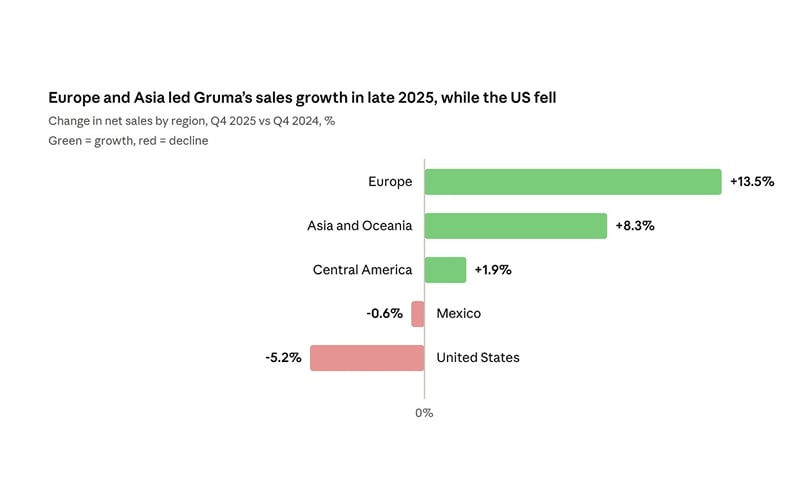
Gruma net sales growth by region, Q4 2025.
Snacking and premium chips: The tortilla chip market is forecast to grow about 4% a year to 2034, from about USD 39 billion in 2025. Premium opportunities include restaurant-style thick chips, blue and multi-colour chips, bean- and vegetable-enriched chips, baked and air-fried chips, bold regional flavours, and "heirloom" or single-origin maize stories.
Health, gluten-free and clean-label demand: Corn masa is naturally gluten-free, whole-grain-based, and high in calcium after nixtamalization. That makes it attractive for gluten-free bakery, clean-label wraps and better-for-you snack lines. Fortification and higher-fibre or higher-protein blends add further positioning options.
Food service and convenience: Fast-casual chains, cloud kitchens, frozen meals and meal kits drive steady demand for masa flour, par-baked tortillas, taco shells and frozen tamales. Ready-to-mix masa harina lets restaurants anywhere make fresh tortillas without nixtamalization equipment.
Local production in emerging markets: Importing masa harina is the usual entry route, but as volumes grow, building local nixtamalization and tortilla capacity becomes cost-effective. Regions with large maize harvests and growing snack markets — such as Southeast Asia, the Middle East and North Africa, Eastern Europe, South Asia and Sub-Saharan Africa — are realistic candidates for new plants or contract milling.
Future Outlook for the Corn Masa Industry
The corn masa industry is set for steady mid-single-digit growth through the early 2030s, in line with the market forecasts in section 11. The direction of travel is clear on five fronts.
- Internationalization. More masa will be eaten outside Mexico and the US every year, and most of it will arrive as masa harina before local production follows.
- Premiumization. Heirloom, blue, organic and single-origin masa will grow from niche to a meaningful premium tier, especially in food service and specialty retail.
- Cleaner processing. Pressure on water and wastewater will push mills toward lower-lime, lower-water and closed-loop nixtamalization, with nejayote turned into feed, fibre, ferulic acid or biogas.
- Digital, automated plants. Inline sensors and data-driven control will make masa quality more consistent and reduce dependence on the craft knowledge of experienced millers.
- Raw-material risk. Climate volatility, mycotoxin pressure and trade policy will keep maize supply the industry's biggest uncertainty, rewarding companies that invest in grower partnerships, diversified sourcing and rigorous testing.
For tortilla and snack manufacturers, ingredient buyers and investors, the opportunity is in combining a 3,000-year-old process with modern food science, efficient engineering and responsible sourcing.