

Importance of Secondary Plant Nutrients in Potato Cultivation
Secondary plant nutrients calcium (Ca), magnesium (Mg) and sulfur (S) play indispensable roles in potato (Solanum tuberosum) production, though they are required in smaller quantities than the primary macronutrients nitrogen (N), phosphorus (P) and potassium (K). These elements are fundamental for structural integrity, metabolic regulation, enzyme activation and stress tolerance, all of which are crucial for achieving high yield and superior tuber quality.
Potatoes are particularly prone to secondary nutrient deficiencies due to their shallow root system (30–60 cm depth), which restricts nutrient absorption, especially in sandy soils with low organic matter or under intensive, high input cropping systems. Global agronomic studies indicate that balanced secondary nutrition can increase yields by 10–30%, improve tuber firmness and skin quality and enhance storability by reducing physiological disorders (such as hollow heart and internal browning) and disease susceptibility.
While irrigation water often supplies part of the crop’s Ca and Mg requirements, sulfur management demands particular attention. Atmospheric sulfur deposition has declined by 40–60% in many regions due to reduced industrial emissions, increasing the risk of deficiency in non-fertilized systems.
Therefore, Integrated Nutrient Management (INM) combining soil testing, tissue analysis and precision fertilizer application is essential to ensure nutrient balance. Overlooking secondary nutrients can disrupt primary nutrient uptake, particularly of N and K and contribute to soil acidification and nutrient leaching. Sustainable management of Ca, Mg and S not only supports crop productivity but also enhances environmental resilience and long-term soil fertility.
Calcium (Ca) Nutrition in Potatoes: Improving Tuber Quality and Plant Health
Role in Potato Plants
Calcium (Ca) is a critical structural and signaling element in potato physiology. It forms calcium pectate in cell walls, conferring rigidity and preventing tissue collapse an essential factor in maintaining tuber integrity. Adequate Ca supply is vital during tuber initiation and bulking, significantly reducing physiological disorders such as hollow heart, internal browning and blackspot bruising which directly affect marketable quality.
Beyond its structural role, Ca enhances root elongation and facilitates nutrient and water transport, compensating for the potato’s shallow root system. It functions as a secondary messenger in numerous enzyme activation pathways, helping to maintain membrane stability and regulate turgor pressure and stomatal activity, thereby improving drought and heat tolerance.
Calcium interacts closely with potassium (K) to maintain osmotic and ionic balance and also serves as a soil pH buffer, mitigating aluminum (Al) toxicity in acidic conditions (pH < 5.5). Recent studies show that Ca upregulates antioxidant enzyme genes helping plants counter oxidative stress during active tuber bulking. Moreover, Ca contributes to nitrogen metabolism and its deficiency can exacerbate N uptake imbalances.
Irrigation water containing 50–100 ppm Ca can supply up to 50–70% of crop requirements in certain systems. In high yielding cultivars, adequate Ca nutrition improves skin firmness, storability and mechanical resistance, potentially extending post-harvest shelf life by up to 20%.
Requirements and Uptake
For achieving yields of 30–50 t/ha, potato crops typically require 3–10 kg/ha of calcium (Ca), equivalent to approximately 0.1–0.3 kg per tonne of tuber yield. Calcium uptake is most active during the early vegetative phase, when 30–50% of total absorption occurs before tuber initiation and continues through the bulking stage at rates of 0.5–1.5 kg/ha per day.
Critical petiole concentrations for optimal growth range between 0.6–1.0% Ca (dry matter basis) with a harvest index of around 0.2–0.3. Varietal variation is significant processing cultivars often demand 10–20% higher Ca levels to maintain tuber firmness and reduce bruising during mechanical handling.
Soil exchangeable Ca should ideally fall within the range of 500–1500 ppm. However, low organic matter (<2%) reduces Ca retention by 20–50% and sandy soils experience 15–30% nutrient losses through leaching. In irrigated systems, uptake efficiency may improve by 15–25%, though mass flow processes often direct a larger proportion of absorbed Ca to vines rather than tubers.
Tuber Ca concentrations below 0.15% dry weight are associated with increased incidence of internal disorders and structural defects. Recent transgenic studies suggest that overexpression of Ca transporter genes enhances tuber Ca accumulation and confers greater resistance to bacterial wilt and other stress factors.
Deficiency Symptoms
Calcium deficiency in potato manifests through a range of physiological and morphological disorders. Characteristic symptoms include hollow heart (central cavities within tubers), internal browning and tip burn on young expanding leaves, accompanied by interveinal chlorosis that progresses to necrotic margins. Affected tubers may exhibit cracking, deformation or rust spotting leading to 15–25% yield reductions and diminished market value.
In severe cases, stems become brittle, increasing susceptibility to lodging and mechanical damage. These symptoms may mimic uneven moisture stress or boron deficiency requiring diagnostic confirmation. Petiole Ca concentrations below 0.6% typically confirm deficiency, which is most common in acidic, sandy or low Ca soils and during rapid vegetative expansion when nutrient demand outpaces supply. Advanced deficiency results in stunted root systems, poor tuber initiation and reduced bulking efficiency.
Management Recommendations
Effective calcium management in potato cultivation involves both soil-based and foliar strategies to ensure continuous availability throughout the growing season.
For pre-planting soil enrichment application of gypsum (calcium sulfate) at 1–3 t/ha is recommended. Gypsum supplies readily available Ca without increasing soil pH making it particularly suitable for acidic soils. It also contributes sulfur (S), creating a synergistic effect that supports protein synthesis and tuber quality.
Foliar sprays of calcium nitrate (1–3%) during mid-season are effective for rapid correction of transient deficiencies, especially where irrigation water is low in Ca (<50 ppm). These applications enhance Ca translocation to developing tubers and reduce internal physiological disorders.
To maintain optimal soil fertility, target exchangeable Ca levels above 500 ppm. Incorporation of dolomitic lime can correct both Ca and magnesium (Mg) deficiencies, helping sustain a balanced Ca:Mg:K ratio. Avoid excessive potassium fertilization as high K levels can suppress Ca uptake; ideally, maintain a Ca:K ratio between 1:2 and 1:3 to prevent nutrient antagonism.
Field trials indicate 10–20% yield increases when Ca management is combined with basalt dust and sulfur amendments, which enhance both Ca availability and cation exchange capacity. In drip irrigation systems, fertigation using soluble Ca sources (e.g., calcium nitrate or chelated Ca formulations) improves nutrient delivery precision and efficiency.
Emerging soil conditioners such as TerraNu Calcium and other organic mineral blends have demonstrated superior Ca uptake and retention compared to traditional pelletized gypsum, offering potential for improved sustainability and nutrient use efficiency in intensive potato systems.
Toxicity Symptoms
Calcium toxicity in potato is rare, as the crop generally tolerates a wide range of Ca concentrations. However, it may occur in highly calcareous or over-limed soils where pH exceeds 7.5 leading to nutrient antagonism and induced deficiencies of magnesium (Mg), potassium (K) and micronutrients such as iron (Fe), zinc (Zn) and manganese (Mn).
Visual symptoms include interveinal chlorosis on younger leaves, often resembling Mg deficiency, accompanied by stunted shoot growth and reduced tuber size. Excessive Ca accumulation may also increase soil hardness and compaction, restricting root penetration and nutrient mobility. Over time, this can lead to imbalanced cation ratios in the rhizosphere, decreasing the efficiency of other essential nutrients and compromising tuber quality.
Magnesium (Mg) in Potato Cultivation: Functions, Deficiency and Nutrient Management
Role in Potato Plants
Magnesium (Mg) is a fundamental element in potato physiology, serving as the central atom in the chlorophyll molecule and thus directly driving photosynthesis and energy production. Adequate Mg supply ensures efficient light capture and ATP generation, which are vital for vigorous vine growth and tuber bulking in high light environments.
Functionally, Mg acts as a cofactor for more than 300 enzymes, particularly those involved in carbohydrate metabolism, protein synthesis and phosphate transfer reactions. This enzymatic activity enhances starch accumulation by 15–20%, contributing to improved tuber dry matter content and processing quality.
Magnesium plays a key role in maintaining ionic balance working synergistically with calcium (Ca) and potassium (K) to prevent leaf and tuber necrosis while stabilizing cell membranes and enzyme complexes. It also supports soil microbial activity, indirectly promoting biological nitrogen fixation and improving overall plant vigor.
In both acidic and calcareous soils, Mg availability can be limited due to competitive uptake with Ca and K. Balanced Mg nutrition has been linked to enhanced lipid and phenolic compound synthesis, improving tuber flavor, firmness and disease resistance. Higher Mg concentrations in tuber tissues contribute to stronger periderm structure and reduced post-harvest water loss, improving storability and shelf life.
At the physiological level, Mg also regulates phloem loading and assimilate translocation by activating H⁺-ATPases, facilitating the transport of carbohydrates and nutrients from leaves to developing tubers.
Requirements and Uptake
For achieving yields of 30–50 t/ha, potato crops typically require 9–15 kg/ha of magnesium (Mg), equivalent to approximately 0.3–0.5 kg Mg per tonne of tuber yield. Magnesium uptake patterns closely parallel those of calcium with 40–60% of total Mg absorption occurring during the vegetative phase and continued uptake of 0.5–1.0 kg/ha per day during the tuber bulking stage.
Approximately 60–70% of absorbed Mg is distributed to the leaves, where it supports photosynthetic metabolism and enzyme activation, while the remainder is partitioned to stems and tubers. Critical petiole Mg concentrations range from 0.3–0.55% (dry matter basis) below which photosynthetic efficiency and carbohydrate accumulation begin to decline.
Magnesium uptake efficiency is strongly influenced by soil cation exchange capacity (CEC) and cation balance, particularly the ratio between Mg and potassium (K). An optimal Mg:K ratio of 1:0.2–0.5 in soil or nutrient solution minimizes antagonism and ensures balanced ion transport. Low-pH sandy soils are especially prone to Mg leaching leading to 20–30% nutrient depletion in high rainfall or irrigated regions.
Varietal differences also influence Mg demand red-skinned cultivars often require 10–15% higher Mg levels to sustain foliage vigor, pigment synthesis and tuber quality. Controlled environment and hydroponic studies confirm that adequate Mg supply promotes root elongation and branching, whereas deficiency disrupts phloem transport and reduces carbohydrate translocation from leaves to tubers, ultimately limiting yield potential.
Deficiency Symptoms
Magnesium deficiency in potato is typically expressed as interveinal chlorosis on the lower (older) leaves, since Mg is mobile within the plant and readily translocated to younger tissues under deficiency. The chlorotic areas develop while leaf veins remain green, producing a distinct mottled or marbled appearance. As deficiency progresses, chlorosis advances upward through the canopy and leaf margins may curl upward or develop marginal scorching under high light intensity.
Affected plants often display stunted vine growth, reduced leaf expansion and smaller tubers, resulting in yield losses of 10–25%. In severe cases, the entire plant canopy appears pale or yellowish-green and photosynthetic activity declines sharply due to impaired chlorophyll synthesis.
Magnesium deficiency symptoms can resemble potassium (K) deficiency, but unlike K shortage, Mg deficiency rarely causes leaf tip necrosis. Confirmation can be made through petiole tissue analysis, where Mg concentrations below 0.3% (dry matter basis) indicate insufficiency.
Deficiency commonly occurs in acidic, sandy or light textured soils with low cation exchange capacity or following excessive K fertilization, which antagonizes Mg uptake. In prolonged deficiency conditions the plants exhibit delayed tuber bulking and reduced starch accumulation, further diminishing both yield and processing quality.
Management Recommendations
Efficient magnesium management in potato cultivation relies on a combination of soil amendments, foliar feeding and nutrient balance to sustain chlorophyll formation, photosynthetic activity and tuber development.
For soil correction, apply dolomitic lime at 1–2 t/ha before planting when soil Mg levels fall below 100 ppm. This amendment not only supplies Mg but also raises soil pH, reducing acidity and improving overall nutrient availability. In neutral to calcareous soils, where pH adjustment is not required, kieserite (magnesium sulfate monohydrate) serves as an effective alternative source of readily available Mg.
For rapid in-season correction, foliar sprays of Epsom salt (magnesium sulfate) at 1–3% concentration can be applied, typically repeated at 4–6 week intervals to maintain adequate leaf Mg levels during peak growth. These treatments are especially beneficial under cool, wet or compacted soil conditions that limit Mg uptake from the root zone.
Optimum fertilization rates range between 50–150 kg/ha Mg, depending on yield targets, soil reserves and varietal demand. Mg applications should be balanced with potassium (K) to avoid antagonism maintaining an Mg:K ratio of roughly 1:0.3–0.5. Combining Mg with nitrogen (N) fertilizers in fertigation or foliar regimes has shown synergistic effects on photosynthesis, chlorophyll stability and carbohydrate transport.
Research demonstrates that adequate Mg fertilization improves post-harvest tuber quality, reducing mass loss and shriveling during storage by enhancing water retention and periderm firmness. In low Mg soils or soilless and hydroponic systems, precise fertigation using soluble Mg sources (e.g., magnesium nitrate or magnesium sulfate) ensures efficient and uniform nutrient delivery, supporting consistent yield and tuber quality.
Toxicity Symptoms
Magnesium toxicity in potato is rare, as the crop tolerates relatively wide Mg ranges in soil and tissue. However, it may occur in serpentine soils rich in Mg or under excessive fertilizer application, particularly in poorly drained or low calcium environments. Elevated Mg levels can lead to osmotic or salt stress, resulting in leaf scorching, chlorotic margins and reduced vegetative growth.
Excess Mg often disrupts the cationic balance in soil, antagonizing calcium (Ca) and potassium (K) uptake and thereby inducing secondary nutrient deficiencies. Prolonged accumulation can also harden soil aggregates, reducing porosity and restricting root expansion and aeration. In such cases, nutrient imbalances may reduce tuber size and compromise quality, emphasizing the need for balanced Mg–Ca–K management in intensive potato systems.
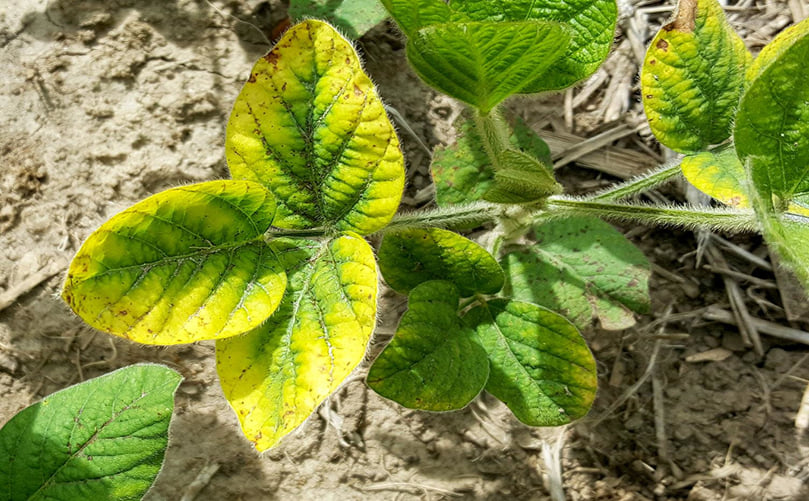
Magnesium (Mg) Deficiency Symptoms in Potato Plants
Sulfur (S) Nutrition in Potatoes for Better Yield and Tuber Quality
Role in Potato Plants
Sulfur (S) is an essential macronutrient that plays a central role in amino acid synthesis, particularly in the formation of cysteine and methionine, which are building blocks of plant proteins and enzymes. Adequate sulfur supply enhances nitrogen use efficiency (NUE) by improving protein synthesis and optimizing starch accumulation in tubers, thereby contributing to both yield and quality.
Sulfur is also a key component of sulfolipids in cell membranes, which strengthen membrane integrity and improve tolerance to cold, drought and oxidative stress. It works synergistically with calcium (Ca) and magnesium (Mg) to enhance tuber firmness, texture and storage stability, while also supporting chlorophyll synthesis and overall photosynthetic activity.
From a plant health perspective, adequate sulfur nutrition has been shown to suppress common scab (Streptomyces scabies) by acidifying the rhizosphere, creating conditions less favorable for pathogen development. Sulfur also contributes to pest and disease resistance by promoting the formation of defensive compounds such as thiols and glucosinolates.
Deficiency of sulfur disrupts the nitrogen sulfur balance leading to lower protein content, reduced canopy vigor and delayed maturity. Emerging research further suggests that integrating elemental sulfur with basalt or silicate amendments can enhance carbon capture and nutrient cycling, supporting climate resilient and sustainable potato production systems.
Deficiency Symptoms
Sulfur deficiency in potatoes manifests as a uniform yellowing (chlorosis) of young upper leaves, often mistaken for nitrogen (N) deficiency but distinct because older leaves remain green. Affected plants appear pale, spindly and stunted with thin, weak stems and delayed maturity. Tubers are typically smaller, lower in protein and show reduced starch accumulation, resulting in 15–20% yield losses. Petiole sulfur concentrations below 0.2% dry matter confirm deficiency. The problem is most common in sandy, low-organic soils, areas with low atmospheric S deposition or under intensive irrigation and high rainfall that promote sulfate leaching.
Requirements and Uptake
For achieving yields of 30–50 t/ha, potato crops typically require 20–30 kg/ha of sulfur (S), equivalent to approximately 0.6–1.0 kg S per tonne of tuber yield. Sulfur uptake is most active during the early vegetative phase, with 30–50% absorbed before tuber initiation and continues at a rate of 1–2 kg/ha per day during the tuber bulking stage.
The critical petiole S concentration ranges from 0.2–0.35% (dry matter basis), below which nitrogen assimilation, chlorophyll formation and protein synthesis begin to decline. Among fertilizer sources, sulfate-based forms (e.g., ammonium sulfate, gypsum, potassium sulfate or magnesium sulfate) are preferred due to their high solubility and rapid plant availability, especially in short cycle potato cultivars.
In recent decades, atmospheric sulfur deposition has declined by nearly 50% across many agricultural regions due to improved air quality regulations, making supplemental S fertilization increasingly essential, particularly in clean air or sandy soil regions with low organic matter.
Sulfur uptake and utilization efficiency are strongly influenced by its interaction with phosphorus (P). Maintaining an optimal S:P ratio promotes balanced energy metabolism and amino acid synthesis, ensuring efficient nutrient assimilation and improving both tuber yield and quality.
Management Recommendations
Apply ammonium sulfate at 50–150 kg/ha S as a sidedress or potassium thiosulfate (KTS) through fertigation to provide a dual supply of potassium and sulfur. Maintain soil sulfate-S levels above 10 ppm for optimal uptake. Integrating sulfur with phosphorus fertilization enhances both nutrient efficiency and yield potential with reported yield increases up to 20% under balanced S:P ratios.
For acidification and scab suppression, elemental sulfur can be incorporated pre-plant; however, it requires microbial oxidation and acts more slowly than sulfate forms. Combining sulfur with nitrogen sources improves protein synthesis, starch accumulation and tuber skin finish. Research consistently indicates that adequate sulfur nutrition enhances tuber quality, marketable yield and overall fertilizer use efficiency, particularly in low-S or sandy soils.
Toxicity Symptoms
Sulfur toxicity is rare but may occur with excessive application or poor drainage conditions. Elevated S levels can acidify soils (pH <5.0), increasing the solubility of aluminum (Al) and manganese (Mn) to toxic levels. Affected plants exhibit leaf tip necrosis, bronzing and root browning, accompanied by reduced vigor and stunted growth. In foliar feeding, high concentration sulfate or thiosulfate sprays may cause leaf scorch or marginal burns, particularly under hot, dry conditions.
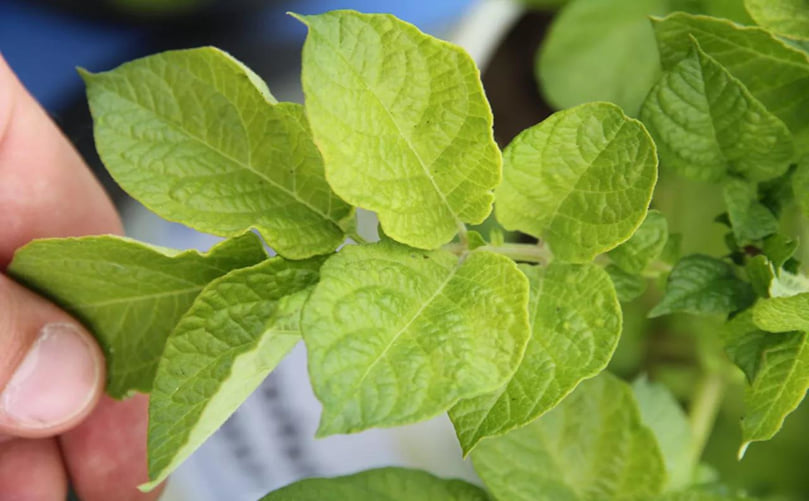
Yellowing of Young Leaves Caused by Sulfur Deficiency
Interactions and Uptake Patterns of Secondary Nutrients in Potato Cultivation
Secondary nutrients exhibit both synergistic and antagonistic relationships influencing overall nutrient efficiency and tuber quality. Sulfur fertilization enhances calcium (Ca) and magnesium (Mg) uptake by 10–25%, supporting improved cell structure and metabolic balance. Maintaining an optimal Ca:Mg ratio of 4–6:1 prevents competitive inhibition and ensures effective nutrient partitioning. Conversely, excess potassium (K) antagonizes Mg and Ca absorption, disrupting nitrogen metabolism and reducing yield potential.
Nutrient uptake follows a sigmoidal pattern Ca and Mg uptake peaks during early vegetative growth for root and vine development, while S uptake continues steadily through tuber bulking. For yields of 30–50 t/ha, total secondary nutrient uptake ranges between 32–55 kg/ha with irrigation water contributing 40–60% of Ca and Mg in calcareous systems. Imbalances among secondary nutrients often magnify primary nutrient deficiencies, lowering efficiency. Integrated Nutrient Management (INM) programs use dilution curve thresholds Ca (0.6–1.0%), Mg (0.3–0.55%) and S (0.2–0.35%) to guide diagnosis and correction. Additionally, micronutrient interactions, particularly boron (B) with calcium play a key role in optimizing tuber integrity and skin quality.
Diagnostic Tools and Monitoring
Effective management of secondary nutrients in potato cultivation depends on accurate diagnostics and continuous monitoring to maintain optimal nutrient balance throughout the growth cycle.
Soil Testing: Pre-plant soil analysis provides the foundation for nutrient management. Tests for exchangeable Ca and Mg and sulfate-S help guide amendment rates. Ideal target ranges are Ca: 800–1200 ppm, Mg: 100–200 ppm and S: 10–20 ppm, with Ca:Mg ratios maintained between 4–6:1. Soil texture and pH should also be evaluated as sandy or acidic soils increase the risk of secondary nutrient losses.
Petiole and Tissue Analysis: Regular petiole sap analysis, typically conducted between 4–8 weeks after emergence, identifies nutrient deficiencies before visual symptoms appear. Critical levels are Ca 0.6–1.0%, Mg 0.3–0.55% and S 0.2–0.35% (dry matter basis). Portable nitrate and ion meters enable on-site, real time assessments for rapid decision making.
Visual Diagnosis: Field scouting remains essential for early detection. Chlorosis, leaf curling and interveinal yellowing signal Mg or S issues, while tuber deformation and tip burn often indicate Ca deficiency. These observations should always be confirmed with analytical data to distinguish nutrient stress from disease or water imbalance.
Precision and Digital Tools: Advanced monitoring technologies such as drone-based multispectral imaging, remote sensing and soil electrical conductivity (EC) mapping enable spatial tracking of nutrient variability across fields. In-situ soil moisture and ion sensors further enhance fertigation accuracy and prevent nutrient leaching losses.
Integrated Monitoring Programs: Combining seasonal soil and tissue testing with georeferenced data from precision tools allows dynamic nutrient adjustment, particularly under intensive rotations or fertigation systems. Regular monitoring also prevents carryover deficiencies in successive crops, ensuring consistent tuber quality and yield performance.
Application and Management in Potato Farming
Effective management of secondary nutrients in potato farming requires site specific strategies that align with soil variability, crop demand and environmental conditions. Major application methods include pre-plant incorporation, side dressing, foliar feeding and fertigation, chosen according to soil texture, pH and irrigation systems.
Calcium (Ca): Apply gypsum (1–3 t/ha) pre-plant in acidic soils to supply Ca and S without altering pH. For rapid correction during vegetative growth and tuber initiation, use calcium nitrate foliar sprays (1–3%), particularly where irrigation water is low in Ca.
Magnesium (Mg): Manage low Mg soils with dolomitic lime (1–2 t/ha) for sustained supply maintaining pH stability. Supplement with Epsom salt (MgSO₄·7H₂O) foliar sprays (1–3%) every 4–6 weeks for immediate uptake and improved chlorophyll synthesis.
Sulfur (S): Apply ammonium sulfate at 50–150 kg/ha S during early bulking to enhance nitrogen efficiency and protein formation. In irrigated systems, potassium thiosulfate (KTS) can be fertigated for combined K and S delivery with high precision.
Soil and tissue testing guide application rates, targeting Ca 500–1500 ppm, Mg 100–200 ppm and S 10–20 ppm in soil and maintaining petiole concentrations within dilution curve ranges (Ca 0.6–1.0%, Mg 0.3–0.55%, S 0.2–0.35%). Maintaining a Ca:Mg ratio of 4–6:1 prevents nutrient antagonism and ensures balanced uptake.
In native soils of regions such as North Dakota and Alaska, secondary nutrient deficiencies are rare; however, irrigated sandy soils are prone to leaching losses, demanding frequent monitoring and supplementation. Precision agriculture tools including variable rate applicators, real time soil sensors and fertigation controllers enhance efficiency, reducing fertilizer use by 15–25% while minimizing risks like acidification from excess sulfur. Integrating these practices with cover cropping, composts and organic amendments promotes nutrient recycling, improves soil structure and supports sustainable high yield potato production.
Impact of Secondary Nutrients on Potato Yield and Quality
Secondary nutrients exert a profound influence on both yield potential and tuber quality in potato cultivation. Balanced applications can increase productivity by 10–30%, while improving tuber size, starch accumulation and post-harvest storability.
Calcium (Ca): Adequate Ca ensures uniform tuber development and prevents physiological disorders such as hollow heart, internal browning and blackspot bruising, which can otherwise reduce yields by 15–25%. By strengthening cell walls and enhancing membrane stability, Ca improves skin firmness, maturity and mechanical resistance, extending storage life by up to 20%. High Ca nutrition also reduces skin cracking and post-harvest decay, contributing to a higher proportion of marketable grade tubers.
Magnesium (Mg): As a key element in chlorophyll and enzyme activation, Mg promotes vigorous vine growth, photosynthetic efficiency and carbohydrate translocation. Deficiencies can lower yields by 10–25%, resulting in smaller, less dense tubers. Optimal Mg nutrition enhances starch synthesis (by 15–20%) and protein formation, improving both dry matter content and texture, which are critical for processing potatoes used in chips and fries.
Sulfur (S): Sulfur improves nitrogen assimilation leading to balanced protein and starch metabolism. It also contributes to scab suppression by slightly acidifying the rhizosphere and enhancing skin smoothness. In S-deficient soils, corrective applications can raise yields by 15–20% while improving tuber firmness and storage quality.
Collectively, these nutrients influence plant height, tuber number and total biomass, resulting in superior yield efficiency. Advanced delivery systems such as foliar sprays, fertigation and nano-formulations can improve nutrient use efficiency by up to 50%, maximizing both agronomic and economic returns.
However, nutrient imbalances especially excessive K or Ca can antagonize Mg and S uptake, diluting overall nutrient concentration despite higher yields. Therefore, adopting integrated secondary nutrient management ensures both high productivity and superior quality. Research on processing potato varieties further indicates that optimal secondary nutrition reduces glycoalkaloid accumulation and after cooking darkening, enhancing color stability, taste and frying quality.