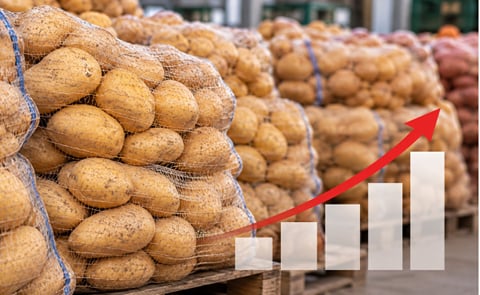

Serbia can export potato to the EU again because the ban introduced back in 2000 has been lifted, which opens room for an increase in the local production, Branislav Gulan of the Serbian Chamber of Commerce (PKS) told Tanjug.
He explained that Serbia could plant potato on 100.000 hectares and reach produce of around one million tons per year.
Over the past few years, the crop was grown on 78.000 hectares on average in Serbia, and the average produce per year totalled 11,5 tons, or around 900.000 tons at the total.
The European Commission adopted a decision to grant permission for potato export to Serbia on April 24 because the country managed to eradicate the bacteria Clavibacter michiganensis ssp. sepedonicus which had been causing the crop to rot.
In its decision, the Commission noted that Serbia demonstrated in its reports filed from 2009 to early 2012 that it carried out the necessary examinations and other procedures so as to eradicate the bacteria.
PKS expert Vojislav Stankovic said that Serbia mostly produces two potato varieties, Desiree and Kondor, for which the country has excellent conditions, fertile land and good air and soil temperature during the vegetation season.
According to Stankovic, the average potato consumption in the EU totals 74,7 kilograms per capita, the average totals 58,7 kilograms in Germany and 51,1 kilograms in France, Austria holds the average at 55,8 kilograms, the Czech Republic has the average consumption at 69,5 kilograms, Italy at 44,7 kilograms, while the figure in Serbia is as low as 35,7 kilograms.
EU issues import permission for Serbian potato
¿Te gustaría recibir noticias como esta por correo electrónico? ¡Únete y suscríbete!
Get the latest potato industry news straight to your WhatsApp. Join the PotatoPro WhatsApp Community!
Noticias relacionadas

Septiembre 28, 2026
México: menor oferta de papa podría impulsar los precios durante el invierno
En México, el cierre de cosechas, los menores rendimientos y la reducción de la superficie sembrada podrían restringir la oferta de papa y generar presión al alza sobre los precios entre diciembre de 2026 y febrero de 2027.

Septiembre 28, 2026
España: la sequía reduce la cosecha de patatas en 2026
La producción española de patata caerá entre un 8% y un 10% en 2026, hasta unos 1,8 millones de toneladas, con descensos de hasta 35% en Andalucía debido principalmente a la sequía y los menores rendimientos.

Septiembre 23, 2026
Chile: buscan mejorar el diagnóstico molecular de la sarna polvorienta y la sarna común en papa
En Chile, el proyecto SCAB-ID 2.0 busca validar un sistema de qPCR multiplex capaz de detectar y diferenciar simultáneamente la sarna polvorienta y la sarna común de la papa, con miras a transferirlo a laboratorios de diagnóstico agrícola.