
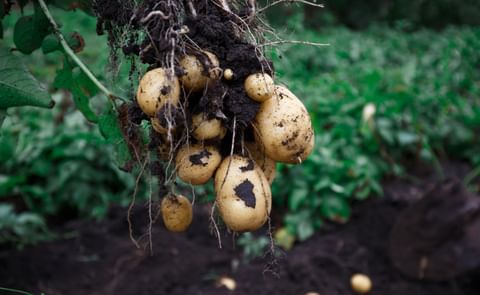
A potato disease known as Late blight is threatening some Wisconsin potato fields, but growers are well aware and making strides to prevent it from spreading.
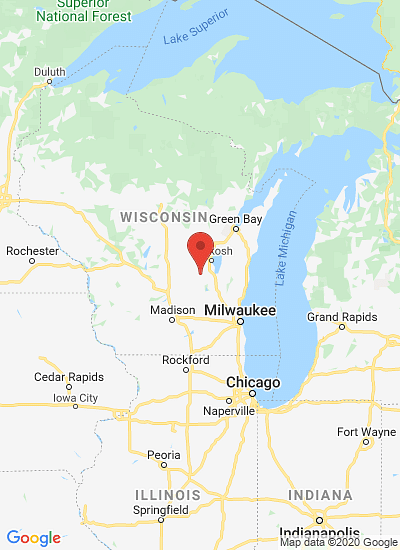
Late blight (Phytophthora infestans) is the disease responsible for the Irish potato famine in the 1840s and 1850s. The fungus which caused this devastation was identified in Portage County just last week and can cause serious problems for potato, tomato, and eggplants as well as other flowering crops. It’s a fast-moving, community disease that can cause perfectly healthy appearing green plants to break out in brown spots, turn yellow and die prematurely. Many home gardeners run to their local garden center for a remedy. But by the time leaves begin to yellow and the brown spots appear, the disease may have progressed to a point where there is no stopping it.
On the farm, vegetable growers face the same threat every year. Potato and vegetable growers in Wisconsin have worked closely with University of Wisconsin researchers for decades, to understand the science behind what makes these blights tick. Through research, growers have developed and implemented innovative disease management strategies to both avoid and combat plant disease problems.
What farmers are managing and attempting to control through their pest management programs is a very persistent fungus. Growers start by ensuring that all seed is clean and disease-free to prevent the introduction and spread of the fungus onto their farm and into their fields. Growers take great care to rotate their crops away from the previous year’s crops, planting them in disease-free areas, which helps avoid the threat of early season infection. They are also careful to wash and sanitize equipment when moving between fields in addition to using disease-resistant varieties.
Farmers inspect their crops every week and are now on the verge of using cutting edge DNA assays to identify individual spores before they can even begin to infect plants. Researchers can assess the precise needs of the foliar blight spore for water and temperature and then develop sophisticated prediction models that allow growers to deploy precise control measures.
By Wisconsin state law, growers, homeowners and/or garden centers are required to properly dispose of any signs and sources of late blight before the start of each growing season. Any and all leftover potatoes, not destined to market are destroyed every year by April 15th..
Growers use a sophisticated weather and disease forecasting model that indicates when they should begin applying crop protectant materials to limit late blight from developing in fields. This forecasting model (Blight Cast,) calculates disease severity values, which accumulate when conditions are right for disease development, usually during cool temperatures, high humidity and rain. Growers proactively destroy large portions of fields if late blight is found. This is the only effective way to stop the disease from spreading as the fungus survives only on living tissue of a host plant.
Growers actively discuss blight occurrences throughout the region. UW-Madison Plant Pathologist Amanda Gevens sends out state-wide updates on when to expect problems (based on conditions reliant on modeling). Research alerts, reports and updates are communicated to growers regarding locations the disease has been documented and the severity of the outbreak. She actively discusses late blight concerns with local media to ensure that the general public is aware of the potentially devastating effects of this serious disease.
Like farmers, gardeners are encouraged to destroy garden areas immediately if infection is found. This action prevents the spread and protects other homeowners as well as local farmers from this disease. It is critical that the public is aware of late blight and the associated risks. We must realize that this is a community-wide problem, which requires everyone who grows plants that can host late blight to be watchful and ready to act. Food security is too important to be placed at risk by failing to act quickly.
Because of proper pest control programs, consumers have access to reliable, nutritious foods at affordable prices while the environment benefits with fewer but more effective controls being used. Battling foliar blights is an ever-evolving process that requires continued investment by growers and researchers. The security of the food supply in key production areas such as Wisconsin’s Central Sands is a valuable resource and everyone needs to work together to manage risks.
Late Blight threatens Wisconsin Potato Fields

¿Te gustaría recibir noticias como esta por correo electrónico? ¡Únete y suscríbete!
Get the latest potato industry news straight to your WhatsApp. Join the PotatoPro WhatsApp Community!
Empresa Destacada

Noticias relacionadas
Septiembre 28, 2026
México: menor oferta de papa podría impulsar los precios durante el invierno
En México, el cierre de cosechas, los menores rendimientos y la reducción de la superficie sembrada podrían restringir la oferta de papa y generar presión al alza sobre los precios entre diciembre de 2026 y febrero de 2027.

Septiembre 28, 2026
España: la sequía reduce la cosecha de patatas en 2026
La producción española de patata caerá entre un 8% y un 10% en 2026, hasta unos 1,8 millones de toneladas, con descensos de hasta 35% en Andalucía debido principalmente a la sequía y los menores rendimientos.

Septiembre 23, 2026
Chile: buscan mejorar el diagnóstico molecular de la sarna polvorienta y la sarna común en papa
En Chile, el proyecto SCAB-ID 2.0 busca validar un sistema de qPCR multiplex capaz de detectar y diferenciar simultáneamente la sarna polvorienta y la sarna común de la papa, con miras a transferirlo a laboratorios de diagnóstico agrícola.