
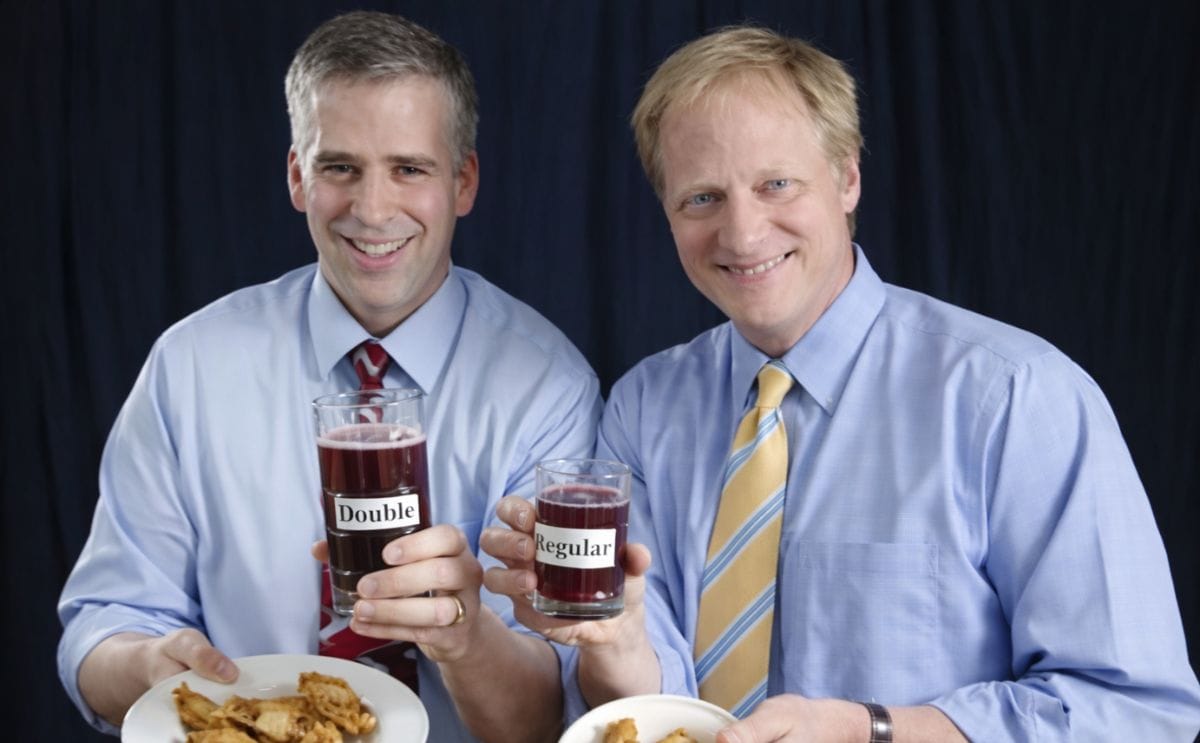
David Just and Brian Wansink
Portion size & size label affect how much we eat
Portions, such as 8, 12 or 16 ounces – are given different labels – small, medium or large – at different restaurants.
However, how a portion is described size-wise impacts how much we eat and how much we’re willing to pay for our food, reports a new study from Cornell published online June 13 in the journal Health Economics.
The research shows that consumers use such labels to dictate how much food they think is a “normal” portion, and then adjust their intake accordingly. “People are willing to pay more for a portion that sounds larger, but they also are apt to eat more of an enormous portion if they believe it is ‘regular’ to do so,” said David R. Just, associate professor at Cornell’s Dyson School of Applied Economics. Just conducted the study with Brian Wansink, the John S. Dyson Professor of Marketing at Cornell. Both are affiliated with the Cornell Food and Brand Lab.
In their study, the researchers served study participants either one or two cups of spaghetti, for example. For some participants, the small and large portions were labeled “half-size” and “regular,” respectively, giving the impression that the larger two-cup portion was the norm. For other participants, the same portions were labeled “regular” and “double-size” – implying that the smaller one-cup portion was the norm.
“These varying concepts of ‘regular’ portions made all the difference in how much people would spend and subsequently eat,” said Just. “Participants ate much more when their portion was labeled “regular” than when it was labeled “double-size.” In fact, participants who thought their portion was “double-size” left 10 times the food on their plate.”
Exploring how portion labels impact the willingness of patrons to pay, the researchers let participants bid on each portion. When the portion was labeled “half-size,” participants were willing to pay only half when the same portion was labeled “regular.” The labels, rather than the visual appearance of each serving, acted as indicators.
“The huge impact of size labels suggests that both consumers and producers could benefit from standardization of food size-labeling,” said Wansink. “Clearly defining the actual amount of food in a ‘small’ or a ‘large’ would inform customers of just how much food they are ordering every time they ask for a certain size. Until then, take the time to think about what portion you’re really getting when you order your standard ‘medium’ meal.”
The study, “One Man’s Tall is Another Man’s Small: How the Framing of Portion Size Influences Food Choice,” was funded by the Cornell Food and Brand Lab.
Like to receive news like this by email? Join and Subscribe!
Get the latest potato industry news straight to your WhatsApp. Join the PotatoPro WhatsApp Community!
Uitgelichte Bedrijven

Gerelateerd nieuws

september 07, 2026
KFC Malaysia and Mister Potato Launch Spicy, Crunchy Limited-Edition Collaboration
KFC Malaysia and Mister Potato launch a limited-time collaboration featuring spicy crispy chicken, a crunchy Zinger burger and Cheezy Wedges-inspired chips for the Merdeka and Malaysia Day season.

september 03, 2026
Pringles lanceert dikkere Dippers, speciaal ontworpen voor dippen
Pringles lanceert in september dit jaar Dippers, zijn eerste dikkere, stevigere en golvende chips, speciaal ontworpen voor dippen, in drie smaken. Het merk breidt ook zijn Minges-assortiment uit met een nieuwe smaak Zoet & Zout.

augustus 30, 2026
Orion Targets Global Potato Snack Growth as Sales Approach KRW 1 Trillion
Orion recorded KRW 874 billion (USD 672.31 million) in global potato snack sales, with overseas markets contributing 73%, as it expands production in South Korea and China and strengthens Pocachip, Oh! Gamja, Swingchip and Yegam globally.