India rapidly emerges as a global hub for frozen french fries, driven by Gujarat’s processing powerhouse
India’s French Fry Revolution: From Local Fields to Global Plates

Fifteen years ago, frozen french fries in India mostly came from ships docking in Mumbai and Chennai. Today, they sail out from the ports of Gujarat, headed for restaurants in Dubai, Manila, Kuala Lumpur, and beyond.
In less than a decade, India has transformed from being a small importer of frozen fries to one of the fastest-growing exporters in the world. Behind this remarkable shift lies a quiet combination of agricultural science, industry partnerships, and technological innovation that turned humble Indian potatoes into a global product.
A Story of Intent and Innovation
India produces over 50 million tonnes of potatoes each year, second only to China. For decades, most of these went into table consumption and starch production. The inflection point occurred as multinational processors began localizing supply chains to mitigate currency risks and high import tariffs. This phase saw the introduction of contract farming protocols and the adaptation of North American seeds to Indian soil conditions. By 2015, India began exporting small quantities, signalling that domestic quality had begun to meet international standards. This era laid the foundational infrastructure in Gujarat, leveraging the state's reliable power supply and favourable industrial policies. The processors also realized that the same crop could be turned into high-value frozen products, fries, wedges, hash browns, that the world’s quick-service restaurants (QSRs) rely on every day.
From 2018 onwards, a wave of investment changed everything. Global brands such as McCain Foods and home-grown players like HyFun Foods, Iscon Balaji, and Falcon Agrifriz began setting up advanced processing facilities. They brought in automation, contract farming models, and cold-chain systems that could compete with established exporters in Europe.
Within five years, India’s frozen potato export volume surged by more than 40 percent, crossing 180,000 tonnes in 2024-25. What began as an import-replacement strategy had now become a global export story.
Why Gujarat Became the Fry Capital of India
If India’s french fry story has a capital, it is Gujarat. The state’s sandy-loam soil, cool winters, and long daylight hours make it ideal for growing potatoes rich in dry matter and low in sugars — the perfect combination for fries that stay crisp and golden.
Gujarat is home to India’s largest processing plants:
- HyFun Foods (Mehsana) – India’s biggest frozen snack exporter
- McCain India (Mehsana) – the pioneer that brought global fry standards to Indian soil
- Iscon Balaji Foods (Deesa) – a regional leader in wedges, hash browns, and other potato specialty.
- Falcon Agrifriz (Patan) – one of India’s most technologically advanced plants.
- Happiyum (Mehsana) – the new-age “clean label” challenger focused on preservative-free, consumer-centric products
Niche and Emerging Players
Goodrich Cereals: Known for potato flakes, Goodrich has diversified into "Flavor-Infused" French fries (onion chilli, oregano), a technological innovation where flavour is internal rather than a coating. They are targeting premium export markets like Japan and Saudi Arabia under the "Potato Gourmet Twist" line.
Chill Fill Foods: Based in Morbi, Gujarat, this company utilizes advanced TOMRA sorting technology to meet European quality standards. They specialize in customized shapes (veggie fingers, shots) for the HoReCa segment and export.
Agristo Masa: This is a massive omission. Agristo (Belgium) has formed a JV with Wave Group (Masa) and is investing ₹750 crore in Bijnor, Uttar Pradesh. This proves the industry is moving beyond Gujarat.
Together, these companies anchor a processing cluster that produces nearly 80 percent of India’s frozen fries. The secret lies in contract farming, where processors partner directly with farmers to ensure that they grow potatoes suitable for french fries. Farmers receive certified seed varieties and technical support on irrigation and crop cycles, while companies guarantee procurement at pre-agreed prices, protecting farmers from market volatility.
Technology at the Heart of the Transformation
Behind India’s global rise is a quiet revolution in machinery and methods. Processing plants now resemble clean-room manufacturing facilities rather than traditional food units. Modern processors deploy advanced systems such as optical sorters, AI-based moisture controls, pulsed electric field cutters, and automated packaging lines.
- Electroporation and PEF Technology Indian processors are increasingly deploying Pulsed Electric Field (PEF)systems, a non-thermal pre-treatment method. By applying short, high-voltage pulses, PEF induces electroporation, creating microscopic pores in the tuber's cell membranes. This process softens the tissue matrix without thermal degradation, facilitating smoother cutting dynamics. Key technical advantages include minimized starch loss, reduced breakage rates, and lower oil absorption during the frying phase, essential for meeting the specific textural parameters of global QSR chains.
Automated Defect Detection To ensure compliance with stringent international standards (zero-defect protocols), facilities utilize advanced optical sorting ecosystems, such as TOMRA 5B sorters paired with Orbit Steam Peelers. These systems employ multi-spectral sensors to identify and reject tubers with minute physiological defects, including greening, black spots, and foreign matter, thereby securing entry into premium export markets like Japan.
Integrated Cold Chain Logistics Post-processing integrity is maintained through a hermetically managed cold chain. Modern facilities function as "clean rooms," utilizing automated packaging lines within sub-zero environments. Operators like Falcon Agrifriz orchestrate an end-to-end logistics network, employing specialized reefer infrastructure to prevent temperature shocks during transit to ports like Mundra, ensuring the preservation of the frozen product's structure.
The Science Behind the Perfect Fry
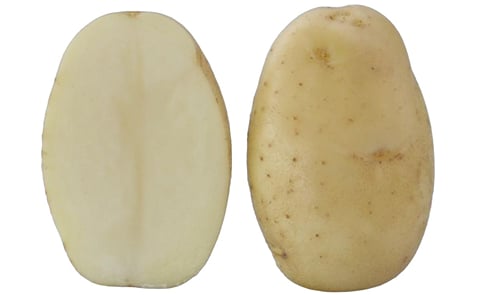
The backbone of this transformation is agricultural science. Traditional Indian potato varieties were unsuitable for long, uniform fries. The solution came through collaboration between research institutions and processors. The Central Potato Research Institute (CPRI) developed Kufri Frysona, India’s first processing-grade variety, with high dry matter, low sugar content, and strong disease resistance.
Private companies built on this foundation, introducing European varieties like Santana and Innovator. Today, Indian fields produce potatoes that meet international standards, ensuring both quality and consistency at scale.
Global Genetics vs. Seed Sovereignty
The market is currently defined by a tug-of-war between established foreign lineages and emerging indigenous varieties designed to reduce reliance on royalty-bearing seeds.
1. The Foreign heavyweights (The Current Backbone)
The export sector relies heavily on Dutch and North American genetics, particularly in Gujarat's sandy-loam soils.
- Santana: Introduced by McCain in 1997, this is the industry standard. Its oblong shape is engineered for long-cut fries (up to 11mm), and its IP is strictly protected until 2035.
- Innovator: A Russet-skinned variety prized for high recovery rates (less waste), though it demands precise irrigation.
- Lady Rosetta: The red-skinned "chipping" queen. It is the staple for crisps and flakes due to its round shape and consistent yields.
2. The Indigenous Response (CPRI Innovation)
To achieve seed sovereignty, the Central Potato Research Institute (CPRI) has moved beyond the pioneering Kufri Frysona.
- Kufri Tejas: A game-changer for heat tolerance, allowing cultivation to expand into warmer regions like Madhya Pradesh.
- Kufri Chipbharat-1 & 2: Designed for speed. These new varieties mature rapidly (90–100 days), enabling farmers to achieve faster crop rotation cycles.
From India to the World: The Export Story
India’s fries are now reaching global plates across Southeast Asia, the Middle East, and Africa. Export volumes have risen sharply, supported by competitive pricing and reliable supply chains. Indian exporters can offer frozen fries at lower prices than European competitors while maintaining identical quality.
This success stems from three pillars:
- Efficient contract farming lowers raw material costs.
- Automation improves yield and reduces wastage.
- Integrated cold chains minimize post-harvest losses.
Case Studies: Companies Driving the Boom
McCain Foods India: The Pioneer: McCain, the original architect of India’s frozen potato industry, is now fortifying its leadership. With a historic ₹4,000 crore “de-risking” bet on Madhya Pradesh and a regenerative agriculture model farm, the company is scaling beyond Gujarat while proving that French fries can be both profitable and sustainable.
HyFun Foods – Scaling the Indian Dream: Now India’s largest exporter of frozen potato products. HyFun’s “Seed-to-Shelf” engine powers 70% export-led growth, and now they’re zeroing in on India. With ₹1,100 crore committed to quadruple capacity and a clear IPO ambition by 2028, the company is modernising farms and aiming for a ₹5,000 crore revenue leap.
Iscon Balaji Foods – The Innovator: Known for its product range and agility in adapting technology to Indian conditions, now a key exporter to the Middle East. IBF pairs Balaji Wafers’ snack pedigree with massive scale, Asia’s largest fry line and 200,000 MTPA capacity. But their edge is sustainability: India’s only off-grid processing plant powered by 25 MW of solar and biogas that covers 60% of their energy needs.
Falcon Agrifriz – The Next Generation: A symbol of modernity, featuring automation, energy-efficient refrigeration, and waste-to-energy systems. Falcon is making its mark with automation-first ambition. Their ₹1,050 crore Mehsana facility houses India’s longest 350-meter fry line and a fully automated setup aimed at delivering consistent, superior taste via their fast-growing “Just Crave” brand.
- Happiyum: The Joyful Challenger Happiyum enters with a “clean label” and consumer-first mindset. From their 10-acre Mehsana unit powered by Dutch Kiremko tech, they’re producing 35,000 tons/year of preservative-free, vegetarian productstargeting health-conscious families in India and high-growth markets across the Far East.
Challenges and the Road Ahead
While growth is strong, the industry faces challenges: skilled labor shortages, rising energy costs, and the need for climate-resilient varieties. Continued infrastructure investment is vital for expansion into northern states such as Punjab and Uttar Pradesh.
Despite hurdles, India’s fry sector is projected to double in market size by 2030, fueled by research partnerships with institutions like the International Potato Center (CIP) in Peru.
Why the World Is Watching India
India’s story demonstrates how scientific innovation, infrastructure, and inclusive farming can transform an agricultural economy. The Gujarat model of contract farming and cold-chain efficiency is now being studied by emerging economies across South America and Africa.
Conclusion: More Than a Market, a Movement
The rise of India’s french fry industry represents more than exports, it is a model of transformation linking farmers, factories, and foreign markets. From the fields of Mehsana to restaurants in Manila and Dubai, each crisp fry tells a story of collaboration, innovation, and ambition.
India hasn’t just joined the global french fry market, it has redefined it.
Like to receive news like this by email? Join and Subscribe!
Get the latest potato industry news straight to your WhatsApp. Join the PotatoPro WhatsApp Community!
Uitgelichte Bedrijven


Gerelateerd nieuws

september 07, 2026
McCain Foods India Appoints Aditya Krishna as Managing Director
McCain Foods India has appointed Aditya Krishna as Managing Director, effective August 1, 2026. He will lead growth, strengthen grower partnerships and continue developing French Fries potato varieties suited to Indian conditions.

augustus 30, 2026
Simplot and Tasmanian Potato Growers Remain at Odds Over French Fry Contracts
Simplot and Tasmanian potato growers remain at odds over prices and supply terms, with growers also concerned about contract cuts and a planned 30,000-tonne reduction in potato volumes through the Ulverstone processing plant.

augustus 23, 2026
Marieke Hoste benadrukt innovatie en samenwerking in aanloop naar haar eerste Aardappeldemodag
Marieke Hoste, de nieuwe directeur van VAVI, bezoekt voor het eerst de Aardappeldemodag, waar samenwerking, innovatie en kennisdeling centraal staan. Volgens haar kan de Nederlandse aardappelsector beleids-, duurzaamheids- en marktuitdagingen gezamenlijk aanpakken.