
Multi-head Weighers in the Potato Industry: An Overview
Every bag of potato chips and every retail pack of frozen French fries carries a declared weight, and the processor pays for every gram above it. On a line packing tens of millions of bags a year, a single gram of overfill per pack adds up to tonnes of product given away. Multi-head weighers, also called combination weighers, were developed to solve exactly this problem: they portion irregular pieces such as chips, fries and wedges quickly and close to the target weight, and they feed that portion straight into a bagmaker.
The technology began in Japan, where Ishida built the first multihead weigher in 1972 to weigh whole peppers. Today multi-head weighers stand at the end of most high-volume potato snack and frozen potato lines, usually mounted above vertical form-fill-seal (VFFS) machines. They pack everything from 20 g snack bags of crisps to 2.5 kg catering bags of frozen fries, and they are among the main tools processors use to control product giveaway.
This article explains how a multi-head weigher works, why potato processors use it, how chips, frozen fries and other potato products behave on the machine, and what to check before buying. It also profiles manufacturers and suppliers and summarises documented installations in potato plants. For the wider picture of packing lines, see potato packaging equipment.
Multi-Head Weighing Technology for Potato Processing and Packaging
Key Facts: Multi-head Weighers in Potato Processing
| Item | Figure | Source / note |
|---|---|---|
| First multihead weigher | 1972, built by Ishida for whole peppers | Ishida range brochure |
| Typical head numbers | 10, 14, 16, 20 and 24; up to 32 on some models | Ishida range data |
| Rated speed (single discharge) | 100 to 200 weighings per minute, by model | Ishida SE3, RVE and AS series |
| Possible combinations, 14 heads | 16,383 (2^14 − 1) | Calculated |
| Typical potato pack weights | About 20 to 200 g for chips; 450 g to 2.5 kg for frozen fries | Supplier and processor data |
| Washdown ratings offered | IP65 to IP69K | Ishida RV washdown model |
| EU tolerable negative error, 450 g pack | 3% (13.5 g) | Directive 76/211/EEC |
| Suppliers listed for potato lines | More than 130 companies | Multi-head weigher supplier directory |
What Is a Multi-head Weigher?
A multi-head weigher is an automatic weighing machine with several independent weighing units, or heads, arranged in a ring. Each head weighs a small part-portion of product. A computer then looks for the combination of heads whose weights add up to the target pack weight, or come as close to it as possible without going under, and releases only those heads. This is why Ishida calls the machine a computer combination weigher (CCW).
Basic concept: Instead of filling one container until it reaches 450 g, the weigher holds, for example, 14 smaller portions of around 100 to 130 g each. Combining three, four or five of them gives many possible totals, and the best one is almost always very close to 450 g.
Role in potato packaging: The weigher is the link between processing and packing. It receives finished chips or frozen fries from distribution conveyors, portions them and drops each portion into a bagmaker, tray filler or carton. Downstream, metal detectors, X-ray systems and checkweighers inspect the sealed packs. On high-speed snack lines the weigher and bagmaker are often supplied as one integrated system.
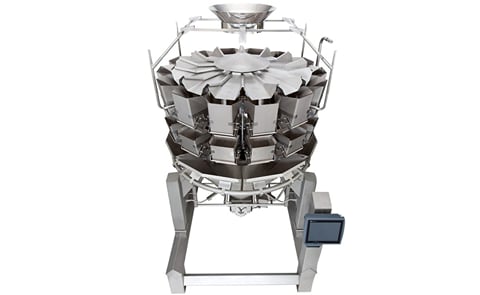
Main machine parts: A typical radial weigher has an infeed conveyor, a vibrating distribution cone, radial feeder pans, pool hoppers, weigh hoppers on load cells, a collecting chute, an optional timing hopper and a control unit with a touch screen. Each part is described in more detail further down.
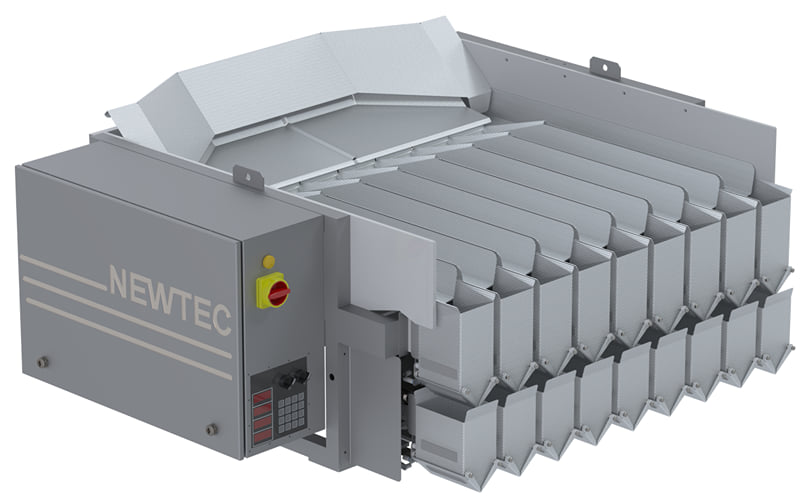
Newtec PC-Series combination weigher, built for potato chips and similar fresh and frozen products. Image: Newtec, from the Newtec product listing.
How Does a Multi-head Weigher Work?
A weighing cycle takes a fraction of a second, and several cycles overlap. The animation below shows one cycle for a 450 g bag of frozen fries on a simplified 10-head weigher.
1. Product feeding: An infeed conveyor, bucket elevator or vibratory feeder delivers product to the top of the weigher. A level sensor above the cone tells the infeed when to run, so the load on the cone stays steady.
2. Distribution through the cone: The top cone vibrates (or rotates, on some models for sticky products) and spreads the product outwards in all directions.
3. Vibratory feeder operation: Around the cone sit radial feeder pans, one per head. Each pan vibrates for a set time and amplitude to move a controlled amount of product to the edge. At Aviko, frozen fries drop onto the dispersion table of each 14-head weigher and 14 vibratory feeders move them to the pool and weigh hoppers.
4. Collection in pool hoppers: Each feeder fills a pool hopper, which holds the next portion. As soon as the weigh hopper below it empties, the pool hopper opens and refills it.
5. Individual weight measurement: Every weigh hopper hangs on a load cell, a strain-gauge sensor that converts weight into an electrical signal. Digital filters remove the effect of vibration from the feeders and the factory floor.
6. Combination calculation: The controller adds up the weights of the hoppers in many different combinations.
7. Selection of the closest weight: It chooses the combination closest to the target that is not under it, usually within upper limits set by the operator. On a Swiss crisp line, Ishida says the weigher usually selects three or four hoppers and calculates combinations to 0.1 g.
8. Discharge into the packaging machine: Only the selected weigh hoppers open. The portion slides down the collecting chute, sometimes through a timing hopper, into the bagmaker forming tube when the bagmaker signals that it is ready.
9. Repeating the cycle: Emptied weigh hoppers refill from their pool hoppers while the other hoppers keep their product for the next calculation. The machine runs continuously, often at more than 100 weighings per minute.
Animated, simplified front view of a 10-head multi-head weigher packing frozen French fries into 450 g bags. Hopper weights are example values; the selected combination is the closest to target without going under it. Chart: PotatoPro, based on the Ishida range brochure.
Combination Weighing in Simple Terms
Think of 14 cups on a scale, each holding a slightly different amount of fries. If you may pour any group of cups into one bag, there are 16,383 possible groups (2 to the power of 14, minus the empty group). Among so many options, there is almost always a group that adds up to just over 450 g. A 10-head weigher has 1,023 possible groups and a 16-head weigher 65,535.
In practice the software limits a pack to a few hoppers, typically three to five, to keep each calculation fast and to keep hoppers at a sensible fill level. On a 14-head machine that still leaves 3,367 groups of three, four or five hoppers. Booster or memory hoppers below the weigh hoppers add more weights to choose from, which is why Ishida specifies them for higher speeds or mixing applications.
How combination weighing works: the controller checks the weights in all hoppers and opens the set that comes closest to the target without going under it. Hopper weights are example values; combination counts are calculated. Chart: PotatoPro; combination counts calculated, hopper weights are examples.
Why Are Multi-head Weighers Used in the Potato Industry?
Automated portion control: Potato pieces vary in size and weight. A single fry or chip can weigh anything from well under a gram to several grams, so volumetric fillers struggle to hit a target reliably. Combination weighing turns that variation into an advantage, because more variety in hopper weights gives more possible totals.
Consistent pack weights: In the EU, prepacked goods sold by weight must meet the three packer’s rules of Directive 76/211/EEC: the average content must not be less than the declared weight, no more than 2.5% of packs may fall below the first tolerance limit, and none may fall below twice the tolerance. For a 450 g pack the tolerable negative error is 3%, or 13.5 g. Other countries apply similar average-quantity rules, such as NIST Handbook 133 in the United States.
Reduced product giveaway: Because packs must average at least the declared weight, a plant with a wide weight spread has to set its target well above the label. A tighter spread lets the target sit closer to the declared weight. The value of that saving is shown in the giveaway chart further down.
Higher packaging throughput: Multi-heads match the speed of modern bagmakers, with ratings of 100 to 200 weighings per minute per discharge depending on the model. Twin weighers split the heads between two bagmakers, so one machine can serve two packing lines.
Less manual intervention: Hand weighing is slow and variable. Ohlson Packaging estimates that a person weighing and packing by hand at about three packs a minute will reach an accuracy of around 5%.
Production efficiency: Weighers record every weighment, so managers can track average weight, standard deviation, reject rates and line efficiency. Data from checkweighers can be fed back to adjust the weigher.
Applications of Multi-head Weighers in the Potato Industry
Potato chips and crisps: The largest snack application. Chips are light, brittle and bulky, so weighers for this duty use wide hoppers, gentle vibration and short drop heights. Pack sizes range from about 20 g to 200 g. Snack weighers are commonly paired with VFFS bagmakers that flush the bag with nitrogen.
Frozen French fries: Frozen fries are firm and fairly free flowing, but cold, abrasive and prone to frost and ice. Weighers for this duty need washdown construction and robust load cells. Retail and food-service packs typically range from 450 g to 2.5 kg, and some plants pack up to 5 kg.
Frozen potato wedges: Wedges are larger and heavier than fries, so fewer pieces fit in each hopper and the weight of a single piece is a larger share of the pack. Larger hoppers (for example 3 to 7 litres) and more heads help.
Potato-based snacks: Extruded, pelleted and popped potato snacks are very light and can bounce or fly out of hoppers. Other light snacks show the same challenge: a South African maker of popped crisps and rice cakes reported cutting giveaway by as much as 35% after installing an Ishida weigher.
Dehydrated potato products: Flakes and granules flow like powders and are usually filled with auger fillers or linear weighers. Multi-heads are used where dried potato pieces, dices or mixed dry meals are packed.
Other processed potato products: Crispy potato slices, hash brown portions, potato dices for salads and chilled potato products are also weighed on multi-heads. Fresh table potatoes and seed potatoes are packed on heavy-duty combination weighers built for whole tubers, such as the Eqraft combination scale used by a Dutch seed potato grower.
Handling Delicate, Frozen, Irregular and Free-flowing Products
| Product behaviour | Potato examples | What the weigher needs |
|---|---|---|
| Delicate and brittle | Thin-cut chips, kettle chips, popped crisps | Low drop heights, soft-closing gates, wide hoppers, gentle feeder settings |
| Frozen | IQF fries, wedges, hash brown pieces | Washdown rating, sealed load cells, surfaces that resist ice build-up, fast cleaning |
| Irregular and long | Long fries, wedges, crispy slices | Larger hoppers, more heads, feeder pans shaped to stop bridging |
| Free flowing | Small dices, dry pellets, granules | Standard pans; fast speeds; linear weighers may also suit |
| Sticky or oily | Seasoned or freshly fried products, coated fries | Dimpled or embossed surfaces, rotary cones or screw feeders |
Types of Multi-head Weighers
Standard combination weighers: General-purpose machines for free-flowing and semi-sticky products. Entry-level ranges such as Ishida’s SE3 offer 10, 14 or 20 heads and around 100 weighings per minute per discharge. They suit smaller chip makers and lower speeds.
High-speed multi-head weighers: Built for snack lines running small packs at 150 to 300 bags per minute. Twin or double weighers feed two bagmakers from one machine; Ishida describes a twin-tube system for potato chips and extruded snacks reaching up to 300 bags per minute, and Yamato states that its Sigma F1 Frontier can run 60 g of potato chips at 210 weighings per minute.
Frozen-product weighers: Robust machines with strong load cells and hoppers sized for fries and wedges. Hopper volumes of 3 to 7 litres are common on fries and wedge lines.
Waterproof and washdown models: Rated to IP65, IP66, IP67 or IP69K, so all parts, including drive units, can be hosed down. Washdown models with IP66, IP67 and IP69K ratings are now common on frozen fries lines.
Weighers for delicate products: Ishida has introduced 10- and 14-head models for fragile items such as biscuits and frozen products, with a ring shutter that reduces breakage in the discharge chute. Other suppliers offer reduced drop heights and soft-drop options.
Mixing and specialist weighers: Segmented weighers combine several products in one pack. Yamato states that up to eight products can be mixed on one Omega weigher, and multiweigh up to 12 ingredients. Screw-feed weighers handle sticky products.

Ishida CCW Open Frame weigher with IP66+, IP67 and IP69K washdown ratings, listed for French fries. Image: Ishida, from the Heat and Control product listing.
10-head, 14-head and 16-head Configurations
| Configuration | Possible combinations | Typical use in potato plants | Limitations |
|---|---|---|---|
| 10-head | 1,023 | Small chip makers, start-ups, lower speeds (up to about 50 to 60 bags/min) | Less accuracy at high speed; smaller choice of weights |
| 14-head | 16,383 | The common choice for frozen fries and chips lines, e.g. Aviko, Pipers Crisps, Simply Roasted | Larger footprint and price than 10-head |
| 16-head and above | 65,535 (16 heads) | High-speed or twin-discharge lines feeding two bagmakers; mixed or large packs | Higher cost and more parts to clean; needs steady infeed |
Main Components of a Multi-head Weigher
Infeed conveyor: Delivers product to the top of the weigher. On snack lines this is often a vibratory conveyor or a gentle distribution system that splits flow between several weighers; on frozen lines it may be an incline conveyor or bucket elevator.
Distribution cone: The vibrating (or rotating) top cone spreads product evenly towards all heads. Its angle, amplitude and surface finish are matched to the product.
Vibratory feeder pans: Radial pans, one per head, carry product to the pool hoppers. Feed time and amplitude are set per product; uneven feeding is one of the main causes of poor accuracy.
Pool hoppers: Hold a portion above each weigh hopper so it can refill immediately after discharge.
Weigh hoppers: The hoppers that are actually weighed. Their weights are the inputs to the combination calculation.
Load cells: Strain-gauge sensors under each weigh hopper. Ishida makes its own load cells; Bilwinco describes a gasket-free direct weighing design. Some weighers fit extra load cells to measure floor vibration so software can subtract it.
Control system: Touch-screen unit and processor that store product presets, run the combination software, manage alarms and record production data. Newer units connect to plant networks through Ethernet or OPC-UA.
Timing hoppers: Optional hoppers at the bottom of the chute that hold the weighed portion and release it in time with the bagmaker. They shorten the product’s fall and help at high speeds.
Discharge chute: Collecting and discharge chutes direct the portion into the bagmaker forming tube or a distribution system for trays or cartons.
Main parts of a radial multi-head weigher. Booster (memory) hoppers are optional and add more weights to each combination calculation. Chart: PotatoPro, based on the Ishida range brochure and Heat and Control product data.
Benefits of Multi-head Weighers for Potato Processors
Improved weighing accuracy: Combination weighing keeps packs close to target even when piece weights vary. A lower standard deviation, not just a correct average, is what lets a plant reduce its target weight.
Reduced product giveaway: Lower overfill is usually the largest saving. On a 450 g line running at 60 packs per minute for 16 hours a day and 300 days a year, each 1 g of average overfill costs about 17.3 tonnes of product a year.
Higher production speed: Faster weighing removes a common bottleneck between frying or freezing and packing, so the line can run at the bagmaker’s full speed.
Consistent package weights: Tighter weights mean fewer rejects at the checkweigher, fewer complaints and less risk in trading standards checks.
Reduced labour requirements: One operator can supervise several weigher and bagmaker sets instead of staffing manual weighing stations.
Flexible pack sizes: Product presets let a line switch between pack weights in minutes. Smaller plants often run several pack sizes on one 10-head weigher.
Improved production control: Weighers log each weighment and can share data with checkweighers and plant software. Ishida’s Czech crisp customer uses seal-test data to spot changes in raw potato size that affect packing.
Weighing accuracy and giveaway. Under the EU average-quantity rules, packs must average at least the declared weight, so a narrower weight spread lets a plant set its target closer to the label weight. Chart: PotatoPro; tolerances from Directive 76/211/EEC, curves illustrative.
Factors Affecting Weighing Accuracy and Performance
Potato piece size and shape: Long fries and large wedges bridge in feeders and hoppers and make each piece a bigger share of the pack. Slicing and cutting settings upstream therefore affect weighing.
Product weight variation: Some variation helps the combination calculation, but very heavy single pieces limit how close the weigher can get to target, especially on small packs.
Moisture content: Wet or oily product sticks to pans and hoppers. Chips that are not fully de-oiled, or fries with surface frost, change how product flows.
Product temperature: Frozen product that warms and refreezes forms ice on contact parts; condensation builds when cold product meets warm air. Stable temperatures at the infeed help.
Feeding speed: An unsteady infeed leaves some hoppers underfilled and others overfilled, which reduces the number of useful combinations.
Vibration settings: Amplitude and time for the cone and each feeder must match the product. Automatic feed control, offered by several makers, adjusts them during production.
Load-cell sensitivity: Load cells must settle quickly and resist shock. Floor vibration from fryers, freezers and conveyors needs filtering; Aviko’s new weighers use four corner load cells to measure floor vibration so software can filter it out of the weight calculation.
Hopper configuration: Hopper size must suit the pack weight and bulk density; booster hoppers add more weights to each calculation.
Product sticking and accumulation: Seasoning dust, starch, oil and ice build up on surfaces and change the weight of empty hoppers. Embossed or coated surfaces and regular cleaning keep zero points stable.
Machine calibration: Load cells must be zeroed and checked with reference weights at set intervals and after maintenance. Many plants combine this with daily checks on the downstream checkweigher.
Integration with Potato Processing and Packaging Lines
Potato chips processing lines: After frying, de-oiling, seasoning and optical inspection, chips travel on gentle distribution conveyors to one or more weighers. Each weigher usually sits on a platform above its bagmaker. Suppliers such as Heat and Control (Ishida’s distributor in the Americas and Australia) and tna offer complete lines from processing equipment to packing.
Frozen French fries processing lines: Fries leave the IQF tunnel freezer, pass graders and optical sorters and are buffered before packing. Some plants pack directly from the freezer; others store bulk product in cold store and repack it. Weighers sit in a cold, wet packing hall, so washdown models are standard.
VFFS machines: The most common partner for a multi-head. The weigher and the VFFS bagmaker exchange ready and discharge signals for every bag; see the VFFS machine listings for models.
Automatic bagging systems: Larger catering packs and sacks may use pre-made bag fillers or heavy-duty baggers.
Checkweighers: Check every pack after sealing and reject those outside the limits. Many can feed average weights back to the weigher.
Metal detectors: Throat detectors between weigher and bagmaker, or conveyor detectors after sealing, look for metal fragments.
X-ray inspection systems: Detect dense foreign bodies such as stone, glass or bone and can check fill levels in packs.
Conveyors and automated feeding systems: Reliable infeed decides weigher performance. Diverting conveyors split product between several weighers or between both sides of a twin weigher.
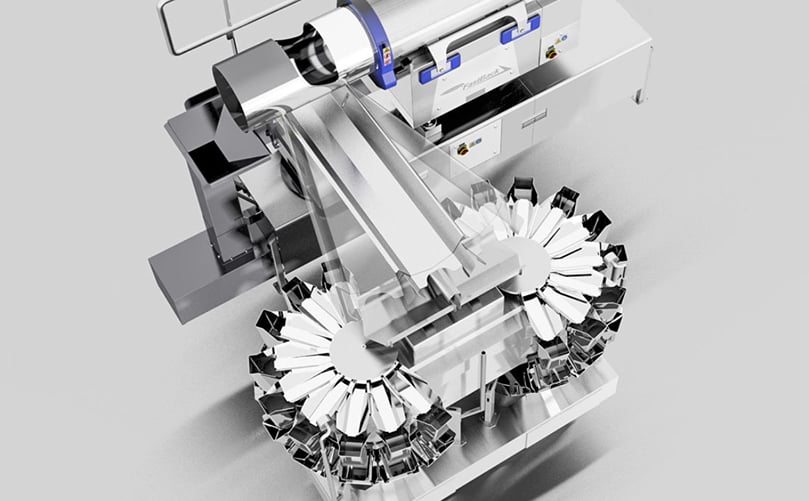
FastBack LRC infeed splitting product between both sides of a twin multi-head weigher. Image: Heat and Control, from the FastBack LRC product listing.
Potato Chips Packaging Line
Typical potato chips (crisps) processing and packaging line. Exact equipment and order vary by plant and product. Chart: PotatoPro, based on potato chip line descriptions from Heat and Control and tna.
Frozen French Fries Packaging Line
Typical frozen French fries processing and packaging line. Some plants also bulk-pack fries for food service before final packing. Chart: PotatoPro, based on French fry line equipment listed by Heat and Control and the packing line at Aviko Germany.
Multi-head Weigher vs Linear Weigher
A linear weigher feeds product along one or a few straight vibratory lanes into a weigh pan until it reaches the target, usually with a fast bulk feed followed by a slower dribble feed. It then empties the pan into the pack. While the pan is filling, no pack is filled. A multi-head weigher fills many hoppers at once and combines them, which makes it faster and usually more accurate on irregular pieces, but also more expensive. Many potato plants use both types for different products.
Multi-head and linear weighers compared. Figures come from manufacturer data and published installations, not guaranteed performance. Based on the Ishida range brochure and the installations described below.
Challenges and Limitations
Initial investment: A multi-head weigher costs more than a linear weigher or volumetric filler, and a complete weigher, bagmaker and inspection line is a major investment. Prices vary widely by make, head count and specification; some Chinese suppliers list complete chip weighing and bagging systems from about USD 56,000 to 100,000 on online marketplaces, while high-end European and Japanese lines cost considerably more. Payback depends mainly on how much giveaway and labour the weigher saves.
Maintenance and cleaning: Dozens of contact parts must be removed, cleaned and refitted. Cleaning time is lost production, which is why washdown ratings and tool-free parts matter.
Product breakage: Chips can break at each drop, from cone to hopper to chute to bag. Broken chips lower perceived quality and can get caught in seals.
Sticky or irregular product flow: Freshly seasoned chips, wet product or long pieces can bridge or stick, starving some heads.
Operator training: Settings for feeders, targets and upper limits need skilled adjustment. Poor settings can wipe out the accuracy gains.
Space and integration requirements: Weighers are tall and usually mounted on platforms above bagmakers, which needs headroom, access stairs and careful integration with conveyors and inspection equipment.
Operational limitations: Accuracy drops when the pack contains only a few heavy pieces, when the infeed is unsteady or when product properties change during a shift. Very fine or powdery products are better handled by other fillers.
How to Select the Right Multi-head Weigher for a Potato Processing Plant
Product type: Chips, fries, wedges and snacks behave very differently. Insist on trials with your own product, including worst-case pieces.
Target pack weight: List every pack weight you need now and in the next few years, from small snack bags to 2.5 kg catering packs.
Required packs per minute: Base the weigher choice on the bagmaker’s real speed for each bag size, not on the weigher’s maximum rating.
Number of weighing heads: More heads mean more combinations and better accuracy at speed, but also higher cost. Ask suppliers for expected accuracy at your speed with 10, 14 and 16 heads.
Hopper capacity: Hopper volume must suit the largest pack and the product’s bulk density; frozen fries and wedges need larger hoppers than chips of the same weight.
Product fragility: Check drop heights, gate designs and options such as ring shutters or soft-drop chutes.
Frozen or ambient conditions: Frozen lines need washdown construction and parts that resist ice; ambient snack lines need dust and seasoning control.
Hygiene requirements: Look at IP ratings, open designs, sloped surfaces and how quickly parts can be removed without tools.
Packaging machine compatibility: Confirm the signal interface, discharge height and chute design for your bagmaker, and whether the weigher can run twin discharge.
Available space: Measure headroom for the weigher, platform and infeed, and plan access for cleaning and maintenance.
Spare parts and after-sales service: Ask where engineers and parts are located and what response times are guaranteed. Local support often decides uptime more than machine specifications.
Total cost of ownership: Add giveaway, energy, cleaning time, spare parts, service contracts and expected downtime to the purchase price. A cheaper weigher with 1 g more giveaway per pack can cost more within a year on a busy line.
Buyer’s Checklist
| Check | Question to ask the supplier |
|---|---|
| Trials | Can we test the weigher with our own chips or frozen fries, including long and broken pieces? |
| Accuracy | What standard deviation and average giveaway can we expect at our pack weights and speeds? |
| Speed | What packs per minute will the weigher and our bagmaker reach together for each bag size? |
| Heads and hoppers | How many heads and what hopper volume do you recommend, and why? |
| Product handling | What drop heights, gate types and surface finishes will protect our product? |
| Hygiene | What is the IP rating, and how long does a full clean take? |
| Integration | Which interfaces connect to our bagmaker, checkweigher and plant software? |
| Service | Where are your nearest engineers and spare parts, and what are the response times? |
| Energy | What is the power consumption, and are energy-saving modes available? |
| References | Which potato processors use this model, and can we visit one? |
A buyer’s checklist for multi-head weighers on potato processing lines. Chart: PotatoPro.
Maintenance and Cleaning
Routine cleaning: Remove product residue, seasoning dust, starch and ice from the cone, pans, hoppers and chutes at the end of each run or shift. On washdown models parts can be cleaned in place; on others they are removed and washed separately. Aviko reports that its fortnightly wet cleaning causes only minimal downtime. Always follow the manufacturer’s limits for water pressure and chemicals.
Load-cell inspection: Check that load cells are undamaged, that nothing touches the weigh hoppers and that zero readings are stable. Load cells are sensitive to shock from dropped parts during cleaning.
Calibration: Check each head with certified reference weights at set intervals and after any repair, and compare the weigher with the checkweigher regularly.
Feeder and hopper inspection: Look for cracks, worn surfaces, loose fittings and damaged springs. Worn feeder pans change product flow.
Discharge gate maintenance: Hopper gates open and close millions of times a year. Check stepper motors, linkages and gate seals, and replace worn parts before they cause product to leak.
Preventive maintenance: Keep a schedule for drive units, cables, touch screens and software updates, and hold critical spares on site.
Food hygiene requirements: Food contact parts are typically stainless steel or approved plastics. Cleaning procedures, allergen changeovers and checks should be part of the plant’s HACCP plan. Guard against loose parts entering product, and record cleaning and inspection.
Developments in Multi-head Weighing Technology
Advanced combination-weighing algorithms: Higher-end weighers run several combination calculations per cycle; Ishida lists triple combination calculations as a feature of its premium range, along with average-weight control software.
Digital weighing systems: Digital filtering and anti-floor-vibration technology let weighers stay accurate near fryers, freezers and heavy conveyors. tna combines strain-gauge load cells with digital filtering to reduce the influence of external vibration.
Automated set-up and feed control: Several weighers adjust feeder settings automatically. Ishida’s RV series has an autosetup function, and Yamato uses Automatic Feed Control on its Omega weighers.
Hygienic and washdown design: IP69K hose-down construction, polygon or open-frame designs and tool-free parts cut cleaning time. MULTIPOND states that its J-Generation weighers can be placed under water during daily wet cleaning.
Remote monitoring: Ishida’s RV weighers can be operated from laptops, tablets and other devices, and cameras above the dispersion table let operators watch product flow remotely.
Industry 4.0 integration: Network connections such as Ethernet and OPC-UA link weighers to plant data systems for OEE, traceability and feedback from checkweighers. PFM’s MBP division includes an Industry 4.0 package as standard on one of its twin weigher lines.
Improved product handling: Gentler feeders, ring shutters, soft-drop chutes and new vibration drives reduce breakage of chips and frozen products. Bilwinco’s Revolution series was developed with a new load cell and vibrator design for difficult foods.
Energy efficiency: The Ishida CCW-RV uses up to 20% less power than recent models and offers three modes that save up to 50% more. Yamato reports that its Dataweigh Omega Plus uses 60% less power than earlier models.
Compact weighers: For small pack weights, Ishida’s Micro weigher weighs 0.5 to 50 g portions at up to 120 per minute in a quarter of the space of a standard model.
Leading Multi-head Weigher Manufacturers and Suppliers Worldwide
The companies below supply multi-head weighers used on potato lines, starting with suppliers in the directory of multi-head weigher suppliers, which lists more than 130 companies, and the multi-head weigher product listings. They are grouped by role rather than ranked, and no market shares are implied.
Selected multi-head weigher suppliers, with directory partner level shown. Labels show listing status, not market position or quality. Chart: PotatoPro, based on the multi-head weigher supplier directory and company profiles.
Heat and Control and Ishida (Hayward, USA, and Kyoto, Japan)
Company: Heat and Control is a privately owned company founded in 1950 and based in Hayward, California, with eleven manufacturing plants, ten test centres and more than 30 offices. It builds complete potato chip and French fry lines and represents Ishida in North America, supplying integrated weigher and bagmaker systems, infeed equipment and checkweighers. Ishida was founded in Kyoto in 1893.
Weighers for potato lines: The CCW-RV series is IP69K-rated and has an autosetup function. The CCW-RVE, in 10-, 14- and 16-head versions with an IP66 option, is the mid-range model and lists French fries among its uses; the CCW-SE3, with 10, 14 or 20 heads, is the entry-level model. The CCW-AS series lists French fries, snack foods and frozen vegetables among its applications. The CCW Open Frame weigher, also aimed at French fries, has IP66+, IP67 and IP69K ratings, 2, 3, 5 and 7 litre hoppers on 14-head waterproof models, and electrical units that can sit up to 20 m from the main body.
Systems: The High Speed Snack Packaging System combines a 16-head weigher, a timing hopper and a built-in CEIA metal detector to reach up to 220 bags per minute. The FastBack LRC infeed feeds Ishida’s back-to-back 218 twin weigher with a proportional stream, so small and large bags can run at the same time. Websites: heatandcontrol.com and ishida.com; all products: Heat and Control product range.
tna (Sydney, Australia)
Company: Family-owned tna supplies complete snack lines, from washing, peeling and slicing to frying, seasoning and packaging, and has deployed more than 16,000 systems in 137 countries.
Weighers: The intelli-weigh omega series runs up to 210 weighs per minute, is rated IP67 for wet or dry products and lists potato chips and French fries among its applications. The intelli-weigh alpha advance series is the simpler option at up to 140 weighs per minute. tna’s toggle-less buckets reduce the mechanical impact on the load cell and shorten settling time.
Lines: The weighers pair with the robag FX 3e VFFS bagmaker, rated up to 250 bags per minute. Italian chip maker Pata runs an intelli-weigh 0314S omega weigher rated up to 200 weighs per minute on a tna line. Website: tnasolutions.com; all products: tna product range.

tna intelli-weigh omega multi-head weigher, rated up to 210 weighs per minute. Image: tna, from the tna product listing.
Newtec (Odense, Denmark)
Company: Newtec makes weighing, packing and sorting machines and reports more than 20,000 installations over 45 years, about a third of them in the potato sector. Its weighers have 4 to 16 weigh heads, run up to 120 portions per minute and cover 50 g to 25 kg, using combination, mix and count-by-weight principles.
Processed potato products: The PC-Series 2009PC/2014PC is built for potato chips and similar fresh and frozen products, with up to 100 portions per minute at 0.25 kg and typical giveaway below 0.4%. The 2008PCM with memory pans, launched at Fruit Logistica in 2024, handles 50 to 500 g portions of snacks and small frozen products at up to 140 per minute with typical giveaway below 0.6%. The PCB-Series is aimed at processed potatoes and vegetables.
Fresh potatoes: For table potatoes, models such as the 4015XB2 shown at Potato Expo 2024 and the weighing and bagging system for potatoes pack 2 to 5 kg bags and 10 to 20 kg sacks. Website: newtec.com.

Newtec 2008PCM with memory pans, for 50 to 500 g portions of snacks and small frozen products. Image: Newtec, from the Newtec product listing.
Van Doren (East Wenatchee, USA)
Van Doren designs and integrates potato handling and packing systems, from receiving, grading and washing to freezing, packaging, palletising and storage. It lists multi-head weighers among its packaging equipment and acts as an agent for Newtec, which makes it a system integrator rather than a weigher manufacturer. Website: vandorensales.com.
Yamato Scale (Akashi, Japan)
Yamato Scale traces its history to 1920 and developed its first Dataweigh combination scale, the ADW-110, in 1979. Its range covers the Omega, Sigma and Epsilon series for snacks, fresh produce and frozen food. Type: manufacturer. Websites: yamatoscale.com, yamatoscale.co.uk.
Kenwei (Zhongshan, China)
Guangdong Kenwei Intellectualized Machinery, founded in 2006, has more than 21,000 m² of factory space and capacity for over 5,000 multi-head weighers a year. It offers standard, frozen-food, screw-feed and mixing weighers, linear weighers, checkweighers and metal detectors, and lists complete weighing and bagging systems for potato chips. Type: manufacturer. Website: kenweigh.com.
Bilwinco (Hjørring, Denmark)
Founded in 1955, family-owned Bilwinco builds multi-head weighers and complete systems for portions of about 10 g to 25 kg at up to 300 portions per minute, with service centres in Denmark, Germany, France, the UK and the USA. Its Revolution series targets wet, sticky and fragile foods. Bilwinco states that the multi-head weigher was invented in Denmark in the early 1960s, which differs from Ishida’s account. No potato processing installation has been published. Website: bilwinco.com; Danish suppliers: multi-head weigher suppliers in Denmark.
Anhui UUPAC (Hefei, China)
Anhui UUPAC Intelligent Equipment, founded in 2015, develops weighing, packing, inspection and conveying systems, including multi-head weighers. It sells in more than 80 countries and regions and runs an after-sales centre in California. Type: manufacturer. Website: uupac.com.
Manter, Eqraft and Sormac: Weighers for Fresh and Seed Potatoes
Manter (APH Group, Netherlands): Manter International, part of APH Group, builds single-row weighers with 8 to 14 buckets and double-row weighers with 10 to 20 buckets for potatoes, onions and carrots. Its M14i D, launched at Fruit Logistica 2025, has 14 weighing buckets with dosing buckets above them and runs up to 70 bags per minute.
Eqraft: The Eqraft Combination Scale has 12 or 16 buckets of 14 litres and packs pre-packs of up to 5 kg at up to 55 drops per minute; a Dutch seed potato grower uses it with a crate filler and sewing lane for small seed orders.
Sormac: The Sormac AFW-DB weighs and mixes potatoes up to 150 mm at up to 1,800 kg per hour.
These machines handle whole tubers rather than chips or fries; see potato packers for fresh potato packing.

Manter MD double-row multi-head weigher with 10 to 20 buckets, used for fresh potatoes and vegetables. Image: Manter (APH Group), from the Manter product listing.
Other International Manufacturers
MULTIPOND (Waldkraiburg, Germany): Manufacturing in Germany since 1946, with more than 5,000 weighing systems installed, MULTIPOND builds customised weighers and the feeding systems around them. Potato references include Branston and Bergia-Frites (see below). Website: multipond.com.
PFM and MBP (Italy): PFM, founded in 1964 in Torrebelvicino, builds VFFS and flow-wrap lines; its MBP division, founded in 1980 and part of PFM since 2002, makes weighers with 8 to 24 heads. Website: pfm.it.
multiweigh (Wetzlar, Germany): MultiWeigh has built weighers for more than 20 years and reports more than a thousand machines installed, mainly in fruit, vegetables and mixed products. Website: multiweigh.com.
Scanvaegt Systems (Aarhus, Denmark): A maker of scales, multi-head weighers, checkweighers and X-ray systems for meat, poultry and fish, which in 2013 became exclusive distributor of Bilwinco in Denmark, Sweden and Poland. Website: scanvaegt.com.
Ohlson Packaging (Taunton, USA): A maker of combination and linear weighers and baggers, acquired by Duravant in 2018, whose clients include Frito-Lay. Website: ohlsonpack.com.
RADPAK (Włocławek, Poland): Founded in 1991, RADPAK builds VFFS machines, cartoners, case packers and complete packaging lines. RW-series weighers appear in its bagging lines, but multi-head weighers are not in its current trade fair range, so it is better described as a line integrator. Website: radpak.pl.
Commercial Applications and Industrial Case Studies
The installations below were reported by the processors or their equipment suppliers. Figures are as published and are not always measured in the same way.
Published results from multi-head weigher installations in potato processing. Metrics differ between sources (speed, giveaway, weight variation) and are not directly comparable. Chart: PotatoPro, based on Aviko, Friweika, Branston, Bergia-Frites, Petr Hobža, Simply Roasted, Brauerei Locher and McCain reports.
Aviko Germany, Rain am Lech: Ishida CCW-RV for Frozen Fries
Processor: Aviko Deutschland GmbH, part of Dutch processor Aviko, processes about 40 tonnes of potatoes an hour in Rain, Bavaria, mostly into French fries, with the rest made into wedges and fried potatoes.
Equipment: Eight Ishida weighers stand side by side, and replacement with 14-head CCW-RV models began in 2023, with three replaced by early 2025 and more on order. They pack frozen fries in bags of 450 g to 2.5 kg, 24 hours a day.
Results: Speed on 450 g bags rose from 50 to 70 packs per minute and output by about 40%, with 2.5 kg bags overfilled by only about 5 g. Aviko expects an amortisation period of about two and a half years.
Friweika, Weidensdorf, Germany: Ishida RV for Peeled, Cooked Potatoes
Processor and product: German potato specialist Friweika packs peeled and cooked whole potatoes, which are wet and are carried to the weighers in streams of water.
Equipment: A 10-head Ishida RV weigher rated IP69K feeds a thermoformer with 500 g retail trays and 2 kg or 5 kg catering packs, using a four-funnel distribution system for catering packs.
Results: The line handles up to 2.5 tonnes per hour around the clock with giveaway of no more than 1.5% on 500 g trays, and one operator runs both the weigher and the thermoformer.
Aviko, Rain am Lech (2008): Earlier Ishida Installation
Results: Aviko bought eight Ishida weighers over six years, and production rose by 56% after the first one with no extra operators. The plant had expected weight variation of about 1%; the annual average turned out to be 0.34%.
Branston, UK: MULTIPOND for Crispy Potato Slices
Processor and equipment: Branston Ltd, one of the largest UK potato companies with three plants, replaced manual tray filling with a 14-head MULTIPOND MP 14-2400/1250-H weigher.
Results: The line fills 77 trays per minute, six times faster than before, and giveaway fell from 6% to 0.4%.
Bergia-Frites, Netherlands: MULTIPOND for Frozen Potato Specialties
Equipment and results: The family-owned Roermond company, founded in 1931, installed five MULTIPOND MP 16-7100/2500-H weighers covering target weights from 100 g to 5,000 g at 60 to 100 weighings per minute.
Petr Hobža, Czech Republic: Ishida Twin Weigher for Potato Crisps
Equipment and results: A 16-head Ishida CCW-RS-216B weigher in twin mode feeds two Astro bagmakers with seal testers and checkweighers, running 180 packs per minute on 60 g bags and 110 on 175 g bags, within 0.1 g of target.
Simply Roasted, UK: Ishida iTPS for Baked Potato Crisps
Equipment and results: A 14-head Ishida CCW-RV weigher with an INSPIRA rotary bagmaker and a DACS checkweigher packs seven flavours at about 80 packs per minute on 21.5 g bags and 60 on 93 g bags, three times the previous speed and within 1 g of target, with less film waste.
Brauerei Locher, Switzerland: Compact Line for Brewery Crisps
Equipment and results: A 10-head Ishida CCW-SE3-210 weigher above a bagmaker with an integrated metal detector packs 10 g, 30 g and 90 g bags at up to 50 bags per minute with maximum overfill of 1.2 g per bag.
McCain Foods, Delmas, South Africa: Three New Packing Lines
Equipment: McCain added three packing lines, each built around an Ishida R-Series weigher, for fries of 6 to 12 cm, wedges and batter fries; the plant already had four Ishida weighers.
Results: The three weighers share one infeed, so one runs when demand is low and all three at peak. Limited by downstream equipment, they run at about 90 bags per minute on 500 g bags and 50 on 2.5 kg bags.
Pipers Crisps, UK: Ishida Weighers for Premium Crisps
Equipment and context: Pipers uses 14-head Ishida CCW-R weighers in a crisp specification with anti-floor-vibration load cells, and later added two tna robag VFFS machines that raised small-bag speed from 80 to up to 140 bags per minute.
Gaps in published evidence: Detailed installation reports from large North American and Asian potato processors were not found in public sources.