Vertical Form Fill Seal (VFFS) Machines in the Potato Industry
Vertical Form Fill Seal (VFFS) machines are automated packaging machines used to form, fill, seal and cut flexible packaging film into individual bags. They are widely used for potato chips, potato crisps, snacks and other food products because they integrate bag forming and product filling into a single packaging system.
What Is a VFFS Machine?
VFFS stands for Vertical Form Fill Seal. A VFFS machine uses a continuous roll of flexible packaging film, known as roll stock, to produce individual bags. The film is unwound and guided through a forming collar, where it is shaped into a tube around a forming tube. The film edges are joined by a longitudinal seal, while horizontal sealing jaws create the transverse seals that form the top and bottom of the bags.
The product is measured by a suitable filling or weighing system and introduced into the formed bag. The machine then completes the top seal and cuts the package from the film tube before discharging the finished bag. VFFS machines may operate in intermittent motion or continuous motion modes, depending on the machine design, product characteristics, bag format and required production rate.
VFFS packaging machines can automate the primary packaging process from roll stock, reducing manual handling and providing consistent bag dimensions, fill weights and sealing. Operators are still required for activities such as film and product loading, changeovers, cleaning, maintenance and quality checks.
In a potato or snack packaging line, the VFFS machine is generally positioned after product conveying and weighing equipment, such as a multihead weigher. Depending on the packaging line, additional equipment may include product elevators, checkweighers, metal detectors, X-ray inspection systems, date and batch coders, case packers and palletizing equipment. The VFFS machine therefore forms the primary retail package around the product.
VFFS machines are used for a wide range of products, including potato chips and crisps, snacks, nuts, seeds, rice, pulses, pasta, confectionery, cereals, pet food, powders and other products suitable for vertical packaging. The filling system, packaging film, sealing method, bag format and machine configuration are selected according to the physical and packaging requirements of each product.
For potato chips and other fragile snacks, VFFS packaging systems can be combined with multi-head weighing and nitrogen flushing equipment. Nitrogen flushing can reduce oxygen inside the package and provide cushioning around fragile products, helping to limit oxidation and physical damage. However, VFFS packaging alone does not determine product shelf life. Shelf life also depends on the product, packaging film barrier properties, residual oxygen, seal integrity, package design and storage conditions.
VFFS describes a packaging machine format and process rather than a single standardized machine configuration. VFFS systems can use different weighing and dosing equipment, packaging films, sealing technologies, bag formats and forming systems. A VFFS machine designed for potato chips may therefore differ considerably from one designed for powders, liquids or other products.
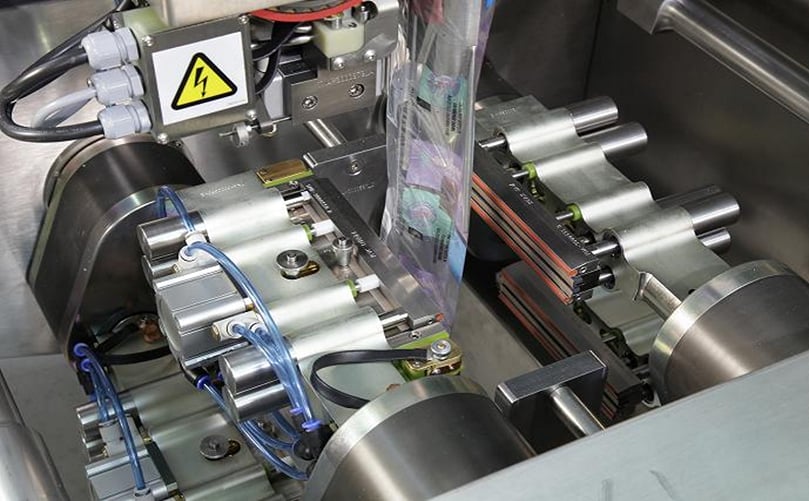
Vertical Form Fill Seal (VFFS) Machine for Potato Chip Packaging
How Does a Vertical Form Fill Seal (VFFS) Machine Work?
A VFFS machine follows a repeating packaging cycle that turns a roll of flexible film into individual filled and sealed bags. Depending on the machine design, the process can run in intermittent or continuous motion. The basic sequence remains the same: the film is fed and formed into a tube, the product is added, the bag is sealed and cut and the finished package is discharged.
Film unwinding and feeding: A roll of flexible packaging film is mounted on the unwind system and fed toward the forming section. The film is kept under controlled tension to prevent wrinkles, shifting or inconsistent bag formation.
Film registration: When printed film is used, a photoelectric registration sensor detects the eye marks printed on the film. This allows the machine to control bag length and keeps the printed design correctly positioned on each bag. With unprinted film, bag length is controlled through the film-feed system and machine settings.
Bag forming: The flat film passes over a forming collar, also called a forming shoulder and wraps around the forming tube. This changes the flat film into a continuous tube. The forming set is selected according to the required bag width and format.
Longitudinal sealing: The overlapping edges of the film are joined along the length of the tube to create the longitudinal seal. Heat sealing is widely used, although other sealing technologies can be used with suitable packaging materials and machine designs.
Product dosing and filling: The product is measured by a suitable weighing or dosing system and released through the forming tube into the open package. For potato chips and other irregular snack products, multi-head weighers are commonly used because they can provide accurate target weights while handling the product efficiently.
Horizontal sealing: Horizontal sealing jaws close the package across its width. In a typical VFFS cycle, the same sealing operation creates the bottom seal of the next bag and the top seal of the filled bag. Sealing temperature, pressure, and dwell time are adjusted according to the film structure and machine requirements.
Cutting: Once the transverse seal has been formed, a knife or integrated cutting system separates the completed bag from the film tube. When printed film is used, cutting is synchronized with the registration system so that the cut occurs at the intended position.
Finished bag discharge: The completed bag leaves the sealing and cutting area and is transferred to a discharge conveyor or downstream equipment. Depending on the packaging line, it may then pass through a checkweigher, metal detector, X-ray inspection system or case packing system. Supporting Systems: Several control systems work together to keep the packaging process stable. Film tension systems maintain consistent film movement, while registration and photoelectric sensors monitor film position and package formation. Servo-driven film feed systems can control film length and timing accurately, while the sealing system regulates parameters such as temperature, pressure and dwell time.
For potato chips and other fragile or irregular products, controlled product feeding and settling can help achieve consistent fill weights and reduce the risk of product becoming trapped in the seal. The exact timing of each operation depends on the machine configuration, product, packaging film, bag format and filling system.
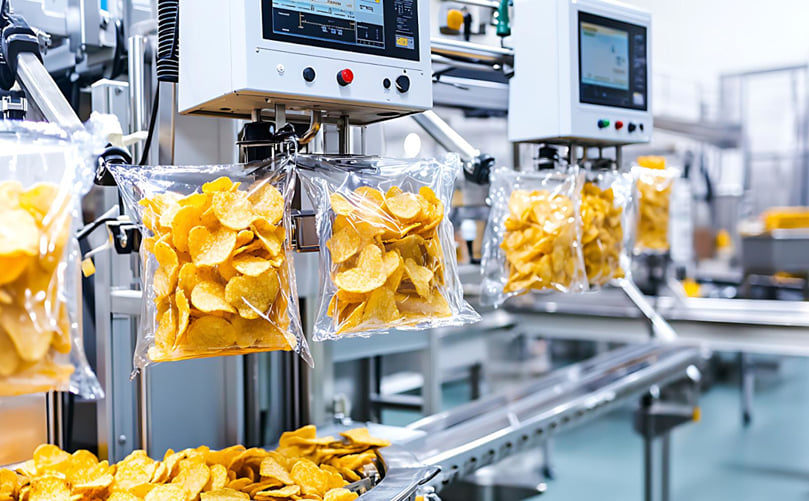
VFFS Machine Packaging Process: From Film to Finished Bag
What Are the Main Components of a VFFS Machine?
A VFFS (Vertical Form Fill Seal) machine combines several mechanical and control components to turn a roll of flexible packaging film into filled sealed bags. Each component has a specific job, from feeding and forming the film to dosing the product, sealing the package and removing the finished bag.
Understanding these VFFS machine components is useful when selecting packaging equipment, troubleshooting production problems or comparing different VFFS machine designs.
Film Unwinding Unit: The film unwinding unit holds the roll of packaging film and feeds it into the VFFS machine. Depending on the machine design, the unwind system may use a motorized drive, brake or other controlled mechanism to maintain a steady film supply.
Film Tension and Guiding System: Consistent film tension is important for accurate bag formation and sealing. Dancer arms, rollers, brakes and film guiding devices help control tension and keep the film properly aligned as it moves through the machine. Poor tension control can result in wrinkles, stretching, film tracking problems or inconsistent bag lengths.
Forming Collar or Forming Shoulder: The forming collar, also called the forming shoulder, changes the flat packaging film into a tube around the forming tube. Its design affects how smoothly the film forms and can be adapted for different bag styles, including pillow bags and gusseted bags.
Forming Tube: The forming tube supports the film as it is shaped into a package. It is hollow so that the product can pass through it and enter the bag. The forming tube and forming collar are selected according to the required bag dimensions, film width and product characteristics.
Vertical Sealing Unit: The vertical sealing unit creates the longitudinal seal along the length of the package. Depending on the packaging design and film structure, the machine may produce a fin seal or lap seal.
Horizontal Sealing Jaws: Horizontal sealing jaws create the top and bottom seals of the bag. They also commonly work with the cutting system to separate one finished package from the next. VFFS machines may use intermittent sealing jaws or continuous-motion, traveling jaws for higher-speed applications.
Cutting Mechanism: The cutting mechanism separates individual bags after the sealing operation. Depending on the VFFS machine design, cutting can be performed using a knife, rotary cutter or blade integrated into the horizontal sealing jaws.
Product Chute: The product chute directs the product from the filling system through the forming tube and into the package. Its design is particularly important when handling fragile, irregular, sticky or free flowing products because it can affect product flow and the risk of blockages or damage.
Filling and Dosing System: The filling or dosing system measures and delivers the required quantity of product into each bag. The type of filler depends on the product being packaged. Common options include multi-head weighers, linear weighers, auger fillers, volumetric cup fillers and liquid filling systems.
Film Registration Sensor: A film registration sensor detects printed eye marks on pre-printed packaging film. The sensor helps the machine control bag length and position the printed design correctly on every package.
PLC Control System: The PLC (Programmable Logic Controller) is the main control system of the VFFS machine. It coordinates machine functions such as film feeding, sealing, cutting, sensor signals, filling synchronization, servo movements, alarms and safety functions.
HMI or Touchscreen: The HMI (Human Machine Interface) allows operators to control and monitor the VFFS machine. Operators can use the touchscreen to set bag length, sealing temperatures, machine speed, recipes and other operating parameters, as well as view alarms and diagnostic information.
Servo Motors and Drives: Servo motors provide accurate and programmable movement for important machine functions. They are commonly used for film feeding, sealing jaw movement, cutting and synchronization between different machine axes. Servo-driven systems can improve positioning accuracy and make recipe changes easier on modern VFFS machines.
Pneumatic System: The pneumatic system supplies compressed air to components such as cylinders, valves, actuators and gates. Depending on the machine design, pneumatic components may be used for sealing mechanisms, film handling, product gates and other auxiliary movements.
Discharge Conveyor: After the bag is cut and released, the discharge conveyor moves the finished package away from the VFFS machine. Depending on the packaging line, the conveyor may also help with bag spacing, orientation, inspection or transfer to downstream equipment.
Safety Guards and Sensors: Safety systems protect operators from moving parts, heated sealing components and other potential hazards. VFFS machines can include safety guards, door interlocks, emergency-stop buttons, safety switches and other protective devices.
How Do These VFFS Components Work Together?
The components of a VFFS machine operate as one synchronized packaging system. The film unwinding and tension systems feed the film at a controlled speed. The forming collar and forming tube shape the film into a package, while the filling system delivers the required product. The vertical and horizontal sealing systems close the package and the cutting mechanism separates the finished bags.
The PLC, HMI, sensors, servo motors and pneumatic components coordinate these operations so the machine can produce consistent packages at the required production speed.
For this reason, the performance of a VFFS machine depends not only on the individual components but also on how accurately they work together.
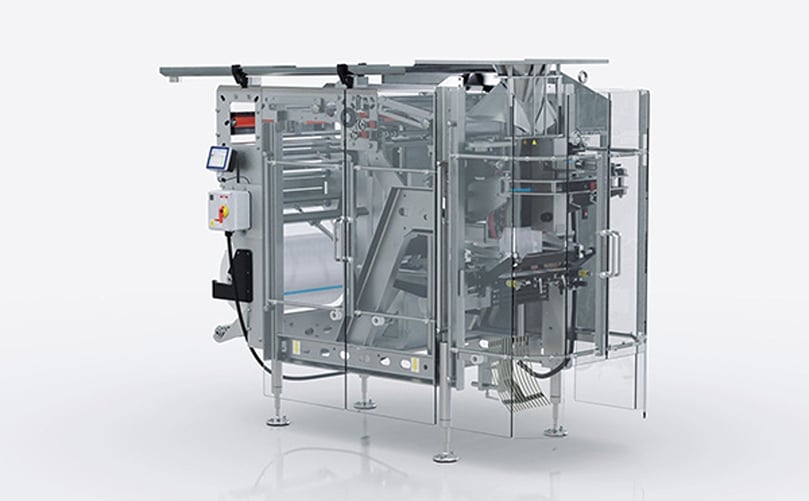
Integrated VFFS Machine
Types of VFFS Machines: Understanding the Main Packaging Systems
VFFS machines can be classified based on their motion system, number of packaging lanes, level of automation and intended production scale.
Intermittent motion VFFS machines: The film stops during filling, sealing and cutting. This design offers good sealing control and is suitable for products that require settling before sealing, including powders and some difficult-to-handle products. Typical speeds are around 30–120 bags/min, depending on the machine and bag format.
Continuous motion VFFS machines: The film moves continuously while the sealing jaws travel with the film during the sealing cycle. They are designed for higher production speeds and are widely used on high volume snack and food packaging lines. Speeds commonly range from about 90–200+ bags/min, depending on the application and machine configuration.
Single-lane VFFS machines: These machines use one forming tube to produce one bag at a time. They are widely used for standard sized bags and applications where moderate production capacity is sufficient.
Multi-lane VFFS machines: These machines have two or more parallel forming tubes and can produce multiple small bags simultaneously. They are particularly useful for sachets, stick packs and other portion sized packages where high total output is required.
VFFS Machines by Drive and Automation System
VFFS machines can also be differentiated by how their mechanical movements are controlled.
Servo-driven VFFS machines: Servo motors provide precise control of film feeding, sealing, cutting and other machine movements. They offer accurate bag length control, quick changeovers, recipe storage and greater flexibility than conventional mechanical systems. Servo technology can be incorporated into both intermittent and continuous motion VFFS machines.
Mechanical or pneumatic VFFS machines: These machines use mechanical cam systems, pneumatic cylinders or a combination of mechanical and pneumatic components for various movements. They can have a lower initial cost but generally provide less flexibility and control than modern servo-driven systems.
Automatic VFFS machines: Automatic VFFS systems integrate functions such as film tracking, product feeding, sealing, cutting and machine control with minimal operator intervention. Automation is a feature or configuration rather than a separate motion type.
Compact VFFS machines: Compact models have a smaller footprint and are designed for applications with limited production requirements or restricted floor space. They are often used by smaller processors, startups and businesses requiring lower capacity packaging equipment.
How to Choose a VFFS Machine?
The appropriate VFFS machine depends on required production speed, product characteristics, film properties, bag size and style, sealing requirements, available floor space, automation level and budget. Intermittent-motion machines are generally suited to applications where flexibility and controlled sealing are important, while continuous motion machines are preferred for high throughput production. Servo-driven systems are increasingly used when precise control, rapid changeovers and flexible operation are required.
What Products Can VFFS Machines Package?
VFFS machines can package a wide range of food products, from potato snacks and frozen products to dry ingredients, powders and other free-flowing items. The appropriate filling system depends on the product’s size, shape, flowability, density, moisture and fragility.
Potato products: Potato chips/crisps are one of the major applications for VFFS machines. They can also package dehydrated potato pieces, potato flakes, potato granules, small whole potatoes and diced or cut potatoes when the product can be handled and fed consistently. French fries and other frozen potato products can also be packaged with suitable feeding and handling systems.
Other food products: Common applications include nuts, seeds, rice, pulses, pasta, dried fruits, confectionery, biscuits, cereals, pet food, flour, spices, milk powder and other free-flowing or semi-free-flowing products.
The filling technology must match the product characteristics. Multi-head weighers are commonly used for irregular or fragile snacks, volumetric cup fillers for free-flowing granular products, auger fillers for powders and pump-based systems for liquids and pastes. Sticky, highly irregular or extremely fragile products may require specialized feeding and handling equipment rather than a standard VFFS setup.
VFFS Filling and Weighing Systems for Potato Products
Multi-head weighers (combination weighers): The most common weighing system for potato chips and other irregular snack products. Multiple weighing hoppers hold individual portions and the control system calculates the best combination of hoppers to achieve the target weight. They provide high speed and good weighing accuracy while minimizing product giveaway. Low drop configurations can also help reduce chip breakage.
Linear weighers: Use a series of weighing heads to portion products to a target weight. They have a simpler design than multi-head systems and are suitable for moderate speed applications and products with relatively consistent flow characteristics.
Volumetric cup fillers: Measure products according to volume rather than weight. They are suitable for free-flowing products where bulk density remains relatively consistent. They can operate at high speeds but generally provide less precise weight control when product density or particle size varies.
Auger fillers: Use a rotating screw to meter powders and fine, cohesive products. The enclosed dosing system provides controlled and consistent filling and can help reduce dust generation. They are more commonly used for powdered potato products and other fine ingredients than for whole potato chips.
Pump-based fillers: Used for liquid, semi-liquid or viscous products such as sauces, purees and pastes. The pump meters a controlled quantity into each package and is therefore relevant to liquid or wet potato products rather than dry potato chips.
For potato chips, multi-head combination weighers are generally the preferred filling system. Potato chips vary considerably in size, shape, thickness and density, making volumetric dosing less consistent. Combination weighing allows the machine to select an optimal combination of portions for each bag, providing high throughput and tight control of target weight. Depending on the product, target weight, machine configuration and manufacturer, commercial systems can achieve very low giveaway and weighing accuracy within a few grams or better; specific accuracy claims should always be stated according to the machine's rated specifications.
Types of VFFS Bags for Potato Chips and Other Products
Pillow bags: One of the most common VFFS bag formats with a longitudinal back seal and top and bottom seals. They use relatively little packaging materials are economical to produce and are widely used for potato chips, snacks, frozen foods and other products. However, they have limited stability on the shelf.
Gusseted bags: Feature folded gussets along the sides or bottom, providing greater package volume and a fuller appearance. They can offer better stability than standard pillow bags and are suitable for larger or higher-volume packs.
Block-bottom bags: Have a flat, square or rectangular bottom that allows the package to stand upright. They provide excellent shelf stability and presentation and are often used where premium appearance and efficient retail display are important.
Quad-seal bags: Use four vertical seals to create a more structured, rectangular package with multiple large printable panels. They provide good shelf presence, stack ability and branding space but generally require more packaging material and more specialized forming equipment than pillow bags.
Stick packs: Narrow, elongated sachets produced in single or multi-lane configurations. They are primarily used for small, single serving quantities of powders, granules, liquids and other portion-controlled products rather than conventional potato chips.
Sachets: Small, generally flat or three or four-side-sealed packs used for single-use or small portions. Depending on the product and package design, they may be produced using VFFS or other form-fill-seal technologies.
The choice of bag style depends on product characteristics, pack size, shelf presentation, material consumption, filling requirements and production speed. Pillow bags are widely used for high volume potato chips because they offer efficient material use and high-speed production. Gusseted, block-bottom and quad-seal formats provide greater structure and stronger shelf presentation and are often selected for larger or premium packs.
One correction to the original wording: bag styles are not always interchangeable simply by changing tooling on the same VFFS machine. The achievable bag formats depend on the machine's forming system, sealing configuration, film dimensions and manufacturer-specific design. Some machines can produce multiple formats with change parts, while others are designed for specific bag styles.
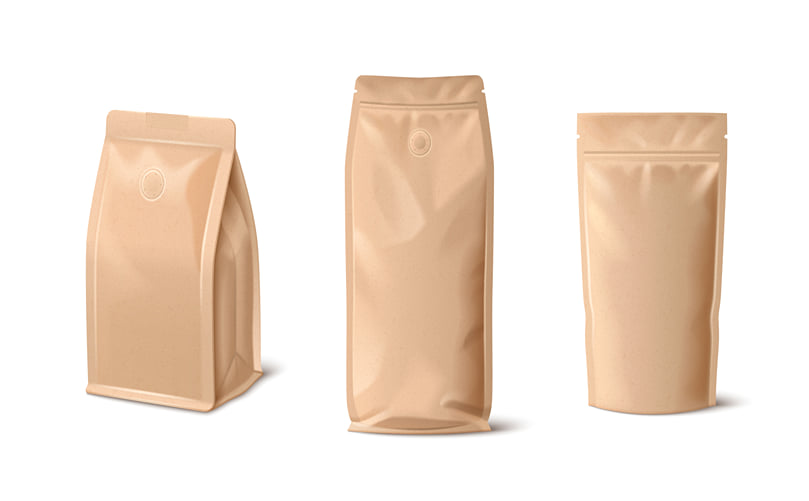
Types of VFFS Bags for Potato Chips and Snacks
Packaging Films and Materials Used in VFFS Machines
Common packaging films and structures used in VFFS applications include:
PE (polyethylene): Provides good heat-sealing properties, flexibility and moisture resistance. PE is commonly used as the inner sealant layer in flexible packaging structures.
PP and BOPP (biaxially oriented polypropylene): Offer good stiffness, clarity, gloss, printability and moisture resistance. BOPP is widely used in snack packaging, including potato chip bags.
PET (polyethylene terephthalate): Provides high mechanical strength, dimensional stability and heat resistance. It is often used as an outer layer in laminated packaging and provides a good surface for printing.
Metallized films: Metallized BOPP, metallized PET and other metallized structures provide improved barriers against oxygen, moisture and light. These properties are particularly important for potato chips because they help protect the product from oxidation and moisture pickup.
Laminated films: Combine two or more materials to provide a balance of printability, strength, barrier performance and heat-sealing properties. Examples include BOPP/metallized BOPP/PE, PET/metallized PET/PE and BOPP/VMPET/PE, although the exact structure varies according to the product and packaging requirements.
High-barrier films: Designed to provide enhanced protection against oxygen and moisture. They may incorporate metallized layers, EVOH or aluminum foil, depending on the required barrier level and packaging design.
Recyclable mono-material films: PE or PP-based structures designed to improve recyclability while maintaining the required sealing and barrier properties. Their actual recyclability depends on the film structure, local collection systems and available recycling infrastructure.
For potato chips, oxygen and moisture barrier performance is particularly important. Oxygen can accelerate oxidation of the oil, leading to rancidity and off flavors, while moisture can reduce crispness. Metallized film structures are therefore widely used where a high level of barrier protection is required.
Sealing Methods and Critical Parameters in VFFS Packaging
Heat sealing (most common): Uses heated sealing jaws to soften or melt the sealant layer and bond the film under pressure. The two main types are constant-heat sealing, where the jaws remain at a set temperature and impulse sealing, where heat is applied in short pulses.
Impulse sealing: Applies heat only during the sealing cycle, followed by cooling under pressure. It provides precise heat control and can be suitable for a wide range of thermoplastic films.
Constant-heat sealing: Maintains a continuous jaw temperature and is widely used for high-speed packaging applications.
Hot-air sealing: Uses a stream of heated air to soften the sealing surfaces. It is used mainly in specialized packaging applications and with certain film structures.
Ultrasonic sealing: Uses high-frequency mechanical vibrations to generate localized heat at the sealing interface. It can reduce energy consumption, allow sealing through certain levels of product contamination, operate with cooler tooling and produce narrower seals. It is increasingly used in specialized VFFS applications.
Critical sealing parameters include temperature, pressure, dwell time, seal width and film compatibility. The sealing temperature must match the film's sealant layer and may typically range from 120–250°C, depending on the material and structure. Adequate and uniform pressure ensures proper contact between the sealing surfaces, while dwell time provides sufficient heat transfer and bonding. Seal width must be appropriate for the package and film. Poor control of these parameters can result in weak seals, burn-through, wrinkles or leakage. Consistent seal integrity is essential for maintaining product protection, package strength and shelf life.
VFFS Machine Speed, Throughput and Production Capacity
VFFS machine speed is usually measured in bags per minute (BPM) or bags per hour. Intermittent motion VFFS machines commonly operate at around 30–120 BPM, while continuous motion machines can reach 90–200+ BPM in suitable applications. Multi-lane machines can produce several bags at the same time, increasing overall production capacity.
The actual output of a vertical form fill seal machine depends on more than its rated speed. Product weight, bag size, film type, number of lanes, filling system and machine configuration all affect the achievable production rate. Product characteristics such as flowability, density, particle size and fragility are also important, particularly when packaging products such as potato chips, snacks, grains and other food products.
Factors That Affect VFFS Production Output
A machine rated at a particular BPM does not necessarily produce that number of saleable bags continuously. Production can be affected by weigher cycle time, inconsistent product flow, film roll changes, film splices, rejected bags, seal defects, cleaning, product changeovers and unplanned stoppages.
For this reason, production planning should consider overall equipment effectiveness (OEE) rather than relying only on the machine's maximum speed. OEE takes into account equipment availability, operating performance and product quality, giving a more realistic picture of actual output.
Manufacturers' high-speed figures are generally based on specific products, bag sizes, films and operating conditions. In a real production environment, the sustainable VFFS packaging speed is often lower than the maximum rated speed. Choosing the right machine, filling system and packaging material is therefore important for achieving consistent throughput without compromising bag quality or product protection.
Accuracy and Product Quality
Accurate filling and consistent package quality are essential for efficient VFFS packaging. Important factors include target fill weight, weighing accuracy, underweight and overweight control, product giveaway, seal strength, bag dimensions and product damage.
For potato chip packaging, product breakage and fines are major quality concerns. Excessive impact during feeding or filling can produce broken chips and fines, affecting the appearance and eating experience. Gentle product transfer, controlled drop heights, suitable forming-tube dimensions and well-designed feeding systems can help reduce damage.
Accurate weighing also helps control product giveaway. Even small amounts of overfilling across thousands of bags can significantly increase product costs. At the same time, reliable weight control helps ensure that packs meet their declared weight requirements.
VFFS Machines for Potato Chips
A typical potato chip packaging line consists of:
Potato chips → Conveyor/elevator → Vibratory feeder → Multi-head weigher → VFFS machine → Sealing → Checkweigher → Metal detector or X-ray → Finished-product conveyor → Case packing
The multi-head weigher plays an important role because potato chips vary in size, shape and weight. Combination weighing allows the system to achieve accurate target weights at high production speeds while limiting product giveaway.
The VFFS machine then forms the packaging film into a bag, receives the weighed product and completes the sealing process. Careful product transfer between the weigher and VFFS machine is important to minimize impact and breakage.
Downstream equipment such as a checkweigher and metal detector or X-ray inspection system provides additional quality control before the bags are packed into cases.
Nitrogen Flushing in Potato Chip Packaging
Nitrogen flushing is widely used in potato chip packaging to replace oxygen rich air inside the bag before sealing. Food-grade nitrogen is introduced into the package, creating a protective atmosphere around the product.
The main purpose is to reduce oxidation of the oils and fats in potato chips, helping maintain flavor and quality during storage. The nitrogen-filled package also provides cushioning, which helps protect fragile chips from crushing during transportation and handling.
The effectiveness of nitrogen flushing depends on factors such as gas flow rate, flushing time, bag size, film characteristics, sealing speed and the amount of air initially present in the package. Residual oxygen can be monitored as part of quality control with the required level depending on the product and expected shelf life.
Nitrogen flushing should not be confused with vacuum packaging. Vacuum packaging removes air from the package, whereas nitrogen flushing displaces oxygen rich air with nitrogen while maintaining a gas-filled package. This makes it particularly suitable for fragile products such as potato chips.
Quality Control and Inspection Systems
Quality control systems are often integrated inline with or downstream of VFFS machines to identify defective or contaminated packages before they reach secondary packaging.
- Checkweighers: Verify the weight of each finished bag and automatically reject packs that fall outside the specified weight range.
- Metal detectors: Identify ferrous, non-ferrous and stainless-steel contaminants in packaged products.
- X-ray inspection: Detects dense foreign materials and can also identify certain product or packaging defects that metal detectors may not detect.
- Vision inspection: Checks factors such as printed information, coding, bag appearance, seal position and other visible defects.
- Seal inspection: Monitors the appearance and consistency of seals to identify issues such as incomplete or irregular sealing.
- Leak detection: Uses pressure, vacuum or other methods to identify packages with leaks or inadequate seals.
- Foreign-body inspection: Metal detection and X-ray systems can be used individually or together depending on the product and required level of protection.
- Automatic reject systems: Remove non-conforming packs from the production line without requiring the entire packaging process to stop.
These inspection systems help maintain product quality, package integrity, food safety and regulatory compliance while reducing the risk of defective products reaching customers. In a typical VFFS line, inspection equipment is positioned after bag formation and sealing and before secondary packaging, although the exact arrangement depends on the product and production-line design.
Smart Automation and Digital Control in VFFS Machines
Modern VFFS machines increasingly incorporate automation and smart-control features to improve efficiency, consistency and ease of operation. Common features include PLC-based control, intuitive HMI/touchscreen interfaces, servo-driven motion, recipe management, automatic film tracking and edge guiding and automated machine adjustments.
Advanced systems may also provide remote diagnostics, production data collection, OEE monitoring, predictive maintenance alerts and Industry 4.0 connectivity through Ethernet, OPC UA or cloud-based interfaces.
These technologies can reduce operator intervention, shorten changeover times, improve machine uptime, maintain consistent packaging performance and support data driven production optimization.
VFFS vs Other Packaging Machines
Machine Type | Best Suited For |
|---|---|
| VFFS | Flexible bags from rollstock, high-speed food packaging (snacks, granules, powders), cost-effective high volume |
| HFFS | Horizontal packaging, individual items, bars, higher speeds for certain formats, flow-wrap styles |
| Premade pouch machine | Preformed pouches (stand-up, zipper, spout), premium appearance, frequent changeovers, lower volumes or complex features |
| Rotary pouch machine | High-volume premade pouch filling |
| Form-fill-seal (general) | Automated bag production and filling (VFFS is the vertical subset) |
VFFS is generally preferred when high production speed, efficient use of rollstock and standard flexible bag formats such as pillow, gusseted or quad-seal bags are required. It is particularly well suited to snacks, granules and other free-flowing products.
HFFS is better suited to products that need horizontal handling or flow-wrap packaging, while premade pouch machines are advantageous for stand-up pouches, zippers, spouts and other specialized features. Rotary pouch systems are appropriate when high-volume filling of premade pouches is required.
The best choice depends on product characteristics, package format, production volume, filling requirements, material cost and the level of packaging flexibility required.
VFFS Machine Selection and Maintenance
How to Choose a VFFS Machine
Machine selection should start with the product and production requirements rather than the machine's rated speed. Evaluate product type, density, flow characteristics, target bag weight and dimensions, required bags per minute, film type and width, sealing technology, filling system and accuracy and whether nitrogen flushing or MAP is required.
Also consider available floor space, automation level, hygiene and cleaning requirements, changeover frequency, number of SKUs, future capacity requirements and compatibility with existing upstream and downstream equipment. Manufacturer support, local service capability, spare-parts availability, training and total cost of ownership are equally important.
Product trials on shortlisted machines are strongly recommended to confirm filling accuracy, sealing performance, film handling, speed and overall suitability before purchase.
VFFS Machine Maintenance
Routine maintenance is essential for reliable operation, consistent sealing and longer machine life. Daily cleaning should cover product contact areas, sealing jaws, the film path, sensors and other areas where product fines or film dust can accumulate.
Regular inspections should include sealing-jaw wear and alignment, temperature uniformity, film-path rollers and belts, sensor cleanliness, specified lubrication points, pneumatic pressure and leaks, conveyors and safety systems. Preventive maintenance should include calibration of weighers and sensors and timely replacement of wear parts such as belts, sealing components, knives and forming parts.
Maintenance intervals should follow the manufacturer's recommendations with service activities and component replacements recorded for effective preventive maintenance.
Common VFFS Problems and Troubleshooting
- Uneven bags or inconsistent bag length: Check the registration sensor, film tension, pull belts and bag-length settings.
- Seal failure: Check sealing temperature, pressure, dwell time, jaw cleanliness and alignment and film compatibility. Contaminated jaws and an unsuitable heat profile are common causes.
- Film wrinkling: Check film tension, rollers, forming-collar alignment and film quality or storage conditions.
- Miscutting: Inspect the knife for wear or misalignment and check cutting timing and registration.
- Inconsistent fill weight: Check weigher calibration, product flow, bridging, hopper-level variation and vibration.
- Potato chip breakage: Reduce drop height and excessive feeding force and review the forming and product handling system for gentle transfer.
- Film tracking problems: Check roll centering, dancer-arm alignment, roller cleanliness, tension balance and edge guide sensors. Tracking problems often originate in the unwind or film-feeding section.
- Product trapped in the seal: Check filling and sealing timing, product bounce and settling time. Better flow control or a settling system may be required.
Troubleshooting should follow a systematic sequence, starting with film handling, registration, sensors and mechanical conditions before changing sealing parameters.
VFFS Machine Cost, Manufacturers and Food Safety
Cost of VFFS Machines
VFFS machine prices vary considerably according to speed, filling technology, automation, supported bag styles, film-handling system, nitrogen flushing, inspection equipment, construction materials, number of lanes, customization and manufacturer.
An entry-level intermittent-motion machine can be relatively economical, while a high-speed continuous motion servo system with an integrated multi-head weigher, nitrogen flushing, inspection and other automation can require a substantially larger investment.
Purchase price should therefore be evaluated together with installation and commissioning, operator training, spare parts, maintenance, energy consumption, film waste during setup and changeovers, consumables and potential downtime. Comparing total cost of ownership and expected return on investment over at least five years provides a more useful basis for purchasing decisions than comparing the initial machine price alone.
VFFS Machine Manufacturers
VFFS equipment is supplied by numerous global and regional manufacturers, with significant differences in machine design, performance, customization and service support. Selection should focus on technical suitability for the product and required production conditions.
Important factors include machine references for similar applications, local technical support, spare-parts availability, training, response time and long-term service capability. Industry equipment directories and specialist potato processing portals can help identify potential suppliers after the technical requirements have been defined.
Food Safety and Hygiene
Food-grade VFFS machines generally use stainless-steel construction, commonly 304 stainless steel and where required, 316 stainless steel for specific applications. Hygienic designs use smooth surfaces, minimized crevices, accessible components and food-grade materials in product-contact areas to facilitate cleaning and reduce contamination risks.
The packaging system should support applicable HACCP and GMP procedures through hygienic design, controlled processing, coding and traceability and integration with inspection equipment. Packaging materials must comply with applicable food-contact requirements.
Regular cleaning, inspection and sanitation validation are particularly important for potato and snack applications where oils, seasoning and product fines can accumulate around the machine.
Sustainability and Future Development
VFFS packaging can improve resource efficiency through lightweight films, accurate filling, reduced product losses, efficient sealing systems, optimized nitrogen use and energy efficient servo drives. Improved packaging-to-product ratios can also reduce material consumption.
Mono-material PE or PP-based structures may offer improved recyclability where suitable collection and recycling infrastructure exists. However, recyclability depends on the complete film structure and the capabilities of the local waste management system. Traditional multi-material and metallized laminates used for products such as potato chips can present greater recycling challenges. Sustainability claims should therefore be based on the actual packaging structure and available end-of-life pathway.
VFFS technology continues to develop through improved servo control, machine diagnostics, film compatibility, automation and integration with weighing and inspection systems. For potato products, multi-head weighing, gentle product handling, suitable barrier films and nitrogen flushing remain important technologies for achieving accurate portions, product protection and extended quality during distribution.
Ultimately, machine specification, installation, commissioning, operator training, preventive maintenance and appropriate packaging material selection have a greater influence on real-world performance than machine speed or purchase price alone.