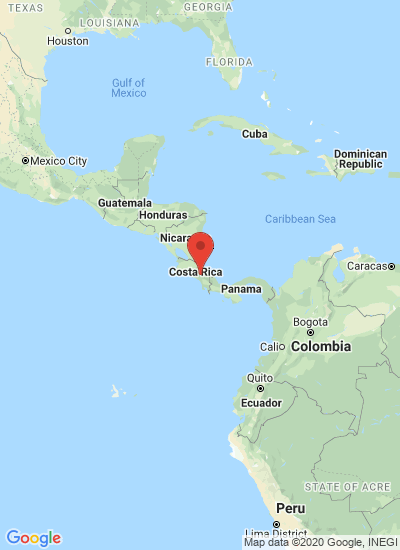
Yannery Gómez Bonilla, a graduate in Biology from the University of Costa Rica, has done research for her PhD into the application of granulovirus against two species of potato tuber moth, the cause of numerous plagues both in the crop fields and during storage. In both environments the efficacy of bioinsecticides using the various formulas employed was shown.
A bioinsecticide is a preparation that contains infectious particles of a virus (known as inclusion bodies). The larvae ingest these inclusion bodies and thus become infected. The virus then multiplies inside the larva. If the quantity of infectious particles ingested is high, the larva dies and secretes millions of inclusion bodies which act, in turn, to infect new larvae.
Ms Yannery Gómez explained that, in the quest for alternatives to the chemical insecticides employed against the past species Phthorimaea operculella and Tecia solanirova, “outstanding is a granulovirus with promising properties as a control agent”. The virus, originally isolated from P. operculella larvae and thus known as P.operculella granulovirus (PhopGV) “is also able to infect T. solanivora, although in this case its bioinsectide activity is less”.
The PhD, “Characterisation of novel granulovirus strains from Costa Rica against Phthorimaea operculella and Tecia Solanivora” was led by university teacher Delia Muñoz Labiano, from the Department of Agricultural Production at the UPNA and lecturer Miguel López-Ferber, from the Mining School at d´Ales (France).
Results in the field and under storage
The prime aim of the thesis was to gather autochthonous strains of granulovirus PhopGV from Costa Rica, where the two species of potato tuber moth are the principal pests in the crop fields and during storage. Then their potential efficiency as an insecticide was evaluated. In the crop fields the virus reduces the damage between 50 and 80%, compared to the non-treated control crops in the trials of winter and summer. “Moreover”, explained the researcher, “this reduction was not significantly different from that produced by a chemical insecticide or by a combination of the virus with a chemical insecticide”.
During storage, the virus reduced the damage by 70% compared to the non-treated control crops when the applications completely covered the surface of the tubers. Apart from this, after undertaking prospections of the earth, three new strains of granulovirus from the soil not employed in growing potatoes were obtained, “which suggests the importance of dispersion and persistence in the transmission of these viruses”. One of these strains showed extraordinary values of pathogenicity against the two species of potato tuber moth, thus highlighting their potential as a bioinsecticide.
“Moreover, their soil origin, their persistence and their adaptability to the host make this granulovirus a promising alternative for control in the crop fields”. In her conclusions, she pointed out that all the Cost Rican strains proved to be good candidates for their application for the two species of potato tuber moth. The efficacy, especially of one of the strains, was demonstrated in the crop fields and during storage, while another strain showed notable bioinsecticidal characteristics in laboratory trials.
Research into use of bioinsecticides for control of potato tuber moth in Costa Rica
¿Te gustaría recibir noticias como esta por correo electrónico? ¡Únete y suscríbete!
Get the latest potato industry news straight to your WhatsApp. Join the PotatoPro WhatsApp Community!
Noticias relacionadas

Octubre 12, 2026
Colombia: menor superficie sembrada impulsa 78% el precio de la papa
En Colombia, el precio de la papa aumentó 78,28% interanual en septiembre, impulsado por una menor superficie sembrada tras las pérdidas de 2025 y por dificultades climáticas que redujeron la disponibilidad en el mercado.

Octubre 11, 2026
EarthFresh Butter Potatoes llega a más de 4 millones de hogares ante el fuerte aumento de la demanda minorista
EarthFresh Butter Potatoes gana impulso en Norteamérica y llega a más de 4 millones de hogares. Con un aumento del 40 % de la superficie cultivada y un 100 % de ventas incrementales, la gama premium ofrece a los distribuidores nuevas oportunidades para hacer crecer la categoría de patata.

Octubre 11, 2026
El Simposio Internacional de la Patata en Madrid destaca los principales retos y oportunidades del sector europeo de la patata
El primer Simposio Internacional de la Patata en Madrid reunió a 250 profesionales para debatir los principales retos y oportunidades de la cadena de valor de la patata.