

Pea Leafminer Fly in Potato: A Major Threat to Yield and Crop Quality
The pea leafminer fly, Liriomyza huidobrensis (Blanchard) is a highly invasive and polyphagous insect pest belonging to the family Agromyzidae. It is one of the most destructive leaf mining pests affecting potato crops worldwide. The larvae feed within the leaf tissue creating characteristic serpentine mines in the leaf mesophyll of potato (Solanum tuberosum) and numerous other host plants. This feeding damages photosynthetic tissue, weakens plant vigor and significantly affects crop productivity.
The pea leafminer fly directly reduces the potato plant’s ability to photosynthesize and efficiently translocate carbohydrates to developing tubers. Damage caused by larval mining decreases leaf efficiency, resulting in reduced plant growth, poor tuber development and lower marketable yields. Even moderate infestations can lead to stunted growth and smaller tuber size, while severe infestations may cause premature defoliation, early plant senescence and in extreme cases, near total crop loss. The pest is particularly damaging during the critical tuber-bulking stage, when potato plants require maximum photosynthetic capacity for tuber filling.
The pea leafminer fly poses a serious economic threat to potato production due to both direct and indirect losses. Yield reductions ranging from 20–70% have been reported in affected potato growing regions, while unmanaged infestations under favorable conditions have occasionally resulted in losses approaching 100%, particularly in parts of South America, Indonesia and South Africa. In addition to yield reduction, growers often face increased production costs because of repeated insecticide applications, resistance management strategies and labor-intensive monitoring programs. Leaf mining also reduces crop quality and may create entry points for secondary pathogens, further affecting plant health and market value. In some cases, infestations may also trigger quarantine restrictions affecting potato trade and export opportunities.
Native to Central and South America, Liriomyza huidobrensis has spread rapidly since the 1980s to major agricultural regions in Europe, Africa, Asia and parts of North America. The pest is considered a significant quarantine concern because of its invasive nature, broad host range and remarkable ability to develop resistance to multiple insecticides. Increased global trade, movement of infested plant material and climate suitability continue to expand its distribution posing an ongoing threat to potato-growing regions worldwide.
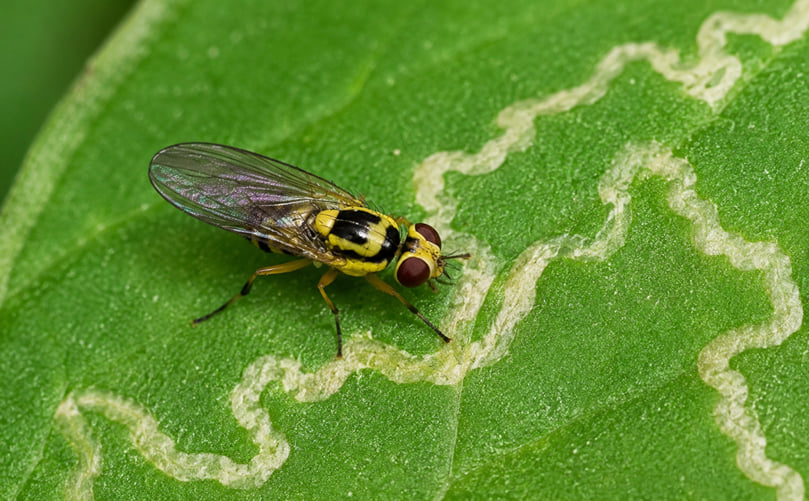
Pea Leafminer Fly (Liriomyza huidobrensis) on Potato Leaf
What is the Pea Leafminer Fly?
The pea leafminer fly, Liriomyza huidobrensis (Blanchard, 1926) (Diptera: Agromyzidae) is a highly destructive and invasive insect pest that attacks a wide range of agricultural and horticultural crops including potato. Previously, it has also been referred to by synonyms such as Agromyza huidobrensis and Liriomyza dianthi. The pest is widely recognized for its ability to rapidly spread, adapt to different environments and develop resistance to insecticides.
Common Names: Liriomyza huidobrensis is commonly known by several names, including pea leafminer, potato leafminer, serpentine leafminer and South American leafminer, reflecting both its host range and geographic origin.
Pest Classification: The pea leafminer fly belongs to the family Agromyzidae, a group commonly known as leaf mining flies. Adult flies are small, delicate insects that cause minor feeding punctures on leaves; however, the greatest damage is caused by the larval stage. After hatching, larvae tunnel within leaf tissues and create characteristic serpentine mines, destroying chlorophyll rich tissue and reducing the plant’s photosynthetic efficiency.
Why is it Problematic in Potato?
The pea leafminer fly is particularly problematic in potato production because larval feeding reduces the effective photosynthetic area during critical crop growth stages, especially during tuber bulking. Heavy mining weakens plant vigor, interferes with carbohydrate production and translocation to tubers and ultimately reduces yield and tuber quality. The pest can rapidly build up populations due to its short life cycle and multiple overlapping generations. It also survives on crop residues, weeds and alternative host plants, allowing infestations to persist between cropping cycles. In potato growing regions with cooler climates or higher altitudes, where environmental conditions favor pest survival and development infestations can become especially severe.
Distribution, Climatic Adaptation and Host Range of Pea Leafminer Fly
Geographical Distribution: The pea leafminer fly, Liriomyza huidobrensis, is native to Central and South America with early reports from countries such as Peru, Argentina and Chile. Since the late 1980s, the pest has spread extensively beyond its native range and is now recognized as a globally important agricultural pest. It invaded several European countries during the late 1980s, followed by expansion into Africa including South Africa in the early 2000s and multiple Asian countries such as Indonesia, Nepal, China and India. The pest has also been reported in cooler regions of North America including California. Today, Liriomyza huidobrensis is a significant pest in both open-field and greenhouse production systems and is often particularly dominant in high altitude agricultural areas above 1,000 m, where cooler temperatures favor its development.
Climatic Preference: The pea leafminer fly thrives under cooler to moderate temperature conditions and generally performs best between 15–25°C. Development and population growth are often reduced when temperatures exceed 30–32°C making extremely hot environments less favorable for survival. The pest is well adapted to temperate climates, tropical highland regions and Mediterranean environments, where conditions support rapid multiplication. Although it can tolerate a range of humidity levels, severe infestations are frequently associated with irrigated production systems or regions with high rainfall and favorable moisture conditions. Under cooler environmental conditions, development slows and the pest can survive unfavorable periods by overwintering in the pupal stage.
Alternative Host Crops and Weeds: One of the major reasons for the persistence and invasiveness of Liriomyza huidobrensis is its exceptionally broad host range. The pest survives on numerous cultivated crops, including beans, peas, tomatoes and various leafy vegetables, as well as ornamental plants. In addition, alternative hosts such as solanaceous weeds, including Solanum nigrum (black nightshade), amaranths and other broadleaf weeds act as reservoirs for pest survival. These alternate hosts enable populations to persist even when potato crops are absent, increasing the risk of reinfestation in subsequent planting seasons.
Crop Continuity Risk: Continuous cultivation of susceptible host crops or poor crop rotation practices can significantly increase pea leafminer fly populations. Successive plantings of potato and other host vegetables create favorable conditions for rapid pest buildup. Volunteer plants, unmanaged weeds, crop residues and nearby vegetable fields frequently serve as reservoirs, allowing the pest to survive and spread between growing seasons. As a result, infestation pressure in potato crops often becomes more severe where crop continuity and poor field sanitation practices occur.
Identification of Pea Leafminer Fly (Liriomyza huidobrensis)
Accurate identification of the pea leafminer fly is essential because several Liriomyza species exhibit similar morphological characteristics and may cause comparable damage symptoms. Species level identification often requires expert examination of adult male genitalia or molecular diagnostic techniques to distinguish Liriomyza huidobrensis from related species.
Adult Fly: Adult pea leafminer flies are small insects with a wing length of approximately 1.7–2.3 mm. They possess a grayish black body with distinct bright yellow to orange yellow markings on the head, thorax and legs, with the femora typically appearing yellow orange. Their wings are transparent and delicate. A key distinguishing characteristic of Liriomyza huidobrensis is the matte grayish black mesonotum, which helps differentiate it from some closely related Liriomyza species. Female flies are generally slightly larger than males.
Eggs: The eggs are extremely small, measuring approximately 0.25–0.30 mm in length and about 0.10 mm in width. They are oval-shaped, smooth and initially appear white to translucent. Female flies insert eggs individually into the leaf epidermis using their ovipositor, usually on the upper leaf surface and often close to leaf veins. After hatching a small puncture mark may remain visible on the leaf surface.
Larvae (Maggots): The larval stage is the most destructive phase of the pea leafminer fly. Larvae are legless, cream colored to pale yellow orange maggots, reaching up to 3–3.2 mm in length during the third and final instar. They feed internally within the leaf mesophyll, creating characteristic serpentine mines that gradually widen as larvae grow. Early mines are narrow and winding, while older mines become broader and may follow leaf veins, a feature commonly observed in Liriomyza huidobrensis. Larval feeding destroys chlorophyll containing tissue, significantly reducing photosynthesis. Dark frass deposits are often visible within the mines and can aid in pest diagnosis. Mouth hooks become more developed with larval age and may assist in identifying developmental stages.
Pupae: Pupae are oval-shaped and slightly flattened on the ventral side measuring approximately 1.6–3.25 mm in length and 0.7–1.1 mm in width. Their color changes from light yellowish-brown to dark brown or black as development progresses. In most cases, mature larvae exit the leaf by cutting a slit and drop to the soil, where pupation occurs. However, pupation may occasionally take place within leaf mines. The anterior and posterior spiracles are visible and serve as important morphological features for identification.
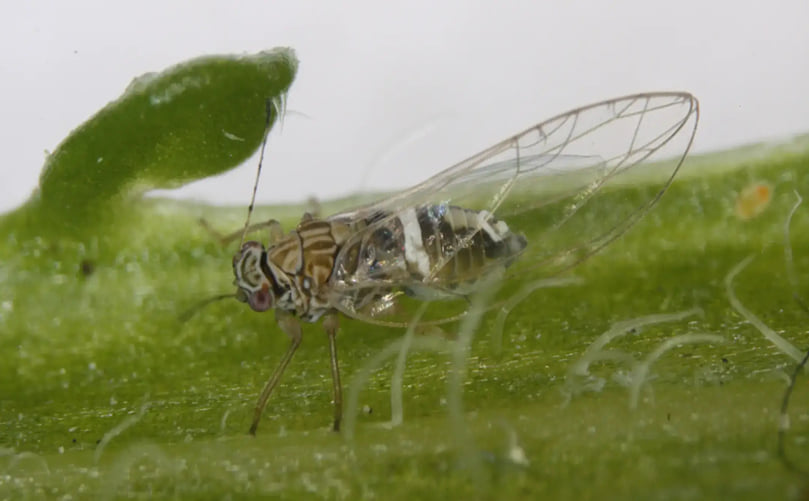
Pea Leafminer Fly (Liriomyza huidobrensis) Adult Identification in Potato Crops
Life Cycle and Development Stages of Pea Leafminer Fly
The life cycle of the pea leafminer fly, Liriomyza huidobrensis, is highly influenced by temperature and environmental conditions. Under favorable conditions, the complete life cycle from egg to adult generally takes 13–43 days with development occurring more rapidly in warm conditions and more slowly in cooler environments. The pest can produce multiple overlapping generations within a single cropping season allowing populations to increase rapidly in potato fields.
Egg Stage: The egg stage typically lasts 2–7 days, averaging around 3 days under favorable conditions. Female flies lay approximately 50–180 or more eggs during their lifetime after a short pre-oviposition period. Eggs are deposited singly within leaf tissues usually near leaf veins.
Larval Stage (Three Instars): The larval stage consists of three instars and generally lasts 4–12 days depending on environmental conditions. Newly hatched larvae are small and nearly transparent, gradually turning cream to yellow orange as they mature. Larvae feed internally within leaves and continue developing until the final instar. Once fully developed, mature larvae exit the leaf and move to the soil for pupation. This stage is the most destructive phase of the pest’s life cycle.
Pupal Stage: The pupal stage usually lasts 7–14 days commonly around 7–11 days under suitable conditions. Pupation mainly occurs in the soil beneath host plants although it may occasionally occur within leaf debris. In cooler climates, the pest may survive adverse conditions by overwintering in the pupal stage.
Adult Stage: Adult flies emerge from pupae, mate shortly after emergence and females begin laying eggs soon afterward. Adults feed on plant sap and leaf exudates through small feeding punctures on leaf surfaces. Male adults generally have a shorter lifespan than females.
Conditions Favoring Rapid Population Development: Rapid population growth is favored by moderate temperatures, abundant host plants, dense crop canopies, lush vegetative growth and reduced natural enemy activity. Under highly favorable conditions, the complete developmental cycle on potato may be completed within approximately 18–25 days, enabling rapid population buildup and severe infestations.
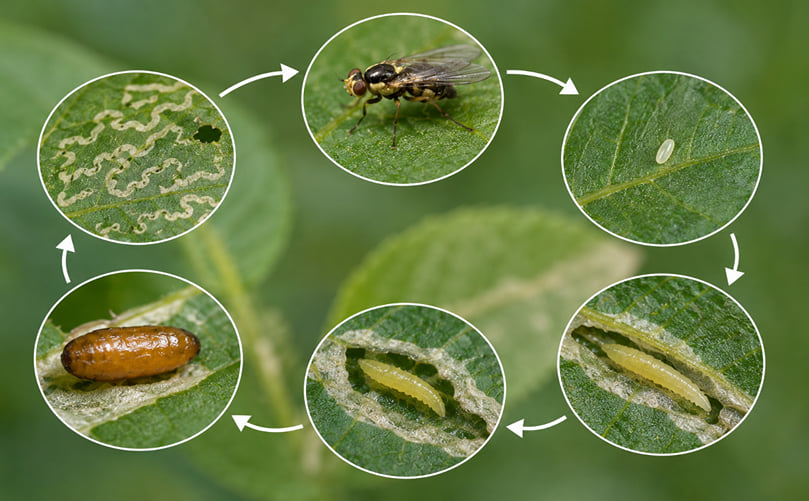
Life Stages of Pea Leafminer Fly: Egg, Larva, Pupa and Adult
Symptoms and Crop Damage Caused by Pea Leafminer Fly in Potato
Damage caused by the pea leafminer fly, Liriomyza huidobrensis, in potato crops results from the combined activity of adult feeding and egg laying punctures and larval feeding within leaf tissues. While adults cause minor surface injury, the larval stage is responsible for the most economically significant damage by destroying leaf mesophyll tissue and reducing plant productivity.
Early Symptoms: Initial symptoms appear as small white to silvery punctures on the upper leaf surface, commonly referred to as stippling. These feeding and oviposition punctures are created by female flies during feeding and egg deposition. Under heavy infestations, punctured leaves may become more susceptible to secondary bacterial and fungal infections.
Shortly after egg hatch, young larvae begin feeding inside the leaf, producing fine, thread like mines that are initially narrow and difficult to detect. Early infestations are often overlooked until mines become more visible.
Characteristic Damage Symptoms: As larvae develop, the mines gradually expand into distinct serpentine tunnels within the leaf tissue. These winding mines widen over time as larvae grow and feed, often remaining close to the leaf midrib and veins in potato plants. Dark frass deposits are frequently visible within the mines and serve as an important diagnostic sign of infestation.
Larval feeding destroys chlorophyll containing tissues, reducing the leaf’s photosynthetic efficiency and overall plant performance. Severely mined leaves initially appear pale or translucent followed by the development of necrotic brown patches as tissue damage progresses. Reduced photosynthetic activity directly limits energy availability for tuber development.
Symptoms Under Severe Infestation: Under severe infestations, potato plants may exhibit premature yellowing, leaf drying, necrosis and partial or complete defoliation. Plants often lose vigor, resulting in reduced canopy growth and weakened overall development. In advanced cases, haulms may senesce prematurely causing affected plants to appear drought-stressed or diseased.
Heavy infestations during critical growth stages, particularly flowering and tuber initiation can severely restrict tuber bulking and reduce marketable yield. In extreme situations, potato fields may develop a scorched or “burned” appearance due to extensive leaf destruction and premature plant senescence occurring several weeks earlier than normal.
Yield and Economic Impact: The severity of yield loss caused by pea leafminer fly infestations varies according to potato variety, crop growth stage, infestation intensity and management practices. Significant reductions in yield and tuber quality have been reported under unmanaged conditions, particularly when infestations occur during key physiological stages associated with tuber development. Early maturing potato varieties are generally more vulnerable because leaf damage during critical growth periods can rapidly reduce tuber formation and size.
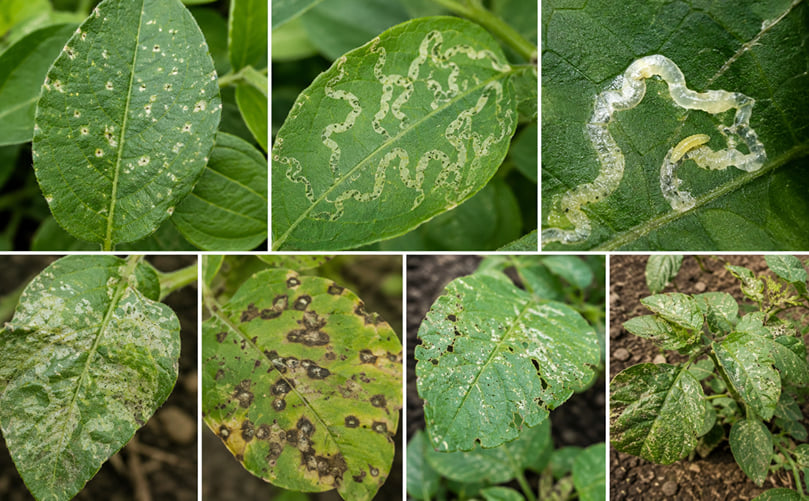
White Stippling and Oviposition Punctures Caused by Liriomyza huidobrensis
Conditions Favoring Pea Leafminer Fly Infestation in Potato
The infestation and population buildup of the pea leafminer fly, Liriomyza huidobrensis are influenced by specific environmental and agronomic conditions that favor rapid development and survival in potato crops.
Temperature: The pea leafminer fly develops best under moderate temperatures ranging from 20–25°C although development may occur within a broader range of 15–28°C. Population growth is fastest within this range, while development slows significantly below 10–15°C. High temperatures above 30–32°C generally reduce survival and population buildup. As a result, the pest is commonly more problematic in cooler highland and temperate potato growing regions and during cooler growing seasons.
Humidity: Moderate to high relative humidity, particularly 80–90% or higher, favors pea leafminer fly infestation. Outbreaks are commonly reported in irrigated potato fields and humid production environments where moisture conditions support pest development.
Dense Crop Canopy: Dense crop canopies create a favorable microclimate for adult flies and support larval development within leaves, increasing infestation levels in potato fields.
High Nitrogen Fertilization: Excessive nitrogen fertilization promotes lush and succulent foliage, which is highly favorable for oviposition and larval feeding, increasing the risk of infestation.
Continuous Host Cropping and Poor Crop Rotation: Successive cultivation of potato and other host crops such as beans and peas enables overlapping generations and rapid population buildup. Volunteer plants and weeds may also serve as reservoirs allowing the pest to persist between potato seasons.
Poor Field Sanitation: Crop residues, infested plant debris and nearby alternative host plants can maintain pest populations between cropping seasons, increasing infestation pressure in subsequent potato crops.
Other Favorable Factors: Irrigated fields, greenhouse or protected cultivation systems and potato production in cooler high elevation areas above 1,000 m increase the risk of infestation. Population levels often increase during later crop growth stages as plant growth slows.
Monitoring and Early Detection of Pea Leafminer Fly in Potato
Early detection of the pea leafminer fly, Liriomyza huidobrensis is essential for effective management in potato crops because of the pest’s rapid development and the protected nature of larvae feeding within leaves. Regular monitoring enables timely intervention before infestations reach damaging levels.
Field Scouting: Regular field scouting is one of the most effective methods for early detection. Monitoring should begin at field edges, where infestations often appear first and gradually extend across the field. Potato leaves should be examined systematically with particular attention to the lower canopy as infestations commonly begin in lower leaves before progressing upward. During scouting, growers should inspect plants for feeding punctures (stippling), active serpentine mines, live larvae and larval exit slits. Sampling multiple plants across different field locations improves detection accuracy and helps assess infestation levels.
Symptoms to Monitor: Early infestation symptoms include small white feeding punctures, fine serpentine mines and localized leaf tissue damage. As infestations develop, mines become more visible and necrotic spots may increase. Regular observation is especially important during the mid-to-late crop growth stages, when population levels may increase rapidly.
Yellow Sticky Traps: Yellow sticky traps are highly effective for monitoring adult pea leafminer fly populations and detecting early infestations. Traps should be placed at crop canopy height and positioned systematically throughout the field including along field edges and representative crop sections. Monitoring trap catches on a weekly or biweekly basis helps identify initial adult activity and track population trends over time.
Monitoring Adult Populations and Economic Thresholds: Adult monitoring is most effective when yellow sticky traps are combined with visual field observations or other sampling methods. Economic thresholds may vary depending on potato variety, crop stage, infestation severity and local production conditions. Decision making should consider the level of crop injury, plant growth stage and the economic feasibility of intervention.
Importance of Early Intervention: Timely action at the first signs of adult activity or early leaf mines can significantly reduce infestation pressure and limit population buildup. Early monitoring supports targeted integrated pest management (IPM) strategies before larvae become protected inside leaf tissues, where control becomes more difficult. In potato production, prompt detection can substantially reduce crop damage and minimize yield losses.
Integrated Management Strategies for Pea Leafminer Fly in Potato
Effective management of the pea leafminer fly, Liriomyza huidobrensis, in potato production requires an Integrated Pest Management (IPM) approach that combines cultural, biological, mechanical and chemical control strategies. Reliance on a single control method, particularly repeated insecticide use, often leads to resistance development and reduced control effectiveness. Integrated approaches have shown positive results in reducing pest pressure, lowering pesticide dependence and improving crop productivity.
Cultural Management: Cultural practices form the foundation of sustainable pea leafminer fly management by reducing pest survival and interrupting its life cycle.
Crop rotation with non-host crops, particularly cereals and non-solanaceous or non-leguminous species helps reduce carryover populations between seasons. Avoiding repeated cultivation of susceptible host crops minimizes pest buildup.
Removal of infested plant material is important for reducing pest reservoirs. Infested leaves, crop residues and severely affected plant material should be removed and properly destroyed through burial or other appropriate disposal methods to reduce survival of immature stages.
Weed and volunteer plant management helps eliminate alternative hosts that sustain pest populations between cropping cycles. Particular attention should be given to solanaceous weeds and volunteer potato plants that may act as reservoirs.
Balanced nutrient and irrigation management can reduce crop susceptibility. Excessive nitrogen fertilization should be avoided because it promotes lush foliage that favors oviposition and larval development. Maintaining healthy crop growth through balanced nutrition and proper irrigation improves plant tolerance to damage.
Field sanitation and planting practices are equally important. Clean planting material should be used and proper field preparation, including soil cultivation, may help expose pupae to unfavorable environmental conditions. Continuous host cropping should be avoided wherever possible.
Biological Control: Natural enemies play an important role in suppressing pea leafminer fly populations and are essential components of IPM programs.
A widely recognized biological control agent is Diglyphus isaea, an ectoparasitoid that attacks leafminer larvae by paralyzing them and feeding externally. Other parasitoids, including species of Dacnusa and Chrysocharis, may also contribute to natural population suppression in potato growing systems.
Biological control can also include the use of entomopathogenic organisms such as Steinernema feltiae, which may target immature stages under suitable environmental conditions. Conservation of beneficial organisms through selective pest management practices is important for maintaining long-term biological control.
Mechanical and Physical Control: Mechanical and physical methods may support overall population suppression, particularly during early infestation stages.
Yellow sticky traps are useful for both monitoring and reducing adult populations through mass trapping. Strategic placement within potato fields can help reduce pest pressure and support informed decision-making.
Protective netting or row covers may provide additional protection in protected cultivation systems or smaller production areas by limiting adult entry.
Reflective mulches may help reduce adult landing and oviposition activity in some production systems.
Chemical Control: Chemical management should be used strategically and integrated with other control measures. Applications are generally most effective when targeted against adult flies and young larvae before larvae become deeply protected within leaf tissues.
Selective insecticides with translaminar or systemic activity, including products containing active ingredients such as abamectin, spinosad or cyromazine, may improve control when applied at appropriate timings. To reduce the risk of insecticide resistance, products with different IRAC modes of action should be rotated and applications should be based on monitoring results rather than routine preventive spraying. Selective insecticides are preferred where possible to conserve natural enemies and support biological control.
Integrated Approach for Sustainable Control: Combining cultural, biological, mechanical and carefully targeted chemical measures provides the most effective and sustainable strategy for pea leafminer fly management in potato production. An integrated approach reduces dependence on insecticides, delays resistance development and improves long-term crop protection.
Prevention Strategies for Pea Leafminer Fly in Potato
Prevention is a critical component of long-term pea leafminer fly management and is more effective than relying solely on corrective control measures after infestations become established. Preventive practices help reduce pest pressure, minimize crop damage and support sustainable potato production.
Regular Scouting and Monitoring: Routine field scouting should begin from planting onward to enable early detection of adult flies, feeding punctures and initial leaf mines. Continuous monitoring helps identify infestations before populations increase to damaging levels and supports timely management decisions.
Conservation of Beneficial Insects: Preserving natural enemies and parasitoids is important for maintaining biological suppression of pea leafminer populations. Habitat management practices and minimizing the use of broad-spectrum insecticides can help conserve beneficial organisms and improve natural pest regulation within potato fields.
Crop Hygiene and Field Sanitation: Strict crop hygiene reduces pest survival between growing seasons. Infested crop residues should be removed and destroyed, while weeds and volunteer host plants should be controlled to eliminate alternative pest reservoirs. Crop rotation with non-host species further reduces the risk of recurring infestations.
Use of Certified Planting Material: Using certified, pest-free planting material helps minimize the introduction of infestations into potato production systems and supports healthy crop establishment.
Optimal Crop Establishment: Potato crops should be established under suitable growing conditions to promote healthy and vigorous plant growth, improving tolerance to pest damage. Where feasible, adjusting planting schedules to avoid periods of peak pest activity may help reduce infestation pressure.
Early Adoption of Integrated Pest Management (IPM): Implementing an IPM approach from the beginning of the growing season is one of the most effective prevention strategies. Early intervention at the first signs of adult activity or initial leaf mines is significantly more effective than delayed, reactive control after populations become established.
Economic Impact of Pea Leafminer Fly on Potato Production
The pea leafminer fly, Liriomyza huidobrensis, causes significant economic losses in potato production through both direct crop damage and increased management costs. The severity of economic impact depends on infestation intensity, crop stage, potato variety and the effectiveness of management practices.
Yield Reduction and Crop Losses: Pea leafminer fly infestations can substantially reduce potato yields due to extensive leaf damage and reduced plant productivity. Under moderate to severe infestations, yield losses commonly range from 20–70%, while unmanaged outbreaks in heavily affected regions have occasionally resulted in crop losses approaching 100%. Early maturing potato varieties are generally more vulnerable to damage because infestations during key developmental stages can significantly reduce tuber formation and growth.
Leaf mining reduces the effective photosynthetic area of potato plants, limiting carbohydrate production required for tuber development. Severe infestations may reduce tuber size, tuber number and overall crop quality, ultimately lowering marketable yield.
Increased Production Costs: In addition to yield losses, pea leafminer fly infestations increase production expenses through repeated pest management interventions. Growers may incur additional costs related to monitoring, labor and insecticide applications, particularly in areas with persistent infestation pressure or resistance concerns.
Market and Trade Impact: Heavy infestations can reduce crop marketability due to poor plant health and increased susceptibility to secondary infections. In some regions, quarantine restrictions associated with pea leafminer infestations may also affect the movement and export of potato products, creating additional economic challenges for producers.
Economic Benefits of Integrated Management: Adoption of Integrated Pest Management (IPM) strategies can help reduce economic losses by lowering unnecessary pesticide use while maintaining crop productivity. Integrated approaches support more sustainable pest management and may improve long-term profitability in potato production systems.
Challenges in Controlling Pea Leafminer Fly in Potato
Managing the pea leafminer fly, Liriomyza huidobrensis, in potato production remains difficult because of the pest’s biological characteristics, adaptability, and ability to persist under diverse production conditions. Several factors limit the effectiveness of control measures and increase the complexity of long-term management.
Protected Larval Feeding Stage: One of the major challenges in controlling pea leafminer fly is the protected feeding behavior of larvae. Since larvae develop and feed inside leaf tissues, they remain shielded from many contact insecticides, reducing treatment effectiveness once mines become established.
Insecticide Resistance: The pea leafminer fly has a strong ability to develop resistance to insecticides, primarily due to its short life cycle and repeated exposure to chemical control measures. Resistance to multiple insecticide groups has been reported in several production regions making chemical management increasingly difficult and reducing the long-term effectiveness of certain products.
Broad Host Range and Pest Reservoirs: The pest survives on a wide range of cultivated crops, weeds and volunteer plants, allowing populations to persist between potato growing seasons. The presence of alternative hosts complicates area wide management efforts and increases the likelihood of reinfestation.
Rapid Population Growth: The ability of pea leafminer fly populations to complete multiple generations within a single season contributes to rapid population recovery and sudden infestation outbreaks. Even after partial suppression, populations may quickly rebound under favorable conditions.
Variable Effectiveness of Control Methods: The success of biological and chemical management strategies may vary depending on environmental conditions and implementation practices. Biological control agents may perform inconsistently under unfavorable environments, while excessive or inappropriate insecticide use can disrupt beneficial insect populations and weaken natural pest suppression.
Regional and Climatic Variation: Effective management strategies often need to be adapted according to local climatic conditions, production systems, regulatory guidelines and potato variety tolerance. Control approaches that are successful in one region may not always provide the same level of effectiveness elsewhere.
Need for an Integrated Approach: These challenges highlight the importance of adopting a diversified Integrated Pest Management (IPM) strategy rather than depending on a single control method. Combining preventive, cultural, biological, mechanical and selective chemical measures improve long-term control and reduces the risk of management failure.
Future Outlook and Research on Pea Leafminer Fly Management in Potato
Ongoing research on the management of the pea leafminer fly, Liriomyza huidobrensis, is increasingly focused on developing sustainable, environmentally responsible and economically viable solutions for long-term control in potato production systems.
Biological Control Advancements: Research continues to improve the effectiveness of biological control through optimized use of natural enemies, particularly parasitoids such as Diglyphus isaea. Additional studies are evaluating the role of entomopathogenic nematodes and fungi, along with conservation strategies that enhance naturally occurring beneficial organisms within potato ecosystems.
Host Plant Resistance: Plant breeding programs are exploring the development of potato varieties with improved tolerance or resistance traits to reduce pea leafminer fly damage. Research on antibiosis and tolerance mechanisms may contribute to varieties with improved resilience under infestation pressure.
Precision Agriculture and Digital Technologies: Emerging technologies such as AI-based monitoring systems, drone assisted surveillance and predictive phenology models are being investigated for earlier pest detection and more precise intervention strategies. These approaches may improve monitoring efficiency and support site-specific management decisions in potato production.
Refinement of Integrated Pest Management (IPM): Research efforts are focused on refining climate adaptive IPM strategies, improving compatibility with the management of other potato pests and evaluating reduced-risk pest control options. Integrated approaches aim to improve long-term sustainability while minimizing environmental impact.
Insecticide Resistance Management: A better understanding of insecticide resistance mechanisms is supporting the development of improved resistance management strategies, including more effective rotation of control measures and reduced reliance on repeated chemical applications.
Future Perspective: Advances in biological control, resistant varieties, precision technologies and improved IPM strategies are expected to strengthen the long-term management of pea leafminer fly in potato production. Continued collaboration among researchers, extension services and growers, combined with farmer education and area wide IPM implementation, will play an important role in developing more resilient and environmentally sustainable potato production systems.