What Are Multi-Head Weighers?
Multi-head weighers—also known as combination weighers—are advanced, high-speed weighing machines widely used in food packaging, including potatoes and snack products. Their core function is to deliver precise, consistent weights at high speeds, making them a standard in automated packaging lines, particularly where accuracy and efficiency are critical.
How Multi-Head Weighers Work
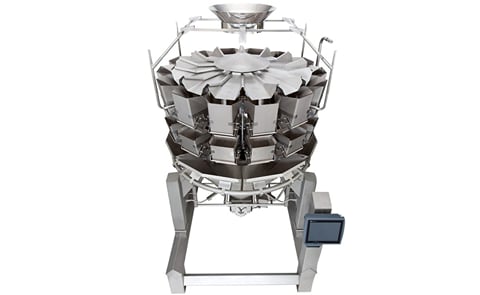
- Product Feeding and Distribution: Bulk product enters the weigher through an infeed funnel, often via a conveyor or bucket elevator. The product is directed onto a central vibrating or rotating cone, which evenly distributes it outward to a series of feeder pans or linear vibration trays.
- Dispersion into Weigh Buckets: The feeder pans vibrate, moving product into multiple weight buckets (typically 10–24 or more, depending on the model). Each bucket is equipped with a highly sensitive load cell that continuously measures the weight of its contents.
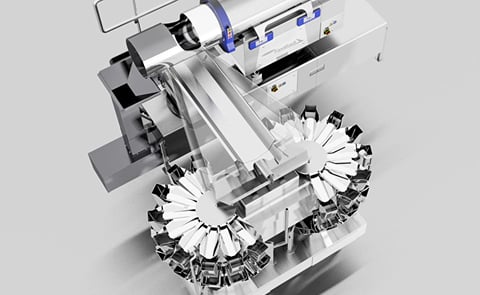
- Intelligent Combination Selection: The system’s computer constantly monitors the weight in each bucket. When a package is to be filled, the software calculates all possible combinations of buckets and selects the set whose combined weight most closely matches the target (for example, 100 grams for a snack pack). The selected buckets open simultaneously, releasing their contents into a chute that leads to the packaging machine (such as a VFFS machine) or directly into trays.
- Continuous Operation: As soon as a bucket empties, it is refilled with product, allowing for uninterrupted, high-speed operation.
Technical Components
- Infeed Funnel and Vibrating Cone: The infeed funnel channels product onto a vibrating cone, which evenly distributes the product to the surrounding feeder pans, ensuring a consistent flow and preventing clumping.
- Feeder/Linear Vibration Pans: These pans use controlled vibrations to move the product from the cone into individual weigh buckets, maintaining a steady and precise feed.
- Weigh Buckets (Hoppers): Each weigh bucket is equipped with a load cell that measures the product’s weight in real time, allowing for highly accurate portioning.
- Buffer Hoppers: Buffer hoppers temporarily hold product, increasing the number of possible weight combinations and enabling faster, more efficient weighing cycles.
- Central CPU/Controller: The central CPU rapidly calculates the best combination of weigh buckets to achieve the target weight and synchronizes the discharge of product for packaging.
- Discharge Chute: Once the optimal combination is selected, the discharge chute directs the weighed product from the buckets to the packaging equipment with minimal spillage.
Operational Workflow (Simplified)
- Product enters via infeed and is distributed to weigh buckets.
- Buckets are weighed in real-time by load cells.
- The system selects the best combination of buckets to match the target weight.
- Selected buckets discharge product into the packaging machine.
- Buckets are refilled and the cycle repeats, enabling continuous, rapid operation.
Key Features and Advantages
- Multi-head weighers operate much faster than manual or linear scales, supporting high-volume lines.
- Achieve extremely tight tolerances, often down to fractions of a gram, by optimizing bucket combinations.
- Suitable for a wide range of products, from fragile potato chips to sticky or granular foods.
- Minimizes product overfill, reducing waste and improving profitability.
- Easily integrates with packaging machines, inspection systems, and conveyors for full automation.
Applications in Potato and Snack Packaging
- Potato Chips and Snacks: Ensures gentle handling, precise portioning, and minimal breakage.
- Fresh or Frozen Potato Products: Used for diced, sliced, or whole small potatoes, delivering consistent pack weights.
- Other Foods: Widely used for dry fruits, candies, grains, and more due to their adaptability.
"Multi-head weighers are essential for modern, high-speed packaging operations. Their combination of speed, accuracy, and flexibility makes them ideal for potato and snack packaging lines, ensuring consistent product quality, reduced waste, and efficient integration with automated packaging systems. ."