News on Acrylamide

Sponsor of the month (Learn more)
Novozymes: Acrylaway industry implementation 'progresses as expected'
June 24, 2008
Novozymes: Acrylaway industry implementation 'progresses as expected'
Acrylaway, the acrylamide-reducing enzyme from Novozymes, has received approval in a slate of countries worldwide and is now being applied across broad range of bakery and snack products. The Danish enzyme specialist launched Acrylaway to the industry ...
From the archive
Acrylamide image for news
June 02, 2008
EFSA Acrylamide risk opinion remains unchanged
Efforts to reduce acrylamide remain a priority as the European Food Safety Authority (EFSA) concludes risk assessments regarding the carcinogen will stay the same. EFSA organised a scientific colloquium in Italy last month, to debate how the current po...
From the archive
Acrylamide may raise kidney cancer risk
May 10, 2008
Acrylamide may raise kidney cancer risk
Consuming large amounts of acrylamide, a chemical commonly found in French fries, cakes, snacks and even coffee, appears to raise the risk of kidney cancer, especially in smokers, Dutch researchers report. "Ours is the first report of a positiv...
From the archive
May 08, 2008
Dr Mai Tran completes PhD research on fat content of french fries
Being an ex-refugee didn’t stop Dr Mai Tran from getting her Doctor of Philosophy (PhD) in chemical and material engineering. For her PhD thesis, Mrs Tran chose the humble spud;the subject of her main experiment was to reduce the oil content in potato...
From the archive
March 06, 2008
Acrylamide might not be so harmful
Acrylamide, that surprised scientists when it was discovered in certain foods might not be as big a concern after all, an Augusta researcher said. Dale Sickles, a neurotoxicologist and vice chairman of Cell Biology and Anatomy at Medical College of Ge...
From the archive
February 28, 2008
Development and Experimental Validation of a Frying Model to Estimate Acrylamide Levels in French Fries
In this study, a numerical model was developed to simulate frying of potato strips and estimate acrylamide levels in French fries. Heat and mass transfer parameters determined during frying of potato strips and the formation and degradation kinetic par...
From the archive
Sponsored Content
Sponsored Content
Sponsored Content
January 23, 2008
FDA petitioned to end Proposition 65 conflict for foods
Swanson Health Products has filed a petition with the FDA asking it to determine that California's Proposition 65 conflicts irreconcilably with food and supplement regulations, making the industry vulnerable to 'bounty hunters'.   Proposition 65 was i...
From the archive
January 10, 2008
Study suggests link between acrylamide in food and breast cancer
Acrylamide in food could increase the risk of developing breast cancer, according to new, EU-funded research published in the International Journal of Cancer. Acrylamide is a small molecule found in certain processed foods. 'Animal tests have shown acr...
From the archive
January 09, 2008
Research: Asparaginase can reduce acrylamide in French fries
Using the asparaginase enzyme to treat French fries could reduce the formation of acrylamide by 60 per cent, a joint Chilean-Danish study has reported. The study, published on-line in the journal Food Chemistry, weighs into the hot topic of acrylamide ...
From the archive
December 04, 2007
Cancer Research UK reassures women over acrylamide/cancer link
Cancer Research UK moved to reassure women over a study suggesting that a common chemical caused by frying, roasting or grilling may be linked to ovarian and womb cancer. The charity said that women should not be overly concerned as the study is the ...
From the archive
Heatox project completed: brings new pieces to the Acrylamide Puzzle
November 26, 2007
Heatox project completed: brings new pieces to the Acrylamide Puzzle
Acrylamide formation in heated food became a totally new research field, when its presence in various foods was revealed in 2002. The EU Commission reacted swiftly and in DG Research Framework Programme 6 (FP6) a strategic targeted research project, ...
From the archive
November 26, 2007
Acrylamide may increase female cancer risks
Increased dietary intakes of acrylamide could raise the risk of endometrial and ovarian cancer by 29 and 78 per cent, respectively, says a new study.Over 62,000 women in the Netherlands, aged between 55 and 69, took part in the research that is one of...
From the archive
Sponsored Content

Current Selection 90 items. Refine:

You May Also Like

November 16, 2007
Acrylamide in food possibly increases risk of endometrial + ovarian cancer
The intake of acrylamide through food possibly increases the risk of endometrial cancer and ovarian cancer. The paper in which this association is described will be published shortly in the scientific journal Cancer Epidemiology, Biomarkers and Preven...
From the archive
November 05, 2007
DSM's Preventase now approved everywhere in the EU and the US
DSM Food Specialities has received approval for Danish food safety authorities for the use of its Preventase, meaning that the acrylamide-reducing enzyme can now be used in food products throughout the EU and the US.At present, enzymes used in food pr...
From the archive
October 10, 2007
El consumo excesivo de frituras ocasiona daños a la salud
Saborear unas humeantes, doradas, saladitas y crujientes papas fritas es una tentación que pocos logran resistir (...) ¿Pero qué tan recomendable o sano es comerlas? (...) (un) factor de riesgo para la salud es que muchas veces las papas son freídas en...
From the archive
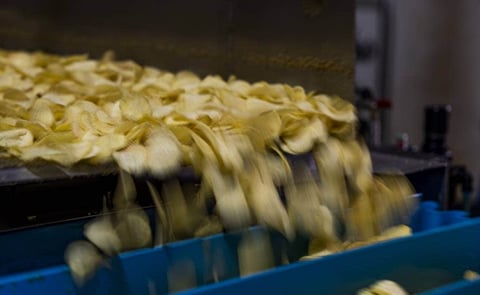
Bluebird makes on average 1.8 tonnes of potato chips per hour.
September 24, 2007
Common food additives may cut acrylamide formation in potato chips
Common food additives like calcium chloride and l-cysteine could reduce the formation of acrylamide in potato chips by about 85 per cent, according to a new study."This research presents a technology to inhibit acrylamide formation in fried potat...
From the archive
September 01, 2007
Novozymes launches Acrylaway to Reduce Acrylamide In Food
Novozymes launches Acrylaway (asparaginase) to reduce acrylamide which is formed when starchy foods are baked, fried or toasted at high temperatures. Acrylamide is under suspicion of causing cancer.
From the archive
DSM Food Specialties awarded for PreventASe acrylamide mitigation enzyme
August 30, 2007
DSM agrees on asparaginase application rights with Frito-Lay and Procter & Gamble
Worldwide licencee for PreventASe™ DSM Food Specialties, Frito-Lay and Procter &Gamble have reached an agreement on the Intellectual Property rights to apply asparaginase in food products in order to reduce acrylamide levels. The reduction is cata...
From the archive

Frequently Asked Questions

Will PotatoPro edit my article?

Yes. We edit almost all submitted articles for style and layout. If you notice a change you are not happy with, contact us and we will find a solution. If you submit news before its official publication date, you can review the item privately before it goes live.

How can I get more visibility for my company’s news?

Besides free news publishing, companies can list in the PotatoPro directories, become PotatoPro sponsors, or use targeted email blasts, the Event Promotion Package and social media exposure with analytics. Find out why companies advertise on PotatoPro.

Does PotatoPro delete old news? Can I add older news?

No, we do not delete old news. News on PotatoPro goes back to 2006, and we consider it a valuable historical record of developments in the industry. If we missed a key development in the history of your company, we can still add it.

What can I do after my news is published?

Share the article with your colleagues and on the social media channels where you are active, and add it to the “Company in the news” section of your website if you have one. You are also welcome to point other media to the PotatoPro article, as long as they include a clickable link to the item on PotatoPro.

I have created an account, but I am not receiving the newsletters. What should I do?

Log in to your profile and check that you have opted in to the newsletters you would like to receive. Also check your spam or promotions folder and make sure you registered with the right email address. If you still do not receive them, contact us at info@potatopro.com. For sign-in or password issues, see the PotatoPro Login & Account FAQs.

Is reading news on PotatoPro free?

Yes. All news articles on the PotatoPro website are free to read. The PotatoPro app is also free but requires a free PotatoPro account, which also works on PotatoPro AI.

Where is PotatoPro news published and how can I follow it?

News appears on the PotatoPro News page and in the PotatoPro weekly newsletter, which you can receive by creating a free PotatoPro account. It is also available in the PotatoPro app for iPhone and iPad and Android, and shared on LinkedIn, Facebook, Instagram, X, YouTube, Telegram and Bluesky.

My company is not in the PotatoPro directory. Can I still submit news?

Yes. Companies that are not yet listed can still submit news, and they are also welcome to contact PotatoPro to be added to the Company Directory.

In what languages can I submit news?

You can submit news in any language. PotatoPro publishes in English, Spanish, Dutch and Simplified Chinese, and plans to add German, French, Arabic, Hindi and Portuguese in 2027.

How long does it take for news to be published?

It depends on the timing of the news, the editorial workload and how much editing the article needs. News from PotatoPro sponsors may be given priority.

When should I submit my news?

As soon as possible, and ideally on the day the news becomes public, even if it is only a link to material published elsewhere. Extra material such as videos or illustrations can be added later. You can also send news before it is public, as long as you clearly state the embargo date and time, including the time zone.

Can I include links in my news article?

You can include one dofollow link to an external source in the body of the text. Links to your brands, your company profile, previous news and other content about your company on PotatoPro are mostly added automatically.

Can I include a video in my news article?

Yes. We can embed videos hosted on YouTube or Vimeo. For best results, use HD quality or better, include sound, and keep the video professionally edited, ideally 1.5 to 3 minutes long.

What images should I send with my news?

Every news item on PotatoPro must have an illustration at the top, which is also used in article summaries and social media posts. The best top images are closely related to the story, eye-catching and colorful, in landscape format and at least 1,200 pixels wide. Avoid logos, pictures with a prominent logo and images with a lot of text, because Google and Facebook may not display them. Send high-resolution JPG or PNG files that you own or have permission to use, each with a caption and photo credit, and mention if an image was made using AI. Extra images for the body of the article are welcome.

What are the guidelines for writing a news article?

There is no maximum length, but we recommend more than 300 words, and we do not accept articles of fewer than 200 words. An article cannot consist only of a list; it needs paragraphs of text. Provide factual, useful information, keep sentences short, and write in the third person or include quotes attributed to a named person. Self-praise full of superlatives is unlikely to be published without heavy editing. Keep abbreviations to a minimum, and if English is not your first language, we recommend having your text reviewed by a native English speaker.

What type of news does PotatoPro accept?

PotatoPro accepts industry and company news, product launches, new facilities, appointments, technology and research updates, and other developments in the potato and savory snack industries. Submissions should give industry professionals useful information rather than being purely promotional.

How can I submit news to PotatoPro?

Email your article, press release or company announcement to news@potatopro.com. Send the text in a Word or Google document, or in the body of the email, and attach images separately. We may also pick up stories shared on X that tag @PotatoPro.

Is it free to publish news on PotatoPro?

Yes. News about the potato and snack industries is published free of charge if we consider it relevant. All submissions are subject to editorial review and will be edited for style and layout.

Filters

Refine By Topics
Refine By Regions
Refine By Year
Language preferences