
News on Services

Sponsor of the month (Learn more)
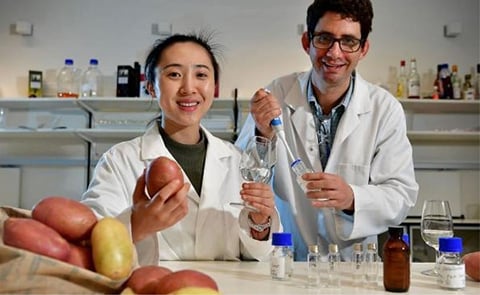
Researchers Yihe Sui and Dr Richard Muhlack, pictured at The University of Adelaide’s Waite Campus, are working with Potatoes South Australia to develop a high-end vodka using waste potato skins.(Courtesy: Bianca de Marchi / Aidelaide now)
September 21, 2017
Potatoes South Australia to develop vodka from waste potato peel
In an effort to combat food waste, Potatoes South Australia has teamed up with the University of Adelaide and Adelaide Hills Distillery to make vodka from potato skins.
From the archive
Potato harvest in Bangladesh
September 17, 2017
Dutch investors keen to invest in potato farming in Bangladesh
At Potato Europe, Dutch traders have shown their strong interest to invest in potato farming in Bangladesh aiming to increase the production.
From the archive
Dr. Yusuf Zafar T.I., Chairman PARC Chairing the Potato Evaluation Committee Meeting at PARC headquarters on August 24, 2017
September 04, 2017
Pakistan proposes National Potato Institute; Seed potato import reduced by 50 percent
Pakistan has reduced the import of potato seeds by 50 per cent as a result of strong public-private partnership in locally-certified potato production through planning and technical assistance.
From the archive
Chuck Schumer proposes a toast on the new Nematode Quarantine laboratory at Cornell University: 'Cheers' - with a potato chip! The upgrades to the facilities and equipment will enable the lab to help protect the US potato Industry against this potato pe
September 03, 2017
Cornell University to receive 400k for update of nematode research facilities
In a visit to the Nematode Quarantine laboratory at Cornell University last Friday, US Senate Minority Leader Chuck Schumer, announced a commitment of $400,000 from the USDA for the upgrades to the facilities and equipment.
From the archive
Potato Beetles on display at the Fredericton Research and Development Centre's open house
August 29, 2017
Fredericton Potato Research Lab invites the public
More than 300 people stopped by Fredericton Research and Development Centre's open house
From the archive
Adrienne Gorny, a fourth-year doctoral student in Plant Pathology and Plant-Microbe Biology at Cornell University, is the recipient of the 2017-2018 NPC Academic Scholarship.
August 25, 2017
National Potato Council awards scholarship to Adrienne Gorny for nematode research
Adrienne Gorny, a fourth-year doctoral student in Plant Pathology and Plant-Microbe Biology at Cornell University, is the recipient of the 2017-2018 NPC Academic Scholarship.
From the archive
Sponsored Content
Sponsored Content
Sponsored Content
In a hidden experimental field in Wageningen, the Netherlands, surrounded by tall maize plants, there are several smaller plots with potato plants. In some of these plots there are only dead plants, in others the plants have been affected by late blight (
August 23, 2017
Solynta's revolutionary hybrid breeding technology protects potato from late blight by multi-resistance
The breeders of Solynta have succeeded in making potato plants insusceptible to the dreaded potato disease Phytophthora infestans, using their revolutionary hybrid breeding technique.
From the archive
The Dutch company Solynta has been focused on non-GMO potato breeding (F1 hybrid potato breeding) and the eventual distribution of its varieties as true potato seed instead of seed potatoes (Courtesy: Solynta)
August 22, 2017
Solynta develops a blight resistant potato variety (non-GMO)
The Dutch company Solynta has developed a potato variety that is resistant to late blight (Phytophthora Infestans). As a result, it could greatly reduce the use of pesticides in agriculture.
From the archive
Penn State Researcher Ali Demirci adjusts a bioreactor in which potato waste is being used to produce bioethanol with a novel process that simultaneously employs mold and yeast to convert starch to sugar and sugar to ethanol.
August 17, 2017
Penn State Researchers find new way to convert potato waste to ethanol
With more than two dozen companies in Pennsylvania manufacturing potato chips, it is no wonder that researchers in Penn State's College of Agricultural Sciences have developed a novel approach to more efficiently convert potato waste into ethanol.
From the archive
Dirk Hays,Texas A&M AgriLife Research plant geneticist: “With Ground Penetrating Radar (GPR), we can image the size of the tubers and get a correlation to the actual physical size of the potato without harvesting them. [...] We can get an almost one-to-
August 17, 2017
Early maturing potato cultivars can be identified using ground-penetrating radar, finds Texas A&M Agrilife
Dirk Hays,Texas A&M AgriLife Research plant geneticist: “With Ground Penetrating Radar (GPR), we can image the size of the tubers and get a correlation to the actual physical size of the potato without harvesting them. Potatoes are a dream for Ground Penetrating Radar.”
From the archive
CIP Director General, Dr. Barbara Wells (left) and Vice Minister of Agriculture, Dr. Qu Dongyu, (right) signed a memorandum of understanding at a handover ceremony in Yanqing, Beijing (Courtesy: Chinese Ministry of Agriculture).
August 15, 2017
Handover of International Potato Center - China Center for Asia Pacific (CCAP) to China
he new International Potato Center-China Center for Asia Pacific (CCCAP) facilities were formalized in a handover ceremony in Yanqing, Beijing on July 11th, 2017.
From the archive
The announcement of £3 million towards a new international laboratory for scientists from Dundee and China underlined Scotland’s global reputation for potato research at the Potatoes in Practice event.
August 12, 2017
Potatoes in Practice stage for Scotland - China Potato Research announcement
The Chinese Government and leading potato company, Xisen Potato Group have committed £3 million to a collaboration with James Hutton Limited (JHL) to breed new varieties and research resistance to pests and diseases, tuber storage and potato processing.
From the archive
Sponsored Content

Current Selection 2767 items. Refine:

You May Also Like

Wilting of a potato plant caused by blackleg
August 12, 2017
Scottish Potato Industry unites to fund major Blackleg Research project
In Scotland, a group of major potato businesses and public sector organisations have sponsored a £242,000 (USD 313,000) research project aimed at reducing the impact of potato disease blackleg on the Scottish seed potato industry.
From the archive
The Potato Centre of Excellence in Jalandhar, Punjab is still under construction
August 07, 2017
Start-up of Punjab’s Centre of Excellence for Potato delayed
The Potato Centre of Excellence, Punjab’s only centre of its kind being set up at Dhogri village in Jalandhar, has not been completed yet, though the deadline for the project was 2015.
From the archive
Deepa Agarwal - an expert in food structure, flavour and product development
August 03, 2017
Perfecting the Pipers crisp
When Pipers Crisps — one of Britain’s best-known crisp brands — wanted to understand more about the science behind their premium products and processes they turned to food experts at the University of Nottingham.
From the archive
Avebe used a potato time capsule as the symbolic basis for ongoing innovative development
August 03, 2017
Avebe finds fertile land at the Zernike Campus to 'grow' their new Innovation Centre
Construction of Avebe's Innovation Centre at the Zernike Campus has started and this milestone was celebrated by 'planting' a potato time capsule.
From the archive
Consumers create less waste from frozen vegetables, potato products and berry fruit than from fresh, or alternatives in cans or jars.
August 02, 2017
Research: Less food waste when using frozen produce
Consumers create less waste from frozen vegetables, potato products and berry fruit than from fresh, or alternatives in cans or jars.
From the archive
Harish Subbaraman (left) works with graduate students in the Advanced Nanomaterials and Manufacturing Lab of Boise State University.
July 07, 2017
Boise researchers to develop an 'extremely low cost' sensor to detect rot in potato storage
Research of Boise State University plan to develop a wireless sensor network that would be able to detect temperature, humidity levels, carbon dioxide and ammonia levels in real time, to help with early detection of rot in stored potatoes.
From the archive

Frequently Asked Questions

Will PotatoPro edit my article?

Yes. We edit almost all submitted articles for style and layout. If you notice a change you are not happy with, contact us and we will find a solution. If you submit news before its official publication date, you can review the item privately before it goes live.

How can I get more visibility for my company’s news?

Besides free news publishing, companies can list in the PotatoPro directories, become PotatoPro sponsors, or use targeted email blasts, the Event Promotion Package and social media exposure with analytics. Find out why companies advertise on PotatoPro.

Does PotatoPro delete old news? Can I add older news?

No, we do not delete old news. News on PotatoPro goes back to 2006, and we consider it a valuable historical record of developments in the industry. If we missed a key development in the history of your company, we can still add it.

What can I do after my news is published?

Share the article with your colleagues and on the social media channels where you are active, and add it to the “Company in the news” section of your website if you have one. You are also welcome to point other media to the PotatoPro article, as long as they include a clickable link to the item on PotatoPro.

I have created an account, but I am not receiving the newsletters. What should I do?

Log in to your profile and check that you have opted in to the newsletters you would like to receive. Also check your spam or promotions folder and make sure you registered with the right email address. If you still do not receive them, contact us at info@potatopro.com. For sign-in or password issues, see the PotatoPro Login & Account FAQs.

Is reading news on PotatoPro free?

Yes. All news articles on the PotatoPro website are free to read. The PotatoPro app is also free but requires a free PotatoPro account, which also works on PotatoPro AI.

Where is PotatoPro news published and how can I follow it?

News appears on the PotatoPro News page and in the PotatoPro weekly newsletter, which you can receive by creating a free PotatoPro account. It is also available in the PotatoPro app for iPhone and iPad and Android, and shared on LinkedIn, Facebook, Instagram, X, YouTube, Telegram and Bluesky.

My company is not in the PotatoPro directory. Can I still submit news?

Yes. Companies that are not yet listed can still submit news, and they are also welcome to contact PotatoPro to be added to the Company Directory.

In what languages can I submit news?

You can submit news in any language. PotatoPro publishes in English, Spanish, Dutch and Simplified Chinese, and plans to add German, French, Arabic, Hindi and Portuguese in 2027.

How long does it take for news to be published?

It depends on the timing of the news, the editorial workload and how much editing the article needs. News from PotatoPro sponsors may be given priority.

When should I submit my news?

As soon as possible, and ideally on the day the news becomes public, even if it is only a link to material published elsewhere. Extra material such as videos or illustrations can be added later. You can also send news before it is public, as long as you clearly state the embargo date and time, including the time zone.

Can I include links in my news article?

You can include one dofollow link to an external source in the body of the text. Links to your brands, your company profile, previous news and other content about your company on PotatoPro are mostly added automatically.

Can I include a video in my news article?

Yes. We can embed videos hosted on YouTube or Vimeo. For best results, use HD quality or better, include sound, and keep the video professionally edited, ideally 1.5 to 3 minutes long.

What images should I send with my news?

Every news item on PotatoPro must have an illustration at the top, which is also used in article summaries and social media posts. The best top images are closely related to the story, eye-catching and colorful, in landscape format and at least 1,200 pixels wide. Avoid logos, pictures with a prominent logo and images with a lot of text, because Google and Facebook may not display them. Send high-resolution JPG or PNG files that you own or have permission to use, each with a caption and photo credit, and mention if an image was made using AI. Extra images for the body of the article are welcome.

What are the guidelines for writing a news article?

There is no maximum length, but we recommend more than 300 words, and we do not accept articles of fewer than 200 words. An article cannot consist only of a list; it needs paragraphs of text. Provide factual, useful information, keep sentences short, and write in the third person or include quotes attributed to a named person. Self-praise full of superlatives is unlikely to be published without heavy editing. Keep abbreviations to a minimum, and if English is not your first language, we recommend having your text reviewed by a native English speaker.

What type of news does PotatoPro accept?

PotatoPro accepts industry and company news, product launches, new facilities, appointments, technology and research updates, and other developments in the potato and savory snack industries. Submissions should give industry professionals useful information rather than being purely promotional.

How can I submit news to PotatoPro?

Email your article, press release or company announcement to news@potatopro.com. Send the text in a Word or Google document, or in the body of the email, and attach images separately. We may also pick up stories shared on X that tag @PotatoPro.

Is it free to publish news on PotatoPro?

Yes. News about the potato and snack industries is published free of charge if we consider it relevant. All submissions are subject to editorial review and will be edited for style and layout.

Filters

Refine By Topics
Refine By Regions
Refine By Year
Language preferences