

Introduction: why salt matters in the potato industry
Salt (sodium chloride, NaCl) is the single most important seasoning in potato processing. It is the defining ingredient of the plain salted potato crisp, one of the world's most popular savoury snacks (called potato chips in North America), and it finishes most portions of French fries served in restaurants.
Potatoes are naturally very low in sodium. Almost all the sodium in a bag of crisps, a portion of fries or a serving of instant mash is added during processing or at the point of sale. That makes salt one of the few ingredients a potato processor fully controls, and one of the most closely watched by regulators.
Salt reaches the consumer through many potato products:
- Potato chips and crisps: salt or salty seasoning is applied straight after frying or baking.
- French fries: salted after frying in quick-service restaurants and food service.
- Frozen fries and wedges: sold plain or pre-seasoned with coatings that contain salt.
- Dehydrated products: potato flakes, granules and instant mashed potato mixes.
- Formulated and extruded snacks: made from potato flakes, starch and seasoning.
Manufacturers have to balance four things at once: the salty taste consumers expect, product quality, declared sodium content and price. Getting the balance wrong costs sales either way. Too little salt can make a familiar brand taste flat; too much puts the product on the wrong side of front-of-pack labels and national reduction targets.
Public-health pressure is now the main force reshaping salt use. The World Health Organization recommends that adults eat less than 2,000 mg of sodium a day, equal to less than 5 g of salt. Yet global mean intake is estimated at about 4,310 mg of sodium a day, roughly 10.8 g of salt and more than double the recommendation. In 2021 WHO published global sodium benchmarks for 64 food categories, including a benchmark of 500 mg of sodium per 100 g for potato, vegetable and grain chips. For the potato industry, salt is no longer just a seasoning decision: it is a product-development, regulatory and commercial issue.
Salt in Potato Processing: Seasoning, Sodium Content and Health Regulations
How salt is used across the potato value chain
Salt enters potato products at different points and for different reasons. In snacks it is a surface seasoning; in fries it is mostly added at the point of service; in dehydrated products it is often left to the consumer; and in some processing operations salt solutions are a tool, not an ingredient.
Potato chips and crisps
Crisps are salted or seasoned straight after frying (or baking), while the surface is still hot and coated with a thin film of oil. Most lines use a rotating seasoning drum (tumble drum): unseasoned crisps tumble gently while a vibratory or screw feeder distributes salt or seasoning powder across the product curtain. Large plants increasingly use on-machine seasoning (OMS) close to the weigher, so each flavour is applied just before packing and changeovers are faster. Industry suppliers describe salt and seasoning being applied while the product is still hot by sprinkling onto a conveyor, tumbling in a drum or electrostatic coating.
Adhesion decides how much of the salt that is dosed actually stays on the crisp. Ohio State University researchers, writing in the Journal of Food Science (2007), found that surface oil content is the strongest factor in salt adhesion, followed by salt particle size; smaller particles stuck better, and crystal shape mattered least. Electrostatic coating, which charges the powder so it is attracted to the product, also improved transfer efficiency, adhesion and evenness of salt on baked potato chips in trials at 30–50 kV.
Particle size also affects flavour consistency. Fine salt spreads more evenly and dissolves faster on the tongue, while coarse crystals can bounce off, segregate in the feeder or end up as dust under the line. Product shape matters too: a ridged or thick-cut crisp needs more seasoning than a thin flat one to give the same flavour impact.
French fries and frozen potato products
For most French fries, salt is added after the final fry, not in the factory. Quick-service chains such as McDonald's say they add a small amount of salt after the fries are cooked in the restaurant, and customers can ask for unsalted fries. This makes the restaurant, not the processor, the main control point for sodium in food-service fries.
Frozen fries fall into two groups:
- Plain (uncoated) frozen fries: potatoes, oil and often a colour-retention agent such as sodium acid pyrophosphate (SAPP) and dextrose. Some retail packs list a little salt, others none.
- Coated or pre-seasoned fries: a thin batter of starches, rice flour and leavening that often contains salt and seasonings. These "clear-coat" and seasoned fries hold crispness longer under heat lamps and in delivery, but they deliver sodium before any salt is added at the fryer. For example, a McCain food-service seasoned fry with salt, pepper and garlic lists 450 mg sodium per 85 g serving.
Note that SAPP and sodium bicarbonate leavening add some sodium even to products with no added salt, so "unsalted" does not mean "sodium-free".
Processed potato ingredients
Dehydrated potato flakes and granules are usually sold unsalted so that food manufacturers and consumers can season them. A plain flake product such as Idahoan Original Mashed Potatoes lists only 10 mg sodium per 22 g of dry mix, and the pack directions ask the cook to add salt. Flavoured instant mash, potato-based soup mixes, stuffing and side-dish mixes are different: salt, cheese powder, stock and flavour enhancers are built into the dry blend, and sodium per prepared serving is much higher.
Fabricated snacks made from potato flakes or starch (stackable crisps and extruded or pellet snacks) carry salt in two places: in the dough or pellet formulation and in the surface seasoning. Stackable crisps cannot be tumbled without breaking, so seasoning is applied on lane conveyors as the chips travel in columns.
Potato starch and industrial applications
Potato starch itself is not a salted product, and native potato starch contains little sodium. Salt matters in starch and raw-material processing in other ways:
- Brine grading of potatoes and strips. Processing potatoes are bought on dry matter. Salt brines of known density separate tubers or cut pieces by specific gravity: potatoes float or sink depending on the brine's density, so a series of brines sorts a sample into dry-matter bands. A brine of about 11% salt has a specific gravity near 1.080, the value used for high-solids Russet Burbank. Patents also describe brine density separation of fry strips and dice.
- Water treatment. Food-grade or industrial salt regenerates ion-exchange water softeners that supply boiler and process water.
- Modified starches. Some modification chemistries use sodium-based reagents, so certain modified starches carry residual sodium. This is a processing residue, not added table salt.
These uses should be kept separate from salt as a seasoning: they are processing aids or utility uses and are not declared as "salt" in a finished potato product.
What does salt do in potato processing?
Salt is a functional ingredient, not just a flavour. Its main job in finished potato products is sensory, but it also affects consistency, formulation and, in specific processes, water behaviour and microbial stability.
- Flavour enhancement: Salt gives a salty taste to an otherwise bland potato base and changes how other flavours are perceived. Sensory research summarised by the University of Nottingham notes that salt reduces bitterness, increases sweetness and masks processed notes, which is why even sweet-chilli or cheese crisps contain salt.
- Seasoning consistency: Consumers notice batch-to-batch variation quickly. A long-standing industry guideline cited in snack-coating training material puts plain salted crisps at about 1.75% salt, plus or minus 0.25%. Holding a tight target depends on uniform particle size, steady feeding and good adhesion.
- Texture and crispness. Salt can affect texture indirectly, for example in reconstituted or expanded snacks where it is part of the dough, and through how surface moisture behaves. It does not automatically make crisps or fries crispier: crispness is set mainly by dry matter, frying conditions, oil and final moisture. Salt applied after frying sits on the surface and has little effect on crunch.
- Product formulation. In flavoured crisps, salt is part of a seasoning system with sugars, acids, dairy powders, spices and flavour enhancers. It also acts as a low-cost carrier and bulking agent in many seasoning blends.
- Microbial control. Salt lowers water activity, but only at high concentrations. A salt solution of roughly 10% NaCl lowers water activity to about 0.94, below which most disease-causing bacteria cannot grow. Seasoning levels of 1–2% on a crisp are nowhere near this. Crisps are shelf-stable because frying drives moisture very low, not because of the salt. Salt should never be presented as a preservation method for chips or fries.
- Water management in processing. Salt solutions (brines) are used as tools in specific operations, such as density grading of tubers and cut strips by specific gravity (see Section 2D). Their effect depends entirely on concentration and contact time, and these brines are not intended to season the product.
Types of salt used in the potato industry
Potato processors choose salt mainly on particle size, purity and flow, because these decide how evenly it doses, how well it sticks and how quickly it tastes salty.
Fine salt: Standard granulated food salt typically runs between about 100 and 700 microns, while micro-sized salt is ground below 50 microns. Smaller crystals dissolve faster in the mouth, so they taste saltier at the same dose, but caking tendency rises as particle size falls.
Coarse salt: Large crystals give a crunchy, pronounced salt sensation that suits premium and "hand-cooked" positioning. Because crystal size reduces adhesion, coarse salt is usually combined with fine salt or applied to products with higher surface oil.
Vacuum-dried and specialty food-grade salts: Vacuum-crystallised salt produces cubic crystals with uniform particle size, which is why it dominates automated seasoning lines. European producers quote typical purity of about 99.9% for vacuum salt and 99% for rock salt. Suppliers also offer porous "modified cube" salts with lower bulk density and more surface area, designed to dissolve faster and cling better.
Salt substitutes and sodium-reduction ingredients: Potassium chloride (KCl) is the most widely used replacer. Ingredient suppliers report that potassium-based systems can help snack makers reach 30–50% sodium reduction, but usage is often limited by bitter or metallic aftertaste, and finer KCl particles help reduce that aftertaste. In 2025 WHO issued a guideline on lower-sodium salt substitutes that supports partial replacement of sodium with potassium at population level, for adults in the general population; it excludes pregnant women, children and people with kidney impairment or other conditions that affect potassium excretion.
Food-grade salt specifications and permitted additives (anti-caking agents, iodine, flow aids) differ by country and by application. Processors exporting to several markets should check each market's rules rather than assume one specification fits all.
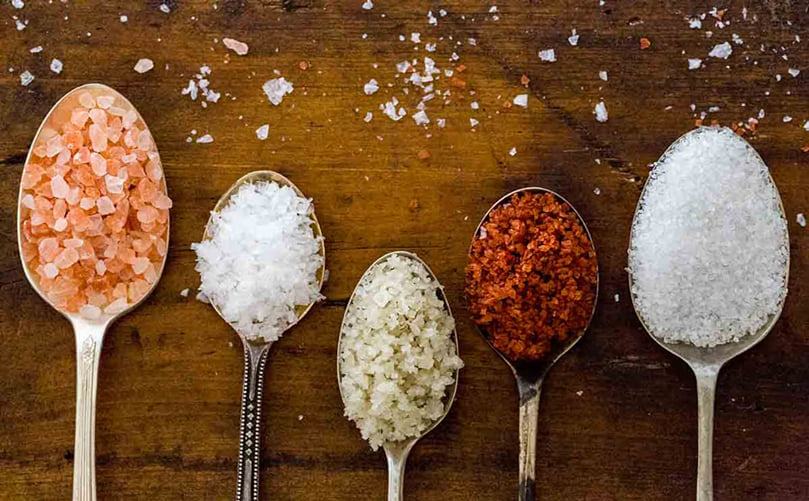
Types of Salt Used in Potato Processing: Fine, Coarse and Specialty Salts
How salt is applied during potato processing
In almost every potato product, salt goes on after cooking, as late in the line as possible. Applying it later keeps it on the surface, where the tongue meets it first, and avoids drawing water out of raw potato tissue. A typical potato chip line runs as follows:
- Receiving, washing, peeling and cutting: Tubers are graded for size, dry matter and sugars, then destoned, washed, peeled and sliced. Salt brines may be used at this stage only for specific-gravity checks, not for seasoning.
- Blanching and pretreatments, where applicable: Common for fries and some kettle-style chips: hot water blanching removes surface sugars, and dips such as dextrose or SAPP control colour. On most chip lines, slices are simply washed to remove surface starch and go straight to the fryer.
- Frying or other cooking: Continuous or batch frying, or baking and air-drying for lower-fat ranges. This step sets crispness and final moisture.
- Surface-oil management and handling: De-oiling conveyors or centrifuges set how much oil remains. Because surface oil is the main "glue" for salt, a change in de-oiling changes how much salt sticks.
- Salt and seasoning application: Plain crisps are salted in a drum or on a conveyor while still hot; flavoured crisps go to the seasoning drum, often at the packaging machine.
- Cooling, packaging and quality checks: Weighers and bagmakers fill nitrogen-flushed packs; quality teams check seasoning level, sodium and breakage.
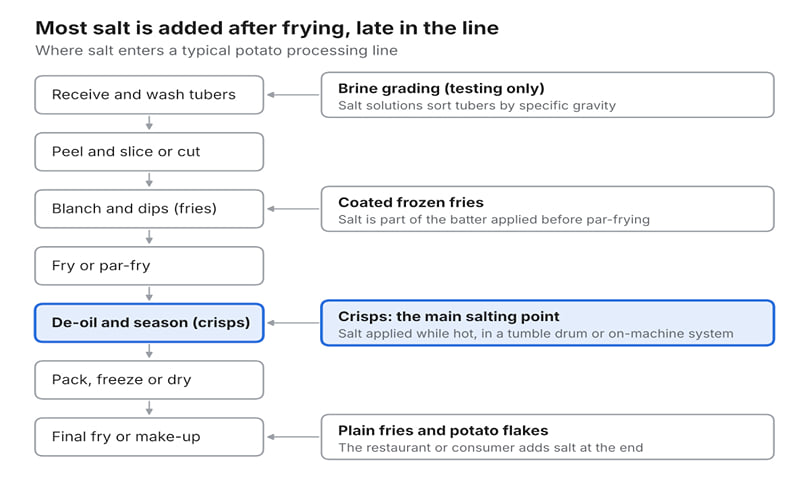
For crisps the processor controls the final salt level; for plain fries and flakes, the restaurant or consumer does.
| Product | Where salt is usually added | Who controls the final sodium content |
|---|---|---|
| Plain and flavoured potato crisps | In a seasoning drum after frying or baking; flavoured crisps receive salt-containing seasoning blends. | Snack manufacturer |
| Stackable or fabricated potato crisps | In the dough or formulation, and/or through seasoning applied after cooking on a conveyor or in a seasoning system. | Snack manufacturer |
| Plain frozen French fries | Usually not added during factory processing; salt is typically applied after final frying in food service or at home. | Restaurant, food-service operator or consumer |
| Coated or seasoned frozen fries | Salt may be incorporated into the coating or seasoning before par-frying and freezing; additional salt may be applied after final frying. | Processor and restaurant, food-service operator or consumer |
| Plain potato flakes and granules | Usually no salt is added to the plain product; salt is added during reconstitution or subsequent product formulation. | Food manufacturer, food-service operator or consumer |
| Flavoured mashed potato products and instant potato mixes | Incorporated into the dry ingredient blend or added during formulation. | Product manufacturer, with additional control by food-service operators or consumers if extra salt is added. |
Equipment used for salting and seasoning:
- Seasoning (tumble) drums, rotating stainless-steel or polymer cylinders in which product tumbles while seasoning is fed in.
- Powder feeders: vibratory trays, screw augers and bias-cut feeders that meter salt evenly across the drum.
- Oil and slurry spray systems for products that need a tack coat before seasoning, such as baked or popped snacks.
- Electrostatic coaters that charge salt particles to improve transfer efficiency and reduce dust.
- On-machine seasoning (OMS) systems with automated dosing. These sit at each weigher, so several flavours run off one fryer. Heat and Control's FastBack system uses load cells that measure product flow and adjust seasoning feed to match, and TNA's intelli-flav OMS 5 controls product, oil spray and seasoning flow into a single drum.
- Dust collection, which recovers airborne seasoning and protects workers and equipment.
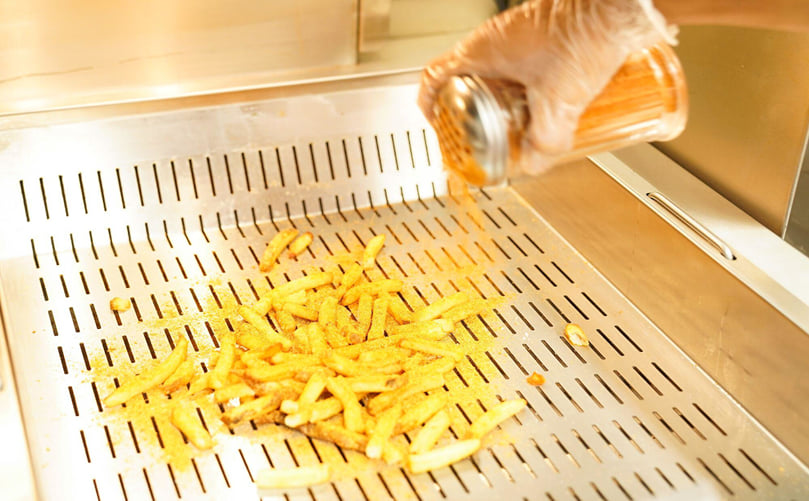
Salt Application in French Fry Processing: From Blanching and Frying to Final Seasoning
Sodium Content in Potato Products: From Unsalted Potatoes to Seasoned Snacks
Sodium in potato products ranges from almost zero in plain flakes and unsalted chips to around 1,000 mg per 100 g in strongly flavoured crisps. The examples below come from national databases and published product specifications; they are illustrations, not category averages, and individual brands vary widely.
| Product (source) | Sodium per 100 g | Salt per 100 g | Per serving | Note |
|---|---|---|---|---|
| Potato chips, plain, unsalted (USDA FDC 170649) | 8 mg | 0.02 g | n/a | Shows how little sodium the potato itself carries |
| Potato chips, plain, salted (USDA FDC 169677) | 527 mg | 1.3 g | about 150 mg per 28 g | Salt added at seasoning |
| Potato chips, sour cream and onion (USDA FDC 167963) | 549 mg | 1.4 g | about 155 mg per 28 g | Sodium from salt plus dairy powders and flavourings |
| Potato crisps, salt and vinegar, Australia (FSANZ) | 970 mg | 2.4 g | 440 mg per 45 g packet | Acid flavours often need more salt to balance |
| Potato crisps, other flavours, Australia (FSANZ) | 620 mg | 1.6 g | 280 mg per 45 g packet | Survey average |
| Fabricated chips from dried potatoes, plain (USDA FDC 168853) | 529 mg | 1.3 g | about 150 mg per 28 g | Salt in dough and topping |
| Coated frozen fries, salted, EU food service (McCain SureCrisp spec) | about 280 mg | 0.7 g | n/a | Before any salt added at the fryer |
| Seasoned coated fries, US food service (McCain spec) | about 530 mg | 1.3 g | 450 mg per 85 g | Salt, pepper and garlic coating |
| Instant mashed potato flakes, plain (Idahoan label) | about 45 mg (dry) | 0.1 g | 10 mg per 22 g dry mix | Cook adds salt at preparation |
Three points matter when comparing products:
- Always state the serving size. A 25 g bag and a 150 g sharing bag of the same crisps have identical sodium per 100 g but very different sodium per occasion.
- Separate salt from sodium. Labels in the EU and UK declare salt; US, Canadian and Australian labels declare sodium. Sodium figures also include sodium from SAPP, sodium bicarbonate, monosodium glutamate and dairy powders, not only added salt.
- Fries are measured as served. Sodium in restaurant fries depends mostly on how much salt the operator shakes on, which is why chains publish typical, not guaranteed, values.
Salt and sodium conversion. Sodium chloride is about 40% sodium by weight, so the standard approximate conversions are:
Salt (g) ≈ Sodium (g) × 2.5
Sodium (mg) ≈ Salt (g) × 400
For example, a crisp with 500 mg sodium per 100 g contains about 1.25 g salt per 100 g, which is exactly the UK's 2024 average target for standard potato crisps (maximum 550 mg sodium, or 1.38 g salt, per 100 g).
Salt reduction: how manufacturers are reformulating potato products
The best-documented sodium cuts in potato snacks come from making each grain of salt work harder, not from removing salt outright. Research and industry programmes show reductions of roughly 25–50% are achievable in crisps, provided taste is protected and consumers are brought along gradually.
Why there is room to reduce. Much of the salt on a crisp is never tasted. University of Nottingham researchers found that the "salt burst" from crisps is only released into the mouth about 20 seconds after chewing begins, so a large share is swallowed before it registers. Any technique that delivers sodium to the tongue faster and more completely lets manufacturers use less.
Main reformulation levers
- Finer and engineered salt particles. Smaller crystals dissolve faster. In a Nottingham study, the smallest salt crystal fraction gave the fastest and highest saltiness per unit of sodium on fried potato crisps. Engineered salts go further: Tate & Lyle's SODA-LO converts salt into hollow crystalline microspheres of about 5–10 microns, with reported salt reductions of 25–50% in applications including chips and French fries. Because it is still salt, it is labelled simply as "salt".
- Better distribution and adhesion. Electrostatic coating, OMS dosing and tighter control of surface oil reduce the over-application processors use to compensate for salt lost as dust. Every gram that stays on the chip is a gram that does not need to be added.
- Optimising where salt sits. Salt on the outer surface reaches the tongue first. Concentrating salt at the surface, rather than in a dough or coating, gives more perceived saltiness per milligram of sodium.
- Partial replacement with potassium chloride and mineral blends. Potassium-based systems can deliver 30–50% sodium reduction in snacks, but bitterness limits use levels. Blends with magnesium or calcium salts, micro-sized KCl and bitter-masking flavours help. A Frito-Lay patent, as summarised by industry analysts, describes a multi-component salt system aimed at up to 50% sodium reduction in potato chips by controlling how each component dissolves.
- Herbs, spices, acids and flavour enhancers. Garlic, onion, pepper, paprika, vinegar and citric acid add impact, while yeast extracts and other umami ingredients boost savouriness. These can let salt be cut in flavoured crisps more easily than in plain salted ones.
- Gradual "stealth" reduction. Cutting a few per cent at a time, below the level most consumers notice, has been central to national programmes such as the UK's voluntary targets.
Results from research and industry
- A University of Nottingham study applied salt designed using "design rules" for particle size and shape and achieved a 30% salt reduction in potato crisps while maintaining saltiness perception and consumer acceptance.
- PepsiCo aims for at least 75% of its global convenient-foods volume to meet category sodium targets by 2030, including a further 15% cut in US Lay's Classic to 140 mg sodium per 28 g serving. It also cites Walkers 45% Reduced Sodium crisps in the UK and "Lightly Salted" lines in the US.
Consumer testing, cost and commercial risk
Sensory evaluation is essential: trained panels profile saltiness, bitterness and aftertaste, and consumer tests check liking and purchase intent against the current product. The Nottingham researchers note that people who dislike a low-salt product may add their own salt or switch to another product, which cancels the health benefit and costs the brand sales.
Reformulation also brings costs and trade-offs:
- Engineered salts and potassium blends cost more per kilogram than standard vacuum salt.
- New ingredients can change the label (for example, adding "potassium chloride" or "flavouring"), which some clean-label brands want to avoid.
- Equipment may need recalibration for powders with different bulk density and flow.
- Reduced-sodium claims must meet each market's legal definitions.
One size does not fit all. A method that works for topically salted crisps may fail in French fries, where salt is added by the restaurant, or in instant mash, where salt is dissolved in the product and particle size no longer matters. Each category needs its own reduction strategy.
Salt in Potato Products: Consumer Health, Sodium Intake and Labelling
The health concern is total daily sodium intake from all foods, not the salt on any single snack. Potato products matter because they are eaten often and in growing portion sizes, but they are one contributor among many.
- Sodium and blood pressure. WHO states that excess sodium raises blood pressure and increases the risk of cardiovascular disease and stroke. Its guideline is less than 2,000 mg sodium a day for adults, equal to less than 5 g of salt, and lower for children in proportion to their energy needs. This is a total daily limit from all sources, not a target for potato products.
- How snacks add up. In high-income countries, most sodium comes from processed and restaurant foods rather than the salt shaker. The World Medical Association notes that sodium added during processing can make up 75–80% of intake in those countries. Savoury snacks are a modest share: PepsiCo, citing US national survey data, puts it at around 3% of daily sodium. Frequent consumption, large bags and salty fries alongside other salty foods still push some consumers well over the limit.
- Portion sizes and brand differences. The same product type can vary several-fold in sodium per 100 g (Section 6), and pack sizes range from 25 g single bags to 200 g sharing bags. Per-serving labelling helps only if the declared serving matches how people actually eat.
- Front-of-pack labelling and consumer education. In the UK, a food is "high" in salt above 1.5 g per 100 g (0.6 g sodium) and "low" at 0.3 g or less, and traffic-light labels colour-code products on that basis. Australia and New Zealand define a "low salt" food as no more than 120 mg sodium per 100 g, and a "reduced salt" claim needs at least 25% less than a comparable food. Other countries use warning symbols or health-star ratings.
- Honest lower-sodium options. A reduced-sodium claim should compare like with like, meet the local legal threshold and not imply that the product is a health food. If potassium chloride is used, people with kidney disease or on medicines that affect potassium should be advised to check with a health professional, which WHO also flags in its 2025 guideline on salt substitutes.
The potato itself is naturally low in sodium and a good source of potassium. Plain unsalted chips contain only about 8 mg of sodium per 100 g, which shows that sodium in potato products is almost entirely a processing choice.
Salt in potato cultivation: soil salinity and irrigation
In the field, salt is a stress, not an input. Potatoes are classed as moderately sensitive to salinity: in the widely used Maas–Hoffman model, yield starts to fall once soil salinity passes an ECe of about 1.7 dS/m and drops roughly 12% for every further 1 dS/m. The equivalent threshold for irrigation water is about 1.1 dS/m.
| Measure | Potato value | What it means |
|---|---|---|
| Soil salinity threshold (ECe) | About 1.7 dS/m | Yield begins to decline when soil salinity exceeds this level. |
| Yield loss above threshold | About 12% per 1 dS/m increase | Estimated relative yield loss for each unit increase in soil salinity above the threshold. |
| Soil salinity at approximately 75% relative yield | About 3.8 dS/m | Estimated yield is around 75% of normal under the stated response model. |
| Irrigation water salinity threshold (ECw) | About 1.1 dS/m | Above this level, salinity management may be needed, depending on soil drainage, rainfall and leaching. |
| Irrigation water salinity associated with approximately 25% yield loss | About 2.5 dS/m | Estimated irrigation-water salinity associated with 75% relative yield under the referenced tolerance model. |
Thresholds vary with variety, climate, soil type and irrigation method; they are guides, not guarantees.
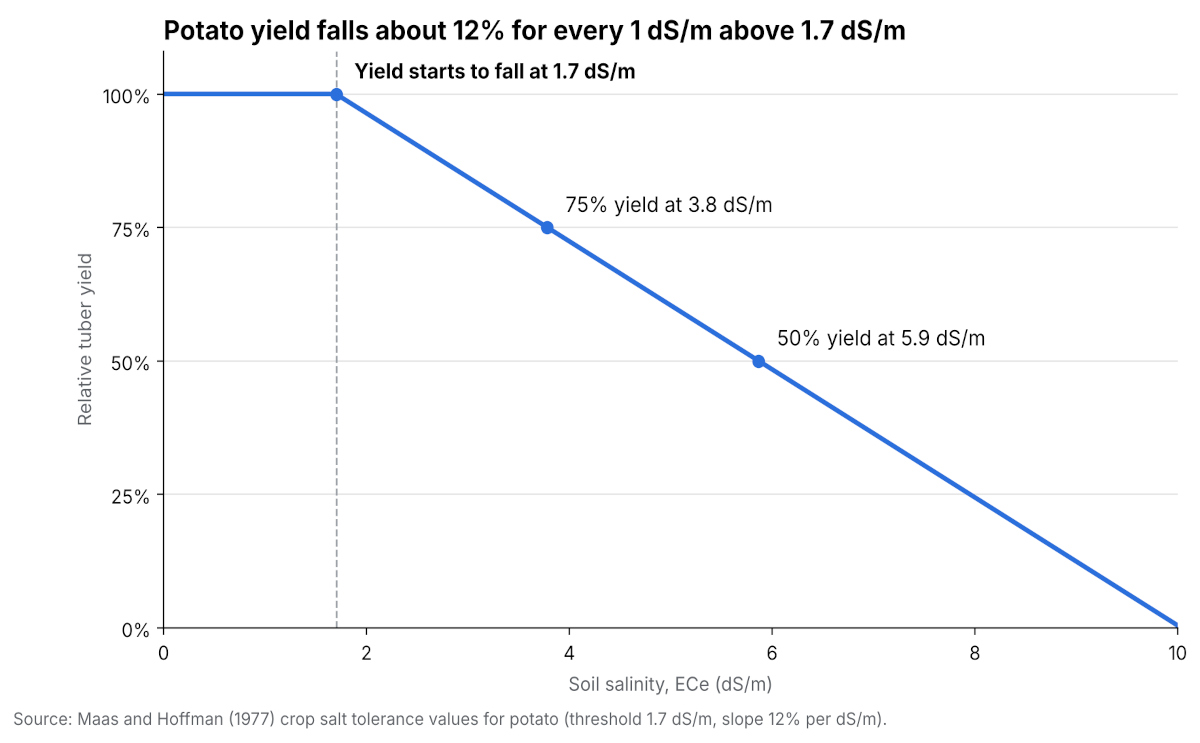
By about 5.9 dS/m, a moderately saline soil, the model predicts only half of normal tuber yield.
How salinity affects the crop. Dissolved salts lower the soil's osmotic potential, so roots struggle to take up water even when the soil is moist. Sodium and chloride then build up in leaves and stems, causing ion toxicity, leaf scorch and reduced photosynthesis. In a screening of 53 cultivars, salt stress cut tuber yield by an average of about 39%, with the tuber potassium-to-sodium ratio among the traits linked to tolerance.
Effects on tuber yield and quality. Saline conditions reduce tuber number and size and the share of top-grade tubers. A trial in Israel with ten Mediterranean varieties found that salinity lowered fresh yield but raised tuber dry matter and soluble solids. Higher dry matter can sound useful for processors, but it comes with smaller tubers, lower marketable yield and less predictable quality.
Sensitive regions. Salinity is a growing issue in irrigated potato areas such as Egypt's Nile Delta and reclaimed desert lands, the Mediterranean, the Middle East, parts of India, Pakistan and Bangladesh, and coastal zones affected by seawater intrusion. Studies show clear differences between cultivars, which gives breeders and growers room to choose more tolerant varieties.
Managing salinity on potato farms:
- Test irrigation water for EC and sodium adsorption ratio (SAR) before the season.
- Monitor root-zone salinity with soil samples or sensors during the season.
- Apply a leaching fraction, extra water that pushes salts below the root zone, and make sure drainage can remove it.
- Prefer drip irrigation, which keeps the root zone wetter and salts at the wetting front, over furrow systems where possible.
- Use gypsum where sodium is damaging soil structure, and maintain good potassium nutrition.
- Choose varieties with proven salt tolerance for marginal land.
Food salt versus field salt. Food-grade sodium chloride sprinkled on crisps and salt accumulating in agricultural soil are the same chemical but entirely different issues. Applying table salt to potato fields is not a normal production practice; sodium chloride in potato cultivation is a problem to manage, not a fertiliser.
Salt quality, food safety and manufacturing standards
Potato processors buy salt against a written specification, just like any other ingredient. The international reference is the Codex Standard for Food Grade Salt (CXS 150-1985), which applies to salt sold to consumers and used in food manufacture and requires at least 97% sodium chloride on a dry-matter basis, excluding additives. National rules (EU, US FDA, FSSAI in India, FSANZ and others) build on or differ from it.
| Requirement | What processors specify | Why it matters |
|---|---|---|
| Purity | NaCl content (Codex minimum 97%; vacuum salt usually above 99.5%); insolubles, calcium, magnesium and sulphate | Off-tastes, cloudiness in brines, scaling in equipment |
| Contaminants | Maximum arsenic, lead, cadmium, mercury and copper. One Codex-referenced supplier spec lists lead 1.0 mg/kg, arsenic 0.5, cadmium 0.5, mercury 0.1 | Food safety and legal compliance |
| Moisture | Maximum moisture, kept very low for dried vacuum salt | Caking, feeder blockages, uneven dosing |
| Particle-size distribution | Sieve analysis by mesh or micron bands | Adhesion, flavour hit, dust, segregation |
| Flowability and additives | Anti-caking agent type and level (for example E535, whose limit differs between Codex and some national codes), iodine yes or no | Line performance; labelling; market acceptance |
| Documentation | Certificate of analysis per lot, food-safety certification (FSSC 22000, BRCGS, ISO 22000), allergen and GMO statements | Audits and customer requirements |
| Traceability | Lot numbers on every bag or bulk delivery | Fast recall if a problem is found |
Storage and handling. Salt is hygroscopic. It should be stored off the floor in a dry, closed area, with bags kept sealed and bulk silos protected from humid air. Lumps and moisture pick-up are the most common causes of poor seasoning performance.
Food-grade versus industrial salt. Industrial grades used for water softening, de-icing or chemical processing are not made or tested for food use. They must be kept physically separate, clearly labelled and never used as an ingredient, even in an emergency. Brine for specific-gravity testing should also be kept away from product lines.
Finished-product compliance. Processors must declare salt or sodium correctly for each market (salt per 100 g in the EU and UK; sodium per serving in the US), list salt and any potassium chloride in the ingredients, and keep claims such as "lightly salted" or "reduced salt" within local definitions.
Quality control on the line. Common checks include:
- Seasoning pickup by weighing product before and after the drum, or by sampling at the bagmaker.
- Salt content by chloride titration or conductivity, and sodium by flame photometry or ICP for nutrition labels.
- Visual or image-based checks of coverage evenness.
- Trend charts for salt per batch, so drift in feeders or surface oil is caught early.
Salt supply chain, cost and potato industry economics
Standard food-grade salt is one of the cheapest ingredients in a potato snack, so the economic questions are less about the salt bill and more about consistency, waste and the cost of reformulating to lower sodium.
Suppliers and procurement. Food-grade salt is supplied by global and regional producers (for example Cargill, Morton Salt, K+S, Compass Minerals, Tata Chemicals, Nouryon and Dominion Salt) and by many national refiners. Large processors usually buy vacuum-dried salt on annual contracts with agreed specifications, certificates of analysis and audit rights. Specialty salts and potassium-based replacers come from a smaller group of ingredient companies and are often bought as part of a seasoning system from flavour houses.
Benchmark price data. The most transparent public series is from the US Geological Survey. In the United States, the average unit value of vacuum and open-pan salt (bulk, pellets and packaged, free on board at the plant) rose from about US$204 per metric ton in 2021 to an estimated US$260 in 2025. Vacuum-pan salt made up only about 9% of US salt sold or used in 2025; most salt goes to chemicals and road de-icing. These are US producer values, not delivered prices to a snack plant, and they exclude freight, packaging and supplier margin. Prices in Europe, India, the Middle East or South America differ and should be checked locally.
What drives delivered cost:
- Grade and form. Fine screened, micro-sized, flake and engineered salts cost more than standard granulated vacuum salt; potassium chloride and blended replacers cost more again.
- Packaging. 25 kg bags, 1-tonne bulk bags or bulk tanker delivery to silos. Bulk handling lowers unit cost but needs investment in storage and conveying.
- Freight. Salt is heavy and low-value, so transport can be a large share of delivered cost, especially for inland plants or imported specialty grades.
- Storage and losses. Caked bags, spills and seasoning dust are real costs that rarely appear on the purchase invoice.
Salt use per tonne of product (illustrative). At the long-standing guide level of about 1.75% salt on plain crisps, a tonne of finished crisps carries roughly 17.5 kg of salt. At US$260 per tonne, that is under US$5 of salt per tonne of crisps before freight, a tiny fraction of the cost of potatoes, oil, energy and packaging. Over-application to cover poor adhesion, plus dust losses, can add several kilograms per tonne.
The real cost is in reformulation. Lower-sodium programmes add costs for:
- higher-priced specialty salts or potassium blends;
- new seasoning formulations from flavour suppliers;
- equipment upgrades such as OMS or electrostatic coaters;
- sensory testing, shelf-life testing and consumer research;
- new packaging artwork, nutrition panels and claims approvals.
How manufacturers judge the trade-off. Processors weigh ingredient cost against taste, line efficiency (less dust, less giveaway, fewer flavour changeovers), brand risk if repeat purchase falls, and regulatory exposure as reduction targets and front-of-pack rules tighten. For many, the efficiency gains from better seasoning control help pay for the more expensive ingredients.
Future trends in salt use in the potato industry
The direction of travel is clear: less sodium per bag, delivered more precisely, with tighter labelling rules. The pace, however, is uneven between companies and countries, and voluntary programmes have had mixed results.
- Reduced-sodium chips and fries. Large snack makers have set public targets, such as PepsiCo's 2030 goal for 75% of its convenient-foods volume to meet category sodium targets. In August 2026 trade reports said PepsiCo had surpassed its 2025 sodium goal and cut sodium in Lay's, Walkers and Doritos. In food service, lower-sodium coated fries are now a standard product line.
- Precision seasoning and automated dosing. On-machine seasoning with load-cell control, vision checks and electrostatic coating cuts giveaway and dust, making it easier to hit a lower target consistently.
- Better salt efficiency. Micro-sized, hollow and porous salts, and research into how texture affects sodium release in the mouth, aim to get more saltiness from every milligram of sodium.
- Potassium-based and hybrid seasonings. WHO's 2025 guideline on lower-sodium salt substitutes gives public-health backing to potassium-enriched salts, which may encourage wider use in snacks, with better bitterness masking.
- Cleaner labels. Consumers increasingly scrutinise ingredient lists, which favours solutions that can still be labelled simply as "salt" or "sea salt" over long lists of flavour enhancers.
- Labelling and policy pressure. The UK's 2024 targets set 500 mg average and 550 mg maximum sodium per 100 g for standard crisps. In the US, the FDA published Phase II voluntary sodium targets for 163 food categories in August 2024. Yet research presented at NUTRITION 2026 found no meaningful drop in sodium in new US products after the Phase I targets, across categories that included potato snacks. Researchers are calling for stronger accountability or mandatory targets, so processors should expect pressure to increase.
- Research on perception and acceptance. Universities and ingredient firms continue to study salt crystal size, shape, texture and gradual reduction, giving manufacturers evidence-based design rules rather than trial and error.
None of these trends is universal. Smaller regional processors, especially in fast-growing snack markets in Asia, Africa and Latin America, may adopt them more slowly, and some premium brands deliberately market "sea salt" intensity. The safest assumption for any potato processor is that sodium will be measured, labelled and compared more closely every year.
