
FAO Food Commodity Price Index and FAO Food Price Index
Despite steady monthly decreases in late 2025, the FAO Food Price Index annual average tops 2024

The FAO Food Price Index* (FFPI) averaged 124.3 points in December 2025, down 0.8 points (0.6 percent) from November, as declines in the price indices for dairy products, meat and vegetable oils more than offset increases in cereals and sugar. The index stood 3.0 points (2.3 percent) below its level one year ago and as much as 35.9 points (22.4 percent) below the peak reached in March 2022. For the year 2025, the index averaged 127.2 points, 5.2 points (4.3 percent) higher than the 2024 average.
The FAO Cereal Price Index averaged 107.3 points in December, up 1.8 points (1.7 percent) from November. Renewed concerns over Black Sea export flows lent support to international wheat prices; however, markets remained pressured down by ample supplies, with confirmation of large crops in Argentina and Australia reinforcing the downward trend. By contrast, world maize markets were boosted by robust export demand and strong domestic ethanol production in both Brazil and the United States of America, while sorghum prices rose in tandem with maize despite a slow pace of sales to China, the world’s major importer of sorghum.
The FAO All Rice Price Index rose by 4.3 percent, as prices increased across all rice market segments due to a combination of reduced harvest pressure, improved demand, and supportive policy measures. For the whole of 2025, the FAO Cereal Price Index stood at 107.9 points, down 5.6 points (4.9 percent) from 2024 and marking the lowest annual average since 2020. The FAO All Rice Price Index averaged 103.5 points in 2025, down 35.2 percent from 2024, reflecting downward pressure on rice quotations from ample exportable availabilities, intense competition among exporters, and reduced purchases by some importing countries in Asia.
The FAO Vegetable Oil Price Index averaged 164.6 points in December, down 0.4 points (0.2 percent) from November and marking a six-month low. The decline reflected lower world prices of soy, rapeseed and sunflower oils, which more than offset higher palm oil quotations. Global soyoil prices declined on ample export supplies from the Americas, while larger rapeseed outputs in Australia and Canada exerted downward pressure on rapeseed markets. For sunflower oil, sluggish global import demand due to weakening price competitiveness contributed to price contractions for the second consecutive month in December.
By contrast, international palm oil prices edged up slightly, largely underpinned by prospective seasonal production slowdowns in Southeast Asia, outweighing the impact of higher-than-expected outputs and inventories in Malaysia in late 2025. For the year 2025, the FAO Vegetable Oil Price Index averaged 161.6 points, up 23.6 points (17.1 percent) year-on-year and marking a three-year high amid tight global supplies.
The FAO Meat Price Index averaged 123.6 points in December, down 1.7 points (1.3 percent) from its revised November value, but still 4.1 points (3.4 percent) above its level a year ago. Prices declined across all meat categories, with those of bovine and poultry meats falling the most. Lower world bovine meat prices reflected weaker quotations in Australia, where seasonally dry conditions prompted herd destocking, increasing cattle availability for slaughter and exerting downward pressure on prices. International poultry meat quotations declined, as ample exportable supplies outweighed global import demand. Ovine meat prices eased marginally amid larger seasonal supplies entering the market, despite continued solid global import demand.
Pig meat prices decreased slightly, led by weaker quotations in the European Union amid subdued global demand. For 2025 as a whole, the FAO Meat Price Index averaged 123.2 points, up 6.0 points (5.1 percent) from 2024, supported by firm global import demand and heightened market uncertainty linked to animal disease outbreaks and geopolitical tensions. World bovine and ovine meat prices were up sharply year on year, on robust import demand and limited export availabilities. By contrast, pig meat prices declined, driven by weaker global import demand, while poultry meat prices edged lower due to abundant supplies.
The FAO Dairy Price Index declined by 5.9 points (4.4 percent) in December. Butter prices fell sharply, driven by seasonally higher cream availability in Europe and stock accumulation following strong production earlier in the year. Whole milk powder (WMP) prices also declined, reflecting peak seasonal milk output in Oceania and subdued buying interest from major importing regions. By contrast, skim milk powder (SMP) and cheese prices eased more moderately. SMP prices edged down amid ample export availability and stable market fundamentals, while cheese prices declined overall.
Well supplied markets and slower export demand in Europe outweighed firmer cheese prices in New Zealand, where peak milk supplies are mainly absorbed by products with greater processing flexibility, notably butter and milk powders. Despite the recent declines, the FAO Dairy Price Index averaged 146.9 points in 2025, 13.2 percent above the 2024 average, reflecting strong price increases during the first half of the year. The annual rise was driven primarily by cheese, WMP and butter, underpinned by strong global import demand and limited exportable supplies earlier in the year, while SMP prices increased only marginally, reflecting ample availability and comparatively subdued demand growth.
The FAO Sugar Price Index averaged 90.7 points in December, up 2.1 points (2.4 percent) from November after three consecutive monthly declines, but it remained 28.6 points (24.0 percent) below its level a year ago. The increase in December was mainly driven by a sharp drop in sugar production in Brazil’s key southern growing regions, reflecting lower sugarcane crushing and a reduced use of sugarcane for sugar production. However, expectations of ample global sugar supplies in the current season, supported by good harvest progress and favourable production prospects in India, limited the upward pressure on world prices. For the entire 2025, the FAO Sugar Price Index averaged 104.3 points, down 21.4 points (17.0 percent) from 2024 and marking the lowest annual value since 2020, amid ample export availabilities.
* Unlike for other commodity groups, most prices utilized in the calculation of the FAO Meat Price Index are not available when the FAO Food Price Index is computed and published; therefore, the value of the Meat Price Index for the most recent months is derived from a mixture of projected and observed prices. This can, at times, require significant revisions in the final value of the FAO Meat Price Index which could in turn influence the value of the FAO Food Price Index.
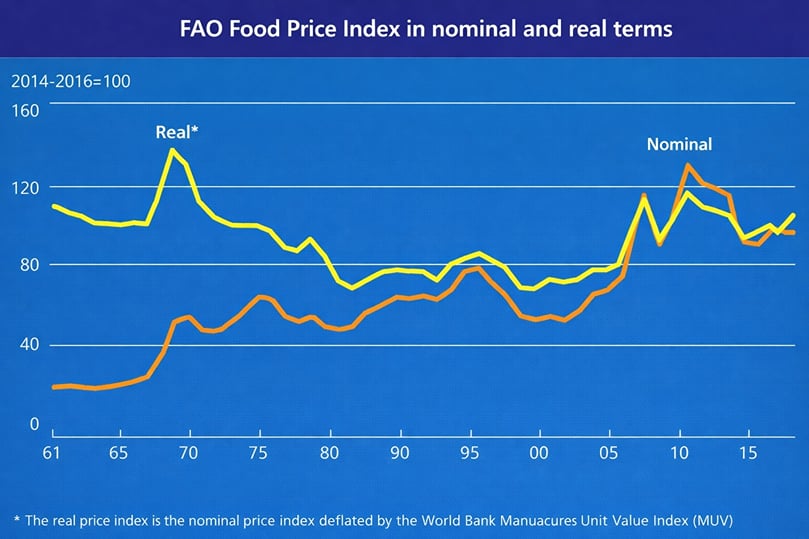
FAO Food Price Index in nominal and real terms
Like to receive news like this by email? Join and Subscribe!
Get the latest potato industry news straight to your WhatsApp. Join the PotatoPro WhatsApp Community!
Highlighted Company
Related News

September 15, 2026
Survey Finds Americans Increasingly Turn to Food Delivery and Grocery Convenience Services
A FinanceBuzz and Bank of America survey finds 63 percent of Americans use food delivery monthly, while high fees influence ordering decisions, with 68 percent abandoning a delivery order after seeing the final cost.

September 06, 2026
FAO Food Price Index rises in August amid broad-based increases, led by sugar
The FAO Food Price Index averaged 131.1 points in July 2026, up 0.7 points from its June level. Increases in the price indices for cereals, sugar and vegetable oils were partially offset by declines in those for meat and dairy products.

August 07, 2026
FAO Food Price Index edges higher in July on stronger crop prices
The FAO Food Price Index averaged 131.1 points in July 2026, up 0.7 points from its June level. Increases in the price indices for cereals, sugar and vegetable oils were partially offset by declines in those for meat and dairy products.