

During Guy Parmelin’s visit to the Herrer family farm in Wileroltigen, in the canton of Bern.
Switzerland: trials with genetically modified varieties are authorized
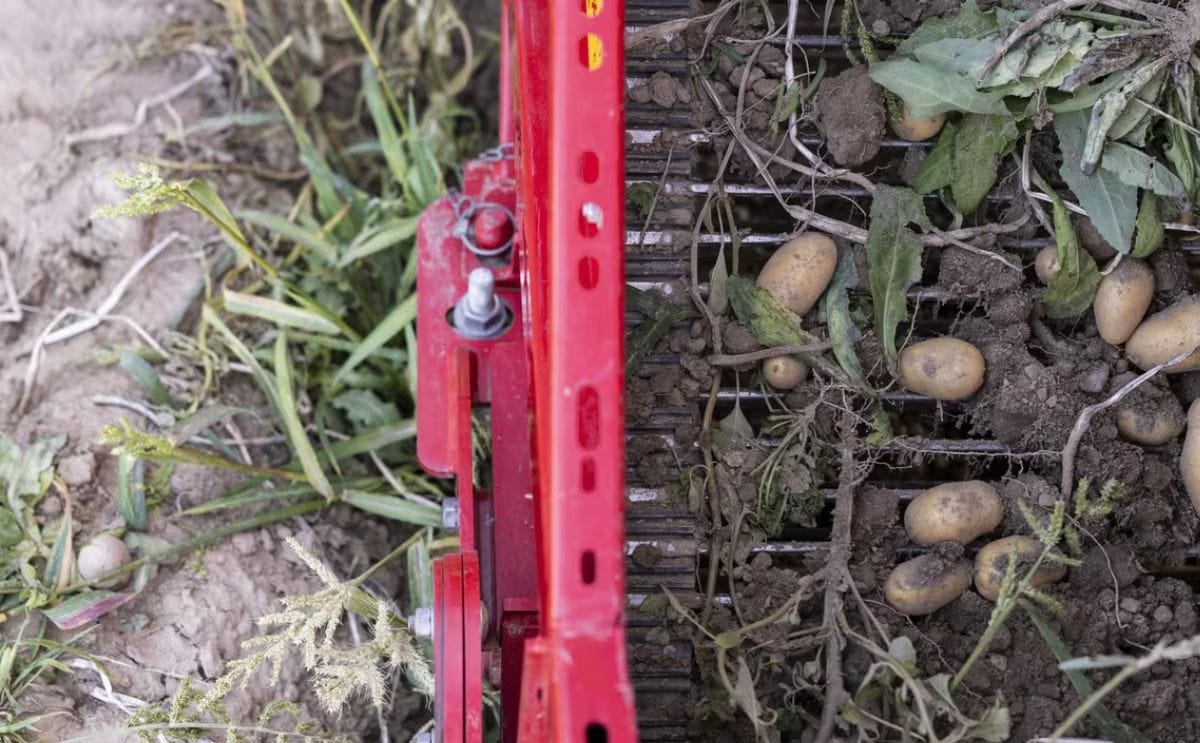
In Switzerland, 1,000 farms have stopped growing potatoes over the past ten years. As part of the international CRISPS project, Agroscope will test a cisgenic variety with greater resistance to late blight.
The Federal Office for the Environment has authorized the research center Agroscope to conduct a release trial of potatoes containing a gene resistant to a fungal disease. The Swiss Alliance for a GMO-Free Agriculture (SAG) opposes the initiative.
This gene provides greater resistance against the fungus that causes blight, according to a press release published Tuesday by Agroscope, the Swiss Federal Office for Agricultural Research. The Federal Office for the Environment (FOEN) announced Tuesday that it had approved the trial, which will run from this spring through autumn 2030 at the protected Reckenholz site in the canton of Zurich.
This gene, known as "Rpi-chc1," comes from the wild potato "Solanum chacoense." Agroscope is seeking to gather information on the field performance of an experimental potato line containing the resistance gene.
Agroscope stated that “the field trial lays the foundation for future research on potato varieties that are more resistant to diseases and more tolerant to drought and heat.”
A sharp decline in production
The center notes that in Switzerland, nearly 1,000 farms have abandoned potato cultivation over the past ten years. This is mainly due to the increase in diseases and the growing frequency of heat waves or prolonged periods of rain.
This trial is part of a series of field experiments carried out במסגרת the international CRISPS project, Agroscope explains. It focuses on cisgenic varieties, whose genes are specific to the species used, but also on varieties resulting from genome editing.
The center is working with Dutch and Swedish partners on two varieties of particular importance to Switzerland. In the coming years, it plans to repair existing resistance genes or selectively switch off susceptibility genes in these varieties before the plants are subjected to field testing.
The authority highlights the conditions imposed on the trial
The Federal Office for the Environment (FOEN) has defined certain measures that Agroscope must implement to prevent the spread of genetically modified material outside the trial plot. According to the press release, these conditions are comparable to those of previous trials conducted in Switzerland with genetically modified potatoes.
In Switzerland, the cultivation of genetically modified plants for research purposes requires authorization. Agricultural production of these plants is prohibited due to a moratorium that runs until the end of 2030.
Opponents question the relevance of the approach
The Swiss Alliance against GMOs said Tuesday in a press release that the trial lacked a scientific basis and that conflicts of interest in the application had not been disclosed. In addition, the gene used was reportedly already patented, which could make access more difficult.
The potato variety "Innovator," for which the trial was requested, “shows low to moderate susceptibility to late blight.” It is intended for French fry production, a form of industrial agriculture that, according to its critics, is neither sustainable nor resource-efficient.
Like to receive news like this by email? Join and Subscribe!
Get the latest potato industry news straight to your WhatsApp. Join the PotatoPro WhatsApp Community!
Related News

October 12, 2025
No Restart for Dutch Potato Processor CêlaVíta — Factory to Be Dismantled and Auctioned Off
CêlaVíta, the Dutch chilled potato processor once owned by McCain, will not restart after bankruptcy. All 171 jobs are lost as the Wezep factory is dismantled and auctioned, marking the end of a well-known name in potato processing.

August 13, 2025
Dutch Chilled Potato Business CêlaVíta bankrupt
Chilled Potato producer CêlaVíta has gone bankrupt. The Dutch company supplied pre-cut potatoes and pre-seasoned potato products to supermarkets, hotels, and restaurants throughout Europe.
April 30, 2025
Side Delights Offers Shoppers Healthy, Filling, Easy-to-Prepare Potato Options for French Fries at Home
Fresh Solutions Network® (FSN) offers shoppers a way to prepare healthy steak fries and potato wedges at home with Side Delights
Sponsored Content
Latest News




Sponsored Content
Sponsored Content
Sponsored Content


Sponsored Content