
Ashley Wagenaar, ag relations director, PGA, stands with Dr. Diksha Singla, post-doctoral fellow, APHTC
Canadian Researchers Use Infrared Imaging to Detect Glycoalkaloids in Potatoes Without Damage

In Canada, potatoes are the fifth-largest primary agricultural commodity and one of the most extensively cultivated vegetable crops. At the Advanced Post-harvest Technology Centre (APHTC) within Lethbridge Polytechnic’s Centre for Applied Research, Innovation and Entrepreneurship (CARIE), researchers are working to ensure every potato reaching consumers meets high food safety standards.
Potatoes naturally produce a defence compound called total glycoalkaloids (TGA), which helps protect the plant from environmental threats. In most cases, TGAs remain within safe limits, but at levels higher than around 200 mg/kg, as set by Health Canada, they can pose potential health risks.
Testing potatoes under light exposure
Diksha Singla, post-doctoral fellow at APHTC:
"Most potatoes are stored in cool, dark conditions, but sometimes they are displayed in grocery stores with significant light exposure, which can lead to increased levels of TGA. Previously, the only way to test potatoes for TGA was to look for greening or cut them open, damaging the product and making it unmarketable."
To better understand and detect TGA levels, Singla and her team stored more than 200 Yukon Gold potatoes under continuous light for up to 14 days, simulating improper storage conditions. TGA levels were measured using high-performance liquid chromatography, a traditional but time-consuming and destructive testing method.
The research team then applied short-wave infrared hyperspectral imaging to scan each potato and develop a predictive model capable of estimating TGA levels without damaging the produce. The resulting model achieved a predictive accuracy of 72 percent for Yukon Gold potatoes.
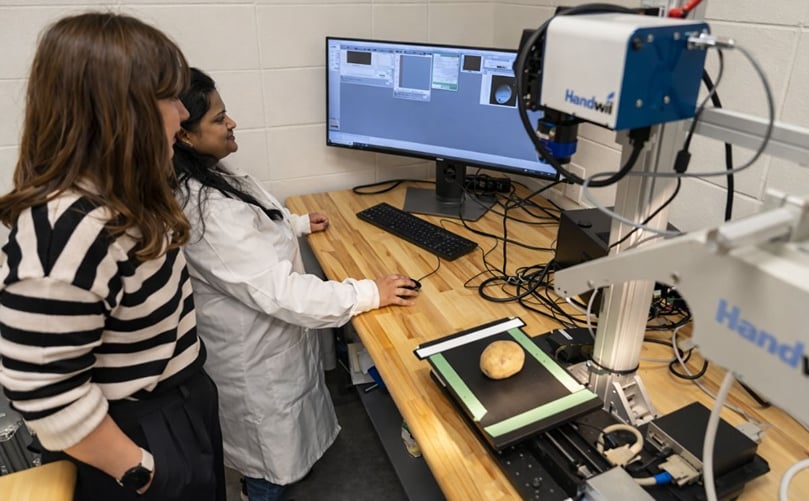
Researchers at Lethbridge Polytechnic working on non-destructive testing methods to detect glycoalkaloid levels in potatoes
Diksha Singla, post-doctoral fellow at APHTC:
"Seventy-two percent accuracy is not perfect, but it demonstrates the potential of infrared imaging as a faster, scalable screening tool for producers. This approach can help producers identify risks earlier, reduce unnecessary crop destruction and remove problem potatoes before they reach the market."
Potential for improving food safety in the supply chain
The study also revealed that in some cases TGA levels peaked after just seven days of light exposure rather than fourteen. Researchers suggest prolonged exposure may trigger structural changes in potatoes, including cellular aging and increased dehydration.
Diksha Singla, post-doctoral fellow at APHTC:
"Our research reinforces the importance of proper storage. While paper or plastic-bagged potatoes provide some protection from light, bulk storage under bright conditions can accelerate greening and potential TGA increases."
Researchers are now exploring how hyperspectral imaging technology could be implemented as a practical tool for producers and processors. Although the technology involves initial investment costs, it may offer long-term benefits by streamlining testing procedures and improving food safety across the potato supply chain.
Ashley Wagenaar, Ag Relations Director at the Potato Growers of Alberta (PGA):
"As one of the involved industry partners, the Potato Growers of Alberta value our partnership with Lethbridge Polytechnic. We are proud to support research that enhances every step of potato production. This work reflects our shared dedication to producing healthy, premium potatoes in Alberta for Canada and international markets."
Diksha Singla, post-doctoral fellow at APHTC:
"We look forward to further advancing research in this field. Our goal is to support Canadian potato growers with innovative tools that protect both consumer health and crop value."
Like to receive news like this by email? Join and Subscribe!
Get the latest potato industry news straight to your WhatsApp. Join the PotatoPro WhatsApp Community!
Highlighted Company

Related News

October 10, 2026
EarthFresh Butter Potatoes Reach More Than 4 Million Households as Retail Demand Surges
EarthFresh Butter Potatoes are gaining momentum across North America, reaching over 4 million households. With acreage up 40% and 100% incremental sales, the premium lineup offers retailers new opportunities to grow the potato category.

October 08, 2026
ICAR-CPRI Potato Varieties Cover Nearly 75% of India’s Potato Area
ICAR-CPRI's Kufri Jyoti, Kufri Bahar, Kufri Pukhraj and Kufri Chipsona-1 together cover nearly 75% of India's potato cultivation area. The varieties have boosted productivity, farmer incomes and the potato processing sector.

October 06, 2026
Dutch Potato Organisation Celebrated Potato Tuesday at Utrecht Central Station on October 6
The Dutch Potato Organisation celebrated Potato Tuesday on October 6 at Utrecht Central Station during the Week of Our Food. Visitors can enjoy free recipe booklets and discover the people behind the Dutch potato industry.