
Packaging Materials in the Potato Industry: Why the Right Material Matters
Every potato that leaves a farm travels in some kind of package: a wooden box in the store, a jute sack on a seed lorry, a 2 kg paper bag on a supermarket shelf, a nitrogen-filled bag of crisps or a case of frozen fries in a reefer container. With world potato production at about 390 million tonnes in 2024, choosing the right packaging materials in the potato industry affects quality, food waste, transport cost and, increasingly, legal compliance.
Fresh and processed potatoes need almost opposite things from their packaging. A fresh tuber is alive: it breathes, loses water and turns green under light, so its package must let air through while limiting light and damage. A potato chip or a frozen fry is no longer alive but it is fragile, oily or frozen, so its package must keep out oxygen, moisture and light, or survive −18 °C and rough handling. Dehydrated flakes and potato starch, finally, are dry powders that must stay dry.
This article explains the main potato packaging materials, their technical properties and best uses, the regulations that apply in major markets, the companies that make them and the business opportunities for suppliers. It complements the PotatoPro overview of potato packaging equipment, which covers the machines that fill and close these packs.
Key Facts: Potato Packaging Materials
The table below summarises the figures most often needed when comparing potato packaging, with the source for each.
| Item | Figure | Source / note |
|---|---|---|
| World potato production | About 390.4 million t (2024) | FAOSTAT via Potato News Today |
| Frozen potato export value | US$7.7 bn (2019) to US$13.2 bn (2024) | Rabobank World Potato Map |
| Standard foodservice fries case | 4 × 2.5 kg; 10.30 kg gross for 10.00 kg net | McCain case data |
| EU retail frozen fries film (Lamb Weston) | 55 µm mono-PE, about 10 g per bag | Packaging World |
| Measured chip bag barrier | WVTR 0.2 g/m²/day; OTR 45 cm³/m²/day/bar | Ibrahim et al. |
| Ventilated big bags for potatoes | 500 to 1,500 kg capacity | LC Packaging |
| EU ban on single-use plastic for fresh produce under 1.5 kg | From 1 January 2030, with exemptions | AGRINFO, Regulation (EU) 2025/40 |
| UK Plastic Packaging Tax | £228.82 per tonne from 1 April 2026 (below 30% recycled plastic) | GOV.UK |
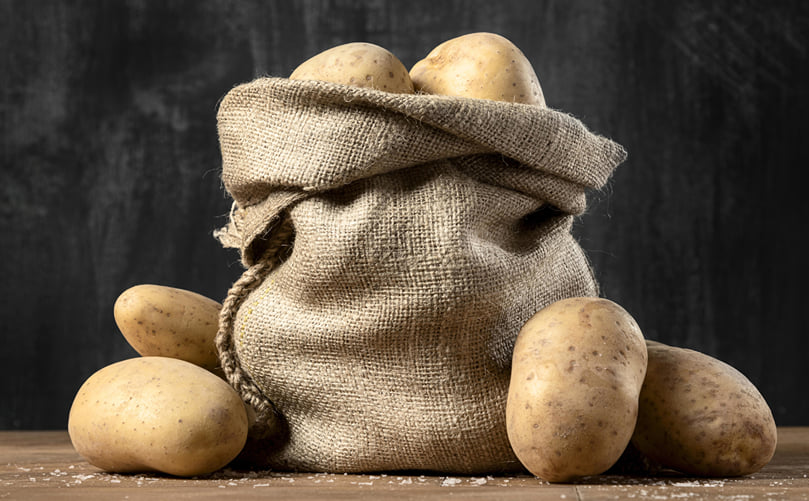
Fresh potatoes in a hessian (jute) sack. Breathable natural-fibre sacks are still used for seed potatoes, exports and premium table potatoes; suppliers of potato packaging materials offer jute alongside woven PP, mesh and paper.
The Role of Packaging Materials Across the Potato Value Chain
Protection from physical damage: Potatoes bruise when they drop or are squeezed. Sacks, boxes and crates spread loads and limit movement, while snack bags use a cushion of gas to protect fragile chips. Frozen fries fall several metres into the bag on a packing line, so the film must resist puncture at low temperature.
Moisture and gas control: Fresh potatoes lose water and give off heat and carbon dioxide. If the package traps moisture, condensation leads to rot; if it breathes too freely in dry air, tubers shrivel. Processed products work the other way round: chips go stale and rancid when they take up moisture and oxygen, which is why most industrially produced chips in Egypt are packed in BOPP bags under nitrogen, as in most other markets.
Light protection: Light makes potatoes turn green and form glycoalkaloids. Norwegian researchers found that none of seven tested packaging materials gave enough light protection for Folva potatoes under retail lighting, so packaging, display temperature and stock rotation all matter.
Contamination and food safety: Packaging keeps soil, pests and foreign bodies away from washed or processed product. For processed foods, the material itself must be food-contact compliant so that inks, adhesives or additives do not migrate into the food.
Storage, transport, retail and export: Packaging turns loose produce into handling units that fit pallets, containers and shelves. Export shipments add new demands: longer journeys, temperature control, phytosanitary checks and buyer labelling rules.
Changing expectations: Shoppers want to see the potatoes they buy, retailers want less plastic and regulators now set recyclability and recycled-content targets. The EU Packaging and Packaging Waste Regulation, which applies from 12 August 2026, is the clearest example and also covers packaging supplied by exporters outside the EU.
Fresh Versus Processed Potato Packaging
The main differences between packaging for fresh and processed potatoes are summarised below.
| Aspect | Fresh and seed potatoes | Processed potato products |
|---|---|---|
| Product state | Living tuber that respires | Cooked, fried, frozen or dried product |
| Main threats | Bruising, greening, condensation, sprouting, rot | Oxidation, moisture pickup, breakage, freezer damage |
| Packaging must | Breathe, limit light, carry weight | Act as a barrier, seal tightly, run on fast machines |
| Typical materials | Woven PP, mesh, jute, paper, PE combo bags, big bags, boxes, crates | Metallised BOPP laminates, mono-PE films, barrier paper, multiwall sacks, FIBCs |
| Typical pack sizes | 1–5 kg retail; 10–50 kg sacks; 0.5–1.5 t big bags and boxes | 20–200 g snack bags; 0.6–2.5 kg fries bags; 20–25 kg sacks; 1 t big bags |
Types of Packaging Materials Used in the Potato Industry
Each material family has its own composition, manufacturing route and best uses. The diagram groups them by the product they mainly serve; the sections below describe each one in turn.
Classification of the main packaging materials used for fresh and processed potato products. Chart: PotatoPro, based on supplier product data from LC Packaging, Volm Companies and processor packaging specifications cited in this article.
Polypropylene (PP) Packaging: Woven and Laminated Bags
Composition and manufacture: Woven PP bags are made from polypropylene film that is slit into narrow tapes, stretched to orient the polymer and woven on circular or flat looms into fabric. The fabric is then printed, cut and sewn. Laminated PP bags have a printed BOPP film bonded to the woven fabric, which improves graphics and moisture resistance but reduces airflow.
Applications: Unlaminated woven and leno PP sacks are widely used for ware and seed potatoes in 10–50 kg sizes, especially in South Asia, Africa and Eastern Europe. In India, manufacturers such as Singhal Industries in Gujarat supply PP woven bags, jumbo bags and leno mesh bags for potato farmers and distributors. Woven PP is also the fabric used for big bags (FIBCs).
Advantages: High tensile strength for its weight, low cost, resistance to rot and the option of UV stabilisation for outdoor storage. Woven PP sacks can be reused several times if they stay clean.
Limitations: Plain woven PP gives little light protection, and laminated bags restrict ventilation, so they are less suited to long storage of fresh tubers. Used sacks are often contaminated with soil, which complicates recycling.
The animated diagram shows how woven PP sacks are produced, from granules to finished bags.
Simplified woven PP sack production process; the highlight steps through each stage. Chart: PotatoPro. Machinery for tape extrusion, weaving and conversion is supplied by companies such as Starlinger.
Jute and Burlap Packaging
Composition: Jute is a natural bast fibre grown mainly in India and Bangladesh. Hessian (burlap) fabric is plain-woven from jute yarn. Bags for food are processed with vegetable oil rather than mineral batching oil; a Swiss supplier, for example, lists its potato jute bags in VOT (vegetable oil treated) leno-bound fabric of 140 g/m².
Breathability and moisture management: Jute breathes well and absorbs some moisture, which can buffer condensation in storage. It is also biodegradable.
Applications: Jute remains common for seed potatoes and premium or export ware. At the Dutch seed grower Schuiling, orders for jute bags of 25 and 50 kg are the most common on its automated packing line. Bangladesh’s SME Foundation notes that hessian bags are used to pack potato, onion, garlic and other vegetables.
Limitations: Jute is heavier and usually more expensive than PP, varies in quality and can shed fibres; the Idaho Potato Commission notes that buyers moved retail packs from burlap to mesh partly because burlap sheds fibers. Its commercial relevance today is strongest where a natural, plastic-free image adds value.

Printed jute sacks of 5, 10 or 25 kg with a sewn-on traceability label, offered by Dutch packer Nedato. Image: Nedato, from the Nedato jute sack product listing.
Mesh and Net Bags
Types: Raschel mesh is knitted from PE or PP monofilament or tape; leno mesh is woven with twisted warp threads that lock the weft; extruded tubular netting is formed directly from molten polymer. Mesh can be combined with printed film bands, labels or clips.
Retail use: Mesh bags give the best airflow and let shoppers see the potatoes. The Spanish group Giro, founded in 1925, says that using mesh for packaging potatoes and oranges emerged in 1958, and its Girsac mesh bag with printed film followed in 1987; it now produces over 1.4 billion metres of tubular mesh a year. Large-format 25 kg net bags are used for wholesale and export.
Ventilation, visibility and handling: Mesh is light: Giro Pack’s lightest welded mesh bag weighs about 3 g of plastic and suits potatoes. The weakness is light: open mesh offers almost no protection against greening, so mesh suits fast-moving stock, cool displays or products sold quickly.
Paper-Based Packaging
Kraft paper bags: Two- or three-ply kraft paper bags, plain or with a mesh window, are long established in North America and Ireland and are growing in Europe. LC Packaging UK, for example, offers 10 kg two-ply and 25 kg three-ply wet-strength paper potato bags.
Paper-based retail packaging: Mondi, Silbo and Meade Farm Group developed an FSC-certified potato bag with a bio-based Sustainex coating and a corn-starch netting window; the pillow pack uses 34% less paper than a block-bottom paper bag of similar size.
Moisture resistance and strength: Paper weakens when wet and its seams can tear when potatoes drop from height; Dutch packers told FreshPlaza that the seams, not the window or holes, are the weak point. Wet-strength grades and coatings help but can affect recyclability.
Recyclability: Paper is widely collected. National rules differ on how much non-paper material a pack may contain and still count as paper: FreshPlaza reports a 15% threshold in Belgium and 5% in the Netherlands. Paper also blocks more light than mesh or clear film, which helps against greening.
Multiwall paper sacks: For dehydrated potato products and starch, multiwall sacks of two or three kraft plies with a PE liner are standard. USDA specifications for dehydrated potatoes describe 20 kg pinch-bottom multiwall bags with an HDPE liner placed between the paper plies.
Perforated paper and film for VFFS lines: Packaging agent VDH Concept in Belgium offers SQ Pack paper film on a roll with net-structure perforations for potatoes and onions, alongside compostable and part-recycled film versions; the company says the small holes let the product breathe and extend shelf life.

Paper-Based Potato Packaging Solutions and Moisture-Resistant Kraft Bags
Corrugated Cardboard and Cartons
Corrugated fibreboard: Corrugated board consists of fluted paper glued between liners. Board grade and flute profile determine compression strength.
Ventilated cartons and export: Vented boxes are used for premium washed potatoes, baby potatoes and export, and for sweet potatoes; Smurfit Westrock designed a custom box and logistics solution that let Peru’s Naturagro export sweet potatoes to Spain and Portugal.
Processed products: Corrugated cases are the standard secondary pack for frozen fries and snacks. An Aviko specification lists a regular slotted corrugated box of 393 × 261 × 210 mm for skin-on fries.
Compression, stacking and protection: Corrugated stacks well and prints well but loses strength in humid or wet conditions. It is single-use in most potato applications, which is why reusable crates compete with it in retail distribution.
Flexible Plastic Films: PE, PP, BOPP and Multilayer Structures
Polyethylene (PE): LDPE and LLDPE films are soft, tough and seal well; HDPE is stiffer. Perforated PE bags are used for fresh potatoes, and PE is the main film for frozen fries because it stays tough at freezer temperatures.
Polypropylene and BOPP: Biaxially oriented polypropylene is stiff, clear and has a better moisture barrier than PE. Cosmo Films, for example, lists BOPP films for multilayer laminates for snack foods and potato chips.
Metallised films: Aluminium vacuum-deposited onto BOPP or PET adds a light barrier and lowers gas and moisture transmission. A typical chip bag laminates printed BOPP to metallised BOPP; a US patent describes the common structure as a 20 µm BOPP film laminated to a 20 µm metallised BOPP film.
Applications: Metallised BOPP laminates are used for chips and crisps; mono-PE films for retail and foodservice frozen fries; perforated PE and light-blocking films for fresh potatoes. Multilayer flexible packaging combines layers for print, barrier and sealing, but mixing materials makes recycling harder.

A printed potato chips pillow bag beside an unprinted bag of the same format. Chip bags are usually printed BOPP laminated to metallised BOPP, sealed on vertical form-fill-seal machines and flushed with nitrogen.
High-Barrier Packaging Materials: PET, PA, EVOH and Aluminium Foil
PET: Biaxially oriented PET is strong and heat resistant and is often the outer layer of barrier laminates. Metallised PET gives a higher barrier than metallised BOPP.
Polyamide (PA): Oriented nylon resists puncture and blocks oxygen well when dry, but lets moisture through: a 15 µm Jindal BOPA film is listed at an OTR of 55 and a WVTR of 280.
EVOH: Ethylene vinyl alcohol is one of the best oxygen barriers when dry, with a normalised OTR of about 0.1–0.2 cm³/m²/day for 25 µm film, but it absorbs moisture, so it is buried between PE or PP layers.
Aluminium foil: Foil without pinholes is an almost complete barrier to gas, moisture and light. It is used in some snack and dehydrated potato pouches but is costly and hard to recycle in laminates, so many brands replaced it with metallised films.
Use in potato products: High-barrier structures matter most for products with long shelf lives or high fat, such as some snacks and dehydrated potato pouches. Frozen fries rarely need an oxygen barrier because low temperature slows oxidation.
Rigid Plastic Packaging: Crates, Bins and Containers
Reusable plastic crates (RPCs): Folding, stackable HDPE or PP crates move bagged or loose potatoes from packer to store and are washed and reused. In the US, Whole Foods Market and IFCO {ext(U["ifco_wfm"], "piloted reusable crates for potatoes, onions, carrots and root vegetables", "FreshPlaza: IFCO and Whole Foods")} before expanding the programme.
Bulk handling containers: Injection-moulded vented bins are used for harvest and storage. IPL Schoeller describes its MacroBin 48-FV as ideal for commodities such as potatoes that require a moisture-free storage environment. In Europe, plastic pallet boxes such as Schoeller Allibert’s Maxipac compete with traditional wooden boxes.
Ventilated storage containers and industrial distribution: Wooden and plastic pallet boxes of 1–2 t remain the backbone of box stores. Rigid containers are expensive to buy and need return logistics, but their cost spreads over many years of use.
The comparison below shows how these materials differ on airflow, light protection, barrier, strength and reuse.
Qualitative comparison of potato packaging materials. Ratings are relative PotatoPro assessments based on supplier data and research cited in this article, not test results. Chart: PotatoPro; sources include Volm, LC Packaging and Nofima.
Matching Packaging Materials to Potato Products
Packaging materials are not interchangeable: a mesh bag that keeps fresh potatoes healthy would ruin crisps in days, and a nitrogen-flushed barrier bag would suffocate living tubers. The table matches common materials to each product.
| Product | Common packaging materials | Main packaging requirements | Typical applications |
|---|---|---|---|
| Fresh table potatoes | Paper bags with window, mesh, perforated or light-blocking PE, combo bags; 10–25 kg sacks; RPCs and cartons | Ventilation, light protection, bruise protection, visibility, branding | 1–5 kg retail packs; foodservice sacks; supermarket crates |
| Seed potatoes | Jute and mesh bags of 25–50 kg, ventilated big bags, wooden or plastic boxes | Breathability, strength, clear lot labelling and traceability | Domestic seed sales and seed exports |
| Processing potatoes | Bulk trailers, wooden and plastic boxes, big bags | Low handling cost, bruise control, ventilation in store | Delivery from farm or store to chip, fry, flake and starch plants |
| Potato chips and crisps | Metallised BOPP laminates, mono-PP structures, paper-based packs, composite paper tubes | Oxygen, moisture and light barrier; seal integrity; nitrogen flushing; print quality | 20–200 g bags, multipacks, stackable tubes |
| Frozen French fries | Mono-PE films (HDPE/mLLDPE), barrier paper bags, corrugated cases | Cold toughness, puncture resistance, moisture barrier, reliable seals at speed | 0.6–1 kg retail bags; 2–2.5 kg foodservice bags in 4–5 bag cases |
| Dehydrated potato flakes | Multiwall paper sacks with PE liner, PE big bags, bulk | Moisture barrier, dust-tight closure, strength for stacking | 10–20 kg sacks for food manufacturers |
| Potato granules | Multiwall sacks, pouches packed in cartons | Moisture and oxygen protection for long storage | 20 kg sacks; 1.36 kg pouches, ten per carton |
| Potato starch | Multiwall paper sacks with PE lining, FIBCs, bulk tankers | Dry, clean, dust-tight; food or industrial grade | 25 kg sacks; 1,000–1,200 kg big bags |
The reasons lie in product behaviour. Fresh and seed potatoes respire, so packaging must exchange gases. Chips are high in fat and very dry, so moisture and oxygen are their enemies; research on potato snacks concluded that the best solution was metallised packaging combined with nitrogen, because neither barrier nor modified atmosphere alone gave satisfactory results. Frozen fries depend mainly on the cold chain, so the bag’s job is mechanical: survive filling, freezing and handling.
Dehydrated products and starch absorb moisture from the air. USDA requirements specify 20 kg bags for potato flakes and allow granules in 1.36 kg pouches packed ten per carton, while Emsland lists its flakes in a 3-layer paper bag with PE inliner, PE big bag or in bulk. Agrana ships potato starch in multiply paper bags of 25 kg with PE lining, 30 bags per pallet.
Key Technical Properties of Potato Packaging Materials
Buyers compare packaging materials on a handful of measurable properties. The table explains each one, its usual unit and why it matters for potatoes.
| Property | What it means and how it is measured | Why it matters for potatoes |
|---|---|---|
| Mechanical strength | Tensile strength and elongation (MPa, %); for sacks, safe working load; for cartons, box compression strength | Sacks and big bags carry 25 kg to 1.5 t; cases are stacked on pallets for weeks |
| Tear and puncture resistance | Force to start or propagate a tear; resistance to dart or probe puncture | Frozen fries and sharp-edged chips can pierce film; jute and paper seams must not split when dropped |
| Moisture vapour transmission rate (WVTR) | Grams of water vapour passing through 1 m² per day, typically at 38 °C and 90% RH (ASTM F1249) | Chips go soft above a few percent moisture; flakes and starch cake; fresh potatoes lose weight |
| Oxygen transmission rate (OTR) | Cm³ of oxygen through 1 m² per day, typically at 23 °C and 0% RH (ASTM D3985) | Oxygen drives rancidity in chips; fresh tubers need oxygen to respire |
| Gas permeability | Transmission of O₂, CO₂ and N₂; for fresh produce, set by perforation size and number | Perforated films can create a modified atmosphere that slows respiration and greening |
| Light protection | Visible and UV light transmission (%) | Light causes greening and glycoalkaloid formation in tubers and rancidity in fried snacks |
| Thermal resistance | Behaviour at freezer temperatures, sealing temperature range, heat resistance near fryers | Fries films must stay tough at −18 °C; seals must form quickly on fast lines |
| Food-contact safety | Compliance with migration limits and declarations of compliance under national law | Processed potato products are in direct contact with films, inks and adhesives |
| Printability | Ink adhesion, print resolution, surface treatment | Branding, nutrition and allergen labels, batch codes, recycling labels |
| Recyclability | Compatibility with collection, sorting and recycling streams; mono-material design | Required by EU rules from 2030 and by many retailers already |
Barrier values vary by orders of magnitude between materials, so they are best compared on a log scale. A 25 µm acrylic-coated BOPP film, for instance, has an OTR of 850 and a WVTR of 5, while a high-barrier metallised OPP is listed at 0.1 for both. The chart compares typical values from manufacturer data sheets and a published test on chip bags.
Typical transmission values from manufacturer data sheets and published tests; actual values depend on grade, thickness, conversion and test conditions. The chip-bag value is OTR per bar and conditions may differ. Chart: PotatoPro, data from Jindal Films, Jindal Nylon Films, Ibrahim et al. and Packaging Warehouse.
Light protection deserves special attention for fresh potatoes. In Michigan State University tests commissioned by Volm Companies, light-blocking bags blocked more than 99.5% of visible and UV light and extended Russet shelf life by 12 to 17 days on weight loss compared with ordinary poly and paper bags. The Norwegian study cited above went further and suggested that packaging for Folva potatoes should aim for a total light transmittance below 0.02 W/m² to avoid greening at 20 °C, a level none of the tested materials reached.
Inside a snack bag, each layer has a defined role. The cross-section below shows a typical chip laminate and a mono-PE frozen fries film.
Simplified cross-sections of a potato chip laminate and a mono-material PE frozen fries film; layer thicknesses not to scale. Chart: PotatoPro, based on USPTO patent 11607864, Jindal Films data, Paik et al. (1994) and Packaging World.
Primary, Secondary and Tertiary Packaging for Potatoes
Primary packaging is in direct contact with the product: a retail potato bag, a crisp packet, a 2.5 kg fries bag or a 25 kg starch sack. It carries most of the protective and food-contact requirements.
Secondary packaging groups primary packs for handling and display: crates, shelf-ready trays and corrugated cases. A McCain 4 × 2.5 kg fries case measures 391 × 290 × 252 mm and weighs 10.30 kg gross for 10.00 kg net, so packaging adds about 3% to the shipped weight.
Tertiary packaging creates the transport unit: pallets, stretch wrap, corner boards, slip sheets and pallet labels. Big bags and pallet boxes can serve as both primary and tertiary packaging for bulk potatoes.
The flow diagram shows how the three levels build up for frozen fries and for fresh table potatoes.
Packaging levels for frozen fries and fresh table potatoes. Chart: PotatoPro, based on McCain case data, an Aviko product specification and fresh-produce supplier data.
Packaging Requirements Along the Potato Supply Chain
Packaging needs change at every step from field to consumer. The flowchart traces typical materials at each stage; the notes below explain what changes and why.
Typical packaging at each stage of the potato supply chain; practices vary by country and company. Chart: PotatoPro, based on sources linked in the popups, including USDA dehydrated potato requirements and LC Packaging.
Farm-Level Handling and Potato Storage: At harvest, the priority is gentle, low-cost handling of large volumes. Potatoes go into bulk trailers or pallet boxes; French manufacturer Barbarie Palox, for example, lists wooden potato boxes of 160 × 120 cm holding about 1,250 kg of ware or 1,300 kg of seed potatoes. Polish manufacturer Inter Agra builds spruce potato boxes of up to 2 tonnes and NL Standard boxes for ventilated stores, with an expected life of 15 years or more. In storage, packaging must allow ventilation through the pile or box stack, resist humidity and be cleanable between seasons to limit disease carry-over.
Potato Packhouses and Fresh Distribution: Potato packers wash or brush, grade and pack tubers into consumer bags and sacks. Here packaging must run on weighers and baggers, carry brand and legal information, and protect against greening during distribution and display. Ventilated big bags of 500 to 1,500 kg carry loose potatoes to repacking plants, while retail packs travel in crates or cartons.
Potato Processing and Frozen Potato Production: Processing plants receive potatoes in bulk and switch to barrier and food-contact packaging after cooking. Chip lines feed multihead weighers and vertical form-fill-seal machines with metallised film; multi-head weighers portion fries into PE bags that are then cased, palletised and frozen. Film must run at high speed: Lamb Weston notes that its fries drop several metres into the bag during packaging, which the thinner film still had to withstand.
Retail, Wholesale and International Exports: At retail, packaging must look good, show freshness and carry recycling and origin labels. For exports, packaging must protect products over long journeys and meet buyer and importing-country requirements. Strong export growth makes this stage important: frozen potato export value rose from US$7.7 billion in 2019 to US$13.2 billion in 2024, and India alone exported 181,773 t of frozen fries in the year to February 2025.
The chart sets these export figures alongside other volumes that depend on transport packaging.
Frozen potato export value 2019–2024 (Rabobank) and selected export volumes; periods differ by series as labelled. Chart: PotatoPro, data from Rabobank via FreshPlaza, EUPPA, EastFruit and PotatoPro.
How to Choose Potato Packaging Materials
No single material is best for every potato product. The table summarises the main selection factors and how each one changes the choice.
| Factor | Key questions | Effect on material choice |
|---|---|---|
| Potato product type | Fresh, seed, chips, fries, flakes or starch? | Breathable materials for fresh and seed; barrier films and sacks for processed products |
| Required shelf life | Days, weeks or months? | Longer shelf life calls for higher barrier (metallised, EVOH, foil) or light-blocking films |
| Storage temperature and humidity | Ambient, cool store or frozen? Humid? | Frozen needs cold-tough PE; humid stores weaken paper and corrugated board |
| Transport distance | Local, national or export? | Long routes need stronger cases, pallet stability and sometimes higher barrier |
| Product weight and pack size | 100 g, 2.5 kg, 25 kg or 1 t? | Heavy packs need woven PP, jute or FIBCs; small packs use films and paper |
| Machinery compatibility | Will it run on existing baggers, VFFS and case erectors? | Paper and new mono-materials may need machine changes or slower speeds |
| Material availability | Is there local supply and stable lead time? | Imported films and paper add cost and risk; local woven PP and crates are easier to source in many markets |
| Packaging cost | Price per pack, per tonne of product and over the life of reusable items | Reusable crates and bins cost more upfront but less per trip |
| Consumer preferences | Do buyers want visibility, plastic-free or premium looks? | Windows, paper and natural fibres for premium; clear film or mesh for visibility |
| Environmental considerations | Is the pack recyclable where sold? Recycled content? | Mono-materials, paper, reusable systems; avoid mixed laminates where possible |
| Export regulations | What do the destination’s packaging, food-contact and labelling rules require? | EU PPWR, food-contact and labelling rules apply to imported packed food |
Sustainable Potato Packaging: Options, Limits and Real Examples
Sustainability claims are often mixed up. For potato packaging the main terms mean different things, and the difference matters both legally and technically.
| Term | Meaning | Potato packaging example | Main caveat |
|---|---|---|---|
| Recyclable | Can be collected, sorted and recycled into new material at scale | Mono-PE fries bags, paper potato bags, PP crates | Only if collection and sorting exist where the pack is sold |
| Biodegradable | Broken down by microorganisms over time; no fixed time or conditions | Jute sacks, untreated paper | Not a disposal route in itself; conditions and time vary widely |
| Compostable | Breaks down under defined composting conditions within a set time (for example EN 13432 for industrial composting) | Compostable paper potato bags with starch-based windows | Needs industrial or home composting, depending on certification |
| Bio-based | Made partly or wholly from renewable carbon | Sugarcane-based mesh; bio-circular PE from used cooking oil | Says nothing about end of life |
| Recycled content | Contains post-consumer or pre-consumer recyclate | Recycled PET or PE in secondary packs | Food-contact use is tightly regulated |
| Reusable | Designed for many trips in a return system | RPCs, plastic bins, pallet boxes, reconditioned big bags | Needs return logistics, washing and pooling |
Recyclable Mono-Material Packaging
For snacks, brand owners are moving from mixed laminates to mainly PP structures. PepsiCo Europe, with Amcor, redesigned its crisp bags to contain greater proportions of recyclable plastics like polypropylene and set a goal of eliminating virgin fossil-based plastic in its European snack bags by 2030. For frozen products, Coveris markets recyclable mono-material PE films for frozen applications, and Lamb Weston’s EU retail fries bag is a mono-material multilayer PE film.
Paper-Based Alternatives
Paper is replacing plastic in several potato formats. Lamb Weston introduced a recyclable paper bag for US foodservice fries in summer 2024 that is designed to pass OCC paper-recycling acceptance testing. Kellanova invested £86 million to move Pringles to a tube made from 90% paper with a paper base, launched in UK Tesco stores in January 2024. In crisps, British Crisp Co launched a paper packet combining paper, Aquapak’s Hydropol and a thin vacuum-deposited aluminium layer, as reported by edie.
The limits are real: paper needs coatings for grease and moisture, seams are weak points and runs on form-fill-seal machines can be slower. Paper-based packs with more than 5% plastic are still caught by the EU ban on single-use plastic packaging for fresh produce under 1.5 kg.
Compostable, Biodegradable and Bio-Based Materials
Giro offers a cellulose mesh bag that is paper based and plastic free, although it costs more than plastic mesh and runs slightly slower: up to 30 bags per minute for 1 kg packs on its cellulose kit. In North America, Arrowfarms introduced two-ply paper potato bags with a compostable sugar-cane mesh window. Volm’s CLAF Bio Fabric mesh contains 96% bio-based content made from sugarcane resins and is compatible with the PE recycling stream.
Potatoes themselves supply packaging ingredients. Avebe makes potato-starch barrier films and adhesives; its PerfectaFILM provides oil and grease resistance without PFAS or fluorochemicals, which matters as PFAS rules tighten.
Recycled Content, Lightweighting and Reusable Transport Packaging
Lightweighting is often the cheapest saving: Lamb Weston reduced its EU retail film from 70 to 55 microns, a 20% material saving, combined with at least 60% bio-circular PE, for a 30% lower carbon footprint.
Reusable transport packaging is well proven for fresh potatoes. A Fraunhofer study for the reusable-crate foundation SIM found that reusable crates emitted 60% less CO₂e than single-use cardboard boxes, with the advantage starting from the sixth use; corrugated-industry studies reached different conclusions, and Fraunhofer’s 2022 review recommends transparent, comparable parameters for such life-cycle assessments. Reconditioning services for big bags can cut the number of new bags needed by up to 40%, according to LC Packaging.
Technical challenges remain: mono-materials can have lower barrier or stiffness, paper needs coatings, compostables need composting infrastructure and recycled content is limited in food contact. Costs are usually higher at first, and recycling infrastructure for flexible films is still patchy in most countries.
Packaging Regulations and Food Safety Standards for Potato Products
Packaging rules differ by country and change often. The timeline shows selected milestones; the sections below explain what they mean in practice. Rules from one market should not be treated as global requirements.
Selected regulatory and standards milestones relevant to potato packaging; check national rules and later amendments before acting. Chart: PotatoPro, based on EUR-Lex, FDA, GOV.UK, FSSAI and IFPA.
European Union: Food-Contact Materials
All food-contact materials sold in the EU must comply with the framework Regulation (EC) No 1935/2004, which requires that materials do not transfer substances to food in quantities that endanger health or change the food unacceptably, and with good manufacturing practice under Regulation (EC) No 2023/2006. Plastic layers fall under Regulation (EU) No 10/2011, which sets authorised substances, overall and specific migration limits and the declaration of compliance that must accompany materials through the supply chain.
BPA is now restricted under Regulation (EU) 2024/3190. Most single-use articles made with BPA could be placed on the market until 20 July 2026, but articles for preserving fruit and vegetables, such as cans for preserved potatoes, have a transition period to 20 July 2028.
European Union: Packaging and Packaging Waste Regulation (PPWR)
Regulation (EU) 2025/40 replaced the Packaging Directive and applies from 12 August 2026. Key points for potato businesses: PFAS limits for food-contact packaging from that date; harmonised material labels from 12 August 2028 or later, depending on implementing acts; and from 2030, packaging must reach recyclability performance grade C or better, tightening to A or B from 2038, with recycled-content minimums for plastic packaging.
Most directly, the PPWR bans single-use plastic packaging for fresh fruit and vegetables in quantities under 1.5 kg from 1 January 2030, covering nets, bags, trays and containers. Exemptions are possible where packaging is needed to avoid water loss, microbiological hazards, physical shocks or oxidation, and member states may add exemptions. EFSA is preparing a scientific opinion on implementation. This will reshape 1–1.5 kg retail potato packs.
National rules can go further. In Spain, the fruit and vegetable exporters’ association Fepex says the national Royal Decree is more restrictive than the EU regulation. France’s attempt to ban plastic packaging for most fresh produce under 1.5 kg was annulled by the Conseil d’État in November 2024 on procedural grounds.
United States: FDA Food-Contact Rules, PFAS and State EPR
In the US, packaging components are regulated as food-contact substances: they must be authorised by FDA regulations in 21 CFR, a food-contact notification, a prior sanction or a GRAS status. FDA explains the routes on its packaging and food-contact substances page. On PFAS, FDA announced on 28 February 2024 that PFAS grease-proofing substances are no longer sold for food-contact use in the US, which affects paper packaging for fries and other fried foods.
Packaging extended producer responsibility (EPR) is spreading at state level: seven states have enacted packaging EPR laws (California, Colorado, Maine, Maryland, Minnesota, Oregon and Washington). Fees already apply in Colorado and Oregon, with California’s first invoices due in January 2027.
United Kingdom: Plastic Packaging Tax and EPR
The UK Plastic Packaging Tax applies to plastic packaging components with less than 30% recycled plastic, at £228.82 per tonne from 1 April 2026, up from £200 when it started in 2022. Packaging EPR fees started in 2025; the year-one base fee for plastic was £423 per tonne, with fees modulated by recyclability from year two.
India: FSSAI Packaging Regulations
India’s Food Safety and Standards (Packaging) Regulations, 2018, govern food-contact packaging. A March 2025 amendment allowed food-grade recycled PET with a mandatory logo, and a draft of 2 November 2026 proposes chemically recycled PE and PP for food contact under conditions. Suppliers to Indian fries and snack exporters also need to meet the rules of each destination market.
Migration Testing, Labelling and Traceability
Migration testing: Food-contact films, inks and adhesives are tested with food simulants under time and temperature conditions that reflect real use, such as frozen storage for fries bags or long ambient storage for chips. Converters pass results to processors through declarations of compliance or equivalent documents.
Labelling and traceability: Packs carry batch or lot codes, best-before dates and, increasingly, recycling labels. Certified seed potatoes must carry official certification labels in most markets, including the EU. Industry body GS1 aims for retail checkouts to read 2D codes by the end of 2027 under Sunrise 2027, allowing batch and expiry data on consumer packs.
Export requirements: Importing countries may require new or clean packaging for fresh and seed potatoes, ISPM 15 treatment for wooden pallets and boxes, language-specific labels and, in the EU, packaging that meets the PPWR. Exporters should check each destination’s plant health and food rules before choosing materials.
| Market | Main rules | Practical implication for potato businesses |
|---|---|---|
| European Union | Reg. 1935/2004, 2023/2006, 10/2011; BPA Reg. 2024/3190; PPWR 2025/40 | Declarations of compliance; PFAS limits from Aug 2026; plan now for 2030 fresh-produce plastic ban and recyclability grades |
| United States | FDA food-contact rules (21 CFR, FCNs); state EPR laws | Confirm authorisation of every layer; PFAS-free grease barriers; EPR fees in seven states |
| United Kingdom | Food-contact rules retained from EU law; Plastic Packaging Tax; packaging EPR | Reach 30% recycled plastic where food rules allow; report packaging data for EPR |
| India | FSS (Packaging) Regulations 2018 and amendments; Plastic Waste Management Rules | Recycled plastics limited to approved PET for now; track 2026 draft on recycled PE and PP |
Emerging Technologies and Innovations in Potato Packaging
Some innovations are already in daily use, others are still in pilots. The table sorts them by commercial readiness and relevance to potatoes.
| Technology | Status | Relevance to potatoes | Example |
|---|---|---|---|
| Light-blocking films and combo bags | Commercial | Slow greening of fresh potatoes on display | Volm Light-Blocker |
| Modified atmosphere packaging (MAP) | Commercial, limited use | Perforation design can lower respiration and greening of fresh potatoes | Greenvale MAP film for organic potatoes |
| Nitrogen flushing | Commercial, standard | Delays rancidity in chips | Paik et al. |
| High-barrier mono-PP films | Commercial, scaling up | Recyclable-ready chip bags | Taghleef DSP-MAT structure |
| Mono-PE frozen films | Commercial | Recyclable fries bags | Lamb Weston and Oerlemans Plastics |
| Barrier paper and fibre packs | Early commercial | Fries foodservice bags, crisp packets, chip tubes | Lamb Weston paper bag |
| QR codes with GS1 Digital Link | Roll-out to 2027 | Batch traceability, recalls, consumer information | GS1 Sunrise 2027 overview |
| RFID on crates and pallets | Commercial in pools | Tracking reusable crates and bins | Euro Pool System depots |
| Digital printing | Commercial | Short runs for regional and private-label packs | Widely offered by converters |
| Active packaging (absorbers, antimicrobials) | Mostly research or niche | Possible for fresh-cut potatoes; little use for whole tubers | Limited published potato use |
| Thinner films and lighter mesh | Commercial | Lower material use and cost | Giro 3 g mesh bag |
Modified atmosphere packaging has to be used carefully with fresh potatoes, because too little oxygen damages tubers. UK packer Greenvale reported that perforated MAP film for its organic potatoes reduced complaints about greening by over 50%. For chips, the main innovation is moving barrier performance into recyclable mono-material structures rather than adding new active features.
Potato Packaging Manufacturers and Suppliers Worldwide
Most companies below are listed in the PotatoPro directory of packaging material suppliers, and each linked company name opens its PotatoPro profile or directory listing. A few international groups that are not listed (shown without a link) are included where they supply a key material, such as crisp laminates or reusable crates. The list is not a ranking.
Many suppliers serve several categories; each appears under its most relevant one. The directory can be filtered by region, for example suppliers in Europe, Northern America, India and Oceania.
Woven PP Bag Manufacturers
Woven PP is supplied by large international groups and by many regional weavers, particularly in India, China and Turkey.
| Company | Headquarters | Packaging products (type) | Potato industry applications | Official website |
|---|---|---|---|---|
| LC Packaging | Waalwijk, Netherlands | WPP bags, leno and raschel bags, jute, FIBCs, paper bags, cartons (manufacturer and distributor) | Potato sacks, net bags and ventilated big bags for growers and packers | lcpackaging.com |
| Pursuit Industry | Surat, Gujarat, India | PP woven fabric, BOPP, block-bottom valve bags, leno mesh bags, FIBCs (manufacturer) | Woven and mesh sacks for potatoes and other produce | See PotatoPro profile |
| NNZ Packaging Network | Netherlands | PP woven sacks, jute, net bags, pallet netting, ventilated FIBCs, retail net, paper and film bags (supplier) | Sacks and bags for potato packers and traders | See PotatoPro profile |
| Volm Companies | Antigo, Wisconsin, USA | Woven poly bags, mesh, poly, paper bags, totes and FIBCs (manufacturer and distributor) | Paper, burlap and mesh potato bags; Light-Blocker bags | volmcompanies.com |
| Singhal Industries | Gandhinagar, Gujarat, India | PP woven bags, leno mesh bags, jumbo bags (manufacturer) | Potato storage and transport bags | singhalglobal.com |
Mesh and Net Packaging Suppliers
Mesh suppliers often provide both the net and the bagging machines that form and close the bags.
| Company | Headquarters | Packaging products (type) | Potato industry applications | Official website |
|---|---|---|---|---|
| Giro Group | Badalona, Spain; Giro Pack in Vidalia, Georgia, USA | Tubular mesh, Girsac and Ultrabag mesh-film bags, cellulose mesh, bagging machines (manufacturer) | Mesh bags for potatoes since 1958 | See company profile |
| Cristóbal Meseguer (CMSA) | Murcia, Spain | Plastic nets, paper and natural-fibre packs, vertical packing machines (manufacturer) | Nets and net bags for potatoes | cmsa.es |
| Famag Packaging | Poland | Raschel bags of 3–25 kg, pallet wrap nets, printed perforated films (manufacturer) | Net bags and retail packs for potatoes and vegetables | See PotatoPro profile |
| Volm Companies | Antigo, Wisconsin, USA | Raschel and leno mesh, Half-N-Half mesh-poly bags | Retail potato bags and 50 lb balers | volmcompanies.com |
| LC Packaging | Waalwijk, Netherlands | Leno, raschel and Baxmatic net bags, netting | Potato net bags, also for automatic filling | lcpackaging.com |
Jute and Natural Fibre Packaging Manufacturers
Jute packaging comes mainly from mills in India and Bangladesh and is sold through European and North American distributors.
| Company | Headquarters | Packaging products (type) | Potato industry applications | Official website |
|---|---|---|---|---|
| LC Packaging | Waalwijk, Netherlands | Jute bags since 1923, Baxmatic jute bags | Printed potato jute bags | lcpackaging.com |
| NNZ Packaging Network | Netherlands | Jute sacks alongside net and woven bags (supplier) | Jute bags for seed and ware potatoes | See PotatoPro profile |
| Silbo | Poland | Linen mesh and compostable flexible packaging (manufacturer) | Natural-fibre and “zero plastic” potato packs | See PotatoPro profile |
| Ludlow Jute & Specialities | Kolkata, India | Hessian and food-grade jute bags, sacking (manufacturer) | Burlap potato sacks | ludlowjute.com |
Paper Sack and Paper Bag Manufacturers
Paper suppliers range from integrated paper groups to specialist bag converters working with potato packers. Paper is still common in Canada: in 2018 the Prince Edward Island Potato Board told the CBC that over half of Island potatoes were still packed in paper.
| Company | Headquarters | Packaging products (type) | Potato industry applications | Official website |
|---|---|---|---|---|
| PEI Bag Co. | Bedeque, Prince Edward Island, Canada | Paper bags and leno mesh bags; started with jute potato bags in 1935 (manufacturer) | Paper potato bags for packers in Canada and the US | peibag.com |
| Coderre Packaging | Quebec, Canada | Multiwall paper bags, SOS bags, bagging equipment (manufacturer and distributor) | Paper bags for potatoes | See PotatoPro profile |
| Émile Sénéchal et Fils (ESF) | Canada; also active in the US | Potato bags and other agricultural packaging (supplier, family business since 1950) | Potato bags for packers | See PotatoPro profile |
| J & M Kehoe Packaging | Ireland | Potato bags, multiwall paper sacks, plastic bags and films, PP and corrugated (supplier) | Potato bags and sacks for Irish packers | See PotatoPro profile |
| VDH Concept | Belgium (production in Poland) | Perforated paper and film rollstock, SQ Pack, JBreeze bags (agent and supplier) | Retail potato packs with net-structure perforations | See PotatoPro profile |
| Semoulin Packaging | Hainaut, Belgium | Block-bottom bags and printed paper rolls (converter) | Paper bags and rolls for potato packers | See PotatoPro profile |
| Rovasac | Oudenaarde, Belgium | Paper and plastic bags (manufacturer, founded 1984) | Paper and plastic bags for produce packing | See PotatoPro profile |
| East Riding Sacks | York, UK | Paper sacks (manufacturer, founded 1968) | Paper sacks for agriculture and food | See PotatoPro profile |
| Smurfit Westrock | Dublin, Ireland | Paper bags and sacks, corrugated, folding cartons (integrated manufacturer) | Paper and corrugated packaging; sweet potato export boxes | smurfitwestrock.com |
| Mondi | UK and Austria | Speciality kraft paper, paper bags, coated papers (integrated manufacturer) | Paper potato bag for Meade Farm Group with Silbo | mondigroup.com |
Corrugated Packaging Companies
Corrugated packaging is regional by nature; processors usually buy from box plants close to their factories.
| Company | Headquarters | Packaging products (type) | Potato industry applications | Official website |
|---|---|---|---|---|
| Smurfit Westrock | Dublin, Ireland | Corrugated boxes, trays, processed-food cartons (manufacturer) | Frozen-food and fresh-produce boxes | smurfitwestrock.com |
| Maritime Paper Products | Atlantic Canada | Corrugated shipping cartons, wax-cascaded cartons, displays, bulk bins (manufacturer) | Cartons and bulk bins for produce, in a major Canadian potato region | See PotatoPro profile |
| LC Packaging | Waalwijk, Netherlands | Cardboard boxes, including machine-erected boxes (distributor) | Boxes for field crops including potatoes | lcpackaging.com |
| Volm Companies | Antigo, Wisconsin, USA | Die-cut cartons, bins (distributor and converter) | Produce cartons and bins | volmcompanies.com |
Flexible Packaging Film Manufacturers
Film producers sell base films to converters, which print and laminate them into finished bags for potato processors and packers.
| Company | Headquarters | Packaging products (type) | Potato industry applications | Official website |
|---|---|---|---|---|
| Amcor Packaging | Zurich, Switzerland | Flexible laminates and films (converter) | PepsiCo Europe’s flexible packaging partner for crisp bags | amcor.com |
| Constantia Flexibles | Vienna, Austria | Flexible packaging films and laminates (converter) | Snack and food packaging | See PotatoPro profile |
| Sanjeev Flexi Pack | Mumbai, India | Flexible packaging materials, printed laminates (manufacturer and exporter) | Snack and food pouches | See PotatoPro profile |
| Filton Packaging | Australia | Flexible films and bags, perforation and printing (manufacturer) | Fresh produce bags, including perforated potato packs | See PotatoPro profile |
| Famag Packaging | Poland | Retail bags of 0.5–3.5 kg; printed perforated films and laminates for vertical machines (manufacturer) | Retail potato packs | See PotatoPro profile |
| Fox Packaging | USA | Flexible produce packaging and bagging equipment (manufacturer) | Retail produce bags | See PotatoPro profile |
| Oerlemans Plastics (OPACKGROUP) | Genderen, Netherlands | Blown PE films, printing, conversion (manufacturer and converter) | Mono-PE film for Lamb Weston retail fries | opackgroup.com |
| Coveris | Vienna, Austria | Recyclable PE and PP films and laminates (manufacturer and converter) | Mono-PE films for frozen food | coveris.com |
High-Barrier Packaging Suppliers
High-barrier suppliers focus on metallised, coated and composite structures for longer shelf life. These film makers are not listed on PotatoPro, but their films are widely used in crisp bags.
| Company | Headquarters | Packaging products (type) | Potato industry applications | Official website |
|---|---|---|---|---|
| Taghleef Industries | Dubai, UAE | BOPP, metallised and high-barrier films such as EXTENDO (film manufacturer) | High-barrier matte chip bag structure | ti-films.com |
| Jindal Films | India; plants in Europe and the US | Metallyte high-barrier metallised films | Very low OTR and WVTR snack films | jindalfilms.com |
| Cosmo Films | New Delhi, India | BOPP, metallised and barrier films (film manufacturer) | Films for potato chip laminates | cosmofilms.com |
| Sonoco | Hartsville, South Carolina, USA | Composite paper containers (manufacturer) | Paper-based Pringles tube (image courtesy of Sonoco Europe, 2024) | sonoco.com |
Sustainable Packaging Material Developers
These companies develop materials or coatings that replace conventional plastics in potato packs.
| Company | Headquarters | Packaging products (type) | Potato industry applications | Official website |
|---|---|---|---|---|
| Silbo | Poland | Compostable flexible packaging, linen mesh, MR PAPER paper packs (manufacturer) | “Zero plastic” potato packaging line; partner in the Mondi paper potato bag | See PotatoPro profile |
| Avebe | Veendam, Netherlands | Potato-starch barrier films, coatings and adhesives (ingredient manufacturer) | PFAS-free grease barriers for paper packaging | avebe.com |
| Giro Group | Badalona, Spain | Cellulose mesh and paper-film bags | Plastic-free bags for potatoes and produce | See company profile |
| Daurema | Europe | Moulded cellulose trays (manufacturer) | Trays for fruit and vegetables | See PotatoPro profile |
| Volm Companies | Antigo, Wisconsin, USA | CLAF Bio Fabric bio-based mesh | 96% bio-based mesh for potato bags | volmcompanies.com |
FIBC and Bulk Packaging Suppliers
Big bags serve both fresh potatoes (ventilated) and powders such as starch and flakes (lined).
| Company | Headquarters | Packaging products (type) | Potato industry applications | Official website |
|---|---|---|---|---|
| LC Packaging | Waalwijk, Netherlands | Ventilated and food-safe FIBCs; reconditioning via WorldBag (manufacturer and distributor) | 500–1,500 kg potato big bags | lcpackaging.com |
| Pursuit Industry | Surat, Gujarat, India | FIBC bulk bags, including ventilated designs (manufacturer) | Bulk bags for produce and food ingredients | See PotatoPro profile |
| NNZ Packaging Network | Netherlands | Ventilated FIBCs (supplier) | Bulk bags for loose potatoes | See PotatoPro profile |
| Volm Companies | Antigo, Wisconsin, USA | Totes and FIBC bulk bags | Bulk bags for produce | volmcompanies.com |

Jumbo bags of 1,000 or 1,250 kg carry loose potatoes to import packing plants. Image: Nedato, from the PotatoPro product listing.
Storage Box, Reusable Crate and Bin Manufacturers
Box and bin makers sell containers for storage and harvest, while crate pools rent reusable crates to growers and retailers.
| Company | Headquarters | Packaging products (type) | Potato industry applications | Official website |
|---|---|---|---|---|
| Inter Agra | Tarnowskie Góry, Poland | Wooden potato storage boxes for natural and forced ventilation (manufacturer) | 2-tonne potato boxes, NL Standard boxes, 2400 × 1200 × 1200 mm boxes | See PotatoPro profile |
| Rowlinson Packaging | UK | Custom and standard timber packaging, founded 1966 (manufacturer) | Wooden boxes and crates for potatoes | See PotatoPro profile |
| V3-Manupal | Belgium | Potato pallet boxes (manufacturer) | Storage boxes for potatoes | See PotatoPro profile |
| Supreme Industries | Mumbai, India | Plastic crates, pallets, films and FIBC liners (manufacturer) | Perforated crates for wholesale vegetable markets | supreme.co.in |
| Hitech Group | India | Rigid plastic packaging (manufacturer) | Rigid containers for food products | See PotatoPro profile |
| IFCO | Munich, Germany | Reusable plastic containers (pool operator) | Potato and root vegetable RPCs for Whole Foods Market | ifco.com |
| IPL Schoeller (Macro Plastics) | Fairfield, California, USA | MacroBin vented bulk bins (manufacturer) | Potato harvest and storage bins | macroplastics.com |
For potato processors, the most important suppliers are film producers and converters for chips and fries, and corrugated plants for cases. Packers and exporters rely more on bag, mesh, jute and big-bag suppliers, and on crate pools for retail distribution. Before switching supplier, processors should trial new materials on their own lines and check food-contact documentation and local service.
Business Opportunities in Potato Packaging Materials
Regulation, export growth and sustainability targets are creating openings for packaging suppliers. The overview below summarises twelve opportunity areas; the table that follows sets out the evidence, customers and barriers for each.
Twelve opportunity areas for packaging suppliers serving the potato industry, each with the main demand driver found in published data. Chart: PotatoPro; sources linked in each popup.
| Opportunity | Why demand may exist (evidence) | Customers and markets | Capabilities, competition and barriers | Investment considerations and outlook |
|---|---|---|---|---|
| 1. Fresh potato retail packaging | EU ban on single-use plastic for fresh produce under 1.5 kg from 2030 (AGRINFO) | Packers and retailers in the EU; exporters to the EU | Paper and cellulose converting, bagging-machine compatibility; competition from established bag makers | Watch EU exemption lists due by 2027; growth likely in paper and fibre formats |
| 2. Seed potato packaging | Netherlands exports about 1.83 Mt of seed a year, around half of world seed exports (Rabobank) | Seed exporters in the Netherlands, UK, France, Germany, Canada | Strong breathable bags, printed labels; jute supply depends on South Asian mills | Stable rather than fast-growing; value in traceable, labelled packs |
| 3. Frozen fries packaging | Export value up from US$7.7 bn (2019) to US$13.2 bn (2024) (Rabobank) | Fry processors in India, China, Egypt, Turkey, Argentina, Europe, North America | PE blown-film and printing lines, case plants; global converters already present | Local supply near new plants reduces freight and lead time |
| 4. Chips and snack packaging | Brand targets such as PepsiCo Europe’s 2030 goal for recycled or renewable snack bags | Snack manufacturers worldwide | BOPP lines, metallising, high-barrier coatings; capital intensive | Shift from mixed laminates to mono-PP needs new film grades |
| 5. Sustainable alternatives | Lamb Weston paper fry bag, Pringles paper tube, Mondi potato bag | Brand owners, retailers, foodservice | Barrier coatings, paper converting; machine trials needed | Higher material cost; demand tied to retailer and regulatory pressure |
| 6. Recyclable flexible packaging | PPWR recyclability grades from 2030; UK tax on less than 30% recycled plastic | All potato processors selling in EU and UK | Mono-material design expertise, recyclability testing | Long-term structural demand; grade criteria still being defined |
| 7. Export-oriented packaging | India exported 181,773 t of fries in 12 months to Feb 2025, +45%; China about 206,000 t in 2024 | Exporters in India, China, Egypt and other emerging hubs | Export-grade corrugated, pallet systems, labelling and documentation | Exposed to trade swings and price competition |
| 8. Bulk industrial packaging | Starch shipped in 25 kg sacks and 1–1.2 t big bags; potato storage in boxes and big bags | Starch and flake producers, storage operators | Woven PP and FIBC production, liners, food-safe certification | Reconditioning and recycling services add margin |
| 9. Smart packaging and traceability | GS1 Sunrise 2027: 2D codes readable at point of sale | Packers, processors, retailers | Variable-data printing, data platforms, GS1 compliance | Low capital for printing; value in data services |
| 10. Local packaging manufacturing | Processing growth in India, China and other emerging producers (PotatoPro reports) | New fry and chip plants and their suppliers | Raw-material access, quality systems, food-contact compliance | Import substitution where duties and freight are high |
| 11. Custom and private-label packs | Retailer own-label potatoes and regional chip brands need short runs | Retailers, regional brands | Digital and short-run flexo printing | Lower volumes, higher margins per pack |
| 12. Advanced barrier materials | FDA PFAS grease-proofer exit (2024); EU PFAS limits from 2026 | Paper packaging users for fries and snacks | Coating chemistry, testing, regulatory approvals | R&D heavy; partnerships with paper mills and converters |
Promising geographies follow processing growth. India’s frozen fries exports have grown fast from a cluster in Gujarat, China became a net exporter of fries in 2022, and the EU remains the largest exporter of processed potato products with about 3 million tonnes shipped outside the EU in 2024. Packaging suppliers close to these clusters can shorten lead times. Profitability, margins and investment costs vary too widely by country and technology for general figures to be meaningful, and no reliable public data were found for them.
Cost and Economic Considerations in Potato Packaging
Raw material prices: Polymer, paper and jute prices follow oil, pulp, energy and harvest markets and can move sharply within months. Long-term contracts and dual sourcing reduce the risk. Detailed price indices are mostly behind paywalls, so no current figures are given here.
Cost per packaging unit: Unit prices depend heavily on country and order size. As an indication from Indian marketplace listings seen in November 2026, 50 kg potato leno bags were offered at about ₹8.5–10 each, which equals roughly ₹170–200 of bags per tonne of potatoes (20 bags), and 20–30 kg vegetable crates at about ₹216–315 each. These are list prices, not contract prices.
Printing and conversion costs: Printing plates or cylinders, lamination and bag-making add to raw material costs. Short runs and many designs raise cost per pack; digital printing helps for small volumes.
Packaging weight: Lighter packs save material, freight and packaging taxes. In the McCain case cited above, packaging adds about 300 g per 10 kg of fries, or about 30 kg per tonne. Lamb Weston’s 20% thinner film shows how weight savings translate directly into lower material use.
Transport and storage: Pack shape and pallet pattern decide how many kilograms fit in a truck or reefer. Folding crates and nested bins reduce return-trip costs; Euro Pool System reports 240 folding crates per pallet compared with 36 non-folding crates.
Single-use versus reusable: Reusable crates and bins cost more to buy but less per trip; a Fraunhofer life-cycle study also found the reusable crate system the most cost-effective over its life cycle among the three European transport systems studied.
Worked Example: Packaging Taxes on Frozen Fries in the UK
The example below shows how packaging taxes and fees add up per tonne of product. It uses published rates and stated assumptions; it is an illustration, not a quote.
| Item | Assumption or rate | Result per tonne of fries |
|---|---|---|
| Retail bag weight | 10 g film per 1 kg bag (Lamb Weston EU bags average about 10 g) | 1,000 bags = 10 kg of plastic |
| UK Plastic Packaging Tax | £228.82 per tonne if the film has less than 30% recycled plastic (GOV.UK, April 2026) | 10 kg × £228.82/t ≈ £2.29 |
| UK packaging EPR fee | Year-one base fee for plastic £423 per tonne (Grant Thornton) | 10 kg × £423/t ≈ £4.23 |
| Total tax and fee on the film | Before corrugated case fees and before modulated EPR rates | ≈ £6.52 per tonne of fries |
Packaging decisions therefore affect overall economics in three ways: direct material cost, product losses avoided through better protection, and the growing cost of packaging taxes and EPR fees. A cheaper pack that raises greening, breakage or freezer damage can cost more in lost product than it saves.