

Potato Prices Explained: What Determines the Price of Different Potatoes?
Potato prices vary widely between countries, seasons and market segments. A seed potato, a table potato and a potato grown for French fries may look similar, but each serves a different purpose and is priced according to different requirements. Variety, quality, size, disease status and processing characteristics all what buyers are willing to pay.
Supply and demand are among the biggest drivers of potato prices. Weather conditions, crop yields, planted area and storage stocks determine how much produce reaches the market, while consumer demand, food processing requirements and export opportunities influence how much buyers need. Because potato production can fluctuate significantly from one season to another, even a relatively small surplus or shortage can cause substantial price changes.
Production costs, storage facilities, transport, contracts and government policies further shape prices. Certified seed potatoes require additional inspection and disease control, while processing potatoes may be priced according to dry matter, sugar content and fry quality. Table potatoes, meanwhile, are often valued for their appearance, cooking characteristics and shelf life. These differences explain why prices can vary considerably even within the same harvest.
Understanding how these factors interact helps growers, buyers, processors and traders make better decisions. This article examines what sets potato prices, why different potato types of command different prices, how quality and production costs affect profitability and how seasonal conditions, storage and market access influence prices across countries.

Potato Prices and Market Trends: What Determines the Cost of Potatoes
What Sets Potato Prices?
Potato prices are set by supply and demand for a particular type of potato, in a particular place, at a particular time. Five forces shape that balance.
Large Supply Swings Meet Steady Demand
Consumers eat roughly the same amount of potatoes whether prices are high or low, so a modest change in supply produces a large change in price. Fresh potatoes are also expensive to move and cannot be stored indefinitely, which limits how quickly a surplus can be cleared.
Northwest Europe in 2025/26 shows how this works. The North-Western European Potato Growers (NEPG) estimated 2025 ware potato production in Belgium, France, Germany and the Netherlands at 27.2 million tonnes, 10% more than in 2024 and 18% above the five-year average. The EU harvest, including seed, reached about 57 million tonnes, up from 51 million tonnes. At the same time, EU frozen fry exports fell for a second season as U.S. tariffs, a strong euro and rising exports from China and India cut into demand.
Free-market prices collapsed. NEPG reported spot prices of EUR 0.50–4 per 100 kg in November 2025 and in the UK, Potato Call's top Maris Piper quote fell to about GBP 180 per tonne in February 2026, against around GBP 400 a year earlier. Growers responded by cutting the 2026 NEPG ware potato area by about 11%, from 604,100 to 536,900 hectares.
From Record Crop to Planting Cuts in Northwest Europe
End Use, Variety and Quality: Each end use is a separate market with its own buyers and specifications. A lot grown for one market cannot always switch to another: fry processors contract specific varieties, seed must be certified before it can be sold as seed and a floury table variety rarely meets a chip maker's sugar limits. Within each market, measurable quality decides whether a delivery earns the base price, a premium or a deduction.
Cost and Marketable Yield: Production costs set the price a grower needs, not the price the market pays. What matters is cost per tonne of potatoes that can actually be sold, after small, damaged and diseased tubers are graded out.
Timing and Storage: Prices are usually weakest at harvest and firmer later in the storage season, when stocks shrink. Storage only pays if that later price covers the cost of storing, weight loss and quality risk.
Market Access and Government Policy: Growers near processors, cold stores, wholesale markets or export routes have more outlets and more bargaining power. Growers without storage or transport often have to sell at harvest to whoever is buying.
Governments also intervene through export limits, import tariffs, minimum prices and public procurement. Kazakhstan has used potato export thresholds of about 500,000–600,000 tonnes to protect domestic supply. In 2025, Bangladesh set a minimum cold-storage gate price of BDT 22 per kg, yet after a record harvest of about 11.5 million tonnes, cold stores were selling at BDT 10–11 per kg. Such measures can soften price swings, but they rarely override a large surplus or shortage.
Types of Potatoes and How Each Is Priced
Every end use pays for different traits and uses a different pricing system. The table summarizes the main markets; the sections below explain how each one works.
| Potato type | What the buyer pays for | How the price is usually set | Main price risks |
|---|---|---|---|
| Seed | Health status, varietal purity, class and size grade | Price per tonne or per 100 kg by size grade and class, often with variety royalties | Downgrading at inspection, virus or bacterial disease, weak demand after a poor ware season |
| Table (ware) | Appearance, skin finish, size band, cooking type, shelf life | Free-market or retail-programme prices by grade and pack | Gluts, greening, blemishes, short storage life |
| French fry | Variety, tuber length, dry matter, low reducing sugars, fry colour | Pre-season contracts with quality bonuses and deductions; surplus sold on the free market | Low dry matter, sugar ends, bruising, rejection, free-market collapse |
| Chip (crisp) | Round shape, high dry matter, very low sugars, chip colour after storage | Contracts with storage and quality clauses | Cold induced sweetening, colour failure, internal defects |
| Starch | Starch content and clean tonnage | Base or campaign price adjusted for starch content; cooperative payouts | Low-starch seasons, starch and protein market prices |
| Dehydration (flakes, granules) | Dry matter, recovery, sound tubers | Contracts or spot purchases, often of out-grades from other markets | Rot, high sugars, low recovery |
| Speciality | Organic status, size, colour, variety or brand | Retail programmes with premiums, usually in small volumes | Small markets, grading losses, certification costs |
Seed Potatoes: A seed potato price is the price of a planting input. The buyer pays for health status, varietal identity and the yield potential of the next crop rather than for food value. Dutch cooperative Agrico, for example, projected an average of EUR 580 per tonne for loose, ex-farm seed of 28 mm and above from the 2024 crop, 34% more than the previous season. Prices for other sizes and classes were set separately.
Certified seed has passed official field inspections and tuber checks and higher classes are also tested for viruses and quarantine organisms. Farm-saved seed is cheaper and is not automatically diseased, but without testing the grower cannot know its virus load or varietal purity and the risk generally rises with each generation saved. Certified seed can cost two to three times as much as farm-saved tubers, yet often returns two to four times higher net profit per hectare.
Many certification schemes follow the UNECE S-1 standard, which groups seed into pre-basic, basic and certified classes and set tolerances for diseases, pests and defects. National rules differ. In the EU, Directive 2013/63/EU limits basic seed to four field generations and certified seed to two, with a combined maximum of seven generations for pre-basic seed in the field and basic seed. Countries such as the United States, Canada, India and Kenya run their own schemes, with their own class names and tolerances. Across systems, earlier classes with fewer field generations command higher prices.
Seed supply adjusts slowly because building stock from disease-free plantlets takes several field generations. Prices tend to rise after seasons of strong ware and processing prices, when growers want to plant more and soften after weak seasons. In 2026, the seed multiplication area in six major European producing countries fell 1.6% to 105,155 hectares, with fry varieties showing the largest decline.

Seed Potato Prices: How Certification, Quality and Supply Influence Costs
Table Potatoes: Table (ware or fresh) potatoes are priced on how they look, cook and keep. Most are sold on open wholesale markets or through retail supply programmes, so table potato prices move more than contract processing prices.
Markets differ in what they want. Some prefer firm, waxy types for boiling and salads; others want floury types for baking, mashing and home frying. Tubers with dry matter above about 18–20% bruise more easily and can break up when boiled and fresh-market buyers in many European markets want tubers of roughly 45–85 mm with clean, blemish-free skins. Skin colour preferences are strongly local: red, yellow and white skins each command premiums in different countries.
New-season potatoes often sell at a premium before the main crop arrives, while well-known local varieties usually sell more easily than unfamiliar ones.
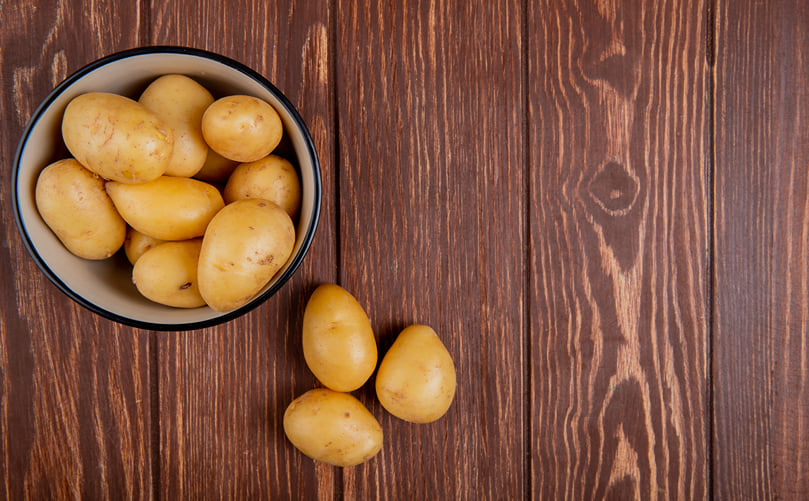
Table Potato Prices: How Appearance, Cooking Quality and Season Affect Value
French Fry Potatoes: Most fry potatoes in Europe and North America are grown under contract, with a base price adjusted by quality bonuses and deductions. Processors pay for raw material that yields a high share of long, light coloured fries, which is what makes a potato perfect for French fry processing.
Processors typically look for long, oblong tubers, because long fries earn more from foodservice buyers. Dry matter of roughly 20–25%, corresponding to a specific gravity of about 1.080–1.100, is a common target, but each factory sets its own range by variety, product and time of year. Reducing sugars (glucose and fructose) must be low, because they cause browning and acrylamide formation during frying. Processors usually judge this with fry-colour tests rather than one fixed sugar limit.
Storage temperature matters. Below about 7–8 °C, many varieties accumulate sugars through cold induced sweetening, so fry potatoes are usually stored warmer with sprout control and some lots are reconditioned at higher temperatures before processing.
Contract terms shifted sharply in 2026. French growers' union UNPT cited a Fontane base price of about EUR 130 per tonne ex-field, against EUR 180 in 2025 and NEPG reported processor offers of about EUR 12.50 per 100 kg ex-field.
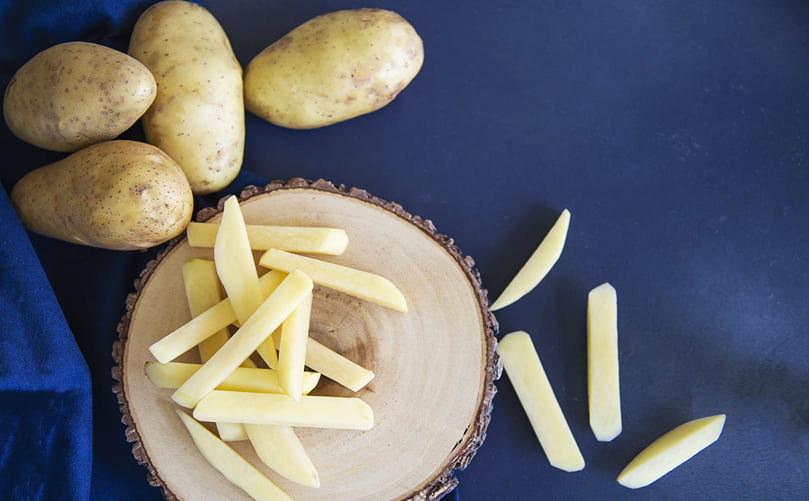
French Fry Potato Prices: How Processing Quality, Dry Matter and Contracts Determine Value
Chip (Crisp) Potatoes: Chip potatoes are priced mainly on how evenly they fry to a light colour, slice after slice. Because chip factories run all year, potatoes for chip production must keep low sugars through 4–10 months of storage at around 7–10 °C.
Chip makers prefer round, medium sized tubers that slice into uniform chips with little waste. They want high dry matter, often a specific gravity above about 1.080 and very low reducing sugars, because thin slices brown quickly. Varieties such as Atlantic, Snowden and Lamoka are widely used in North America. Buyers score chip colour and the share of defective chips after months in store and lots that fail on colour can be rejected or diverted at a discount.

Chip Potato Prices: How Fry Colour, Dry Matter and Storage Quality Affect Value
Starch Potatoes: Starch potatoes are paid for the starch they deliver, not for how they look. They are high yielding, high starch varieties grown under contract for factories that extract native potato starch, often cooperatives.
Starch content is measured by underwater weight: the heavier a sample is in water, the more starch it contains. Royal Avebe in the Netherlands pays members a campaign price based on a standard potato, adjusted for starch content, delivery time and quality, plus any payout from the cooperative's result. Its advance price has been based on a standard starch content of 19%, while the average in its 2024 starch potato campaign exceeded 20.5%. In Avebe's 2016 campaign, each percentage point of starch above the average was worth about EUR 4 per tonne.
Starch potato prices per tonne are usually far below seed or table prices, but they are more predictable and depend largely on world prices for starch and potato protein.

Starch Potato Prices: How Starch Content, Yield and Processing Demand Determine Value
Potatoes for Dehydrated Products: Dehydration plants turn potatoes into potato flakes, granules and powders for mashed potato, snacks and food ingredients. They often buy sound potatoes that are too small or misshapen for fresh or fry markets. Not every reject qualifies: rot, high sugars and foreign material are limited and because the product is sold dry, higher dry matter means more product per tonne.
Speciality and Premium Potatoes: Speciality potatoes sell in smaller volumes at higher prices per kilogram. Organic potato production has lower yields, higher disease risk and certification costs, so it needs a premium, although organic markets can also be oversupplied in good years. Baby or salad potatoes need dense planting, early harvest and careful grading. Purple, red-fleshed and heritage varieties serve chefs and premium retailers in small, volatile markets. Some varieties are licensed and sold under brands with controlled supply, which supports a steadier premium but means royalties and strict specifications for growers.
Why Are Seed Potatoes More Expensive Than Ware Potatoes?
Seed and ware potatoes may look alike, but they are produced for different purposes and carry different costs and risks.
| Factor | Seed potatoes | Ware (table or processing) potatoes |
|---|---|---|
| Production goal | Healthy, true-to-type tubers in planting sizes | Maximum marketable tonnes |
| Growing practice | Isolation, removal of off-type and diseased plants, early haulm killing to limit aphid-borne viruses, often at the cost of yield | Full-season growth for yield and size |
| Inspection and testing | Official field and tuber inspections; virus testing for higher classes | Buyer quality checks only |
| Grading and sale | Narrow size grades (for example 28–35 mm or 35–45 mm), labelled and traceable lots | Broader size bands, sold by grade or pack |
| What the buyer values | Health and yield potential of the next crop | Eating or processing value |
| Price | Higher per tonne, set by size and class | Lower and more volatile |
For a ware grower, seed is one of the largest variable costs, so its price feeds directly into cost per tonne. Growers still pay for certified seed because better health and vigour usually return more in yield and quality than they cost.
Why small ware potatoes are not seed potatoes: A small tuber from a ware field may look like seed, but it has no certified health status. It may carry viruses or bacterial diseases picked up during a full growing season and it may include other varieties. Many countries restrict or prohibit selling uncertified tubers as seed, so size alone never makes a seed potato.
Why Some Potatoes Sell at a Discount or Not at All
Potatoes lose value when they miss a buyer's specification, arrive at the wrong time or cannot be stored. How much value they lose depends on whether another outlet exists for them.
Out-of-specification tubers: Undersized, oversized or misshapen tubers are graded out of premium packs and processing deliveries. Some can go to value packs, flake plants, starch factories or animal feed, but only where such outlets exist nearby and the tubers meet their own quality and safety requirements.
Defects and disease: Bruising, cuts, scab, rots, sprouting and pest damage all lower value. Greened tubers must be removed because they contain higher levels of glycoalkaloids. A lot with a high defect rate may cost more to grade than it earns.
Deductions and rejection: Contracts set tolerances for defects and deliveries outside them face price deductions or rejection. A typical UK processing contract, for example, allows a maximum of 5% out-grades by weight. In Europe, disputes over quality are often settled under the RUCIP trade rules.
Unwanted varieties: A variety that local consumers or processors do not want can trade at a steep discount even in a normal year.
Surplus disposal: When stocks exceed demand, prices can fall below the cost of handling. In Belgium, maincrop potatoes traded at about EUR 10 per tonne in March 2026 before the free-market quotation reached zero and Flemish growers were permitted to spread unsold potatoes on fields because stores were full. Some pooled potatoes in Northwest Europe went to flake and starch plants or became animal feed. On 23 April 2026, the April contract of Europe's processing potato futures settled at a record low of EUR 1.40 per 100 kg.
How Variety and Quality Specifications Affect Potato Prices
Quality only moves prices when it is measured. Processing contracts, seed schemes and retail programmes therefore turn quality into specific parameters, tolerances and payment grids.
| Quality parameter | How it is measured | Why buyers care | How it affects price |
|---|---|---|---|
| Dry matter / specific gravity | Underwater weight or hydrometer | Finished-product yield, texture, oil uptake | Bonus and penalty grids in fry, chip, starch and flake contracts |
| Reducing sugars / fry colour | Laboratory analysis; fry or chip colour tests | Browning and acrylamide formation | Acceptance limits; rejection or reconditioning |
| Size and length | Sizing screens; length counts | Product yield and pack sizes | Premiums for long tubers in fry contracts; size-band prices for table and seed |
| External defects | Percentage by weight in a sample | Waste and appearance | Deductions above tolerance |
| Internal defects | Cut samples | Waste and product quality | Deductions or rejection |
| Tare | Soil and stones as a percentage of weight | Transport and cleaning cost | Deducted from paid weight |
The exact limits are not universal. They depend on the variety, the factory, the finished product and how long the potatoes have been stored. A fry processor in one country may accept a lower specific gravity than another; a chip maker may tighten its colour limit late in the storage season.
Variety comes first, because it determines which specifications a crop can meet. Russet Burbank, Innovator, Fontane and Agria are widely used for fries; Atlantic, Snowden and Lady Rosetta for chips. Growers and buyers can compare maturity, end use and processing traits in the PotatoPro potato variety database.
Storage history matters as well. Lots from well-managed stores, with a clear record of temperature, sprout control and disease checks, sell more easily than lots of unknown history. For table potatoes, national grade standards such as USDA grades and the UNECE standard for ware potatoes define classes and tolerances, which makes prices easier to compare between sellers.
Potato Production Costs and Break-Even Prices
Production costs tell growers what price they need. They do not decide what price the market pays. Four terms are often confused:
- Cost of production: all cash and fixed costs per hectare, including land, seed, inputs, labour, machinery and storage.
- Break-even price: the price per tonne at which revenue covers those costs, given the marketable yield.
- Desired or target price: break-even plus a margin for risk and return, which growers' organizations use in contract negotiations.
- Realised price: what the grower is actually paid, after quality bonuses, deductions and any sales at free-market prices.
In the Netherlands, the potato working group of the Dutch Arable Farmers' Union (NAV) calculates standard costs on model farms each year. For 2026, it set the desired price for fry potatoes, cost plus a 15% risk margin, at 18.7 euro cents per kg ex-field on sandy soil and 22.8 cents on clay, rising to 24.1 and 29.1 cents for delivery from storage in week 12. Irrigation is excluded and costed separately at about EUR 270 per hectare for each 25 mm application; two applications add roughly 1 cent per kg. NAV also estimates that table potatoes cost at least 2.5–3 cents per kg more to grow than fry potatoes at comparable yields.
The main cost items are broadly similar worldwide, although their weight varies by country:
- Seed, often one of the largest variable costs, especially where certified seed is imported.
- Fertilizers and crop protection, including fungicides against late blight, whose cost rises in wet seasons.
- Labour, machinery, fuel and irrigation, with labour more important in hand harvested systems and irrigation in dry regions.
- Harvesting, grading, washing and packing, which weigh most on table and seed potatoes.
- Storage, energy and transport, which are critical for crops sold late in the season or far from where they are grown.
The figure that links costs to prices is cost per marketable tonne:
Cost per marketable tonne = Total cost per hectare ÷ (Gross yield in t/ha × Marketable share)
At a cost of EUR 10,000 per hectare, a crop of 50 t/ha with 90% marketable costs about EUR 222 per marketable tonne. The same cost with 40 t/ha and 75% marketable rises to about EUR 333 per tonne. Grading losses therefore raise the break-even price as much as higher input costs do.
Higher costs do not guarantee higher prices. In February 2026, French growers' union UNPT said announced fry contract prices were largely below production costs, even though costs had not fallen. In an oversupplied market, cost increases come out of growers' margins.
How Seasonality, Storage and Weather Affect Potato Prices
Potato prices follow the crop calendar: usually weakest at harvest, firmer as stocks are drawn down and most volatile just before the next crop arrives. Weather can override that pattern in any season.
Harvest pressure: When many growers sell at harvest, prices fall. Growers who cannot store or who need cash must sell into this pressure. In India, for example, wholesale prices typically weaken during the main harvest from February to March as farmers sell or rush to load cold stores before summer heat.
Storage economics: Storage spreads supply across the year, but it costs money and potatoes lose weight. Typical shrinkage in modern potato stores is 2–6% over six months and general storage ranges are about 3–4 °C for seed, 4–7 °C for table potatoes and 7–10 °C for processing potatoes, although the right temperature depends on variety and end use. Warmer stores need effective sprout control. A grower who stores therefore needs the later price to cover energy, weight loss, sprouting and disease risk and the interest on unsold stock. When stocks are too large, as in Northwest Europe in 2025/26, that seasonal premium may never arrive.
Cold-storage capacity: Where cold storage is scarce, farmers lose access to the off-season premium and prices swing more sharply between harvest and lean months. In India, the pace at which potatoes are released from cold stores between March and December has a strong influence on prices.
Weather: Heat and drought reduce yields, tuber size and often dry matter. Frost damages crops in the field and in poorly protected stores. Heavy rain delays planting or harvest, spreads late blight and rots and raises soil tare. A weather shock in a major producing region can lift prices across a whole trading area.
Different growing seasons: Harvests in the northern and southern hemispheres and in highland and lowland regions, fall at different times. This creates trade windows, such as early potatoes from the Mediterranean, North Africa and the Middle East sold into Northern Europe in spring at premium prices.
How Potato Contracts and Market Quotations Work
The same potato can carry several prices at once, depending on where in the chain it is measured and how it is sold. Before comparing two figures, check the market level, the unit, the delivery terms and the date.
Farm-gate, wholesale and retail: The farm-gate price is what the grower receives. Wholesale prices add transport, handling, market fees and trader margin; retail prices add washing, packing, store costs and margin. The gap between them varies widely by country, product and season and retail prices usually react more slowly than farm-gate prices.
Contract and free-market prices: Contract prices are agreed before planting for a set area or tonnage. Free-market (also called free-buy or spot) prices reflect day-to-day supply and demand. In the Netherlands, average fry contract prices for the 2023–2025 harvests exceeded NAV's cost price and the average 2025-crop contract for week-12 delivery was about 26.5 euro cents per kg. Free-market potatoes from the same crop later traded close to zero.
Delivery terms and storage premiums: Contracts set a base price for early delivery and rising prices for later delivery from storage. For the 2026 crop, Lamb Weston's Fontane main-crop price started at EUR 12.25 per 100 kg and rose to EUR 22.65 for week-17 delivery and EUR 25.05 for week 26. The same report noted that Simplot-Clarebout's base offer covered 75% of the previous year's volume, which leaves more of a grower's crop exposed to free-market prices.
How a Fry Contract Pays for Storage
Volume commitments and rejection risk: Growers who cannot deliver contracted volumes may have to buy potatoes elsewhere, while tonnage above the contract is usually sold at free-market prices. Rejected loads may be returned, diverted or sold at a discount; who bears the cost depends on the contract and on independent inspection.
Bargaining power: In many countries, a few large fry and chip processors buy most processing potatoes. Growers strengthen their position through cooperatives, producer organizations, pools, their own storage and a spread of buyers. Where there are few buyers and little storage, farmers have little bargaining power.
Futures markets: Northwest Europe long had an exchange traded processing potato futures contract, settled against an index of Fontane and Agria-type potatoes. After trading dried up, EEX delisted the European Processing Potato Future on 5 June 2026. Price discovery in the region now relies on physical quotations such as Belgapom and Fiwap, contract announcements and trade reports.
Why Potato Prices Differ Between Countries
Because potatoes are bulky and perishable, national markets stay partly separate. Domestic supply, costs, infrastructure and trade rules shape prices in each country.
Production relative to demand: Large crops relative to local demand mean lower prices. In the United States, the average price growers received for the 2025 crop fell to USD 10.80 per hundredweight (about USD 238 per tonne), from USD 11.70 in 2024.
Costs and yields: High-wage, high energy countries face higher costs per hectare but usually achieve higher yields. In 2024, average yields exceeded 40 t/ha only in North America and Oceania, against a world average of about 22.9 t/ha.
Trade and exchange rates: Trade links national markets, mainly through seed potatoes and processed products rather than fresh potatoes. International trade in frozen potato products grew from about USD 7.7 billion in 2019 to USD 13.2 billion in 2024 and China and India have moved from importing to exporting. Exchange rates shift competitiveness: a strong euro was one of the reasons NEPG gave for falling EU fry exports in 2025, a key factor in Europe's potato overproduction crisis. Longer term, global demand for frozen French fries continues to grow, with foodservice taking about 71% of frozen potato consumption.
Tariffs and phytosanitary rules: Import duties, seasonal restrictions and rules on quarantine pests such as brown rot, ring rot, potato cyst nematodes and wart disease limit trade and keep national prices apart. Some countries also restrict exports to protect domestic supply.
Infrastructure and margins: Countries with modern wholesale markets, cold chains and good roads tend to have smaller gaps between farm-gate and retail prices and less waste. Where infrastructure is weak, prices can differ sharply between producing and consuming regions of the same country.
Recent Potato Price Signals Around the World
| Country / market | Recent price signal | Main driver | Source |
|---|---|---|---|
| Belgium, free-market processing potatoes (April 2026) | Belgapom quotation at EUR 0/t; 70–80% of the crop under contract | Full stores, weak fry export demand | PotatoPro |
| United Kingdom, free-buy Maris Piper (Feb 2026) | About GBP 180/t, against about GBP 400/t a year earlier | Northwest European surplus | FreshPlaza |
| Netherlands, fry contracts | Average 2025-crop contract about 26.5 cents/kg (week 12); NAV 2026 desired price 18.7–29.1 cents/kg | Costs steady while contract offers fall | PotatoPro |
| United States, all potatoes (2025 crop) | USD 10.80/cwt (about USD 238/t), down from USD 11.70 | Large crop, high yields | USDA NASS |
| South Africa, fresh market (Aug 2025) | Prices up to 50% lower year on year and below production costs | Bumper harvest | PotatoPro |
| Bangladesh, cold stores (Oct 2025) | BDT 10–11/kg against a government minimum of BDT 22/kg | Record harvest of about 11.5 million tonnes | PotatoPro |
Price movements in India, the United States, the United Kingdom, the Netherlands, Pakistan, Brazil, Mexico and Kazakhstan show how differently each market reacts to the same global trends.
Potato Prices and Profitability Across the Supply Chain
Each business in the chain earns its margin on a different number. Growers live on price times marketable yield; processors on the product they recover from each tonne; traders and retailers on the spread between buying and selling.
Growers, a higher price is not always a higher profit: In the hypothetical comparison below, both growers have the same cost of EUR 6,000 per hectare. Grower A harvests 50 t/ha, of which 90% is marketable and sells at EUR 150 per tonne. Grower B harvests 40 t/ha, of which 75% is marketable and sells at EUR 220 per tonne.
A Higher Price Does Not Always Mean a Higher Profit
Grower B sells at a price almost 50% higher but earns less, because grading losses and lower yield cut the saleable tonnage.
Storage decisions: Holding potatoes for a later sale pays only if the price rise covers storage costs, weight loss, quality risk and the cost of waiting for payment. Contract storage premiums make this calculation predictable; free-market storage is a bet on prices.
Seed buyers: Growers compare seed cost per hectare with the value of the crop it will produce, not seed price per tonne alone. Comparing offers from several seed potato suppliers on class, size grade and variety helps them judge that value.
Processors: Raw material is the largest cost in fry, chip and flake production. Higher dry matter and fewer defects mean more finished product per tonne of potatoes, which is why processors pay quality premiums and deduct for out-grades.
Traders and retailers: Traders earn margins for transport, grading, storage, credit and price risk; their margins widen in volatile markets, but so do their losses when prices fall while they hold stock. Retailers often keep consumer prices stable while farm-gate prices swing, using potatoes to attract shoppers and earning more on washed, packed, branded and speciality lines.
Where to Check Potato Prices and Market Information
Reliable potato market prices come from official statistics, market authorities and specialist industry reports. Each source measures something different, so check whether a figure is a farm-gate, wholesale, retail, contract or export price and note its unit and date.
How Potato Prices Are Quoted
| Unit | Equals | Commonly used in |
|---|---|---|
| Tonne (t) | 1,000 kg | International trade, contracts, Europe |
| Per 100 kg (decitonne) | One-tenth of the per-tonne price | Northwest European quotations and contracts |
| Quintal (q) | 100 kg | India (₹/quintal at mandis) and other markets |
| U.S. hundredweight (cwt) | 100 lb = 45.36 kg | United States (USD/cwt) |
| Per kg, bag or sack | 1 kg; 10 kg; 25 kg; 50 lb | Retail and fresh wholesale markets |
To convert USD per cwt to USD per tonne, multiply by 22.05. To convert ₹ per quintal to ₹ per kg, divide by 100.
Price Sources to Check
| Source | What it covers | Link |
|---|---|---|
| PotatoPro Potato Prices | Price news by country | potatopro.com/topics/potato-prices |
| PotatoPro regional statistics | Production, trade and price history by country | potatopro.com/potato-markets/world |
| FAO price data | International prices and producer prices (FAOSTAT) | fao.org/prices |
| FAO GIEWS FPMA Tool | More than 2,700 monthly domestic price series in about 130 countries | FPMA dashboard |
| Agmarknet (India) | Daily arrivals and min/max/modal prices by mandi, ₹/quintal | agmarknet.gov.in |
| USDA AMS Market News (U.S.) | Daily shipping-point and terminal market prices | mymarketnews.ams.usda.gov |
| USDA NASS (U.S.) | Monthly prices received; annual Potatoes Summary | nass.usda.gov |
| EU agri-food data portal | Market prices by EU member state | agridata.ec.europa.eu |
| Fiwap / NEPG (Northwest Europe) | Belgian market quotations and NEPG market reports | fiwap.be |
| UN Comtrade | Import and export volumes and unit values by HS code | comtradeplus.un.org |
Most countries also publish wholesale prices through a ministry of agriculture, statistics office or market board. Growers' organizations such as NAV and UNPT, cooperatives and seed houses publish cost calculations and contract indications. Export unit values from customs data are averages across grades, destinations and packing, so treat them as indicators rather than farm-gate prices.