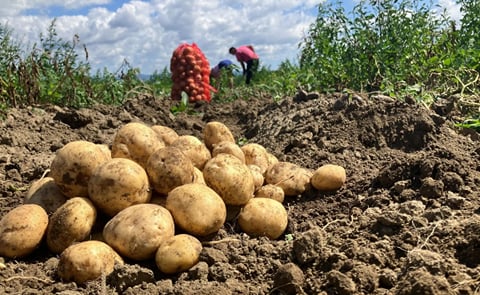

News on GM Potatoes

Sponsor of the month (Learn more)
Europatat welcomes the EU’s adoption of the New Genomic Techniques (NGT) Regulation, a landmark decision expected to accelerate potato breeding innovation, strengthen crop resilience, enhance food security, and support the long-term sustainability of European agriculture.
June 22, 2026
Europatat Welcomes EU NGT Regulation, Opening New Opportunities for Potato Innovation
Europatat welcomes the EU’s adoption of the NGT Regulation, opening new opportunities for innovative potato varieties with improved disease resistance, climate adaptability, and processing traits, while boosting breeding research and investment.
Wageningen University & Research initiates new field trials to evaluate genetically modified potatoes with enhanced disease resistance and reduced pesticide needs
April 21, 2026
Wageningen University and Research Launches New Field Trials for Genetically Modified Potatoes
Wageningen University & Research starts new field trials with genetically modified potatoes. The potatoes tested in these field trials have been genetically modified by adding or switching off multiple genes.
BRS F21 potato plants in the field as part of Embrapa’s processing-oriented breeding program.
April 14, 2026
New field trials mark the next step for genetically modified potatoes in Europe
New trials in Europe will evaluate genetically modified potatoes with enhanced resistance to diseases such as late blight, aiming to reduce pesticide use and provide evidence for the regulatory debate on new genomic techniques.
Potato field
January 21, 2026
EEUU: nueva variedad GMO aprobada por el gobierno
En Estados Unidos, la FDA avaló la papa Russet Burbank II de J. R. Simplot, una variedad GMO desarrollada con resistencia natural al *Phytophthora infestans*, al considerarla tan segura como las convencionales y capaz de reducir pesticidas y mejorar el almacenamiento.
StTST2–SUT2 regulatory module in potato. Confocal and protein interaction analyses show StTST2 on the vacuolar membrane interacting with SUT2, enhancing sugar transport from leaves to tubers, boosting photosynthesis and yield, and highlighting its key role in sugar accumulation and tuber productivity.
January 10, 2026
Haplotype-Resolved Potato Genome Reveals Key Gene Driving Sugar Accumulation and Yield
Scientists decoded a haplotype-resolved potato genome and GWAS of 141 accessions, identifying StTST2, a tonoplast sugar transporter. StTST2 boosts photosynthesis, sugar accumulation, source–sink transport, and tuber yield via interaction with SUT2.
Mariette Andersson (left) of SolEdits and Kalle Johansson (right) of Lyckeby examine CRISPR-edited potato plants developed to produce storage-stable starch and reduce the need for chemical modification.
November 17, 2025
SolEdits and Lyckeby ready to Launch CRISPR-Edited Potatoes to Deliver Chemical-Free, Storage-Stable Starch
SolEdits and Lyckeby have developed CRISPR-edited potatoes with storage-stable starch, removing the need for chemical modification. Once allowed in the EU, this innovation can save 5,000 tonnes of chemicals yearly in Sweden and up to 75,000 across the EU.
Sponsored Content
Sponsored Content
Sponsored Content
Project Oppotunity CRISPR-Cas field trials for late blight resistant starch potatoes in Sweden and Denmark, 2025.
October 21, 2025
Oppotunity conducts NGT Field Trials and Potato Seed Multiplication of starch potatoes with improved late blight resistance
Project Oppotunity completed the first CRISPR-Cas field trials of starch potatoes bred for late blight resistance, with test plots in Sweden and Denmark. Early results indicate stronger disease resistance and a very promising path to resilient crops.
PoLoPo potato harvest
July 28, 2025
PoLoPo Shifts Focus to Snack Industry with High-Protein Potato Chips, Targeting Clean-Label and Scalable Growth
PoLoPo, a B2B deeptech firm, is shifting focus to the snack industry. It's patented potato offers up to three more protein than regular tubers, enabling high-protein chips with great taste and texture for brands and food manufacturers.
The PoLoPo team celebrates a groundbreaking achievement as they successfully scale molecular farming, becoming the first to grow and process protein-rich potatoes at an industrial level.
March 24, 2025
PoLoPo Successfully Scales Functional Protein Production in Potatoes to Outdoor Field Cultivation
PoLoPo, a molecular farming pioneer has announced it has increased its capacity to produce samples for food industry partners with new, larger-scale lab equipment following its first successful outdoor field cultivation of protein-packed potatoes.
Athanase Nduwumuremyi, Senior Research Fellow and Roots and Tubers Program Coordinator at RAB, during a tour at a greenhouse in Karago Sector, Nyabihu Distric
March 17, 2025
Trials for GMO potato varieties underway in Rwanda
The Rwanda Agriculture and Animal Resource Development Board (RAB) is conducting trials on new potato varieties that require no fungicide spraying
Adam Jozwiak, UCR molecular biochemist, Lead study author
February 23, 2025
Researchers identify biosynthetic pathway of GlycoAlkaloid formation in potato
Scientists have discovered a way to remove toxic compounds from potatoes, making them safer to eat and easier to store. The breakthrough could cut food waste and enhance crop farming in space and other extreme environments.
PoLoPo Scales to Field Cultivation of Protein-Producing Potato Plants
January 02, 2025
PoLoPo Scales to Field Cultivation of Protein-Producing Potato Plants
PoLoPo, a molecular farming pioneer, has announced it has moved beyond greenhouse scale and begun planting its genetically modified potatoes in fields, the first wide cultivation of plants derived from PoLoPo’s proprietary metabolic engineering techniques.
Sponsored Content

Current Selection 213 items. Refine:

You May Also Like

Bolivia: nuevas variedades y mejor tecnología
December 17, 2024
Bolivia: nuevas variedades y mejor tecnología
En el marco de una alianza interinstitucional público-privada, el Banco de Desarrollo Productivo (BDP) promueve el mejoramiento de las condiciones productivas y el incremento de rendimientos de papa en el altiplano paceño
Katherine Meacham-Hensold led work looking to improve the photorespiratory bypass of potato as a postdoctoral researcher in Don Ort’s lab at the University of Illinois Urbana-Champaign.
December 12, 2024
Climate-ready potato crop: RIPE team shows yield increase under heatwave conditions through photorespiratory bypass
A team from the University of Illinois has engineered potato to be more resilient to global warming, showing 30% increases in tuber mass under heatwave conditions.
Solynta's Potato Hybrids Double Kenyan Farmers' Yields Without Fungicides
October 08, 2024
Potato Revolution in Kenya: Record Yields Without Fungicides
Solynta's potato varieties with high resistances against Late Blight provide Kenyan farmers with good yields, as demonstrated in a comparative field test during an extensive spray/no spray trial in Limuru, Kenya.
Royal Avebe substantially increases its Solanic potato-protein production
August 29, 2024
Breakthrough: Functional Patatin (Potato Protein) added to Commercial Product Lineup of PoloPo
PoLoPo, a molecular farming pioneer has announced it will begin supplying patatin, the native protein in potatoes, to commercial clients following regulatory approval.
Fresh Potatoes
November 23, 2023
Nigeria’s GM Potato project concludes first-year trial, shows 300% yield advantage
The Genetically Modified (GM) Potato Project ongoing in Nigeria has concluded its first-year multi-locational confined trial in three locations
McGill University Professor Martina Stromvik and her team have created a potato super pangenome to identify genetic traits that can help produce the next super spud.
August 29, 2023
Mapping genetic variation of the potato: McGill researchers create super pangenome
Scientists have assembled the genome sequences of nearly 300 varieties of potatoes and its wild relatives to develop more nutritious, disease-free, and weather-proof crop.

Frequently Asked Questions

Will PotatoPro edit my article?

Yes. We edit almost all submitted articles for style and layout. If you notice a change you are not happy with, contact us and we will find a solution. If you submit news before its official publication date, you can review the item privately before it goes live.

How can I get more visibility for my company’s news?

Besides free news publishing, companies can list in the PotatoPro directories, become PotatoPro sponsors, or use targeted email blasts, the Event Promotion Package and social media exposure with analytics. Find out why companies advertise on PotatoPro.

Does PotatoPro delete old news? Can I add older news?

No, we do not delete old news. News on PotatoPro goes back to 2006, and we consider it a valuable historical record of developments in the industry. If we missed a key development in the history of your company, we can still add it.

What can I do after my news is published?

Share the article with your colleagues and on the social media channels where you are active, and add it to the “Company in the news” section of your website if you have one. You are also welcome to point other media to the PotatoPro article, as long as they include a clickable link to the item on PotatoPro.

I have created an account, but I am not receiving the newsletters. What should I do?

Log in to your profile and check that you have opted in to the newsletters you would like to receive. Also check your spam or promotions folder and make sure you registered with the right email address. If you still do not receive them, contact us at info@potatopro.com. For sign-in or password issues, see the PotatoPro Login & Account FAQs.

Is reading news on PotatoPro free?

Yes. All news articles on the PotatoPro website are free to read. The PotatoPro app is also free but requires a free PotatoPro account, which also works on PotatoPro AI.

Where is PotatoPro news published and how can I follow it?

News appears on the PotatoPro News page and in the PotatoPro weekly newsletter, which you can receive by creating a free PotatoPro account. It is also available in the PotatoPro app for iPhone and iPad and Android, and shared on LinkedIn, Facebook, Instagram, X, YouTube, Telegram and Bluesky.

My company is not in the PotatoPro directory. Can I still submit news?

Yes. Companies that are not yet listed can still submit news, and they are also welcome to contact PotatoPro to be added to the Company Directory.

In what languages can I submit news?

You can submit news in any language. PotatoPro publishes in English, Spanish, Dutch and Simplified Chinese, and plans to add German, French, Arabic, Hindi and Portuguese in 2027.

How long does it take for news to be published?

It depends on the timing of the news, the editorial workload and how much editing the article needs. News from PotatoPro sponsors may be given priority.

When should I submit my news?

As soon as possible, and ideally on the day the news becomes public, even if it is only a link to material published elsewhere. Extra material such as videos or illustrations can be added later. You can also send news before it is public, as long as you clearly state the embargo date and time, including the time zone.

Can I include links in my news article?

You can include one dofollow link to an external source in the body of the text. Links to your brands, your company profile, previous news and other content about your company on PotatoPro are mostly added automatically.

Can I include a video in my news article?

Yes. We can embed videos hosted on YouTube or Vimeo. For best results, use HD quality or better, include sound, and keep the video professionally edited, ideally 1.5 to 3 minutes long.

What images should I send with my news?

Every news item on PotatoPro must have an illustration at the top, which is also used in article summaries and social media posts. The best top images are closely related to the story, eye-catching and colorful, in landscape format and at least 1,200 pixels wide. Avoid logos, pictures with a prominent logo and images with a lot of text, because Google and Facebook may not display them. Send high-resolution JPG or PNG files that you own or have permission to use, each with a caption and photo credit, and mention if an image was made using AI. Extra images for the body of the article are welcome.

What are the guidelines for writing a news article?

There is no maximum length, but we recommend more than 300 words, and we do not accept articles of fewer than 200 words. An article cannot consist only of a list; it needs paragraphs of text. Provide factual, useful information, keep sentences short, and write in the third person or include quotes attributed to a named person. Self-praise full of superlatives is unlikely to be published without heavy editing. Keep abbreviations to a minimum, and if English is not your first language, we recommend having your text reviewed by a native English speaker.

What type of news does PotatoPro accept?

PotatoPro accepts industry and company news, product launches, new facilities, appointments, technology and research updates, and other developments in the potato and savory snack industries. Submissions should give industry professionals useful information rather than being purely promotional.

How can I submit news to PotatoPro?

Email your article, press release or company announcement to news@potatopro.com. Send the text in a Word or Google document, or in the body of the email, and attach images separately. We may also pick up stories shared on X that tag @PotatoPro.

Is it free to publish news on PotatoPro?

Yes. News about the potato and snack industries is published free of charge if we consider it relevant. All submissions are subject to editorial review and will be edited for style and layout.

Filters

Refine By Topics
Refine By Regions
Refine By Year
Language preferences