
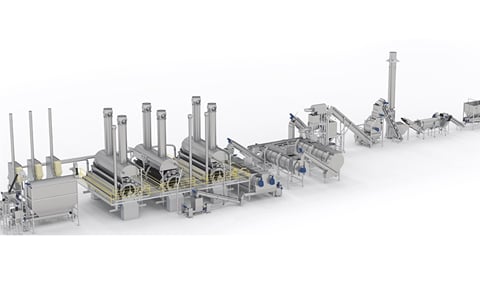
Stackable potato chips displayed with processing visuals from Tummers Food Processing Solutions, highlighting how potato remnants can be transformed into uniform, stackable chips through a sustainable flake-to-dough production process.
Turning Potato Scraps into Perfect Stackable Chips with Sustainable Processing

Stackable chips, known from brands such as Pringles, have a distinctive shape: thin, perfectly uniform, and neatly stackable in a tube or tray. But behind this seemingly simple snack lies a surprisingly efficient and sustainable production process. Unlike traditional potato chips, stackable chips are made from the entire potato and/or its remnants, which are first processed into a puree and then ground into a powder. This process makes it possible to utilize the majority of the potato.
From Potato to Potato Puree
The process naturally begins with the potato. In the food processing industry, not only perfect potatoes are used, but also smaller ones and leftover pieces that arise when cutting potatoes for other products, such as French fries.
These small pieces, often referred to as nubbins and slivers, are usually too small or irregular to be sold as fries or slices. However, they still contain the same high-quality potato raw material. Instead of wasting these leftovers, they are collected and processed into potato puree.
From Puree to Flakes and Powder
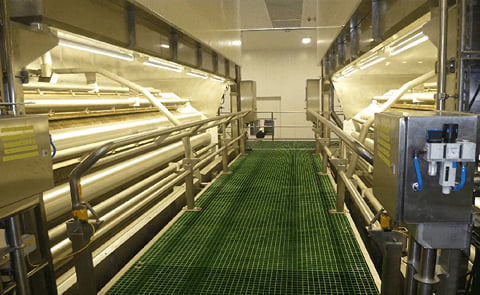
In the next step toward producing stackable chips, the potato puree is further processed into potato flakes. This is done by drying the puree on a drum dryer. During this process, a thin potato layer is formed, which is then broken down into flakes. These flakes can then be further milled into potato powder.
This powder forms the basis for the dough used to make stackable chips. By mixing potato powder with water and other ingredients, a homogeneous dough is created that is highly suitable for shaping.
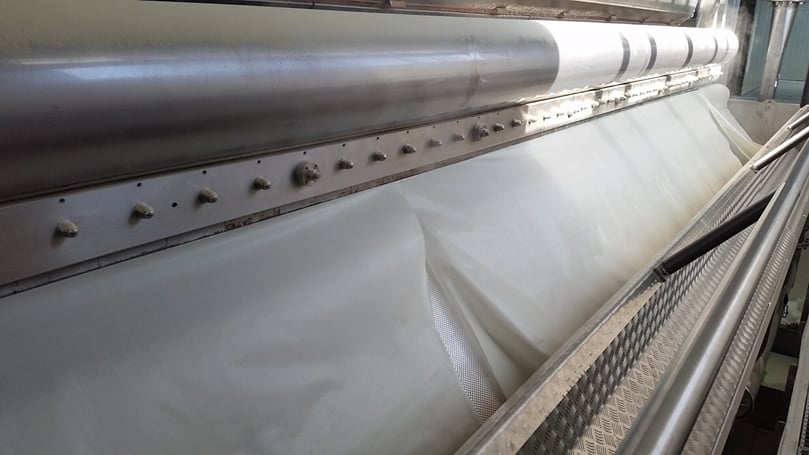
A drum dryer forms dried potato flakes from puree—an essential step in producing stackable chips using processing solutions from Tummers Food Processing Solutions.
The Shape of Stackable Chips
What makes stackable chips instantly recognizable is, of course, their shape. This is created by first rolling the dough into a thin sheet and then stamping it into the characteristic form.
Thanks to this shape, the chips can be fried efficiently and neatly stacked in the tubes and trays we all recognize. This not only creates a distinctive product but also allows for more efficient transport and less breakage during storage and distribution.
Smart Use of By-Products
The production process of stackable chips clearly shows how by-products can be transformed into valuable raw materials. What was once a residual stream of small potatoes or cutting remnants has now become an important ingredient for a finished product.
Today, not only nubbins and slivers are given a new role in the production process. Other parts of the potato that were once considered “waste” are increasingly being utilized. For example, water released from potatoes can be captured and reused in the production process. Potato peels can be used for applications such as animal feed, fiber products, or other industrial uses.
Companies such as Tummers Food Processing Solutions develop installations that can efficiently separate, process, and reuse these residual streams. By recovering water from potato streams or processing peels into new raw materials, potato processing is becoming increasingly circular.
Sustainable and Efficient
The production of stackable chips clearly illustrates how modern food processing works: efficient, innovative, and increasingly sustainable. By utilizing nearly all parts of the potato and reusing residual streams, waste is minimized and the value of the entire production process increases. Even the residual heat from the energy used in the preceding flake production process can be recovered—partly to supply the plant’s own energy needs and partly to support other processes.
In this way, a leftover piece of potato can ultimately be transformed into a pre-formed chip in a tube — a great example of how a by-product can grow into an A-product.
Like to receive news like this by email? Join and Subscribe!
Get the latest potato industry news straight to your WhatsApp. Join the PotatoPro WhatsApp Community!
精选企业
产品
相关新闻

十月 11, 2026
哥伦比亚:PepsiCo将投资10亿美元,可能强化其马铃薯供应链
PepsiCo将在未来五年向哥伦比亚投资10亿美元,用于扩大生产和分销;这一扩张可能强化其马铃薯供应链,而PepsiCo已是哥伦比亚最大的马铃薯工业采购商,年采购量约8.4万吨。

九月 07, 2026
KFC Malaysia and Mister Potato Launch Spicy, Crunchy Limited-Edition Collaboration
KFC Malaysia and Mister Potato launch a limited-time collaboration featuring spicy crispy chicken, a crunchy Zinger burger and Cheezy Wedges-inspired chips for the Merdeka and Malaysia Day season.
九月 03, 2026
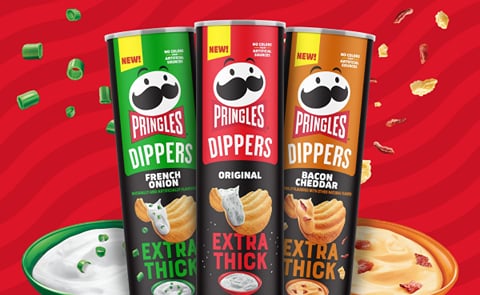
品客推出专为蘸食设计的更厚薯片
Pringles 将于今年9月推出 Dippers,这是品牌首款专为蘸食设计的更厚、更坚固且波浪形更强的脆片,共有三种口味。该品牌还以新的甜咸口味扩展了其 Mingles 产品线。