Primary tabs

TOMRA Food

Company Description

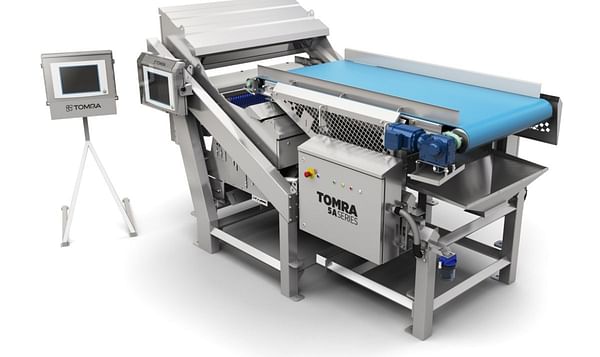
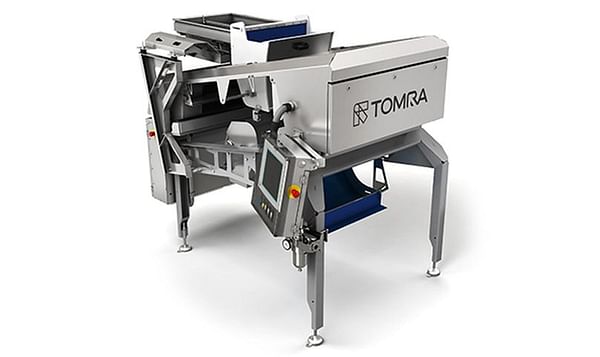
TOMRA Food is a global supplier of sensor-based sorting, grading, and peeling equipment to the food processing sector. The business creates technologies that combine cameras, lasers, and artificial intelligence (AI) to detect flaws, eliminate extraneous elements, and organize food products by color, size, shape, and quality. Its products are frequently utilized to improve food safety, product uniformity, and processing efficiency in industrial processes.

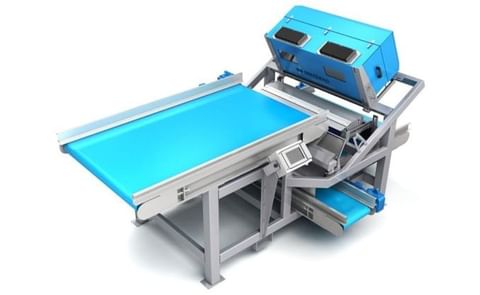
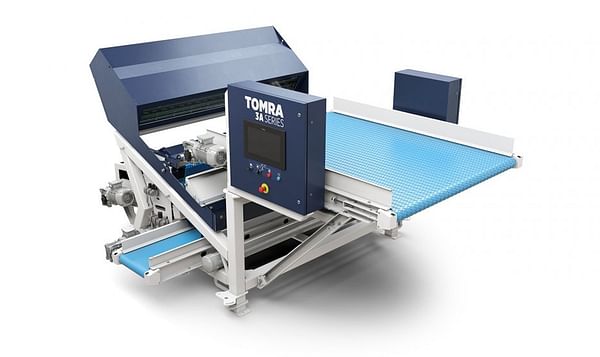
The firm provides a diverse range of equipment, including optical sorting machines (belt, chute, and free-fall sorters), grading and inspection systems, and steam peeling solutions including the Eco, Orbit, and Odyssey peelers. These systems may be used as standalone devices or incorporated into whole processing lines, enabling automated and high-capacity food production facilities.

The company has more than 12,800 units installed at food growers, packers and processors around the world for confectionery, fruit, dried fruit, grains and seeds, potatoes, proteins, nuts, and vegetables.

TOMRA Food operates centers of excellence, regional offices and manufacturing locations within the United States, Europe, South America, Asia, Africa and Australasia.


(Click picture to watch video)InVision2 in Action: High-Precision Fruit Sorting Demo


InVision2 in Action: High-Precision Fruit Sorting Demo
A subsidiary of:
Subsidiaries and Factory Locations
Products Offered
Product Types offered by this company
Brands
Trade Show Participation
News for this Company
The award winning user interface of TOMRA's sorting equipment is already implemented in a.o. the Halo and the Field Potato Sorter and will be expanded in the rest of the product line.
August 26, 2015
TOMRA wins Award for the User Interface applied in the Halo, Field Potato Sorter
TOMRA’s Common User Interface (CUI) - already applied in the Halo and the Field Potato Sorter - received this year´s International Design Excellence Award (IDEA) at a gala ceremony in Seattle, US, on the 22nd August.
From the archive
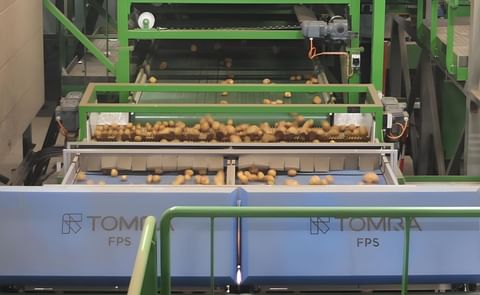
The newly installed TOMRA FPS 2400 at the Nedato packing line directly at the reception of the potatoes results in fewer clods and better quality potatoes.
August 23, 2015
Nedato improves potato quality with Field Potato Sorter installation
To obtain a better quality potatoes and fewer clods, potato packer Nedato has installed a TOMRA Field Potato Sorter directly at the reception of the potatoes.
From the archive
TOMRA demonstrates Field Potato Sorter at Fruit Logistica
August 20, 2015
TOMRA Sorting Food will demonstrate Field Potato Sorter at Potato Europe
Farmers, growers and producers looking to enhance their sorting process efficiency should head to PotatoEurope next month, where TOMRA Sorting Food will be demonstrating its Field Potato Sorter.
From the archive
Screenshot of the new French language version of the TOMRA website.
August 10, 2015
TOMRA launches French language version of its website
TOMRA Sorting Food has launched a French version of its website to showcase to French-speaking countries the sorting and peeling solutions the company offers.
From the archive
Agents for this company

Frequently Asked Questions

How does TOMRA’s technology influence pricing dynamics in agricultural markets?

By enabling precision grading, TOMRA allows producers to segment products into multiple value tiers. This leads to more dynamic pricing strategies where premium quality is monetized better, while lower grades are efficiently diverted to processing or alternative uses, maximizing overall revenue.

How does TOMRA’s technology impact processing efficiency in the potato industry?

In potato processing, sorting precision directly affects peeling loss, frying quality and final product consistency. TOMRA’s systems help reduce raw material waste, improve cut quality and ensure uniformity critical for products like chips and fries.

How might TOMRA influence the future design of food processing factories?

Factories may be designed around integrated, automated and data-connected systems rather than linear processes. TOMRA’s ecosystem approach could drive the shift toward smart factories in agriculture.

Can TOMRA’s solutions standardize food quality globally or will regional diversity resist it?

While technology pushes toward standardization, consumer preferences and local varieties will maintain diversity. The future likely involves standardized processing with localized customization.

Make This Page Even Better!

This content was last updated on March 28, 2026

Have a helpful detail to contribute? Catch something that should be corrected?