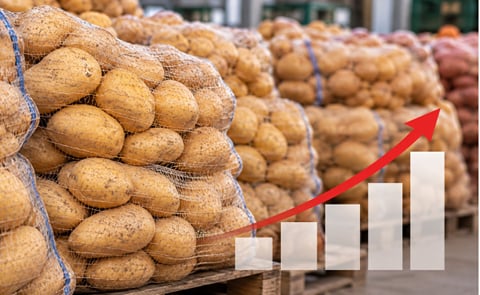

Farmers harvest potatoes in India, highlighting the importance of quality seed, scientific multiplication and organized seed systems in improving productivity and building a more efficient potato value chain (Created by PotatoPro using AI).
India’s Potato Future Starts With Better Seed: Building a Stronger Seed Ecosystem for Farmers

India’s potato industry is entering a new phase as the sector shifts from a volume-driven production model toward a quality-led and value-added future. At the centre of this transition is an often-overlooked part of the value chain: the potato seed.
For Indian farmers, seed is more than an agricultural input. The quality, health and genetic potential of seed tubers can strongly influence the yield, quality and profitability of an entire crop season. Although India is the world’s second-largest potato producer, average potato yields remain at around 28–30 tonnes per hectare, roughly half the levels achieved in major potato-producing hubs such as the Netherlands and the United States.
The productivity gap does not necessarily reflect limitations in India’s soil or climate. Instead, it highlights structural challenges within the country’s potato seed ecosystem, particularly the availability, quality and replacement of planting material.
Low seed replacement remains a major challenge
One of the key issues affecting Indian potato productivity is the relatively low Seed Replacement Rate (SRR), estimated at around 25–30%. SRR refers to the proportion of quality-assured or truthful-label seed used by farmers compared with farm-saved planting material.
Many farmers continue to depend on saved potato tubers because of traditional practices, accessibility and cost considerations. However, repeated use of farm-saved seed can contribute to varietal degeneration, disease accumulation and declining crop vigour over successive generations.
Because the success of a potato crop is effectively influenced from the point of planting, improving access to healthy and quality-assured seed could play a major role in addressing the productivity gap.
Soil management, irrigation and crop protection remain essential components of successful potato production. However, the genetic potential and health of the seed tuber establish the foundation on which these other inputs can deliver results.
From seed distribution to an integrated marketing ecosystem
As India’s potato sector becomes increasingly diversified, an organised seed marketing system needs to move beyond simply supplying planting material. It should connect genetic innovation, seed multiplication, agronomic advice and market requirements with farmers.
Variety-to-market alignment is becoming increasingly important. The expansion of frozen potato products, Quick Service Restaurants (QSRs) and sophisticated retail markets is creating demand for potatoes with specific processing, quality and performance characteristics.
A modern seed marketing system can help farmers select varieties according to their agro-climatic conditions and intended markets rather than relying on a one-size-fits-all approach.
Such alignment could also provide farmers with greater access to stable and predictable markets, including contract-based opportunities, potentially reducing their exposure to volatile mandi prices.
Digital intelligence can strengthen farmer support
The evolution of seed marketing is also increasingly connected with digital agriculture.
A modern seed ecosystem can integrate mobile-based advisories and digital intelligence to provide farmers with real-time information on crop monitoring, nutrient management and pest and disease diagnostics.
This approach changes the nature of the relationship between farmers and seed suppliers. Instead of being limited to a one-time seed transaction, the system can provide continuing agronomic support throughout the crop cycle.
Such services can help farmers make more informed decisions while improving the effectiveness of inputs and crop-management practices.
Better seed can deliver wider economic benefits
For potato farmers, the transition toward an organised and quality-assured seed marketing system could have direct economic benefits.
Access to high-quality truthful-label seed through structured supply channels can help reduce one of the farmer’s biggest risks: crop failure. High-vigour seed can support better germination and more uniform crop establishment, while potentially reducing the need for excessive chemical inputs and lowering cultivation costs.
Traceability and transparency can also help address information asymmetry within agricultural supply chains. A more structured system can give farmers greater confidence regarding the identity, quality and source of the seed they purchase.
The benefits therefore extend beyond productivity. A stronger seed ecosystem can contribute to improved crop consistency, lower production risks and better alignment between what farmers produce and what downstream markets require.
Consistency will define India’s next phase of growth
India has already demonstrated its ability to produce potatoes at scale. The next stage of development, however, will depend increasingly on the country’s ability to consistently produce the right potato for the right market.
The challenge is therefore no longer simply whether India can produce enough potatoes. The larger question is whether the country can develop the seed ecosystems needed to support the next generation of its potato industry.
A robust and organised seed marketing system can provide the foundation for this transformation by connecting scientific seed multiplication with digital agronomy and processor-aligned variety selection.
By strengthening these links, India can move toward a potato supply chain that is more predictable, sustainable and profitable while helping farmers capture greater value from a rapidly evolving domestic and global potato market.
The author is the Chief Executive Officer of HyFarm.
¿Te gustaría recibir noticias como esta por correo electrónico? ¡Únete y suscríbete!
Get the latest potato industry news straight to your WhatsApp. Join the PotatoPro WhatsApp Community!
Noticias relacionadas

Septiembre 28, 2026
México: menor oferta de papa podría impulsar los precios durante el invierno
En México, el cierre de cosechas, los menores rendimientos y la reducción de la superficie sembrada podrían restringir la oferta de papa y generar presión al alza sobre los precios entre diciembre de 2026 y febrero de 2027.

Septiembre 28, 2026
España: la sequía reduce la cosecha de patatas en 2026
La producción española de patata caerá entre un 8% y un 10% en 2026, hasta unos 1,8 millones de toneladas, con descensos de hasta 35% en Andalucía debido principalmente a la sequía y los menores rendimientos.

Septiembre 23, 2026
Chile: buscan mejorar el diagnóstico molecular de la sarna polvorienta y la sarna común en papa
En Chile, el proyecto SCAB-ID 2.0 busca validar un sistema de qPCR multiplex capaz de detectar y diferenciar simultáneamente la sarna polvorienta y la sarna común de la papa, con miras a transferirlo a laboratorios de diagnóstico agrícola.