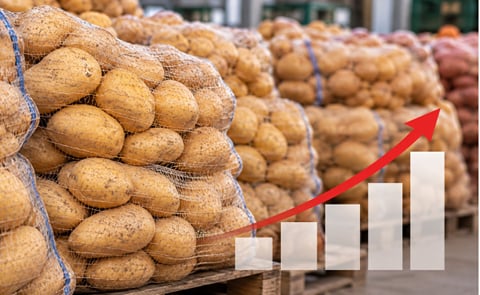

Flemish growers store surplus potatoes on fields, as warehouses remain full and Belgium’s free-market prices fall to zero
Joint raw material declaration allows Flemish growers to dump surplus potatoes on fields

Growers who can no longer sell their surplus potatoes anywhere now have the option to dump their potatoes on their fields via a raw material declaration. They can register via the website of Boerenbond, which obtained the declaration for all Flemish growers. Many growers are expected to make use of it, as the warehouses remain full. Meanwhile, the price on the Belgian free market has also officially dropped to zero euros.
Anyone forced to return surplus potato stock to the fields must arrange a raw material declaration. Normally, farmers have to handle this individually, but this requires extensive administrative and scientific substantiation. Agricultural organization Boerenbond therefore arranged a raw material declaration at the sector level with the Flemish Public Waste Management Agency (OVAM) and the Manure Bank. As a result, all growers, including non-Boerenbond members, can now easily sign the declaration online.
Processing under conditions
Boerenbond emphasizes that growers must first seek other sales opportunities before dumping potatoes. Users of the raw material declaration must be able to demonstrate that they have made sufficient efforts to valorize the surpluses for food, animal feed, or the fermentation circuit. The processing of surpluses on the fields must also under no circumstances lead to an exceedance of the nitrate limit in the autumn. Every grower must comply with the Manure Decree.
Storage must not cause a nuisance
The surpluses can be incorporated at two times: before sowing the spring crop, or on the grain stubble after the summer harvest. To avoid excessive use of pesticides, the germination capacity of the potatoes must be reduced upon application to the field by mechanical crushing and plowing under.
When storage outside the storage shed is necessary, this must take place on the plot where the use is intended or on an adjacent plot. If the storage is to last longer than seven days, the pile must be covered with an air-permeable and waterproof tarpaulin.
Boerenbond emphasizes that prolonged storage in the field can lead to increased phytosanitary risks and nuisance to the surrounding area, and says this must therefore be limited as much as possible. If nuisance to the surrounding area is detected, such as pests, sap losses, or odor nuisance, the grower must immediately take appropriate measures.
Belgian free-market potato price drops to zero
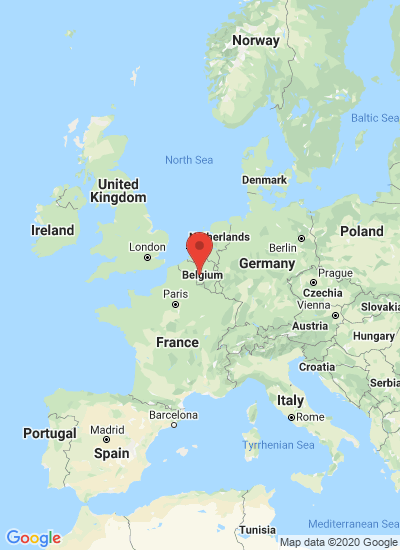
For three weeks, Belgapom recorded no free-market price because market transactions had come to a complete standstill. Processors and traders have more than enough of their contracted potatoes and are no longer buying anything on the free market. Some are even no longer collecting potatoes, even though they have paid for them to the grower. Last Friday, the price finally officially dropped to zero euros for Fontane and Challenger, following a transaction with negligible volumes.
In a vlog post, Christophe Vermeulen, CEO of Belgapom, stated that the potato sector is currently evolving further towards fully covering contract farming, now that the futures market in Leipzig is also closing permanently. But according to him, the malaise on the free market is by no means a sign that the potato sector in Flanders should be buried for good.
Christophe Vermeulen, CEO of Belgapom:
"The current reorientation is necessary, and not entirely unexpected after a decade of growth. In the short term, the cost structure needs to be put in order, but we have a robust and flexible industry with a top-quality product that will not simply disappear. Regaining confidence and the market is a slow process, but worldwide, demand for fries continues to grow by six percent. To meet this demand, a large share will continue to come from our crown lands."
¿Te gustaría recibir noticias como esta por correo electrónico? ¡Únete y suscríbete!
Get the latest potato industry news straight to your WhatsApp. Join the PotatoPro WhatsApp Community!
Empresa Destacada

Noticias relacionadas

Septiembre 28, 2026
México: menor oferta de papa podría impulsar los precios durante el invierno
En México, el cierre de cosechas, los menores rendimientos y la reducción de la superficie sembrada podrían restringir la oferta de papa y generar presión al alza sobre los precios entre diciembre de 2026 y febrero de 2027.

Septiembre 28, 2026
España: la sequía reduce la cosecha de patatas en 2026
La producción española de patata caerá entre un 8% y un 10% en 2026, hasta unos 1,8 millones de toneladas, con descensos de hasta 35% en Andalucía debido principalmente a la sequía y los menores rendimientos.

Septiembre 23, 2026
Chile: buscan mejorar el diagnóstico molecular de la sarna polvorienta y la sarna común en papa
En Chile, el proyecto SCAB-ID 2.0 busca validar un sistema de qPCR multiplex capaz de detectar y diferenciar simultáneamente la sarna polvorienta y la sarna común de la papa, con miras a transferirlo a laboratorios de diagnóstico agrícola.