

The Science and Design Behind Stackable Potato Chips
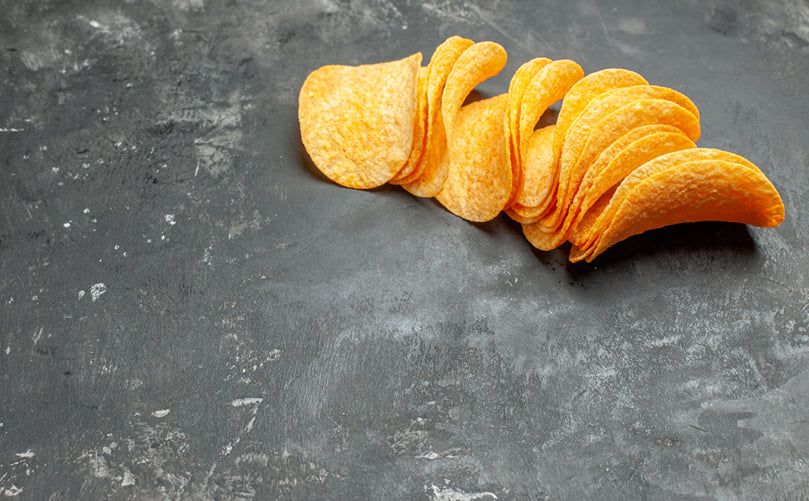
Stackable potato chips most famously Pringles are fundamentally different from conventional sliced and fried potato chips or kettle cooked varieties. They are manufactured from a reconstituted potato dough that is precisely molded into a uniform saddle shape, mathematically known as a hyperbolic paraboloid and designed to stack perfectly inside a rigid cylindrical can.
This controlled geometry and production process virtually eliminate breakage, ensure consistent texture and flavor in every piece and deliver a clean, predictable, mess free eating experience that traditional chips cannot replicate.
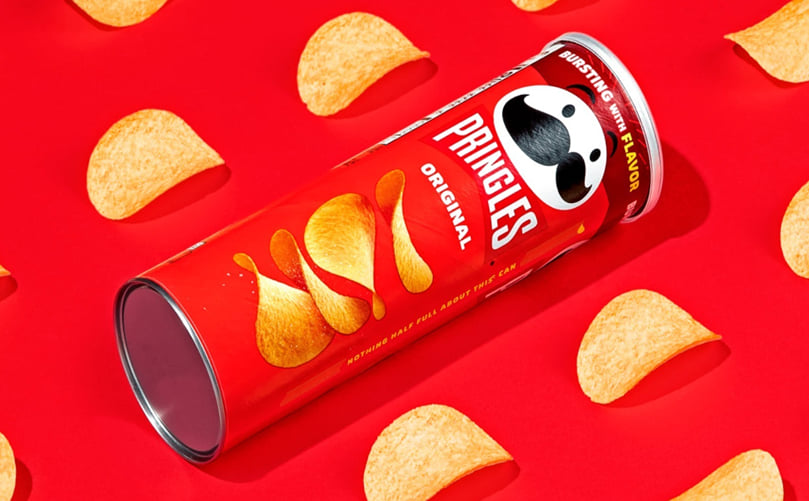
Engineered for Precision: The Hyperbolic Paraboloid Chip
Origin and Evolution of Stackable Potato Chips
Consumer complaints in the 1950s about broken, greasy, stale chips and excessive air in packaging pushed Procter & Gamble (P&G) to rethink the potato chip. In 1956, P&G assigned organic chemist Fredric J. Baur the challenge of creating a better alternative. Over the next two years, Baur developed the iconic saddle shaped chip, mathematically known as a hyperbolic paraboloid, made from fried dough. He also invented the rigid tubular can that allowed the chips to be stacked neatly while protecting them from breakage and staleness. While Baur successfully solved the structural and freshness problems, he struggled to achieve an appealing taste and texture, leading P&G to reassign him.
In the mid 1960s, the project was revived by another P&G researcher, Alexander Liepa of Montgomery, Ohio. Liepa focused on improving flavor and palatability and succeeded by formulating a dough made from dehydrated potatoes. His work perfected the eating quality of the product and his name appears on the 1976 patent (US Patent 3,998,975), even though the original shape and packaging concept were Baur’s innovations. Around the same time, mechanical engineer Gene Wolfe, who later became a renowned science fiction author, designed the specialized cooking equipment that enabled efficient mass production.
Pringles were first launched in 1968 in Indiana test markets under the name “Pringle’s Newfangled Potato Chips.” Initial consumer response was lukewarm and the product was initially considered as a commercial failure. However, steady improvements in marketing and growing consumer acceptance helped the brand gain momentum during the 1970s. Pringles expanded nationally by 1975 and entered international markets by 1991. The origin of the name “Pringles” remains debated, with theories ranging from a 1937 potato processing patent by Mark Pringle to a nearby street name or simply a name chosen for its pleasant sound.
Fredric J. Baur remained deeply proud of his invention throughout his life. In a final tribute to his work, when he passed away in 2008, his family placed a portion of his ashes inside an original Pringles can before burial. The brand’s ownership has since evolved significantly. P&G sold Pringles to Kellogg’s, now known as Kellanova, in 2012 and in 2024 Kellanova was acquired by Mars Inc. Today, Pringles are sold in more than 140 countries worldwide, standing as one of the most iconic examples of engineered snack food design.
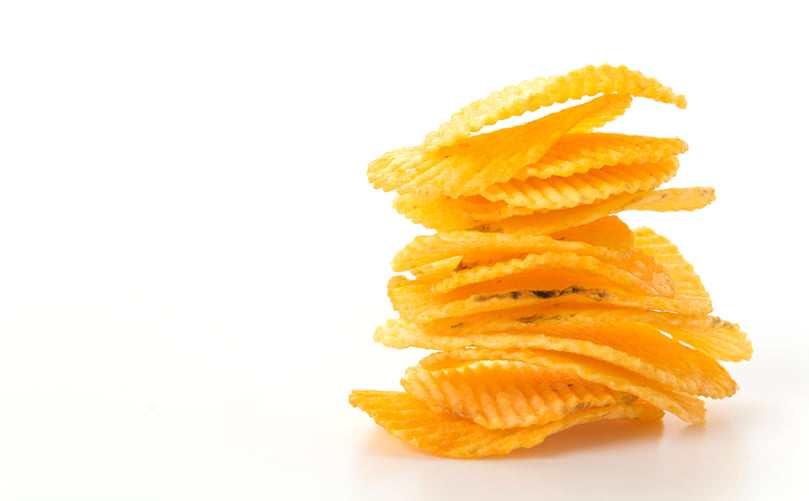
The Engineered Curve That Changed Potato Chips
Precision Ingredients Behind Perfectly Uniform Stackable Chips
Unlike traditional potato chips made from freshly sliced potatoes, which naturally vary in size, moisture content, starch levels and sugar composition, stackable chips begin with dehydrated potato flakes or granules that make up roughly 42% of the final product by weight. This highly controlled raw material base eliminates natural variability and enables exceptional uniformity in shape, texture and flavor.
According to the official ingredient label for Original Pringles, the formulation includes dried potatoes, vegetable oil sourced from corn, cottonseed, canola, high oleic soybean and/or sunflower, degerminated yellow corn flour, cornstarch, rice flour, maltodextrin, mono and diglycerides used as emulsifiers, salt and wheat starch.
The remaining approximately 58% of the formulation consists primarily of starches and flours derived from rice, wheat and corn. These components are essential for forming a stable, low moisture, pourable dough that can be precisely molded. Emulsifiers contribute to a smooth, uniform texture, while maltodextrin enhances flavor adhesion and supports the development of a crisp bite during frying. Because the potato content is below 50% and the product is molded rather than sliced directly from whole potatoes, stackable chips have historically been classified in several countries, including the UK and the US, as “potato crisps” rather than traditional “potato chips.” This distinction became the basis of a high profile UK VAT tax dispute between 2008 and 2009, which Procter & Gamble ultimately lost.
This carefully engineered formulation ensures that every chip delivers identical color, thickness, flavor and crunch, a level of consistency that is virtually impossible to achieve with fresh potato slicing methods.
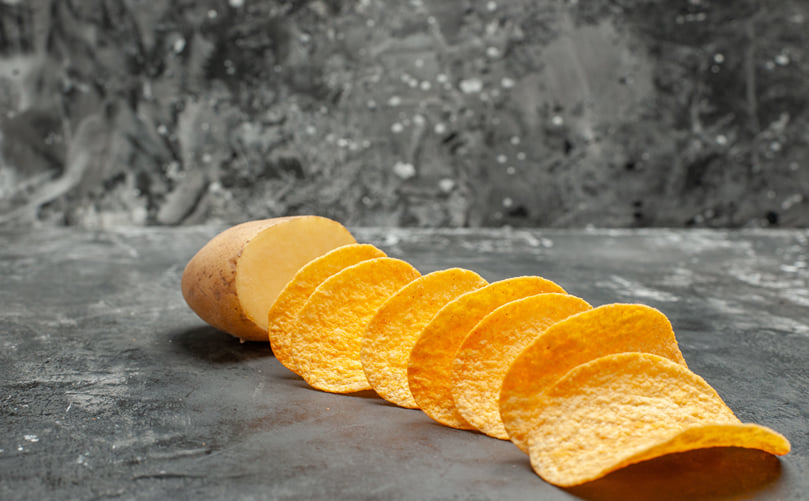
From Standardized Inputs to Perfect Stacks
Engineering Consistency: How Stackable Potato Chips Are Made
The production of stackable potato chips such as Pringles is a highly automated, precision engineered operation designed to deliver absolute consistency in shape, thickness, texture and quality. Unlike traditional sliced potato chips, where natural variation in raw potatoes affects frying behavior and final texture, stackable chips are made from a reconstituted, low moisture dough. This allows extremely fast cooking, precise molding and a level of uniformity that conventional chip manufacturing cannot achieve.
The process begins with ingredient preparation and dough mixing. Dehydrated potato flakes or granules are first sifted and quality checked to remove oversized particles. These are then blended with water, vegetable oils, corn flour, cornstarch, rice flour, maltodextrin, mono and diglycerides, salt and wheat starch under tightly controlled conditions. The typical formulation results in a thick but pourable dough, often described as a “potato paste,” with roughly one third water to two thirds dry ingredients. The dough is fluid enough to flow smoothly through funnels and onto conveyors, yet stable enough to hold its structure during shaping.
Next comes sheeting and cutting. The dough is deposited onto a moving conveyor belt and compressed into a thin, uniform sheet using augers and heavy rollers that apply several tons of pressure. This step ensures consistent thickness across the entire sheet. A rotary cutting system then stamps out precise oval shapes, commonly referred to as “dough-vales,” which serve as the base form for each chip.
Immediately after cutting, the soft dough-vales are molded into the signature saddle shape, mathematically known as a hyperbolic paraboloid. Specialized forming molds press each piece into this exact curvature while the dough is still pliable. This shaping technology, refined through engineering innovations developed during the product’s early years, is critical for ensuring stack ability, structural strength and the distinctive mouthfeel of the finished chip.
The shaped chips then move through a rapid frying stage. They are submerged in hot vegetable oil typically corn, cottonseed, high oleic soybean or sunflower oil for only about 11 to 15 seconds. Because the dough starts with low moisture content water is driven off very quickly, allowing the chips to become crisp without excessive oil absorption or overcooking. After frying, jets of air remove surface oil to further standardize fat content.
Seasoning is applied using a controlled “waterfall” system, where fine seasoning powders fall evenly onto the chips as they pass beneath. Unlike the tumbling drums used for bagged chips, this method allows precise placement and dosage. Most flavors are applied primarily to one side of the chip, typically the side that faces upward when stacked in the can with some redistribution occurring naturally during stacking.
Finally, the chips are automatically stacked, inspected and packaged. Machines align the chips into neat columns, reject defective pieces using optical inspection systems and slide the stacks into foil lined cylindrical cans. The cans are sealed to protect freshness and fitted with resealable lids. From raw dough to a finished, shelf ready can, the entire process takes roughly 20 minutes and modern facilities operate continuously, producing millions of chips per day.
This combination of precise moisture control, high pressure forming, ultra short frying times and fully automated stacking is what enables stackable potato chips to achieve unmatched consistency on a global scale.
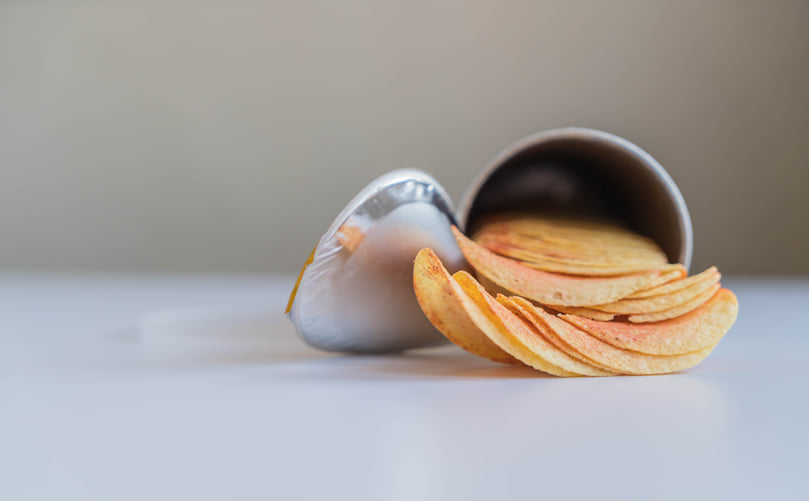
From Dough to Can: The Engineered Journey of Stackable Chips
Texture, Mouthfeel and Eating Experience
Stackable chips deliver a signature light, airy crispness with a clean, uniform crunch that feels carefully engineered and highly predictable. The molded saddle shape controlled low moisture content and brief frying time create a thin, brittle structure that snaps cleanly without excessive oiliness or irregularity.
Consumers often describe the mouthfeel as smoother, less greasy and more “refined” than traditional potato chips, which can have random thick or thin spots and occasional chewiness. The crunch is loud and satisfying research indicates that louder crisp sounds make food seem up to 15% fresher and crisper contributing to the iconic “once you pop” appeal.
In comparison: traditional thin chips tend to be oilier and more variable in texture, with some pieces soggy and others overly hard, while kettle chips are thicker, heartier and have a rustic chew with uneven crunch. Pringles feel lighter and cleaner in the mouth, making them ideal for extended snacking without mess or fatigue. Some consumers note that recent batches can feel slightly flakier or dustier, but the core engineered lightness remains a major draw.
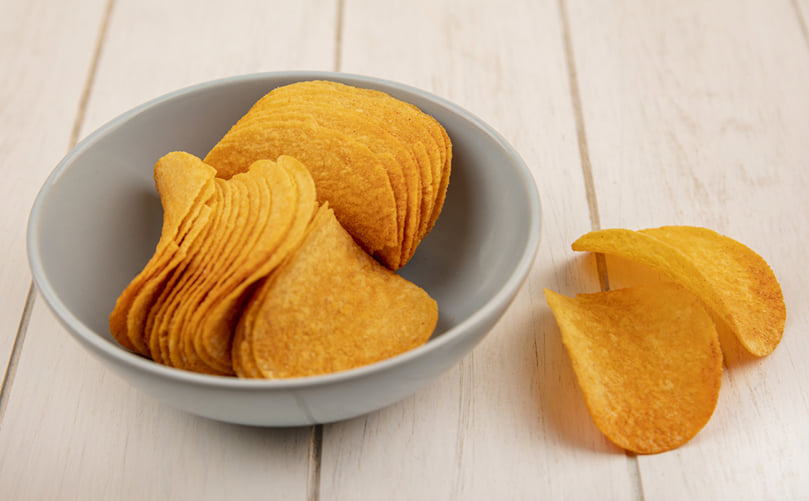
Engineered Crunch: The Sensory Signature of Stackable Chips
Flavor Delivery and Seasoning Performance
The smooth, uniform surface of stackable chips promotes even seasoning distribution. Pringles use a “waterfall” seasoning method, which applies powder primarily to one side the concave or top side that faces upward in the can. This approach results in stronger initial flavor when eaten “correctly” (top side down on the tongue, as recommended by Kellanova/Pringles), while gradual flavor transfer during stacking ensures a balanced taste across the entire stack without clumping.
This system works especially well for subtle, consistent flavors such as Original or Sour Cream & Onion, offering uniform taste with minimal mess, unlike kettle chips, which can have uneven seasoning and occasional overpowering spots. For bolder flavors, the precision of the stackable chip design prevents flavor overload, ensuring each bite remains predictable and enjoyable.
The flavor delivery in stackable potato chips like Pringles is carefully engineered through a combination of their uniform hyperbolic paraboloid shape, smooth molded surface and a specialized “waterfall” seasoning application, which differs significantly from the tumbling barrels used for traditional bagged chips. After frying, the warm chips still slightly moist from the brief 11–15 second oil bath move along a conveyor beneath fine nozzles or rotating drums that create a cascading “curtain” of powdered seasoning. This powder typically consists of salt, maltodextrin, flavorings such as onion or cheese derivatives and colorants, customized for varieties like Original, Sour Cream & Onion or BBQ.
This method primarily seasons the convex “top” side of each chip, the surface that faces upward during conveyance and becomes the outer curve in the stack. Approximately 70–80% of the seasoning adheres to this top side, aided by residual post fry oil acting as a natural binder, while maltodextrin further improves adhesion without causing clumping. The concave “bottom” side receives minimal direct seasoning about 20–30% but during automated stacking in the can, subtle flavor transfer occurs through surface contact and humidity equilibration. The result is a balanced overall taste, with the original variety containing roughly 1.0–1.2% salt by weight.
From a scientific perspective, the saddle shape’s double curvature (described by the equation 𝑧 = 𝑥 2/ 𝑎 2 − 𝑦 2 /𝑏 2where a and b define the paraboloid’s uniformity) promotes even flavor perception. The smooth, non-porous surface minimizes seasoning shedding less than 5% loss compared to 15–20% in tumbled chips reduce mouth coating residue and ensures predictable flavor release during chewing. The initial top side burst delivers an intense hit to the taste buds, followed by the base potato notes. Sensory studies also show that the loud, clean crunch created by the brittle, uniformly fractured chip amplifies perceived freshness and flavor by 10–15%, as acoustic feedback tricks the brain into experiencing a crispier, more flavorful bite.
This system performs well for both subtle and bold flavors, including global varieties like Wasabi or Jalapeño, with batch-to-batch variability under 2%, compared to 10–15% in continuously fried chips. It ensures even seasoning distribution without overwhelming the palate, making it ideal for repetitive snacking. Limitations include a one sided flavor bias optimal taste occurs when eaten convex side down on the tongue and reliance on engineered binders to maintain adhesion.
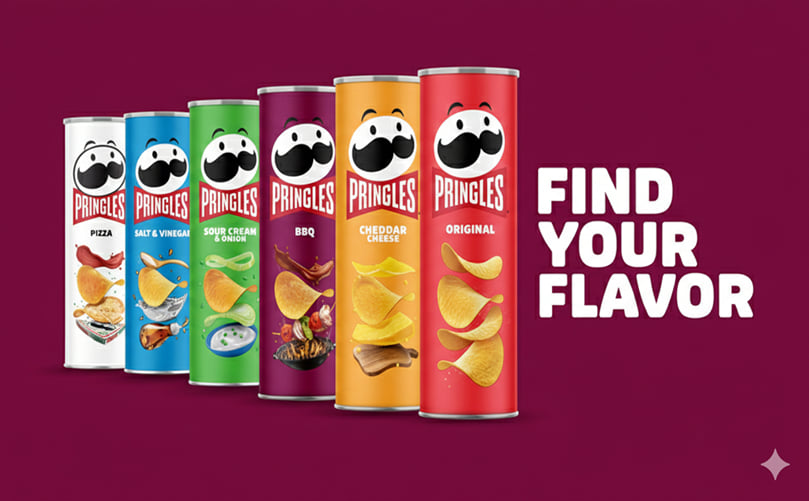
Engineered Flavor, Applied with Precision
Engineered Packaging: Maximizing Shelf Life and Efficiency
The cylindrical can co-invented by Fredric J. Baur is a rigid steel or aluminum tube, typically in the 7.1 oz (200 g) size, measuring approximately 10 cm in diameter and 23 cm in height. It features a foil polymer liner, vacuum sealed to less than 50 mbar and a resealable plastic lid. This design achieves a near zero oxygen transmission rate (OTR < 0.8 cc/m²/day), providing a shelf life of 6–9 months, compared to 4–6 weeks for nitrogen-flushed bags.
The stackable saddle shape of the chips interlocks with less than 1 mm of play, preventing over 95% of breakage during transit compared with 20–30% fragmentation in traditional bagged chips. This design also improves logistics: cylindrical cans can be palletized 1.5–2 times more densely than bags (approximately 1,200 cans vs. 600 bags per pallet), reducing shipping volume by around 30% and minimizing damage claims.
The vacuum sealed foil barrier protects against moisture (water activity < 0.3), light and lipid oxidation, preserving crispness (moisture regain < 2% over six months) and flavor volatiles, such as hexanal and ketones (<10% loss). Portion control is enhanced by the “pop and stop” resealable lid, allowing consumers to moderate intake roughly 15–16 crisps per serving.
Recent innovations include paper fiber bottoms, which are 95% recyclable and maintain airtightness through proprietary welding. This reduces plastic and metal use by up to 50% while retaining a low OTR. Limitations of the cylindrical can include higher material costs about 20–30% more than standard bags and added recycling complexity due to multi-layer separation requirements.
Globally, this packaging format supports distribution in over 140 countries with a product rejection rate of less than 1%, combining superior protection, shelf stability and logistical efficiency.
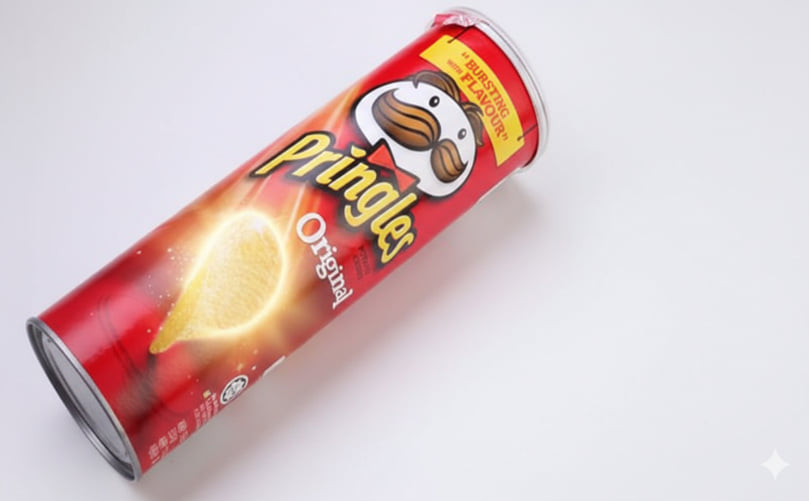
Packaging as Engineering, Not Just a Container
Balanced Nutrition and Health Considerations of Stackable Chips
A standard 28 g serving of Original Pringles approximately 15–16 crisps provide 150 kcal, with total fat of 9 g (32% DV), including 2.5 g saturated fat (13% DV) and 0 g trans-fat. Sodium content ranges from 150–170 mg (7% DV), total carbohydrates 17 g (6% DV), dietary fiber <1 g (3% DV), total sugars 0 g and protein 1 g (2% DV). Micronutrients include potassium at around 150 mg (3% DV). The fat profile is roughly 50% polyunsaturated (from high oleic oils), 29% saturated and 21% monounsaturated.
The Reduced Fat variant contains approximately 25% less fat, providing 140 kcal per 28 g serving, with 7 g fat (2 g saturated) and 130 mg sodium. This reduction is achieved through starch modifications that lower oil absorption from about 33% to 21% of product weight, decreasing overall calories from 540 kcal/100 g to 479 kcal/100 g. The uniformity of stackable chips ensures precise portion sizes, aiding calorie tracking and consistent intake. Benefits include a lower glycemic response due to controlled starch gelatinization, no cholesterol or trans fats and predictable sodium content for those monitoring intake.
Criticisms focus on the ultra-processed nature of the product (classified as NOVA Group 4) due to the combination of 42% potato flakes and 58% starches and emulsifiers. Compared with some traditional sliced chips, Pringles contain higher saturated fat (2.5 g vs. 1.5 g per serving in Lay’s) and sodium levels that could pose risks for hypertension. Additives like mono and diglycerides and maltodextrin may contribute to overconsumption. Some studies indicate that nutrition labels may underestimate calories by approximately 4.3% due to carbohydrate measurement methods. Additionally, the perception of being “less real” potato has contributed to a “fake chip” stigma, though label variances remain within FDA tolerances.
Overall, stackable chips offer convenience and portion control, making them suitable for moderation, but they should not be considered a health food. They are best enjoyed as an occasional treat rather than a dietary staple.
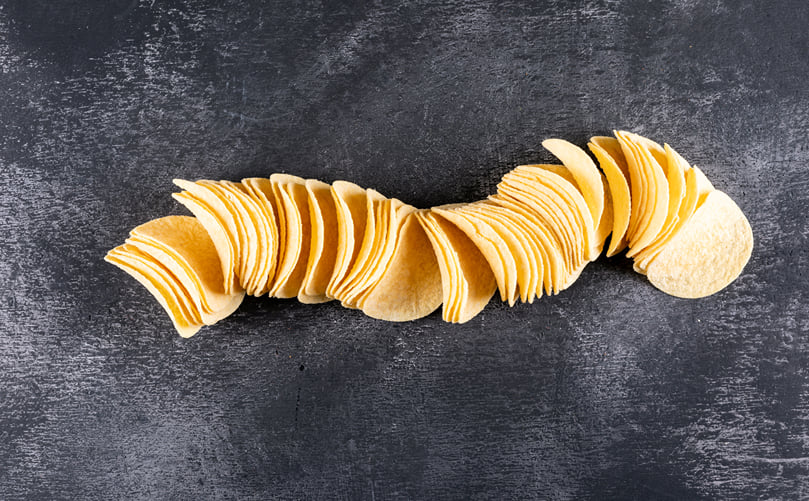
Understanding the Nutrition Behind the Stack
Consumer Appeal and Usage Occasions
Stackable potato chips appeal strongly to convenience seekers across multiple demographics. Young adults aged 18–34, of whom 42% prefer bold flavors, families seeking a no mess snack for children and urban professionals looking for on-the-go options comprise a significant portion of the market approximately 57.5% of consumers seeking “experiential” snacking. Market research indicates that Pringles generate around USD 3 billion in revenue, driven by portability (ideal for travel or lunchboxes), shareability at parties and sports events and gifting, thanks to the iconic stackable can.
Common usage occasions include solo snacking during commutes, where urban appeal is highest (65%), social sharing at parties with the fun “duck bill” eating experience, travel and gifting thanks to breakage resistant packaging and office or midday snacking that keeps hands clean. In humid climates such as Bengaluru, consumers particularly value that the chips maintain crispness longer. Loyalty is reinforced by the predictable texture and flavor of stackable, in contrast to the variability often experienced with kettle cooked or traditional sliced chips.
From Solo Snacks to Social Sharing
Innovation, Flavors and Future Trends
Pringles continues to innovate through product reformulation, new cooking techniques and expanded ingredient profiles. Reduced fat variants achieve approximately 25% less fat through starch modifications, lowering oil absorption to 21%, while baked and popped options, such as Poptillas, offer reduced fat and zero cholesterol. Multigrain and fortified lines incorporate added fiber and protein to appeal to health-conscious consumers.
The brand offers over 100 global flavors, including staples like Sour Cream & Onion, BBQ, Wasabi and Pizza, as well as limited edition varieties such as Hot Ones and Sharp White Cheddar. Bold and spicy flavors account for approximately 42% of Gen Z sales, highlighting the demographic’s preference for experiential and adventurous snacking.
Emerging trends focus on sustainability, alternative ingredients and personalization. Packaging innovations include 95% recyclable paper-based cans, backed by significant investments (€50 million), while oil alternatives such as avocado or high oleic oils reduce saturated fat. Clean label initiatives aim to lower sodium and minimize additives and AI driven flavor matching offers the potential for personalized taste experiences. Research continues to refine starch-based fat reduction achieving up to an 11% decrease and extruded hybrid formats expand textural possibilities.
Key challenges remain, including the ultra-processed stigma and strong competition from baked, organic and traditional snacks. Looking ahead, future developments are likely to include fortified options with added vitamins, zero waste packaging solutions and region specific flavors tailored to local tastes, such as masala variants for the Indian market.