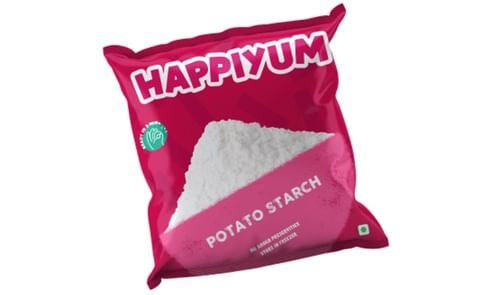

Native Potato Starch: What It Is, Properties and Applications
Native potato starch is a refined, unmodified starch extracted from the tubers of Solanum tuberosum (potato). It is produced through mechanical separation and purification processes that isolate the natural starch granules without chemically modifying them. As a major commercial starch alongside maize (corn) and wheat starch, potato starch is used in food, pharmaceutical, paper, textile and other industrial applications worldwide.
Native potato starch is valued for its high paste viscosity, good clarity, strong water-binding capacity, and neutral taste and odor. These properties make it useful as a thickener, binder, stabilizer and texture modifier in a wide range of products. Potato starch is also naturally gluten-free, making it suitable for many gluten-free food formulations.
Unlike modified potato starch, native potato starch retains the natural characteristics of the starch as it occurs in the potato. Its functional properties are influenced by factors such as potato variety, starch granule size, amylose and amylopectin content, phosphate groups and processing conditions. These characteristics give potato starch its distinctive performance in food and industrial applications.
Native Potato Starch: Properties and Applications
What Is Native Potato Starch?
Native potato starch is the purified starch extracted from potato tubers (*Solanum tuberosum*) without any chemical, enzymatic, or intentional physical modification of the starch molecules themselves. It is produced mainly through mechanical methods that separate and clean the natural starch granules while keeping their original chemical structure unchanged.
Potato starch is one of the major commercial starches, along with maize (corn) and wheat starch. It is widely used in food, pharmaceutical, paper, textile, and other industrial applications.
Native potato starch consists mainly of two glucose polymers: **amylose and amylopectin**. Amylose is a mostly linear chain of α-1,4-linked glucose units, while amylopectin is a highly branched molecule containing α-1,6 branch points. Commercial potato varieties typically contain about **18–25% amylose and 75–82% amylopectin**, although the proportion can vary, with reported amylose levels ranging from approximately **15–30% or higher depending on the cultivar**.
One of the distinctive characteristics of potato starch is its naturally occurring **phosphate monoester groups**. Potato amylopectin contains relatively high levels of these phosphate groups, commonly reported at around **500–1,000 ppm phosphorus**, often close to **800 ppm**. They are mainly attached to the C-6 and C-3 positions of glucose residues. These naturally occurring phosphate groups contribute to the characteristic **high swelling power, high viscosity, and good paste clarity** of potato starch.
In the potato tuber, starch is stored as discrete **starch granules**. Potato starch granules are characteristically large and are generally oval to spherical in shape, with sizes ranging from approximately **5 to 100 μm** in diameter. Many commercial potato starches have granules averaging around **20–50 μm or larger**.
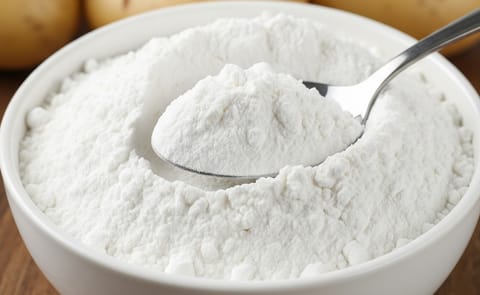
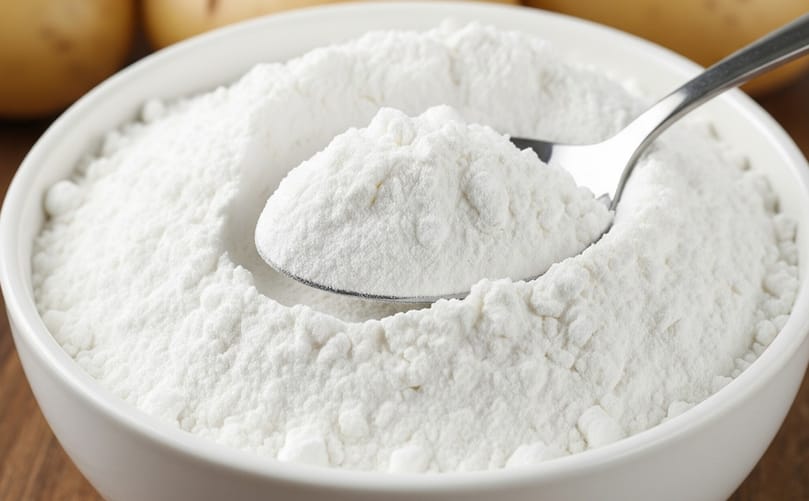
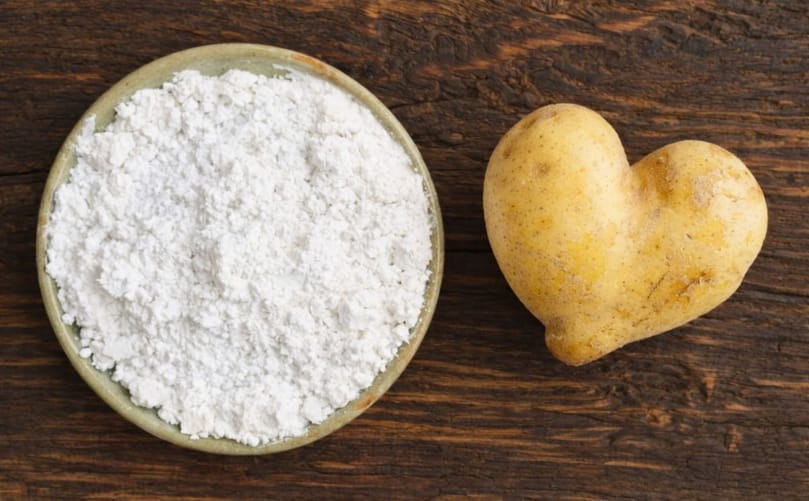
After proper extraction and purification, native potato starch is obtained as a **fine white powder** with very low levels of residual protein, lipid, and fiber. It commonly contains **more than 98–99% carbohydrate on a dry basis**, while the moisture content of commercial native potato starch is typically around **17–20%**.
Because native potato starch is produced through mechanical separation, purification, and drying without intentionally changing the starch molecules, it is generally considered an **unmodified starch**. It is distinct from **modified potato starch**, which has been deliberately altered to improve specific functional or processing properties.
Native potato starch is also different from **potato flour**. Potato flour contains a broader range of potato components, including fiber, protein, and other potato solids, whereas native potato starch is a highly purified starch fraction.
The natural properties of native potato starch make it useful as a **thickener, binder, stabilizer, and texture modifier**. It is used across a wide range of applications, including food, pharmaceuticals, paper, textiles, and other industries.
Understanding Native Potato Starch