

Aeroponics: Revolutionizing Potato Minituber Production for Sustainable Farming
Aeroponics is an innovative soilless cultivation method that suspends plant roots in the air while delivering nutrients through a fine mist, promoting accelerated growth and high-quality potato mini tuber production. Developed initially for space exploration and adapted for terrestrial agriculture, it minimizes disease risks and resource consumption compared to traditional soil based or hydroponic systems.
This technology has shown potential to produce yields of 60–80 minitubers per plant, far surpassing the 5–10 achieved in conventional field conditions making it a valuable tool for addressing seed shortages in resource-limited areas. By optimizing environmental controls and nutrient delivery, aeroponics supports sustainable potato farming, enhancing resilience against climate challenges and contributing to global food security efforts.
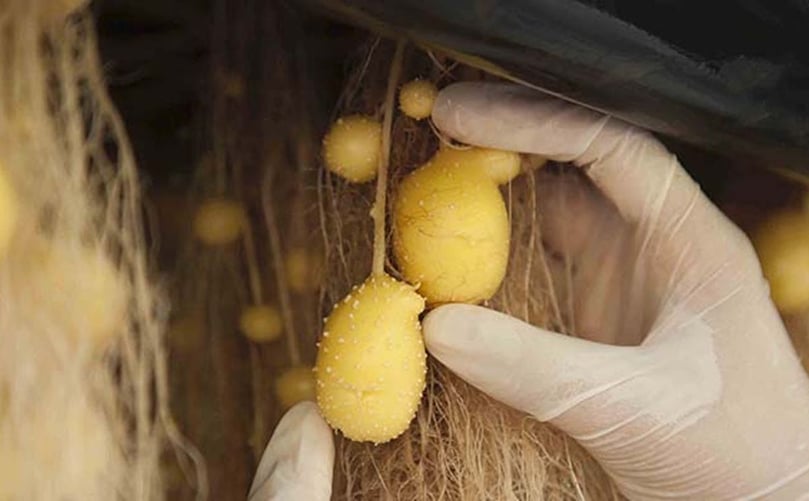
Potato minitubers growing in aeroponic setup
What is Aeroponics?
Aeroponics is an advanced form of soilless cultivation in which plants are grown without any solid growing medium and their roots are suspended in air while being periodically misted with a nutrient rich solution. The system uses high pressure atomizers to produce ultra fine droplets (5–50 microns), ensuring efficient nutrient absorption and maximum oxygen exposure to the roots.
In potato production aeroponics has proven especially effective for generating disease free minitubers, since the absence of soil eliminates risks from soil borne pathogens and nematodes. The controlled environment allows precise management of temperature, humidity and nutrient composition, resulting in uniform, vigorous tubers with accelerated growth rates.
Compared to conventional methods, aeroponics can achieve up to tenfold higher yields per unit area, while reducing water and fertilizer use by up to 90% making it both resource efficient and sustainable. This technology is increasingly integrated into vertical farming systems, optimizing limited space in urban or high-tech greenhouse setups. Recognized by the International Potato Center (CIP) and other global research institutions, aeroponics is reshaping modern seed potato production through its potential for rapid multiplication, biosecurity and scalability.
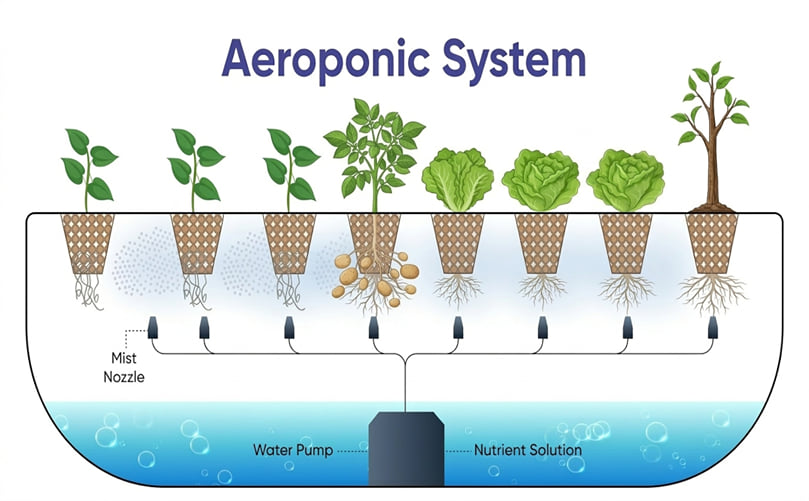
Illustrated aeroponic system with nutrient mist nozzles
Principles of Aeroponics in Potatoes
Aeroponics represents a cutting-edge soil less cultivation technique in which potato plants are grown with their roots suspended in air and periodically misted with a nutrient rich solution. This method delivers water, nutrients and oxygen directly to the root zone, bypassing the limitations of soil or substrate media. The result is a highly efficient environment that promotes accelerated growth, enhanced nutrient uptake and superior plant health.
In aeroponic potato systems, high pressure misting nozzles (80–100 PSI) generate ultra fine droplets (10–50 microns) that coat the entire root surface, ensuring optimal hydration and aeration. This environment increases root respiration and metabolic activity leading to 20–30% faster growth and improved tuber initiation rates. The system typically operates under controlled climatic conditions with temperatures maintained between 20–25°C, relative humidity around 70–80% and nutrient solution pH between 5.8 and 6.2 to promote tuberization.
Aeroponics achieves exceptional resource efficiency, using up to 95% less water than soil-based methods through nutrient recirculation and even 90% less water than hydroponics. Moreover, because roots are never exposed to soil the system virtually eliminates soil borne pathogens and supports disease free mini tuber production making it ideal for pre-basic and basic seed multiplication programs.
Research and large-scale trials have demonstrated that aeroponically produced mini tubers show superior physiological uniformity, higher multiplication rates and slower degeneration across generations compared to conventional tuber propagation. This precision-controlled system thus plays a pivotal role in modern seed systems, enhancing both seed quality and sustainability while aligning with climate smart and biosecure agricultural practices.
Historical Evolution of Aeroponics in Potatoes
The concept of aeroponics originated in the 1940s, inspired by early experiments in soilless plant culture conducted to explore sustainable food production in confined environments, notably within NASA’s space farming programs. These studies laid the groundwork for the controlled misting systems that would later revolutionize agricultural propagation.
The application of aeroponics to potatoes began in the 1980s through pioneering work at the International Potato Center (CIP) in Lima, Peru. Researchers sought efficient, disease-free propagation techniques to address the recurring challenges of virus accumulation and degeneration in vegetatively propagated potato seed systems. This innovation enabled the large-scale production of clean mini tubers, setting a global benchmark for pre-basic seed generation.
During the 1990s, aeroponic potato technology gained traction in Colombia, Ecuador and other Latin American countries, supported by CIP’s detailed manuals and regional training initiatives. These efforts established the first commercial aeroponic seed production facilities, significantly improving the availability and quality of planting material for smallholders.
In the 2000s and 2010s, the technology expanded to Asia and Africa, with India, Kenya and Pakistan launching pilot programs and research collaborations to enhance seed system efficiency. These initiatives demonstrated aeroponics’ potential for scaling clean seed production in tropical and subtropical environments, where traditional seed multiplication faced climatic and pathogen-related constraints.
Modern aeroponic systems now integrate NASA’s oxygen enriched misting principles with advanced agricultural engineering, automation and nutrient management. This synergy has transformed aeroponics into a core component of sustainable potato seed production, supporting the global shift toward climate smart, high efficiency and bio-secure seed systems.
Components and Functioning of an Aeroponic Potato Cultivation System
An aeroponic system for potato cultivation is an integrated, precision-controlled environment designed to optimize root aeration, nutrient delivery and disease-free growth. It consists of several core components, each contributing to the efficient production of high-quality mini tubers.
The system includes enclosed growth chambers or aeroponic units that support suspended potato plants keeping roots exposed to an oxygen rich atmosphere. High pressure pumps connected to atomizing nozzles (operating at 80–100 PSI) generate a fine nutrient mist of 10–50 microns, ensuring uniform coverage and efficient nutrient absorption. A nutrient reservoir stores the fertilizing solution, which is continuously recirculated and filtered to reduce waste and maintain optimal chemical balance.
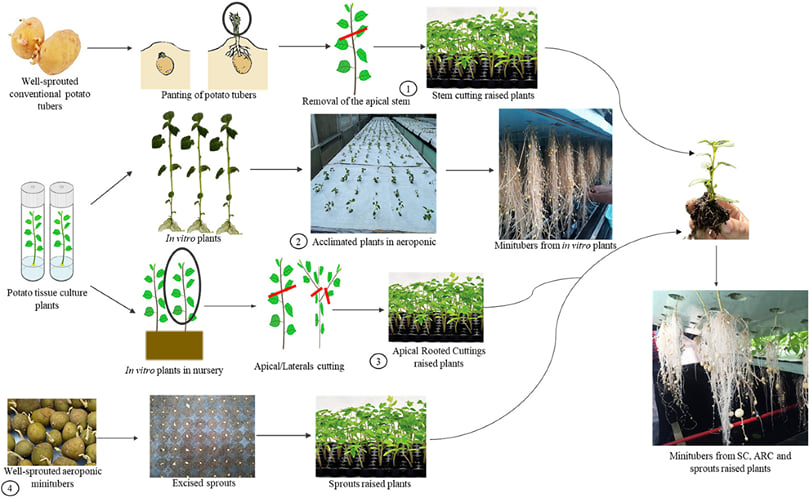
Sensors and automated controllers regulate key parameters such as temperature, humidity, pH and electrical conductivity (EC), ensuring the environment remains conducive for tuberization. Prior to setup, chambers and components are sterilized using UV light or mild disinfectants to eliminate contamination risks. In-vitro plantlets or apical cuttings are then placed into net pots or foam holders, suspended above the misting zone.
To support photosynthesis, LED lighting systems emitting red (≈660 nm) and blue (≈450 nm) wavelengths provide targeted illumination, while programmable timers control misting intervals typically every 5–10 minutes to balance hydration and oxygenation. Vertical stacking systems and modular units enable space efficient expansion from small research labs to full scale commercial production.
Proper calibration of misting pressure and nozzle placement is critical to achieving uniform nutrient distribution, which directly influences tuber size uniformity, yield consistency and overall system efficiency. When maintained correctly, this setup can produce high quality, pathogen free mini tubers at multiplication rates several times higher than conventional soil or hydroponic methods.
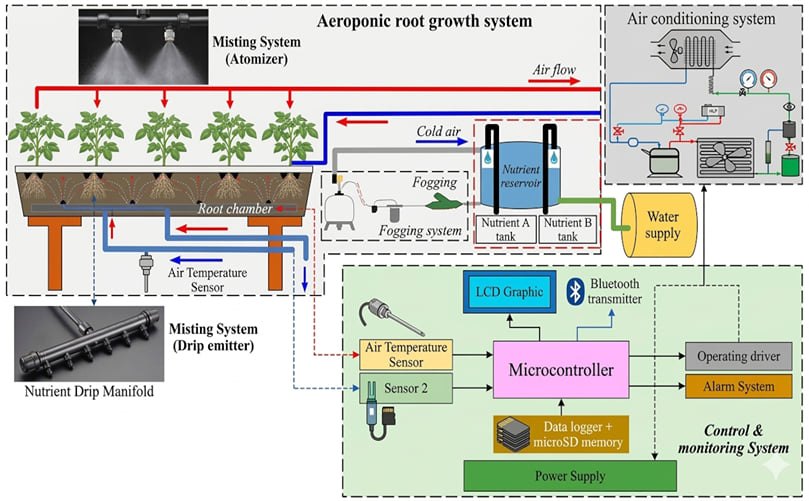
Schematic Representation of Aeroponic System for Potato Cultivation
Aeroponic Potato Production Process
Production in aeroponic systems begins with the use of in-vitro plantlets or micro propagated shoots, which serve as disease free starter material derived from tissue culture. These plantlets are carefully inserted into aeroponic chambers, where their roots are suspended in air and exposed to intermittent nutrient misting cycles typically every 5–10 minutes delivered through high pressure nozzles.
The nutrient solution supplied during these misting intervals commonly follows an NPK ratio of 5:10:10, tailored to encourage root and tuber development and is enriched with essential micronutrients such as zinc (Zn), iron (Fe), manganese (Mn) and boron (B). Automated recirculation systems ensure continuous nutrient availability while minimizing waste.
Environmental controls play a critical role in maintaining optimal growth conditions: temperatures are held between 20–25°C, relative humidity between 70–80% and photoperiods of 12–16 hours are provided using LED lighting with balanced red and blue spectra. Under these parameters, plants typically undergo 8–12 weeks of growth before minitubers are harvested.
The use of tissue cultured plantlets guarantees virus free propagation, enabling multiple harvest cycles per year and ensuring the production of genetically stable, high quality seed material.
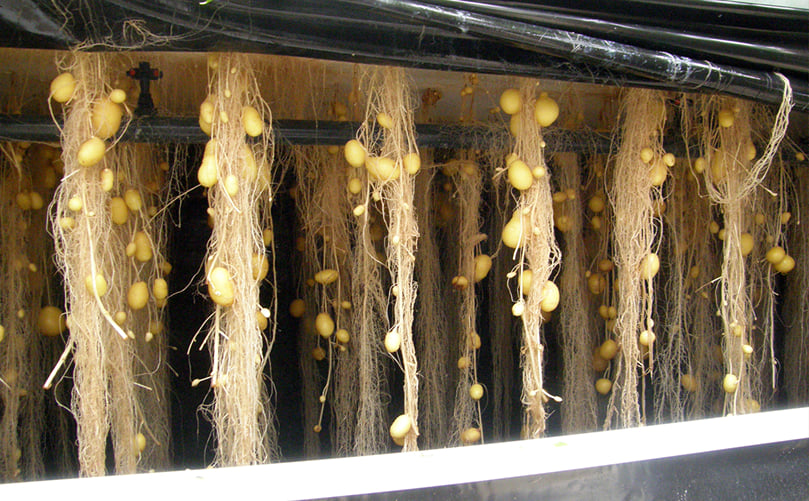
Mature aeroponic potato plants with mini tubers
Recent technological innovations have further advanced aeroponic efficiency. IoT-enabled sensors and automation systems now allow for real time monitoring and adjustment of pH, EC, temperature and nutrient concentrations, maintaining consistent environmental conditions. Hybrid systems which combine misting with partial nutrient submersion have been developed to enhance root resilience under variable conditions.
Additionally, vertical aeroponic towers and AI-optimized lighting systems have significantly improved space utilization and energy efficiency. Studies have reported up to a 30% increase in tuber yield and uniformity in such adaptive systems compared to conventional aeroponic setups, underscoring their potential for scalable, climate smart seed potato production.
Mature aeroponic potato plants with mini tubers
Nutrient Solutions for Potatoes in Aeroponics
Nutrient formulations are tailored for potato growth stages: vegetative phases require higher nitrogen (e.g., 200-250 ppm), while tuberization benefits from increased potassium and phosphorus (300-400 ppm each). Solutions often include Hoagland's formula modified with calcium nitrate, magnesium sulfate and trace elements like boron and molybdenum to prevent deficiencies. pH is maintained at 5.8-6.2, with electrical conductivity (EC) between 1.5-2.5 mS/cm. Recirculation minimizes nutrient waste, but regular monitoring prevents buildup of salts. Research shows optimized solutions can boost tuber numbers by 20-30%, with biofortified variants enhancing micronutrient content like iron and zinc for nutritional improvement.
Comparative Analysis with Conventional and Soilless Methods
Aeroponics offers significant advantages over traditional soil-based systems and other soilless methods, positioning it as a transformative approach for potato cultivation. Compared to conventional soil-based methods, aeroponics eliminates soil borne diseases such as Rhizoctonia and Fusarium, which can reduce yields by 20-30% in traditional fields while drastically cutting water use by up to 95% through its mist based nutrient delivery system.
This efficiency translates to a remarkable yield of 60–80 mini tubers per plant a stark contrast to the 5–10 mini tubers typically achieved in soil-based agriculture, driven by optimized root exposure and nutrient absorption. When pitted against hydroponics, another soilless technique, aeroponics further reduces water consumption by approximately 90% hydroponics relies on continuous sub erosion or flooding, using 10 times more water than aeroponics and enhances root oxygenation by 25-30% due to intermittent misting, resulting in a productivity boost of 30–50% in terms of mini tuber output.
The use of Apical Rooted Cuttings (ARC) in both systems supports mini tuber propagation but aeroponics stands out with its superior virus free output, leveraging tissue culture to achieve a 95% disease free rate and its resource efficiency requiring only 5-10% of the water and 20% of the nutrient input of hydroponics. However, the initial setup costs for aeroponic systems remain a challenge with small scale units ranging from 40,000 USD to 50,000 USD depending on automation levels as reported by the International Potato Center (CIP) in recent studies.
Despite this, research from Vietnam and Indonesia, conducted in disease prone lowland and highland regions, demonstrates 20–30% yield gains, attributing success to tailored nutrient mixes and LED optimization. A persistent technical hurdle however, is achieving uniform misting across large scale setups, where pressure variations (20-50 pounds per square inch) can lead to uneven growth, necessitating advanced nozzle designs and real time monitoring systems that are currently under development.
Key Benefits and Economic Advantages of Aeroponics
Yield Enhancement: Aeroponics offers a substantial improvement in seed potato multiplication efficiency, achieving 30–50% higher yields than conventional hydroponic systems. Each plant can produce 60–80 high quality mini tubers, effectively addressing the seed bottleneck that limits productivity in traditional potato farming. The high propagation rate allows for rapid multiplication within confined spaces, enabling consistent seed supply across multiple growing cycles. This intensive yet sustainable production model supports both research institutions and commercial seed enterprises in scaling clean seed availability.
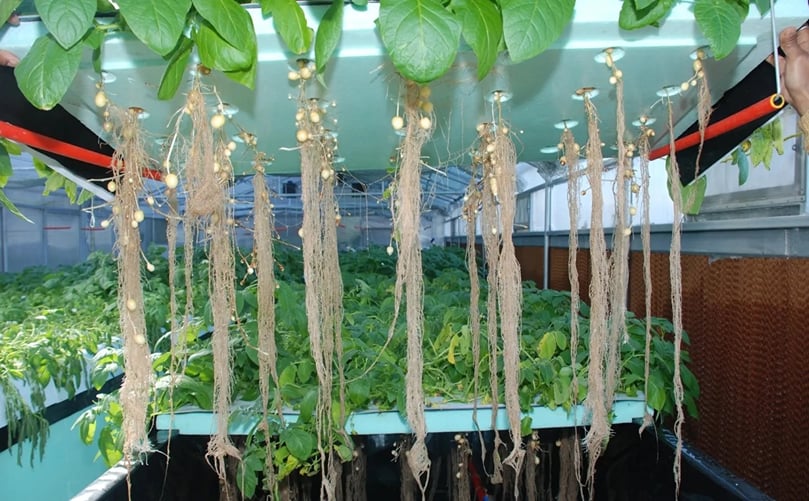
Disease Control: By eliminating soil as a growth medium, aeroponics removes major sources of pathogen transmission including Phytophthora infestans (late blight), Rhizoctonia solani and Ralstonia solanacearum (bacterial wilt). As a result, over 95% of the output qualifies as pure G0 (generation zero) minitubers, free from tuber borne viruses. This drastically reduces chemical pesticide requirements by up to 90%, minimizing environmental contamination and preserving beneficial microbial ecosystems. Furthermore, the closed, sterile environment prevents viral degeneration over successive generations, maintaining varietal integrity and vigor.
Disease-free potato plants in aeroponics
Economic and Environmental Gains: Aeroponics significantly lowers production costs by 20–30%, primarily through 95% water use efficiency, minimal pesticide application and precise nutrient recirculation. The system’s high input efficiency makes it particularly suitable for urban and peri-urban farming, where space and water resources are constrained. Pilot scale analyses have shown strong profitability for smallholders, especially when integrated with solar powered energy systems, which can reduce operational energy costs by up to 40%. These characteristics align with low carbon agricultural goals, enhancing both environmental sustainability and financial viability.
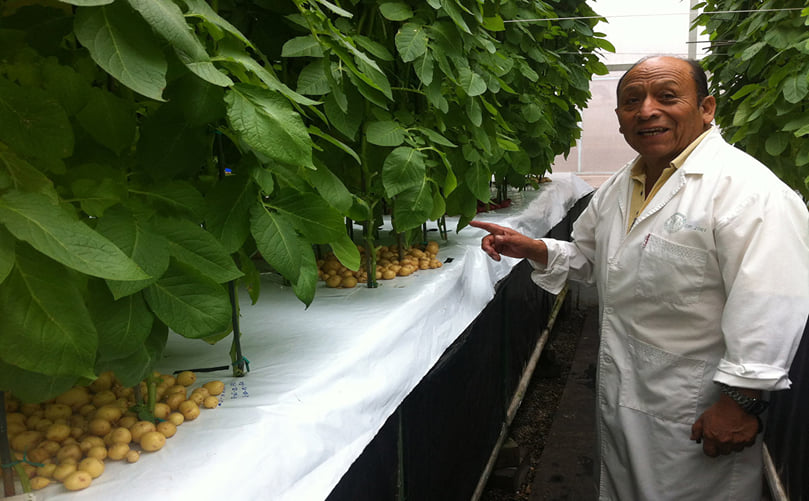
Chuquillanqui demonstrates the soilless technology used to grow potato seed (Source: CIP)
Regional Adoption and Technological Advancements
The aeroponic revolution in potato cultivation is gaining momentum worldwide with diverse regions adopting this technology to strengthen local seed systems and improve productivity under varying agroecological conditions.
In India, large scale aeroponic facilities in states such as Uttar Pradesh and Maharashtra are producing elite quality mini tubers that feed into national seed distribution networks, accelerating certified seed availability. In Pakistan, public private partnerships have established commercial aeroponic production units that collectively generate millions of disease-free mini tubers annually, contributing directly to national food security and self-sufficiency goals.
Across Southeast Asia, Vietnam has demonstrated the success of aeroponics through highland trials, where systems have shown remarkable resilience and productivity under fluctuating temperature and humidity conditions. In Indonesia, aeroponics has been adopted by smallholder cooperatives, delivering strong economic returns through efficient, year-round seed multiplication.
In East Africa, countries like Rwanda and Kenya are pioneering solar powered aeroponic units, integrating renewable energy with controlled environment agriculture. These innovations not only expand local access to clean seed potatoes but also advance off-grid, low carbon production systems suited to rural contexts.
Technological advancements are further refining aeroponic efficiency. Modern systems now integrate AI-driven nutrient optimization, IoT-based environmental monitoring and real time data analytics for automated control of pH, electrical conductivity and temperature. Meanwhile, CRISPR-assisted breeding programs are being employed to develop varieties with improved disease resistance, drought tolerance and nutritional value.
The introduction of vertical aeroponic architectures has also revolutionized space utilization, reducing land requirements by up to 80% while maintaining high yields. These integrated innovations collectively reduce seed import dependency, stimulate local agribusiness growth and enhance climate resilience within global potato value chains marking aeroponics as a cornerstone of future ready, sustainable agriculture.
Overcoming Challenges in Aeroponic Potato Farming
Despite its numerous advantages, the widespread adoption of aeroponics in potato cultivation faces several technical, economic and operational challenges. Addressing these constraints is essential to make the technology accessible, scalable and sustainable for diverse farming systems.
Initial Investment Barriers: The high setup cost remains one of the major limitations in aeroponic adoption. A basic system equipped with growth chambers, high pressure pumps, nutrient tanks and misting infrastructure can cost up to USD 50,000, even for small to medium scale operations. Such expenses pose challenges for resource limited farmers and research institutions in developing countries. However, recent innovations such as solar powered aeroponic systems, locally fabricated components and low-cost modular units are helping to reduce capital and energy costs, improving accessibility and long-term feasibility.
Technical Skill Requirements: Aeroponic systems demand high technical precision in managing nutrient concentrations, misting intervals and environmental conditions. Errors in pH balance, nutrient formulation or mist frequency can lead to root desiccation, clogging or rot, severely impacting yields. System failure, even for short durations can cause significant crop loss due to the lack of soil buffering. Therefore, operator training, capacity building and real time monitoring tools are critical for success. The use of IoT sensors and automated feedback systems now offers a partial solution by maintaining consistency and alerting users to system deviations.
Scalability Constraints: Expanding aeroponic production to a commercial scale introduces challenges in uniform mist distribution and environmental control. Variations in droplet size or nozzle pressure across large chambers can lead to 10–20% yield variability between zones. To overcome this, modern setups employ modular design approaches, dividing production into independently controlled units to ensure uniformity. Emerging innovations such as drone-based monitoring, pressure calibration systems and AI-driven environmental mapping further enhance performance and reduce variability making large scale aeroponics more practical and reliable.
Overall, the combination of cost reduction strategies, skill development programs and technological automation is steadily enabling aeroponics to transition from a niche innovation to a scalable, climate smart solution for global potato seed production.
Cutting Edge Innovations and Future Prospects
The evolution of aeroponic potato farming is being driven by technological integration, genetic innovation and sustainable design, transforming it into a cornerstone of next generation seed production systems.
Technological Advancements: Modern systems are adopting hybrid aeroponic hydroponic configurations that combine the high oxygenation efficiency of aeroponics with the buffering stability of hydroponics, minimizing root stress and system downtime. AI-driven nutrient optimization algorithms continuously adjust macro and micronutrient concentrations based on plant growth data, ensuring ideal root zone conditions. Additionally, IoT-enabled sensors and predictive maintenance systems monitor temperature, humidity and nozzle performance in real time, preventing failures and improving resource use efficiency.
Genetic and Structural Innovations: Breakthroughs in CRISPR-based genome editing are enabling the development of stress tolerant and disease resistant potato lines specifically suited for soilless systems. Institutions such as the International Potato Center (CIP) are pioneering vertical aeroponic towers, which reduce land and space requirements by nearly 80% making seed production viable even in urban or land scarce regions. These compact designs also facilitate controlled microclimates for uniform tuberization.
Future Outlook: The future of aeroponics lies in automation, sustainability and global scalability. The use of biodegradable construction materials, renewable energy integration and robotic tuber harvesting will further reduce the carbon footprint and labor dependency. As adoption expands, aeroponics is poised to meet a significant portion of global seed potato demand, reducing import reliance and strengthening climate resilient, localized seed value chains across developing and developed regions alike.
Global Influence and Contribution to Food Security
Aeroponics is emerging as a transformative solution for global food and nutrition security. Across Africa and Asia, more than 480,000 smallholder farmers benefit from aeroponic seed systems that enhance productivity by 20–30%, strengthen local seed networks and reduce reliance on costly imports. The production of biofortified, virus free mini tubers support nutritional improvement and disease-free cultivation, addressing both yield and health challenges in vulnerable regions.
Moreover, the system’s 95% water use efficiency and suitability for urban and peri-urban farming make it a cornerstone for sustainable agriculture under water scarce and land limited conditions. By enabling resilient, high quality seed supply chains, aeroponics holds the potential to transform the global seed potato market, ensuring steady production and equitable access for billions in the face of accelerating climate change.
